|
THE JAB & GAB
The newsletter of the Wyoming Department
of Health Immunization Unit
immunizewyoming.com April 2022
| |
|
Up first
-
Spotlight: Midway Clinic, Corner Stone Pharmacy, Ivinson Medical Group
- Meet Corrie, Taylor and Jessi
WyIR
- Has your organization completed the WyIR contact update form?
- Printable vaccine eligibility table
COVID-19 vaccine information
- Temperature log reviews due
- Vaccine and administration fee billing
- COVID-19 vaccination records Q&A
- Reporting suspected fraud or theft of COVID-19 vaccines and vaccination cards
- COVID-19 resources, all in one place
| |  |
|
Vaccine information
- Storing and handling varicella component vaccines
- Polio vaccine series recommended for some travel destinations
- Clinical guidance update: pediatric needle usage
- New hepatitis B recommendations
- Timing and spacing of immunobiologics
Resources
- Tips and Tidbits: the order workflow for public vaccine
- Pink Books! Come get your Pink Books!
| |
|
We'd like to hear from you!
Are you hosting a community event, a health fair or community baby shower? Let us know! We have giveaways for providers, expectant mothers, parents, and adults. Do you have a coworker or clinic that you'd like us to spotlight?
Don't hesitate to reach out the the editor at kelly.douglas@wyo.gov.
| |
The Wyoming Department of Health Immunization Unit would like to recognize three providers for their work vaccinating patients for COVID-19. Corner Stone Pharmacy in Buffalo, Midway Clinic in Basin, and Ivinson Medical Group in Laramie. | | |
|
Photo: Corner Stone’s “Pharmily”
Corner Stone Pharmacist Chadwick Sommers in Buffalo has been instrumental in providing vaccinations to his community. I’d like to recognize him for his hard work and enthusiasm!
-Cheri Casey, COVID-19 Immunization Project Coordinator
Midway Clinic in Basin received 100% on their compliance site visit. They vaccinated patients at the local nursing home, assisted the prison with vaccinations, and ensured they have COVID-19 vaccine for the patients at their clinic. They are meticulous in their operations of the COVID-19 Program and exceed the program requirements and recommendations.
-Summer Kelly, Public Vaccine Program Coordinator
| | | |
|
|
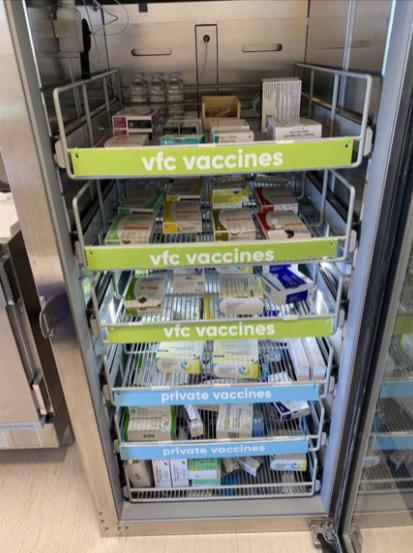
I'd like to give a shout out to Ivinson Medical Group for such a unique and creative way to organize their VFC and private stock within their refrigerator.
-Taylor Moulton, Adult Immunization Coordinator
| | |
 |
Meet Corrie, Taylor and Jessi
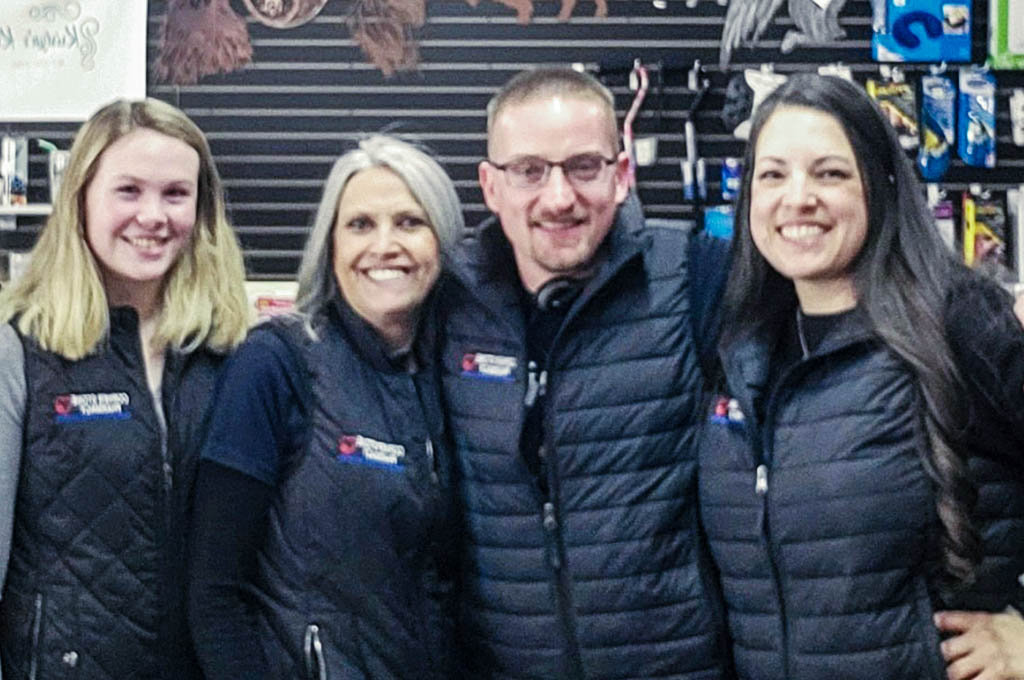
The Immunization Unit would like to welcome three new employees!
Administrative Assistant Corrie Kemp (center) has a background in healthcare, earning her certification in podiatric medicine and working as an assistant to a podiatrist in Michigan. When she and her family came to Wyoming in the late 2000s, she decided it was time to do something different. She then worked in various county offices, including the Laramie County Treasurer’s Office.
As administrative assistant for the Immunization Unit, Kemp answers the main line for the unit, 307-777-7952, works with school waivers, helps both providers and community members find the right answers to their questions, and helps her team with any task they can think of!
Kemp and her husband live in the county outside Cheyenne, where they keep a garden, a few chickens, two steers, a heifer, and a big Charolais cow named Sky. She thinks the scenery between Michigan and Wyoming are so different, she just can’t compare them. “I find there’s beauty in both places,” she said.
Adult Immunization Coordinator Taylor Moulton (left) grew up in the Salt Lake City area, where he earned an associate of science degree and went on to work for an orthopedic specialty hospital. His work included prepping equipment for surgery in the busy practice, where surgeons would perform up to 35 surgeries a day.
He has only been on the Immunization Unit team since January, but Moulton has already conducted 11 virtual compliance site visits with Public Vaccine Providers (PVP)s. Compliance site visits are required for PVPs, and help providers audit and improve their vaccine storage, handling, billing, and documentation process.
Moulton’s favorite part of his work so far is meeting providers, who are working so hard to manage the vaccines. “You can see they care about these kids,” he said. “This is a great opportunity to get these kids the vaccines they need.”
Interoperability Support Specialist Jessi Willey has worn many hats during her career, but her first hat was a cowboy hat on her family’s ranch near Douglas. She grew up in Gillette, then attended college at the University of Idaho where she earned her bachelor’s degree in theatrical technology with a minor in interior design. She moved to Boise, where she was the visitor experience coordinator at the James Castle House Museum and the City of Boise. Willey saw the need for interactive computer-based exhibit design for accessibility, which led her to earn her certification in User Experience Design, or UX, technology.
Willey is an experienced interaction designer who processes HL7 data for Wyoming Immunization Registry (WyIR) users. The WyIR is Wyoming’s secure and confidential database for immunization providers. HL7 is an encryption language that allows providers to report and query immunization data for patients, even if the patient was immunized by a different provider.
| |
Has your organization completed the WyIR contact update form?
Tiffany Hehr, Client Management Specialist
The Wyoming Department of Health Immunization Unit will now perform regular reviews of our Wyoming Immunization Registry (WyIR) contact information data. This review is meant to ensure that the WyIR contains the most up-to-date and accurate information for each and every enrolled Organization, Facility and Provider Contact. Accurate data ensures timely communication and relevant and accurate processes for WyIR enrollment. As a reminder, changes to WyIR contact information should be reported to the Immunization Unit as they become known by your facility, in addition to this regular review.
In order for the Immunization Unit to verify the accuracy of the contact information data in the WyIR for your Organization (School District), Facility (School) and Contacts, please click on the Google Form link below to update your information.
WyIR School Contact Updates
WyIR Organization Contact Updates
If you encounter any difficulties with these Google forms, please reach out to the Immunization Unit at wyir@wyo.gov.
| | |
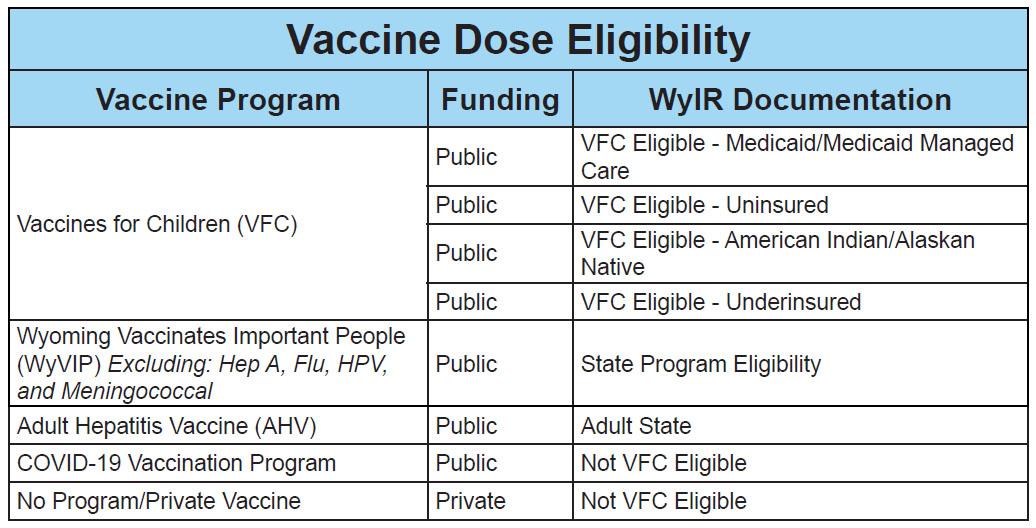
Vaccine dose eligibility table
Summer Kelly, PVP Coordinator and Taylor Moulton, Adult Immunization Coordinator
The Immunization Unit has created a table to assist providers properly document eligibility in the Wyoming Immunization Registry (WyIR). The table outlines the funding source and the drop-down selection to use to document in the WyIR based on the patient’s program.
Prior to documenting, please ensure patients are being screened for the correct program using the VFC/WyVIP Eligibility Screening form, which is found on the Forms and Reports page of the Immunization Unit website. Screening is required at every immunization encounter.
| |
COVID-19 vaccine information | |
Temperature log reviews are due every month
Public Vaccine Program Staff
As a reminder, vaccine storage units that store COVID-19 vaccine must have temperatures monitored by and recorded from a calibrated data logger thermometer. Vaccine storage unit temperatures must be recorded twice per day using the Immunization Unit’s monthly temperature log templates (refrigerator, freezer, ultra-cold). Templates are located under the “COVID-19 Vaccine Storage Units & Temperature Monitoring” toggle, on the Immunization Unit's COVID-19 vaccine information for providers web page.
In an effort to verify stable temperatures for storage of COVID-19 vaccines, the Immunization Unit is implementing a temperature log review process for all COVID-19 providers. The Immunization Unit is requesting two action items from your facility:
Beginning May 1, 2022, all temperature logs (ultra cold, refrigerator, and standard freezer) will need to be submitted on a monthly basis. Temperature logs need to be submitted to wdh.covidenrollment@wyo.gov between the first and fifth of every month regardless of whether the facility is placing an order or receiving a transfer. Temperature logs must also be kept for at least three years and made available for review during site visits.
If a facility does not submit monthly temperature logs to the Immunization Unit for review within the time frames noted, all COVID-19 vaccine orders and transfers will be denied until temperature logs have been submitted and reviewed by the Immunization Unit.
Please don't hesitate to reach out to the Immunization Unit with any questions regarding the temperature log review process at 307-777-7952.
| |
COVID-19 vaccine and administration fee billing
Summer Kelly, Public Vaccine Program Coordinator
The Centers for Medicaid and Medicare Services (CMS) and the American Medical Association (AMA) collaborated on a new approach to report use of COVID-19 vaccines. This release includes the coding structure, currently comprised of both of these:
-
An AMA-issued HCPCS Level I CPT code structure
- A CMS-issued HCPCS Level II code structure
Together, these codes support the administration of COVID-19 vaccines and monoclonal antibody infusions, as they become available. CMS and AMA developed this code structure to make claims processing for COVID-19 vaccines and monoclonal antibody infusions that get Food and Drug Administration (FDA) emergency use authorization (EUA) or FDA approval more efficient. Medicare effective dates for the codes will match with the date of the EUA or FDA approval.
HRSA COVID-19 Uninsured & Coverage Assistance Fund shut down
The HRSA COVID-19 Uninsured Program and the Coverage Assistance Fund Program were shut down due to lack of sufficient funds. The Centers for Disease Control and Prevention (CDC) requirements for the COVID-19 Vaccination Program states providers must continue to administer COVID-19 vaccines at no out-of-pocket cost to recipients. Information about the claims submission deadlines can be found online at:
Alternative resources for uninsured individuals who need COVID-19 services or other healthcare coverage include:
• Wyoming Medicaid enrollment
• Health Insurance Marketplace enrollment
• COVIDtests.gov
• HRSA.gov – Find a Health Center
COVID-19 vaccine charge
- No person, insurance or third party can be charged for the COVID-19 vaccine. The vaccine is provided free.
COVID-19 administration fee
- No patient can receive a bill for the administration fee.
- A claim may be submitted for the administration fee to Medicaid, Medicare and private or commercial insurance.
- The reimbursement amount for Medicaid and Medicare is $40.00
- Private/commercial insurance reimbursement may be different depending on the provider's contract with the insurance company
-
Coding chart from CMS outlines CPT codes and fees.
*In some instances a penny charge for the vaccine is needed to associate an administration fee.
- When billing for the Moderna and Pfizer second booster, use the same CPT code as the first booster.
- If insurance does not cover the administration fee, steps must be taken to prevent the patient from receiving a bill.
- Self-pay or uninsured patients must not receive a bill.
General policies
- Staff responsible for billing must be trained and able to clearly explain the billing policies for the cost of the vaccine and the administration fee for Medicaid-enrolled patients, uninsured, underinsured, and insured.
- Providers must administer COVID-19 vaccine regardless of the vaccine recipient’s ability to pay COVID-19 vaccine administration fees or coverage status.
- Everyone is eligible, regardless of immigration status.
- Providers may seek appropriate reimbursement from a program or plan that covers COVID-19 vaccine administration fees for the vaccine recipient, but may not seek any reimbursement, including through balance billing, from the vaccine recipient.
- Providers cannot charge an office visit fee or other fee if COVID-19 vaccination is the sole medical service provided.
- If payment is inadvertently received from a patient, there must be a process in place to reimburse the patient.
- Cash or donations cannot be requested in order to receive a COVID-19 vaccine.
- Billing records must be kept for three years, at minimum.
|
COVID-19 vaccination records Q&A
Heidi Gurov, RN, Clinical Nurse Consultant
Q: A patient called asking for a QR code vaccination record for travel. How do we get them one?
A: At this time the Wyoming Immunization Registry (WyIR) and State of Wyoming are unable to generate a Quick Response (QR) code vaccination record for a patient. Depending on where the patient was vaccinated, they may be able to receive a code from their vaccination site. Examples of possible sites include pharmacies and larger health systems.
Q: Which WyIR record is best for COVID-19?
A: Often patients need the brand of COVID-19 vaccine received and/or lot number listed on their record. Therefore, it is recommended that the “Wyoming Medical Record Report” is provided to the patient, as the brand of vaccine given along with the lot number will display on the report. When the Immunization Unit processes record requests, the medical report along with the “School Form,” which has the state seal and signature line are included, certifying the record as official.
|
Reporting suspected fraud or theft of COVID-19 vaccines and vaccination cards
NCIRD Weekly Reader
Jurisdictions, providers, and others have reported that COVID-19 vaccination cards have been stolen, fraudulently reproduced, and illegally sold to reflect full vaccination status for someone who has not received a COVID-19 vaccine. There have also been reported incidents of stolen and lost vaccine vials. To address these issues, please consider the following strategies:
- Always secure COVID-19 vaccine vials and vaccination cards to protect them from inappropriate distribution.
- Monitor both the inventory of COVID-19 vaccine and blank vaccination cards and keep them locked up when not being used. If you are unable to store the excess cards, offer them to the jurisdictional health department(s), or, as a last resort, destroy them.
The Immunization Unit encourages you to report suspected fraud and theft incidences to local law enforcement agencies, and to the HHS Office of Inspector General and/or the FBI as listed below:
| |
COVID-19 resources, all in one place
Heidi Gurov, RN, Clinical Nurse Consultant
Immunize.org has compiled an amazing checklist of COVID-19 vaccination resources, which is updated at least monthly. Download this checklist online at www.immunize.org/catg.d/p3130.pdf.
Resources on the checklist include clinical considerations, EUA Fact Sheets, package inserts, standing order templates, vaccine preparation and administration summaries, and vaccine storage and handling summaries.
| |
Storage and handling: varicella component vaccines
Taylor Moulton, Adult Immunization Coordinator
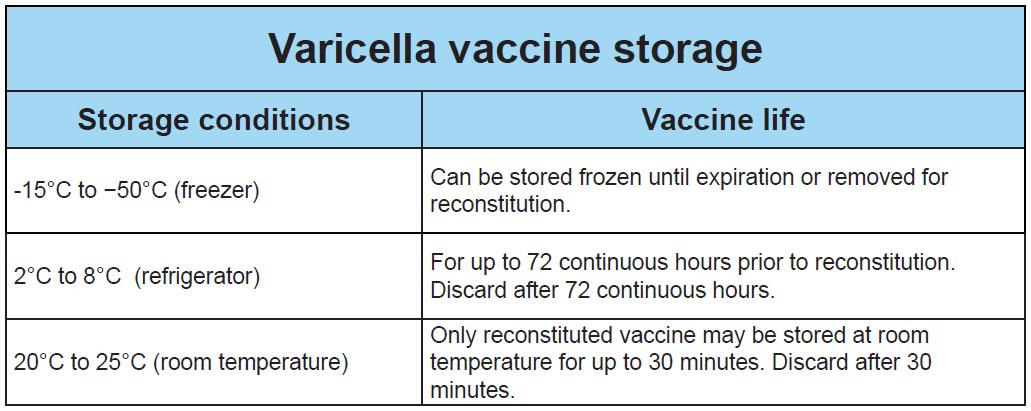
The Immunization Unit would like to share helpful reminders on storing vaccines that contain the varicella (chickenpox) component.
Varivax (varicella) and ProQuad (MMRV) are considered a varicella live virus component vaccine. Both are shipped from Merck in a frozen state between -15°C and -50°C and should be stored in a standard freezer immediately upon receipt.
- Vaccines containing varicella virus need to be protected from light always.
- Reconstituted vaccine cannot be refrozen.
- Diluent vials should be stored separately; at room temperature, or in the refrigerator
You can download and print the table by clicking this link.
For information regarding Varivax or questions regarding storage conditions, call 1-800-9-VARIVAX (1-800-982-7482).
For information regarding ProQuad or questions regarding storage conditions, call 1-800-MERCK-90 (1-800-637-2590).
| |
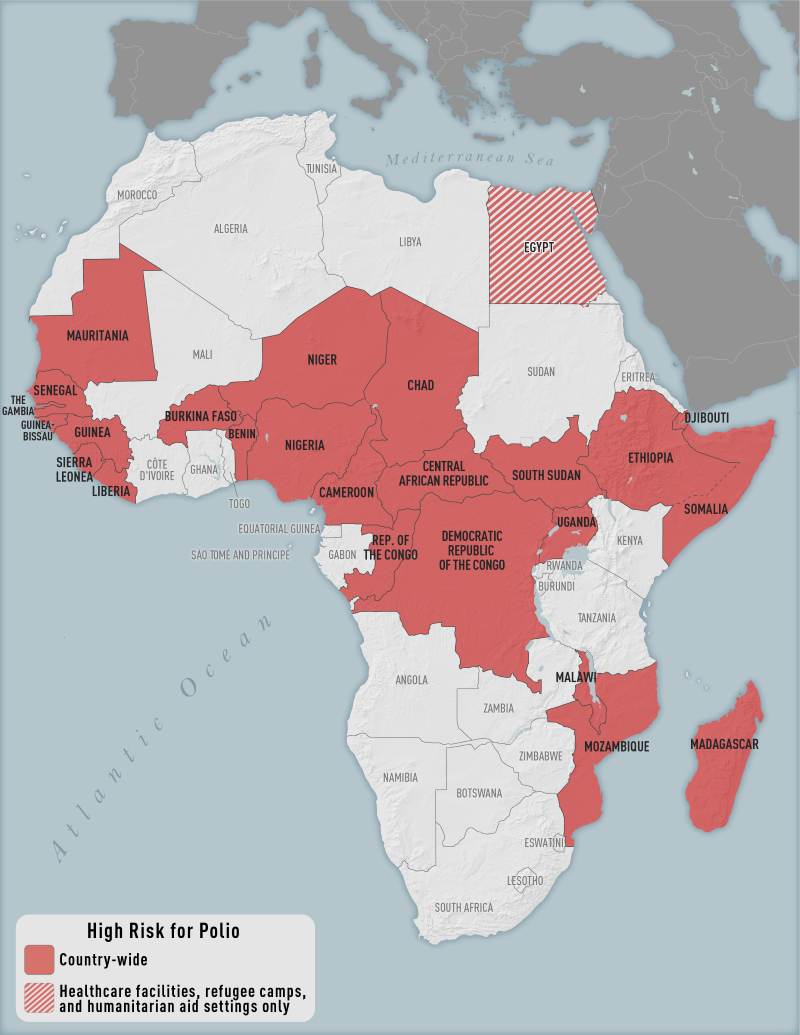
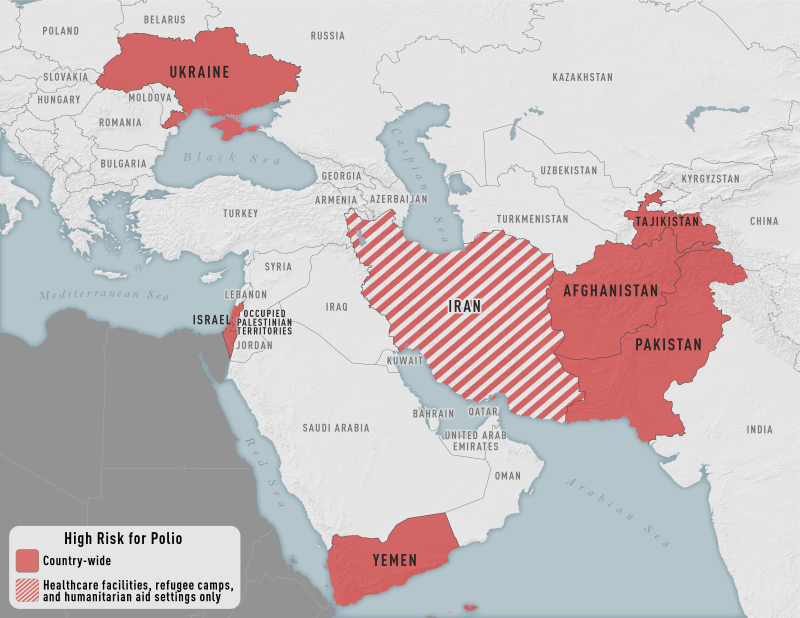
Polio vaccine series now recommended for some travel destinations
From Immunize.org
The Centers for Disease Control and Prevention’s Travelers' Health main page includes a web page on Travel Health Notices. On March 21, CDC identified destinations in Africa, Asia, and Eastern Europe as “alert level 2” with respect to polio. In these areas travelers should practice enhanced precautions.
CDC suggests that before any international travel, anyone unvaccinated, incompletely vaccinated, or with an unknown polio vaccination status should complete the routine polio vaccine series. If traveling to areas of high risk, CDC recommends that adults who previously completed the full, routine polio vaccine series receive a single, lifetime polio vaccine booster.
Related Links
For more information on travel vaccines, including polio vaccine, please contact Heidi Gurov, RN, Clinical Nurse Consultant, at 307-777-8981 or heidi.gurov@wyo.gov.
| |
Clinical guidance update: pediatric needle usage
NCIRD Weekly Reader
The Advisory Committee on Immunization Practices (ACIP) recommends using a 1-inch needle for children 1 year of age and older when administering vaccines to ensure the vaccine is deposited well into the muscle tissue. A 5/8-inch needle may be used in some circumstances if the child’s skin is stretched tightly, and subcutaneous tissues are not bunched.
Providers should use professional judgment: for the rare situation in which a 5/8-inch needle is required, one can be obtained from the facility’s inventory and replaced with supplies from the ancillary supply kits.
Ancillary kits for COVID-19 vaccines contain only 1-inch needles.
Please refer to the following CDC web pages for more guidance:
ACIP Vaccine Administration Guidelines for Immunization | CDC
| |
New HBV recommendations
From the Centers for Disease Control and Prevention
On March 31, the Centers for Disease Control and Prevention published the updated hepatitis B vaccination recommendations that all adults aged 19 through 59 years receive the hepatitis B vaccine. Adults aged 60 years and older with known risk factors for hepatitis B may also receive the hepatitis B vaccine. CDC continues to recommend hepatitis B vaccination for all infants and unvaccinated children under the age of 19 years. Fully implementing existing and new recommendations can reduce the burden of hepatitis B, while also moving toward elimination of the virus in the United States. Read the full letter here.
Find the recommendations on the CDC web page.
| |
ACIP updates to timing and spacing guidelines
On March 15, the Advisory Committee on Immunization Practices (ACIP) updated portions of the Timing and Spacing of Immunobiologics portion of the General Best Practice Guidelines for Immunization.
Major changes to the best practice guidance for timing and spacing of immunobiologics include 1) guidance for simultaneous vaccination in the context of a risk for febrile seizures and 2) clarification of the use of the grace period between doses of MMRV.
For more information visit https://www.cdc.gov/vaccines/hcp/acip-recs/general-recs/timing.html.
| |
 |
Tips & Tidbits: the order workflow for public vaccine
Jane Whitley, Provider Support Specialist
When placing orders for Public Vaccine it may be helpful to understand the ordering workflow.
- From the first through the fifth of each month, vaccine coordinators are expected to complete each of the following:
- Submit a completed temperature log
- Reconcile and submit inventory into the WyIR
- Create a vaccine return order for all eligible vaccines
- Create and submit the facility's public vaccine order
- Inactivate 0 lot numbers in the WyIR inventory
- Once this has been completed, the provider support specialist reviews all of the temperature logs, making sure they are complete and that the temperatures have been adequately maintained in the storage units throughout the month.
- To assist in the ordering process please make sure the temperature logs are completely filled out. Specifically, please include:
- Facility pin number
- Names of staff that have recorded temperatures throughout the month
- AM and PM temps, recorded for each day the facility was open
- MIN/MAX temps from the data logger are recorded
- Use the comment section to report any abnormal situations, i.e. a change in facility office hours, defrosting of a storage unit, a temperature excursion that occurred during the month (please include the name of the Immunization Unit staff member who took the temperature excursion report)
- Make sure you complete the Order Volume Justification form if an order is five times the allowable vaccine order volume (5 X doses administered - inventory).
The vaccine orders that are in compliance with the above guidelines will be approved and uploaded to the CDC ordering system by the 10th of every month.
| |
Pink Books! Come get your Pink Books!
Heidi Gurov, RN, Clinical Nurse Consultant
The Pink Books have arrived! The Immunization Unit has a stock of updated Pink Books ready to be shared with our vaccine providers.
What is the Pink Book?!
CDC has just released the 14th edition of its book, "Epidemiology and Prevention of Vaccine-Preventable Diseases" (also known as the Pink Book). The previous edition was published in 2015. This edition provides updated disease and vaccination information useful to public health practitioners, healthcare providers, health educators, pharmacists, nurses, and others involved in vaccination.
The 14th edition of the Pink Book includes:
- General immunization recommendations
- Vaccine safety, storage and handling, and administration information
- Information about vaccine-preventable diseases, including pathogenesis, clinical features, epidemiology, and secular trends in the United States
- Information about vaccines, including characteristics, schedule and use, efficacy, safety, and contraindications and precautions
The book is available online by clicking this link.
If you are interested in receiving a printed copy for your clinic, please fill out this Google form.
For those who expressed interest earlier, copies were mailed via USPS in mid-March.
| |
|
Wyoming Department of Health Immunization Unit team, including:
Heidi Gurov, RN, Clinical Nurse Consultant
Tiffany Hehr, Client Management Specialist
Summer Kelly, Public Vaccine Program Coordinator
Taylor Moulton, Adult Immunization Coordinator
Jane Whitley, Provider Support Specialist
Immunize.org
National Center for Immunization and Respiratory Diseases (NCIRD)
Questions or comments? Message the editor at kelly.douglas@wyo.gov
| | | | |