AOM logo 600

Visit our Website


Shamans


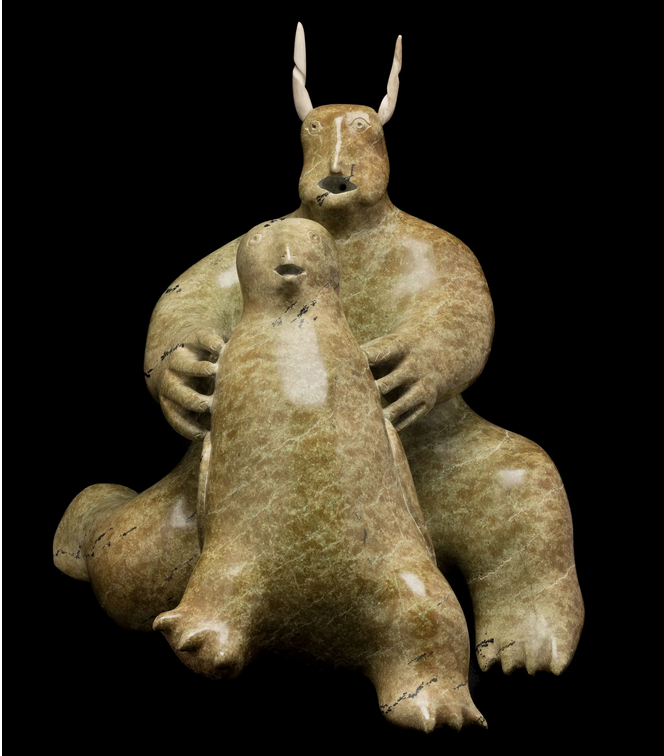
Nuyaliaq Qimirpik (1937-2007) created this magnificent Horned Shaman with Owl in the late 1960's in Kimmirut (Lake Harbor). A similar carving by Nuyaliaq is the cover illustration of Celebrating Inuit Art 1948-1970, Edited by Maria von Finckenstein (Canadian Museum of Civilization, 1999). In an interview for the book, Nuyaliaq explained that "the figure is half human and half polar bear, with antlers, depicting a shaman." This sculpture has horns rather than antlers, and, in addition, it is holding an owl, almost certainly the shaman's helping spirit. But you can clearly see that the face and hands of the figure are human, while the hind feet are those of a polar bear. Alas, it lacks the bear's tail.


Shamans, or angakoqs, were central to the traditional Inuit cosmology. Harold Seidelman, in The Inuit Imagination: Arctic Myth and Sculpture (Douglas & McIntyre 1993), explains:


"The Inuit believed that unseen forces governed every aspect of existence from birth to death. All living things and even inanimate objects were possessed by spirits or souls called inua. . . . Certain individuals had a special ability to communicate with the invisible forces. The shamans or angakoqs were men and women set apart from their communities by their spiritual powers, which were usually acquired after a difficult apprenticeship. . . . The shaman, unlike normal people, had the ability to see into the spirit world, to see into darkness and to see far away. . . . When his powers were needed, the angakoq would go into a hypnotic trance . . . . Once in the trance, the angakoq was believed to leave the world of the living to travel to the spirit world, Leaving his body behind, he would call on his helping spirits to guide him in this journey and to help him overcome the many dangers. He might travel to the moon to9 visit the kindly moon spirit Tarqeq or to the bottom of the sea to visit Sedna, the mother of the sea creatures."


Nuyaliaq created this carving, and the carving shown in Celebrating Inuit Art, during a brief period in the late 1960s when a local schoolteacher who was buying carvings for the government encouraged the local artists to create spirit carvings.


It embodies the mystery associated with shamans, as described by Seidelman, with its suggestion that the shaman could transform into other creatures (here, a polar bear) and its prominent reference to helping spirits.


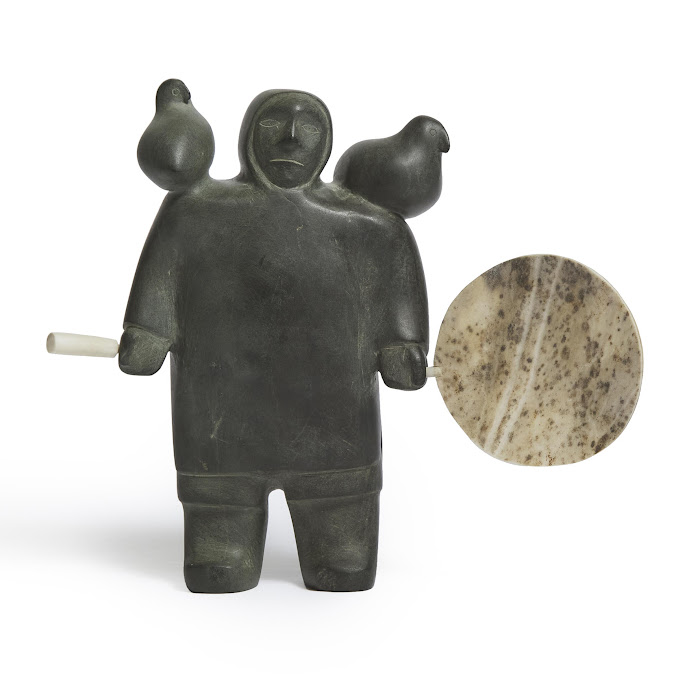
George Tataniq (1910-1991) presents a sterner shaman in this carving. The two birds on his shoulders are his helping spirits, and the shaman holds a drum and its beater. The ponderous figure leaves no doubt as to his powers.


In the 1986 catalogue for the exhibition The Keewatin Spirit, author and collector Norman Zepp speaks of "a purity of line [in Tataniq's works] which elevates his sculpture beyond the purely descriptive. Both Tataniq's images of the empirically observable world and his images of the supernatural are characterised by a monumental weight, and as here, a purity of line, eye for plane and volume, and exceptional sure-footedness in his address of all three."


This sculpture is published in The Inuit Imagination: Arctic Myth and Sculpture.

A closely-related work to this sculpture was chosen for the cover of the 1992 revised and updated publication of George Swinton's classic reference work Sculpture of the Inuit.


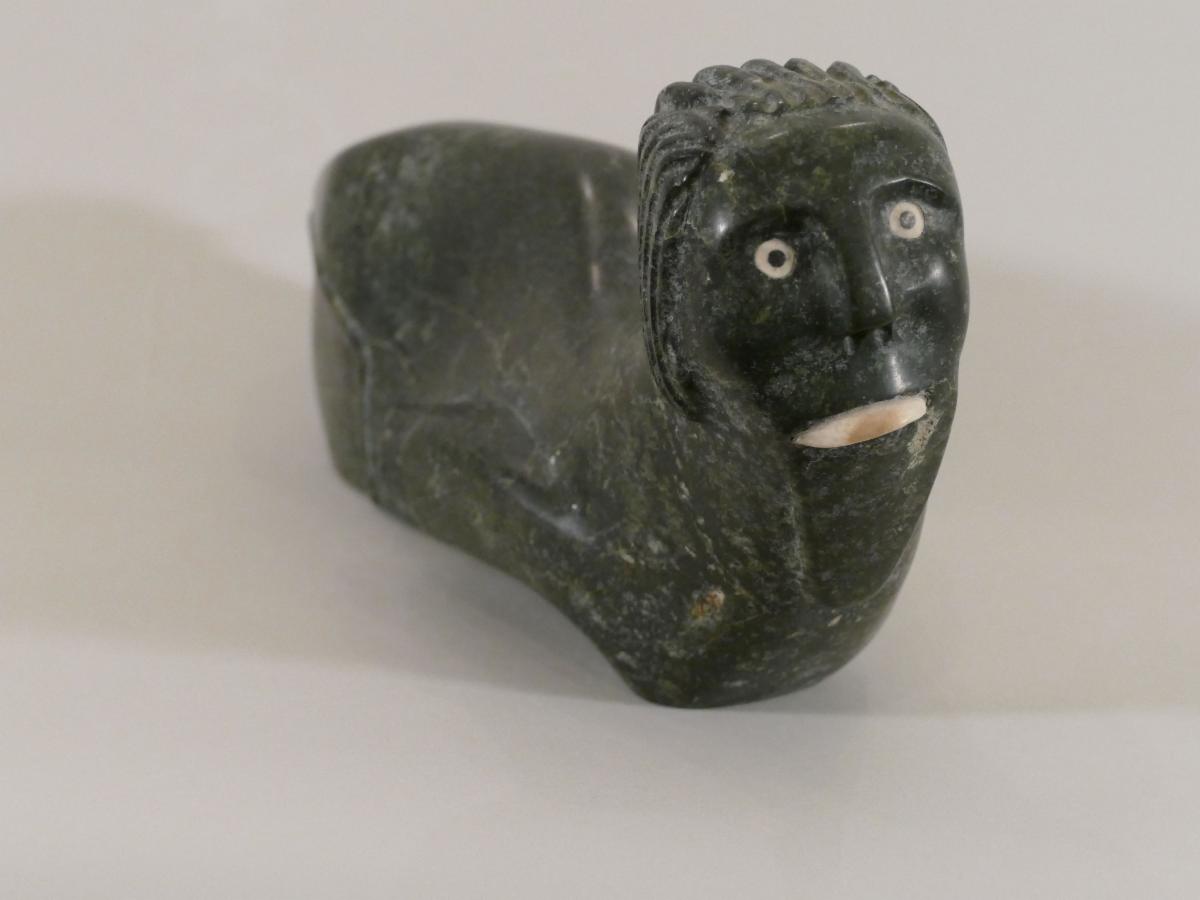
Shamans could take many forms. A naive contrast to the two imposing shamans pictured above is Samuel Nahaulaituq's Flying Shaman. Nahaulaituq (1923-1999) lived in Taloyoak (Spence Bay), a community with stone that is much harder to carve than Kimmirut's stone. It is not surprising that Nahaulaituq's shaman is simple and streamlined; the face appears almost puzzled that she (the figure wears a woman's amaut) has achieved flight.

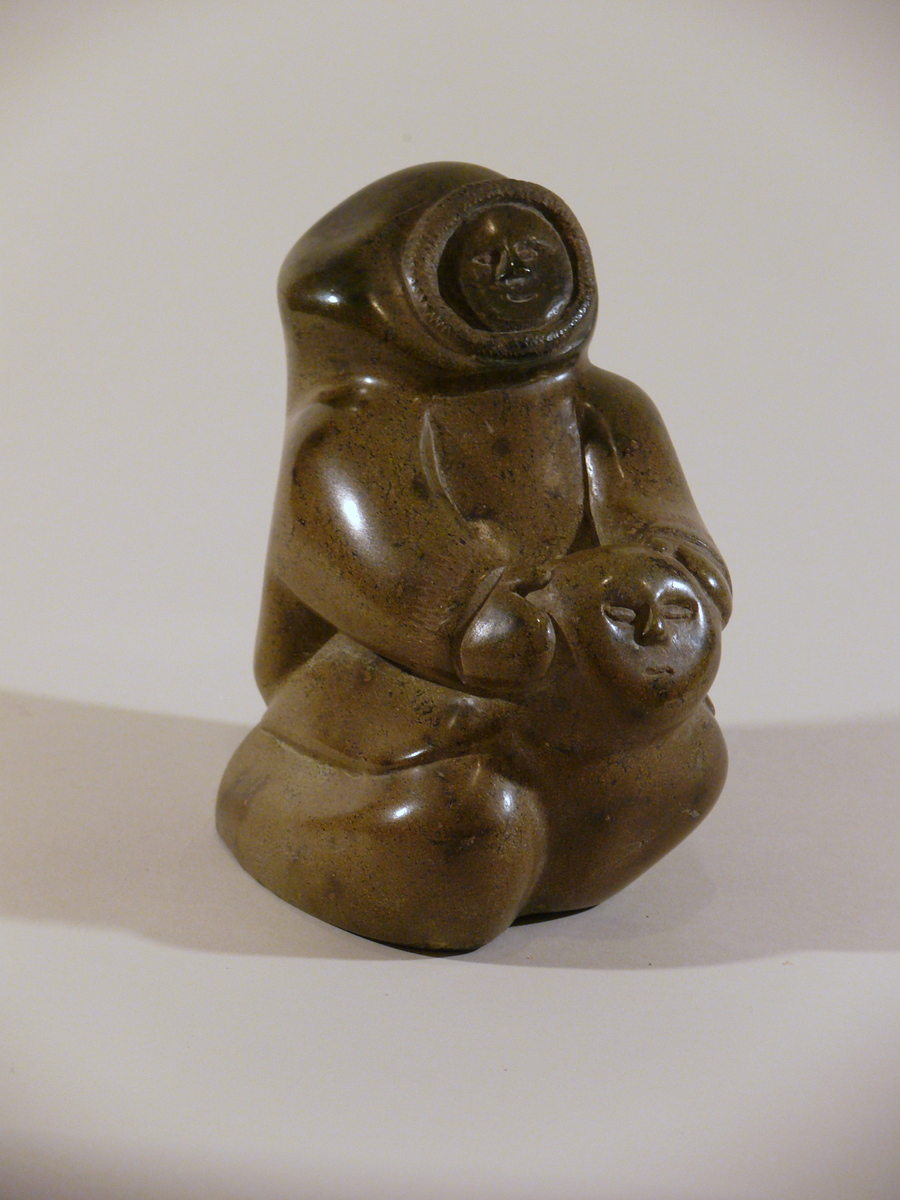
Finally, Nowdlak Lyta (b. 1944), also from Kimmirut, presents a shaman who is tranquil and almost cuddly. She holds a spirit face, presumably her helping spirit.


Climate Change


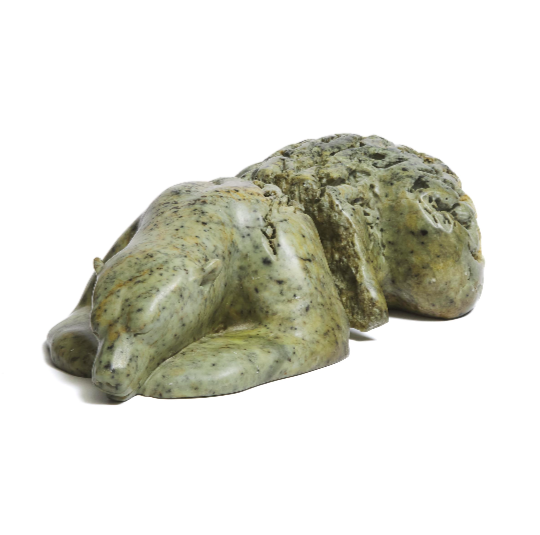
This Eroding Polar Bear is one of a series of powerful sculptures by Billy Nasogaluak (b. 1953), originally from Tuktoyaktuk in the Northwest Territories that decried the degradation of the Arctic environment, with its attendant catastrophic effect on the Arctic animals, caused by climate change. The sculpture is in two pieces; the front half of the bear is a normal, sleeping polar bear. The rear half, however, is disintegrating. Related sculptures by Nasogaluak include haunting images of polar bears trapped in rotting ice.

About
Alaska on Madison

In keeping with our self-description as a virtual gallery run by collectors for collectors, we offer a limited number of pieces. Every piece is one that we would be happy to have in our personal collection, and the description of each piece explains why. 

We are happy to assist you with inquiries, with searches for particular pieces or artists, with organizing your collections and with buying or selling at auction. Our Inuit artist search tool is available on our website, and we would be delighted to help you use it. If you prefer to puzzle things out for yourself, Deciphering Inuktitut Signatures will help you to identify artists. 
 
We are always pleased to answer questions or just chat. You can contact us by email or by phone at (908) 487-5757.

Our very best wishes to you all.

Ann and Michael Lesk

Alaska on Madison | (908) 487-5757 | alaskaonmadison@gmail.com | www,alaskaonmadison.com
STAY CONNECTED
Facebook  Twitter  Instagram