April 2024

In this issue:


  • Population increases across 90 of Tennessee's 95 counties in 2023
  • Significant changes to race and ethnicity data collection by federal agencies
  • The Boyd Center's new intercensal estimates, upcoming population projections
  • Music censuses taking the stage in Tennessee

Toplines

8 States Require Personal Finance Classes


to graduate from high school, including Tennessee. A growing number of states (33) now require some exposure to the topic, according to research compiling nationwide curriculum. Other work has shown students’ financial outcomes improved through measures of credit scores, delinquencies, payday borrowing and financing of post-secondary education.

4.3 Percent of Young Tennessee Children


were excluded from the 2020 Census in a new Census Bureau analysis comparing birth records and census counts. Shelby County’s estimated undercount of -6,835 children (-10.5 percent) was the state’s largest and accounted for almost 40 percent of the shortfall. Rankings show Tennessee was mid-pack nationally. An interactive state and county map has more detail.

2023 County Population Estimates Show Widespread Increases

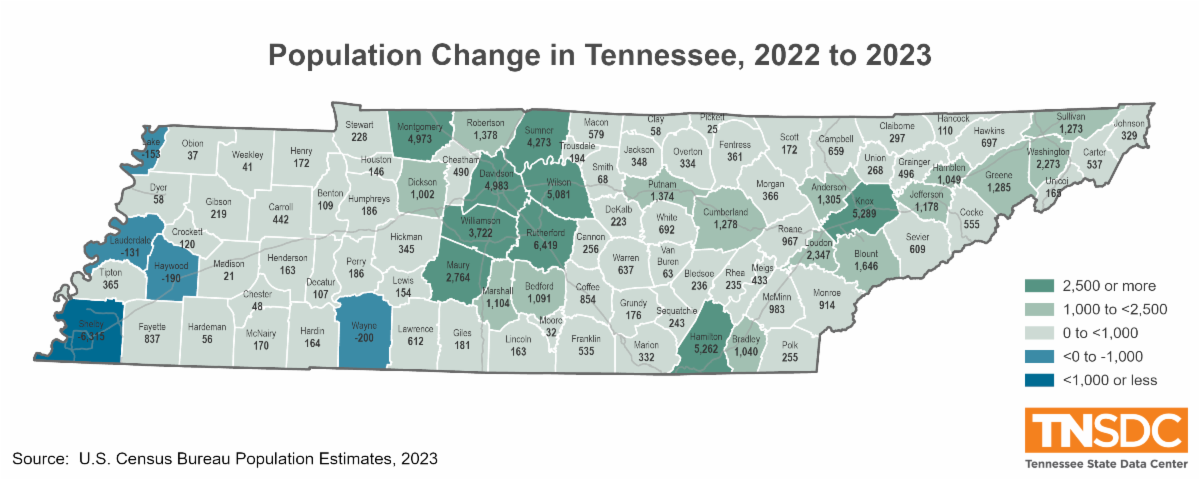
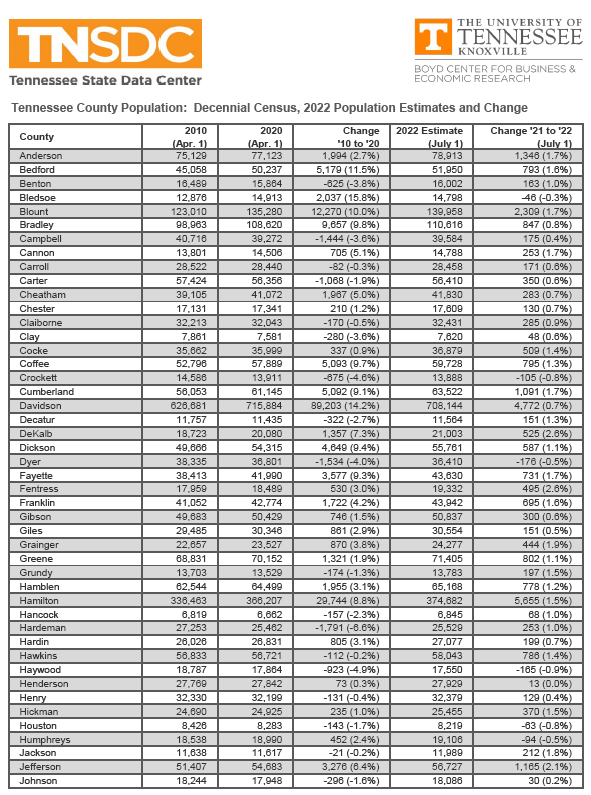
The headline numbers from the Vintage 2023 Population Estimates release feature many of the usual suspects when it comes to Tennessee counties with the largest population increases. Suprise – it’s Rutherford County for the eighth straight year. Eight of the other nine counties in the top 10 were also on last year’s list. In most cases, increases for these counties were smaller when compared to 2022’s torrid pace.


But what caught our attention was a couple of statistics showing how Tennessee’s total population gain of 77,500 people in 2023 was spread statewide.


90 of 95 counties logged population gains in 2023. That was the largest number of counties to experience a year-over-year increase since 1997 and was eclipsed just once in 1995 when 91 counties grew. Nationally, 60 percent of counties had population growth last year, compared to Tennessee where 95 percent of counties had increases. Only three states had a higher percentage of counties with gains – Delaware, Florida and Idaho.


Those gains translated to a 1.4 percent rate of population increase for the state’s 78 rural counties in 2023, outpacing the 0.9 percent growth rate among the 17 urban counties. Additionally, compared to 2022, growth rates increased slightly in rural counties but fell marginally in those classified as urban.

Learn More: Read the Full Breakdown
Download TN County Population Fact Sheet
Tennessee Population Estimate Dashboard
co_est_202x_dash_screenshot1 image

Hispanic and Middle Eastern Race Categories Added in New Federal Rules


On March 28, the White House Office of Management and Budget (OMB) released an updated directive outlining significant changes to the ways that race and ethnicity data are collected and reported by federal agencies.


Both data users as well as state and local governments that interface with the dozens of affected agencies will eventually see changes. This could include revisions to forms, survey questionnaires and the structure of statistics that are reported to or published by the federal government. All U.S. agencies are required to develop an implementation plan by the fall of 2025 and enact those changes no later than early 2029.


What’s changing?

Two new categories were added into a combined race/ethnicity question:

  • Hispanic or Latino
  • Middle Eastern and North African

A separate question asking about Hispanic or Latino ethnicity has been eliminated.

Additional detail about country of origin, ethnic background or tribal affiliation is required to be collected unless an exception is granted due to burdens or confidentiality.

The maintenance of race data time series will be a chief concern among many data users. Some initial work developing factors and tools to crosswalk data between the new 2024 standards and the 1997 standards has already started. Expect to hear more about tools and techniques after data collection and data products become available.


Read the full breakdown on our website and check the announcement on the OMB’s dedicated site: spd15revision.gov

Boyd Center 2010-2020 Tennessee Intercensal Estimates Released


If you need an annual population estimate between 2010 and 2020, it’s recommended that you use an intercensal estimate once they are available. Unfortunately, the U.S. Census Bureau’s Intercensal Estimate release has been delayed several years but should be available this fall.


Since we needed intercensals for our forthcoming population projections release, we created our own and published them for free download. There are some important differences between our product and the ones that will eventually be published by the Bureau. Check out our FAQ for an overview and an article we posted in March for a longer discussion of our plans for this product in the next few years.


And don’t hesitate to contact us for help with all your intercensal estimate needs!

Post-Chart-2010-2020-Est-v-Intercensal image

Tennessee’s Vintage 2020 Population Estimates (6,886,834) were 38,785 people lower than the July 1, 2020, estimate of 6,925,619 from the Vintage 2022 Population Estimates. In the new Boyd Center Intercensal Estimates, this error of closure was distributed linearly across the annual figures from 2011 to 2020 to create a seamless connection to the next decade’s population estimates.

Tennessee Economic Indicators

Unemployment

rate 

(03/2024)

TN: 3.2% | US: 3.8%

-0.0 points since

Mar. 2023

Nonfarm

payrolls

(03/2024)

TN: 3,329,300 employees

+0.5% since

Mar. 2023

Manufacturing payrolls

(10/2023)

TN: 363,800 employees

-0.7% since

Mar. 2023

Real gross

domestic product 

(Q4 2023)

TN: $430.50 Billion

+2.8% since

Q4 2022

Per capita

personal income 

(Q4 2023)

TN: $61,550

US: $69,408

+3.9% since 

Q4 2022

View interactive data on our FRED Dashboard.

Around the State

Music Censuses Take the Stage in Tennessee


Census of population, horses, agriculture – we love them all. Why not a music census?


There have been a growing number of efforts to learn about regional music ecosystems across Tennessee in the last several years. The informal nature of some aspects of an area’s music culture makes it difficult to measure the challenges faced by those in the industry. A music census is designed to characterize the fragmented collection of artists, promoters, and venue operators. They also collect information about challenges and opportunities that can be used to design policies that help support the sector.


Data collection for the latest project, the NE Tennessee Music Initiative, will kick off in May. That effort is centered on an eight-county area in northeast Tennessee that includes the Tri-Cities. All people affiliated with the music industry, whether paid or unpaid, are encouraged to participate.


Sound Music Cities – a consulting group focused on civic engagement related to the music industry – is administering the work that is supported by the Tennessee Department of Economic and Community Development.


This effort comes on the heels of a 14-county Greater Nashville Music Census whose findings will be available in the early summer of 2024. Results from the 2022 Chattanooga Music Census are available from their tourism corporation. Both communities joined a cohort of 15 U.S. cities in the peer-learning system.


The State estimates that nearly 62,000 jobs are supported by Tennessee’s music industry.

Short Takes

Boyd Center Population Projections Release Coming Soon


Keep your eyes on your inbox over the next several weeks. We’ll announce information about the release of our 2022-2070 County Population Projections for Tennessee. The projections were last updated two years ago and work to update the new forecast will be wrapping up soon.


The release products will include:

  • Annual county-level projections of population by age groups, race/Hispanic ethnicity and sex
  • Revised population projection dashboard
  • Webinar hosted by TNSDC and the Boyd Center


These projections are set against a backdrop of the state’s first natural population decreases to start the decade, record 1-year net domestic migration in 2022, a sudden rural population uptick, and delays in obtaining the necessary 2020 Census data. Meh… no problem.

2030 Census Planning Accelerates


The 2030 Census is still six years away but it’s about to get real. Since last year, over 50 research projects to improve various aspects of census operations have been underway.


This year, the Census Bureau took additional steps in preparation for the nation’s 24th decennial census operation including:


  • Formation of a 2030 Census Advisory Committee tasked with sharing expertise and recommendations with the Census Bureau Director about the design and execution of the census.
  • Released a series of strategy documents outlining how the count will be conducted and guiding engagement with stakeholders.
  • Forthcoming announcement about details of the 2026 Census Test – the first of two major field tests in the lead-up to 2030. The scope of that work will be announced at an April 26th webinar and the locations will be released this summer.


Follow along at the Bureau’s 2030 Census Page.

Join our Mailing List!
Facebook  Twitter  
Newsletter Archive
About the Tennessee State Data Center Network
The State Data Center Program is a cooperative program of the State of Tennessee, The University of Tennessee and the U.S. Census Bureau. Data Centers in each state assist the Bureau by disseminating Census data, other federal data sets and information.
Data Center Affiliates

Each center has an internal statewide affiliate network to further assist in disseminating data to local users. These affiliates also have local information and expertise to offer. Visit tnsdc.utk.edu for a full listing of affiliates.
Tennessee State Data Center | 865-974-6070 | tnsdc@utk.edu
916 Volunteer Blvd. | 713 Stokely Management Center
Knoxville, TN 37996