Vol. 41 | April 2026, 5-minute read | | SPARC: From Community to Clinic | | |
UT Southwestern is launching an expansive new research study that will deliver on the promises of population health and precision medicine. The project, named Sequencing Populations to Accelerate Research and Care, or SPARC, will create one of the largest biobanks in the country at UT Southwestern.
Through SPARC, we will perform whole exome sequencing, a cutting-edge analysis of the parts of DNA most likely to influence health. When combined with information from medical records, such as history and medications, these data will allow researchers to rapidly identify treatments and translate new discoveries into clinical care based on the biomarkers revealed.
Over time, SPARC seeks to enroll 150,000 participants or more, creating a powerful resource to help researchers identify genetic drivers of disease, better understand differences in risk and treatment response, and improve screening, prevention, and care.
At this time, the SPARC pilot is open for UT Southwestern faculty and staff. If you are interested in participating in the study, please complete the interest form.
For potential collaborations, contact us at sparc@utsouthwestern.edu.
|
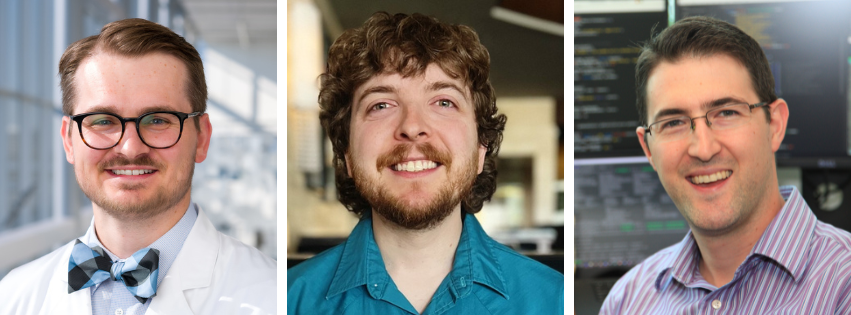
| UTSW Researchers Awarded Grants to Advance AI | | Pictured from left: Michael Dohopolski, M.D., Assistant Professor of Radiation Oncology; Dylan Owens, Ph.D., M.S., Postdoctoral Researcher; and Andrew Jamieson, Ph.D., Assistant Professor in the Lyda Hill Department of Bioinformatics. | | |
The UT REAL Health AI program has awarded grant support to three innovative projects by UTSW researchers, underscoring UT Southwestern's commitment to leading cutting-edge research in artificial intelligence in health care. The UT REAL Health AI Pilot Program grants support to innovative, collaborative, and implementation-focused artificial intelligence initiatives designed to advance shared AI platforms, cross-institutional collaboration, systemwide scalability, and real-world healthcare impact across UT health-related institutions.
Teams will showcase their projects at the UT AI Symposium this fall. The three UTSW projects selected are:
Project MAPLES
Led by Andrew Jamieson, Ph.D., and Judah Gruen, M.D., Project MAPLES was awarded $300,000 in total support in the AI Project Supplement/Collaboration category. This initiative expands the use of advanced AI tools to swiftly analyze and grade medical student Objective Structured Clinical Examinations (OSCEs). The zero-shot AI program uses multimodal inputs including audio, video, and written notes to assess students’ clinical competencies. The grant funding will allow the team to expand the AI to student evaluations at UT Southwestern, UT Houston, UT Rio Grande Valley, UT Tyler, UT San Antonio, and UT Medical Branch, giving educators across the state access to AI-assisted assessment technology that can dramatically reduce grading workload while maintaining, and often improving, grading quality.
Learn more.
Reimagining Clinical Registry Abstraction with Uncertainty-Aware, Self-Improving AI
This project, led by Dylan Owens, Ph.D., M.S., was awarded $500,000 in the Award for AI Innovation Moonshot category in support of developing a UT System tailored AI platform to automate clinical quality registry participation. The project addresses a longstanding bottleneck in patient registries – the significant time and labor needed to survey EHR information and input it into clinical registry case report forms. The AI system will reduce this bottleneck by reliably integrating structured patient information and unstructured notes to automate registry entries and surface targeted areas requiring clinician review. This project will position the UT System as a leader in scalable, transparent, and cost-effective clinical AI infrastructure. Development will begin with The American Heart Association Get With The Guidelines-Stroke registry and expand to the Society of Thoracic Surgeons Adult Cardiac Surgery Database.
Connect with the team.
Scaling Human-in-the-Loop AI Trial Prescreening Across UT System HRIs
Led by Michael Dohopolski, M.D., this initiative was developed to transform clinical trial recruitment across the UT System. The project aims to address the resource-intensive process of identifying eligible participants to accelerate clinical trial recruitment, while reducing the manual workload for trial coordinators. The initiative uses LLM technology to identify and present potential participants to clinical trial coordinators, integrating dashboard summaries of their recruitment status and providing prompts for feedback from coordinators to optimize patient matches. This project will integrate trials from UTMB and UTSA-HSC to test cross-institution feasibility and build operational systems across diverse clinical environments. This work positions the UT System as a national leader in scalable, AI-supported clinical trial optimization.
| | Discovery at UT Southwestern | | |
The 2026 edition of Discovery at UT Southwestern has been released and each faculty member will receive a mailed hardcopy later this month, featuring our institution’s latest developments in biomedical science and clinical research.
This edition includes stories on scientists who are unveiling how an FDA-designated orphan drug may enhance the response to radiotherapy for lung cancer patients; studying how interconnected circuits in a critical region of the songbird brain offer a viable model for better understanding how humans learn to speak and what goes wrong in communication disorders; and preparing to launch a large-scale whole-exome sequencing program.
Another story demonstrates how a long-term scientific partnership between a biomedical engineer and a head and neck surgeon resulted in impactful science and led to key clinical advances. This issue also covers how our faculty are developing artificial intelligence tools to increase the efficiency and accuracy of medical student performance evaluations and taking advantage of improved access to technologies to enhance postpartum care.
| | |
Applications Open for the 2026-27 Texas Health Resources Clinical Scholars Program
The Texas Health Resources (THR) Clinical Scholars Program supports the training and development of outstanding clinician-researchers at UT Southwestern. It provides up to 70% protected research time and other resources to promote career development for clinical investigators. Scholars are eligible to receive up to $750,000 for research and salary support for three years.
-
Cycle 1 applications are due May 8.
-
Cycle 2 applications are due Sept. 25.
-
Cycle 3 applications are due Jan. 30.
| |
Children's Clinical Research Advisory Committee Grant Funding Cycle Now Open*
Use the opportunity title links below for full details.
Applications due May 4.
Applications due May 4.
Applications due July 1 and Oct. 1.
| |
NAIRR Pilot Deep Partnerships
The National Artificial Intelligence Research Resource Pilot is seeking applications for "Deep Partnership" proposals leveraging state-of-the-art models for health, molecular, and materials discovery. The NAIRR Pilot aims to connect U.S. researchers and educators to computational, data, and training resources needed to advance AI research.
Application Information.
| | Important Dates and Upcoming Events | | |
Innovation Hub Live: Explore What’s Possible
Hear from UTSW leadership and experts about why the Innovation Hub is a strategic priority for our institution, how it supports clinicians and scientists across campus, and how its Discovery Information Management System (DIMS) – a UTSW platform built specifically for you – helps move your ideas forward with greater structure, visibility, and momentum.
| |
Accessibility 101: The Why Behind the What
To support UT Southwestern’s move toward compliance with federal digital accessibility requirements, the Accessibility 101 training series will continue as a standing monthly offering.
Sessions are held the second Wednesday of each month.
Register for a session.
| |
Charles Morris Ginsburg Simulation-Based Quality Improvement and Research Forum
This immersive, daylong, hybrid event brings together professionals from diverse backgrounds who share a passion for simulation-based learning, innovation, and collaboration. The forum features poster and oral presentations and offers an Emerging Ideas section where participants can seek mentorship for new projects in development.
| |
|
University Lecture Series - Michael Rapé, Ph.D.
Join the UTSW University Lecture Series and the Department of Biochemistry Chilton Lecture with guest speaker Michael Rapé, Ph.D., Howard Hughes Medical Institute Investigator and Professor of Molecular & Cell Biology at UC Berkeley.
| | |
RNA Biology and Therapy Symposium
This symposium aims to bring together the RNA biology and therapeutics community at UTSW to raise the profile of this increasingly important area of research on our campus and to create new opportunities for collaborative basic and translational RNA-focused science.
| |
Clinical Informatics Center: April Seminar Series
Please join the Clinical Informatics Center for a presentation from Danielle Mowery, Ph.D., M.S., M.S., FAMIA, FACMI, Chief Research Information Officer at the University of Pennsylvania Perelman School of Medicine, for a presentation on "The Role of a CRIO: Advancing Clinical and Translational Research." CME credit is available for all attendees, and complimentary lunch will be provided for those joining us in person.
| |
Annual Family Medicine Update
This one-day live course is designed to provide practicing family medicine physicians and their teams with updates and latest advances in the primary care field. Didactic lectures, case studies, and an interactive Q&A session will provide a comprehensive review of topics relevant to the continuous practice of family medicine.
| |
University Lecture Series - Dominique Chapelle, Ph.D.
Join the UTSW University Lecture Series and the Department of Biochemistry Chilton Lecture with guest speaker Dominique Chapelle, Ph.D., Senior Researcher at the National Institute for Research in Digital Science and Technology (Inria) in France.
| |
Surgery Research Forum
This annual event provides junior researchers of all levels – from faculty to residents to students – an opportunity to share their work and will feature guest speaker Hasan Alam, M.D., Chair of Surgery at Northwestern University and a nationally known trauma researcher. His clinical interests revolve around the areas of trauma, emergency general surgery, and surgical critical care. His research interests are in the areas of novel resuscitation strategies, hemorrhage control, modulation of cell protective strategies, consequences of septic shock, and traumatic brain injury.
His talk title will be "Academic Journey: Lessons Learned."
| | |
4th Pak Symposium in Mineral Metabolism Research
Join the Pak Center for Mineral Metabolism and Clinical Research for the 4th Pak Symposium in Mineral Metabolism Research: Cancer and Bone 2026.
| | | | |