|
|
|
April 2019 Featured Agency
|
|
Glenn County Office of Education- Child Care Resource Referral and Payment Program
has been serving families in Glenn County since 1998. Located in the rural Sacramento Valley, Glenn County is home to approximately 30,000 people. With over 1,188 farms, agriculture is the primary source of Glenn County's economy; commodities include rice, almonds, milk products, prunes, and livestock. Understanding our community is key to successfully meeting the needs of families as they utilize largely varied and non-traditional employment and education schedules.
**Thank you to Joie Owen, Family Services Division Manager, for the submission!**
|
In the past three months since the Camp Fire, VALLEY OAK CHILDREN'S SERVICES has had some successes in the world of child care.
We would like to share KUDOS with our local Regional Licensing office, City and County Planning offices and Fire Marshalls, and the Department of Education. While VALLEY OAK CHILREN'S SERVICES has been working hard to assist families find childcare that meets their needs being affordable, quality, reliable, and welcoming these mentioned agencies have moved mountains to approve fire clearances, use permits, licenses and waivers for Family Child Care Homes and Centers.
Butte County is seeing child care growth with 4 re-opened FCC's, 6 new licensed FCC's, and 1 new Center. We are offering 10 plus hours of provider training monthly ranging from Getting Started in the Business of Child Care, Child Development, Learning Environments, Professional Development, and Trauma Informed Care.
Other areas of success are in the lives of families that we serve with Behavioral Health, Bridge Program and Early Head Start.
Here is an example of a success we had in our Bridge Program:
Back in December, we were able to enroll a family into Bridge. The mother, S., came in and completed enrollment for the child and was able to get child care services in place the day before he was psychically placed with her! Already a huge success. During her enrollment story, she told me a bit about herself. She had very recently become approved as a certified resource family. She has 2 biological daughters, both teenagers. As a result, she had decided that she would like to take in any teenage girls that would come her way. She felt that her home would be a good fit for a teenage girl going through the foster care system. To her surprise, the first call she received for placement was for a little boy, aged 1. She was open to the idea, but knew that she needed childcare, since she had initially planned on taking in school-aged children. The CSD worker informed her about Bridge, and she was immediately referred to VOCS. As a result of the assurance that she would have, at least temporarily, assistance with childcare she decided to take in this little boy.
The little boy had lost his placement in the Camp Fire, since the family he was staying with had lost their home and no longer had stable housing. During her enrollment appointment, she was able to pick out a bunch of clothes for him and other supplies like diapers, baby wipes, etc.. She even came back a second time and picked out a couple more things J
After about a month, I checked in with her and she shared with me that, her and her family had fallen in love with this little boy. She told me how helpful her teenage daughters have been and how they love showing off their "little brother" to their friends. She then went on to tell me that she was strongly considering adopting the little boy.
Well. Today she was enrolled onto CAPP and can now potentially have services for him until he is 13. This family's story is ongoing but WOW. Who knows what would have happened with the services. But as a result of the support received through VOCS, this little boy is in a very loving home receiving stable and consistent child care at a center.
-----------------------------------------
Do you have success news to share with us?! We love to hear what our members are up to and where they're going! Submit your accomplishment(s) big OR small by emailing us!
|
|
|
CAPPA's
2018-19 Board of Directors
|
|
Rick Richardson
Child Development Associates
Karen Marlatt
Valley Oak Children's Services
Beth Chiaro
Child Care Resource Center
LaVera Smith
Supportive Services Fresno
Martin Castro
Mexican American Opportunity Foundation
Jeffrey Moreira
Crystal Stairs, Inc.
Public Policy Co-Chair
Phillip Warner
Children's Council San Francisco
Tina Barna
Choices for Children
Abby Shull
YMCA Childcare Resource Service
Leslie Reece
Family Resource & Referral of San Joaquin County
Jeanne Fridolfs
Napa County Office of Education
Mike Michelon
Siskiyou Child Care Council
Marco Jimenez
Central Valley Children's Services Network
San Mateo 4Cs
Michelle Graham
Children's Resource & Referral of Santa Barbara County
Joie Owen
Glenn County Office of Education
Denyne Micheletti Colburn
CAPPA CEO
|
|
|
ELCD/CDE, DSS & CCLD Updates
|
|
April 3, 2019
March 18, 2019
The ELCD will host a webinar on
Thursday, March 14, 2019 from 10 a.m. to 12 p.m. to provide technical assistance with the CDMIS.
January 28, 2019
January 4, 2018
The California Department of Social Services (CDSS) has amended regulations pertaining to CalWORKs, within the Eligibility and Assistance Standards Manual. The changes are detailed in
CDSS Manual Letter No. EAS-18-05
|
|
|
Is Your Organization Hiring?
Post your job announcement here for thousands to see!
There is no charge for CAPPA members.
Non-members will be charged a fee of $75.
MCT Technology
Child Care Resource Center
Community Action Partnership of San Luis Obispo County, Inc.
Pomona Unified School District- Child Development
Children's Council San Francisco
Child Care Coordinating Council, Inc. of San Mateo County
|
The CAPPA Board has made it a priority to support our field with a coordinated calendar to note upcoming statewide conferences, federal conferences of relevance, CDE and DSS stakeholder meetings and legislative and budget deadlines and hearings.
NOTE: If you would like to share your newsletter or items of interest with our field via the Monday morning e-Newsletter, then please
email us
a link. Please make sure that you have a link included to an online version or viewing.
|
|
|
Become a Monday
Morning
Update
Partner!
|
|

Our Monday Morning Update supports our Early Learning & Child Care field with timely information about what is going on in California and nationally; as well as dates to be aware and upcoming events.
Our weekly (50 times per year) Monday morning distribution is to more than 4,000 federal and state local agencies, resource and referrals, contractors, legislators and their staffs', centers, parents, providers, state departments and advocates.
To help support the continuation of this resource and or advertise in the Monday Morning Update, click
HERE.
You can also make a donation to CAPPA and CAPPA Children's Foundation
The Children's Foundation is a non-profit organization (501(c)3), Taxpayer Identification Number is
03-0521444. Your generous donation is tax deductible.
|
|
|
|
|
 WHAT DO WORKING FAMILIES NEED?
ACCESS!!
WHEN DO THEY NEED IT? NOW!!
AB 194 (Reyes) Building Equitable Futures for Families Act needs your support.
AB 194 will be heard in the ASM Human Services Committee this Tuesday, April 9, 2019 at 1:30pm!
There is currently a severe shortage of child care in California. Recent data shows that 1.8 million children are eligible for state-subsidized child care but do not receive it due to the lack of access in the state (California Budget & Policy Center; 2019). The shortage is most acute for our youngest children, ages zero to three, with less than 14% of infants and toddlers who qualify for subsidized child care actually receiving services. These large gaps in access mean that of our state's children are missing out on essential learning opportunities.
AB 194 invests $1 billion over three years to increase the number of subsidized child care slots for the highest need families in California, expanding access to the state's early childhood education (ECE) programs.
If you would like to join onto the support letter being submitted by the following noted below, click here to send your logo:
|

- Monday, April 8, 2019:
- SEN Human Services (Hurtado, Chair) @ 3 pm
- Tuesday, April 9, 2019
- ASM Human Services (Reyes, Chair) 130 pm
- SEN Education (Leyva, Chair) 900am
- SB 614 (Rubio) Early childhood education: county offices of education: grant program
- Wednesday, April 10, 2019:
- SEN Governance and Finance (McGuire, Chair) 930am
- ASM Education (O'Donnell, Chair) 130pm
- Monday, April 22, 2019:
- SEN Appropriations (Portantino, Chair) 10am
- SEN Human Services (Hurtado, Chair) 300pm
- Tuesday, April 23, 2019:
- ASM Judiciary (Stone, Chair) 800am
- AB 378 (Limon) Childcare: family childcare providers: bargaining representative
- ASM Jobs, Economic Development, & the Economy (Cervantes, Chair) 900am
- AB 23 (Burke) Office of Small Business Advocate: Deputy of Business and Workforce Coordination
- Wednesday, April 24, 2019:
- ASM Insurance (Daly, Chair) 9am
- SEN Education (Leyva, Chair) 9am
- Wednesday, May 1, 2019:
- ASM Elections & Redistricting (Berman, Chair) 9am
- AB 220 (Bonta) Political Reform Act of 1974: campaign funds: childcare costs
Click here
to see all of the legislation identified of interest to our field. NOTE: Fact sheets are coming in that provide more details on legislation of importance to our field.
They too are posted here.
Each week we will profile a piece of legislation on our radar. Below are a couple highlights:
Early Care & Education Coalition Bill Package
ASSEMBLY
- AB 124 (McCarty) creates preschool facilities school bond. Fact Sheet.
- AB 125 (McCarty) adopts a policy to begin the process of developing a single, regionalized reimbursement rate system. Fact Sheet.
- AB 194 (Gomez-Reyes) invests $1 billion dollars throughout five years to create additional child care slots. This funding will go towards Alternative Payment programs and General Child Care, which generally serve the vast majority of eligible infants and toddlers in the system and where the need is more dire. Fact Sheet. Support letter template.
- AB 324 (Aguiar-Curry) will require the development of guidelines for AB 212 programs based on a set of principles to ensure a standardized and effective AB 212 professional development and retention system. Fact Sheet.
- AB 452 (Mullin) would provide grant funding for program facilities to serve children from birth to age three. Fact Sheet.
- SB 174 (Leyva) adopts a policy to begin the process of developing a single, regionalized reimbursement rate system. Fact Sheet.
Click here to see calendar of field events/interests and legislative hearings and deadlines. If you would like something added to the field calendar, click here and submit details.
|
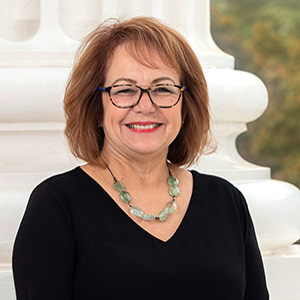
PROFILED BILL OF THE WEEK
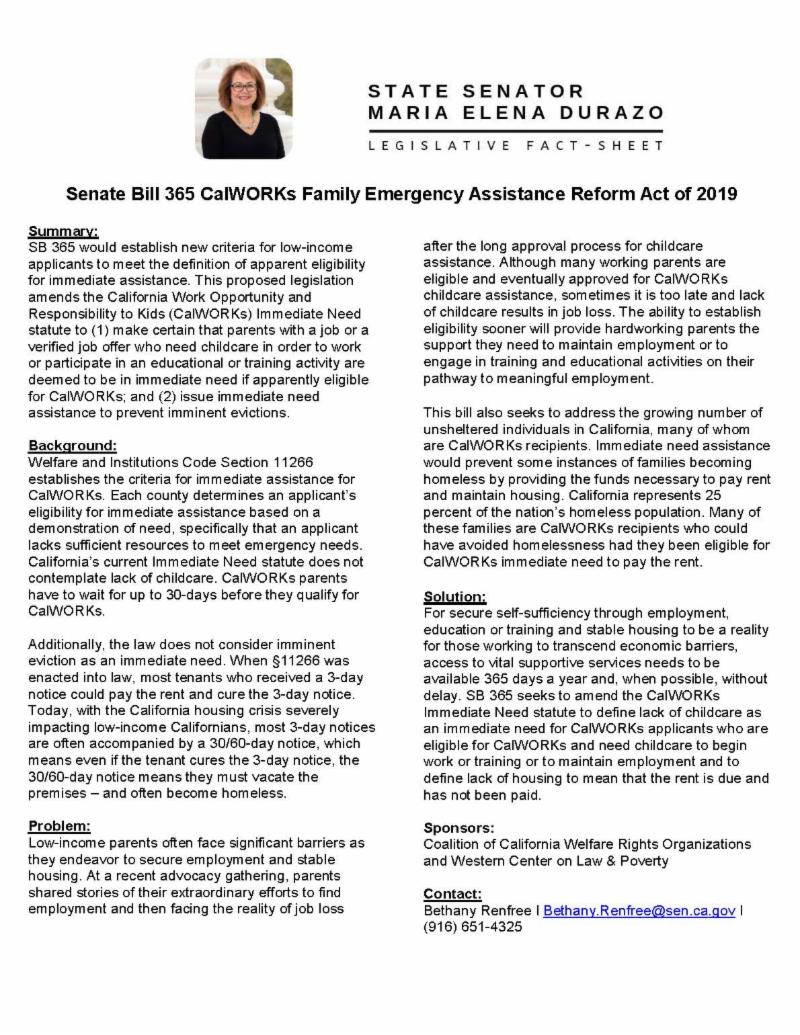
SB 365 ~ Senator Maria Elena Durazo
CalWORKs Family Emergency Assistance Reform Act
This bill will make changes to the CalWORKs definition of immediate need to consider parents who need immediate childcare in order to work and families facing immediate
evictions. This bill will help make self-sufficiency a reality for working families by offering the necessary support and opportunity to obtain childcare and stable housing.
SB 365 is set to be heard:
|
Click here to see the Budget Trailer Bill Language (TBL) has been put forward on the following:
Click here to view a field calendar that will include legislative and bill hearing dates. Below are scheduled budget hearings:
- April 10, 2019 ASM Sub 1 @ 2:30 PM - DSS: Child Welfare Services/Foster Care, Community Care Licensing
- April 11, 2019 SEN Sub 3 @ 9:30 AM - DSS: CalWORKs, CalFRESH
- April 25, 2019 SEN Sub 1 @ 9:30 AM - CDE Child Care and Early Education, Special Education
- May 6, 2019 ASM Sub 1 @ 2:30 PM - OPEN ISSUES
- May 7, 2019 ASM Sub 2 @ 9:00 AM - OPEN ISSUES
- May 9, 2019 SEN Sub 1 @ 9:30 AM - OPEN ISSUES
- May 9, 2019 SEN Sub 3 @ 9:30 AM - OPEN ISSUES
Click here to read the ECE Coalition letter addressed to Assembly and Senate Budget Leaders.
Click here to read the End Child Poverty in California letter addressed to Assembly and Senate Budget Leaders.
|
 SAVE THE DATE-
Early Learning and Care Division
This notice informs ELCD contractors of key SAVE THE DATE Request for Applications (RFA) events for the following RFAs:
- The California State Preschool Program (CSPP) Expansion RFA will announce score notifications to applicants by mid-March 2019, and send out Proposed Award Letters in mid-May 2019. The program start date will be June 28, 2019. Please note this date has changed from previous years' start dates.
- The General Child Care and Development (CCTR) RFA will announce score notifications to applicants by mid-March 2019, and send out Proposes Award Letters in mid-May 2019. The program start date will be June 28, 2019. Please note this date has changed from previous years' start dates.
- For all other questions regarding the CSPP RFA, please send an email to CSPPRFA@cde.ca.gov.
- For all other questions regarding the CCTR RFA, please send an email to CCTRRFA@cde.ca.gov.
|

To better support our field, CAPPA, in partnership with CDE, will be hosting one-day informational trainings for our field in Pomona and Sacramento!
These Statewide Meetings will bring our field together to share insights and experiences, explore ideas, shape policy, and discuss best practices.
The training in Pomona will have an additional track of workshops on Trauma and Resiliency, as space at that venue allows for that. The Sacramento training will just offer the CDE workshop track.
We hope you can join us!
April 23, 2019- Sacramento
Sacramento Agenda will include CDE topics on:
- Early Learning and Care Division Updates
- Updated Review Guides
- 12-month Eligibility
|
Event Sponsorship
Thank you to our event sponsors!
 
|
Interested in sponsoring these events?
|
|

Network and CAPPA Joint Annual Conference 2019
October 2-4, 2019
DoubleTree Hotel Sacramento
Sacramento, CA
The California Child Care Resource & Referral Network and the California Alternative Payment Program Association look forward to hosting our 7th Joint Conference together this fall.
Registration information, along with a preliminary conference program, will be released in July. At that time, online registration will be open and attendees will be able to indicate their
workshop selections when they register for the conference.

Please see the
2019 Call for Presentations Document for more information about this year's conference. At the bottom of this document you will also find the link to complete the online Call for Presentations. You can also
Click Here to be taken directly to the Call for Presentations application.
Workshop proposals are due Friday, April 26th.
Please share this Call for Presentations link with others you feel could present workshops which would be of benefit to conference attendees.
Thank you!
|
Data Hits
Highlights Prevalence of Child Poverty in California; Racial and Ethnic Disparities
Even though California is often portrayed as an economic powerhouse, it has one of the highest poverty rates in the nation as well as one of the highest child poverty rates. In addition, research shows that growing up in poverty can have lasting, harmful effects on children that could follow them into their adult lives.
Two new Data Hits from Senior Policy Analyst Alissa Anderson show that poverty is more prevalent among families with kids in California compared to the rest of the US and that significantly higher poverty rates exist for children of color than for white children in our state. In fact, if children of color had as low a poverty rate as white children, nearly one million fewer kids would be living in poverty in California.
In order to help all children reach their full potential, state policymakers could invest in and expand early care and education, the California Work Opportunity and Responsibility to Kids (CalWORKs) program, and the California Earned Income Tax Credit (CalEITC).
Expanding the CalEITC: A Smart Investment to Broaden Economic Security in California
"The California Earned Tax Credit (CalEITC) is a refundable state tax credit that helps people who earn little from their jobs to pay for basic necessities. The CalEITC builds on the proves success of the federal earned income tax credit (EITC), which reduces poverty and boosts employment, and may even improve children's health and educational attainment.
A new California Budget & Policy Center guide,
Expanding the CalEITC: A Smart Investment to Broaden Economic Security in California, provides an overview of how EITCs support families, children, and communities; examines key features of the CalEITC; and shows how Governor Gavin Newsom's 2019-20 budget proposal to significantly expand the credit will impact state residents with low incomes. The guide also highlights several ways that the CalEITC could be further strengthened, including by extending the credit to working immigrants who pay taxes and to unpaid family caregivers.
|
|
"Could California End Child Poverty"
The American Prospect
"
If there's one state we can call the progressive homeland, it's most likely California. The state is overwhelmingly Democratic and disproportionately liberal. Democrats hold more than three-quarters of the seats in the legislature, while Governor Gavin Newsom has already demonstrated he's clearly to the left of his predecessor, Jerry Brown.
Sacramento is abuzz with progressive proposals from both Newsom and the legislators. The governor wants to have Medi-Cal (the state's Medicaid program, which serves 14 million Californians) bargain directly with drug companies over prices. He also wants the state to fund universal pre-K for four-year-olds. Legislators are mulling over proposals to invest major sums in affordable housing.
Perhaps the most far-reaching set of proposals to come before legislators is that developed by a task force the legislature established two years ago. If enacted in their entirety, the proposals could do something that's never before happened in the United States: eliminate childhood deep poverty. Many of those proposals have been included in the budget that Newsom has presented to the legislature.
...Jessica Bartholow, a policy advocate at the Western Center on Law and Poverty and a key member of the state's task force, has long argued that ending poverty is a political decision. But, she says, "I feel like any time I said that before [we created this plan] it was just political rhetoric. Because someone could have said to me, 'OK, what's the plan?' and I wouldn't have been prepared to answer that question.
"But now we have a plan.""
|
|
FY2020 Child Care Development Block Grant Ask
"Last year saw the biggest increase for the Child Care Development Block Grant. However, much more is needed to help thousands of new children and families gain access to high-quality, affordable care.
Therefore, we are going even bolder and asking Congress for what we need: A $5 billion increase for CCDBG. This critical funding will continue to assist states, providers, and parents to ensure young children are in a healthy, thriving learning environments that will help them prepare school and succeed later in life.
To make this happen, we need your help! Contact your delegation today and call on them to support a $5 billion increase for CCDBG. Our children and families need it! "
|
Trump Administration Shares Additional Materials to Support Its FY 2020 Budget
"On March 18, the Trump Administration published additional materials to support its
 FY 2020 budget request
to Congress. While the budget request includes proposals to address the child care crisis in the U.S., it falls well short of what is needed long-term. Additionally, the President's request includes
proposals that would harm millions of working families with cuts to critical funding streams and access to basic needs.
Attacking the Health and Safety of Low Income and Working Families
Over the next 10 years, President Trump proposes steep cuts to Medicaid, imposing new work requirements, and converting it to a block grant. If enacted, this would likely result in millions of working families losing access to health care coverage. According to
Kaiser Family Foundation
, nearly 75 million Americans depend on Medicaid, and children account for nearly 43 percent of enrollees.
The budget request also targets the Supplemental Nutrition Assistance Program (SNAP) by proposing a $220 billion cut over the next decade and imposing tighter restrictions on unemployed or underemployed SNAP recipients. As the
Food Research and Action Center
highlights, the new restrictions would cause nearly 755,000 to lose access to SNAP benefits, denying them access to nutritious food for their families. With more than 42 million people depending on SNAP each month, cuts to this critical program would harm the nation's most vulnerable families.
SNAP is a proven program that lifts families out of poverty and the Administration should strengthen it, not harm it.
Proposes Band-Aid Solution with One-Time Investment in Child Care at the Expense of Other Programs
Only one in six families who qualify for child care assistance actually receive it, and that is why CCAoA supports a $5 billion increase in funding for CCDBG for next year.
In addition to the shortcomings of a one-time, $1 billion investment, the Administration's budget request includes proposals that would actually harm child care. This includes states "removing unnecessary regulations" in order to receive a portion of the new funds. The CCDBG Reauthorization Act of 2014 has helped implement new standards to improve safety and access to high-quality care, and reducing or eliminating these new regulations could lead to consequences that put children at-risk of being exposed to unsafe care.
What's Next?
The President's budget request was "step one" in the process of enacting next year's spending priorities. The responsibility of moving this forward is now up to Congress.
Therefore, Congress should reject it and work together to reach a deal that prioritizes the needs of children and families and provides robust funding for early education and high-quality child care programs. Any deal must also include raising NDD spending overall to avoid across the board spending cuts due to sequestration (Budget Control Act of 2011).
In 2018, Congress reached a historic budget deal that lifted key programs like CCDBG to new levels that allowed them to serve more children and families than ever, and lawmakers must come together again to ensure children and families are protected."
|
|
|
|