A Frontal Assault on the Rights of Students | | |
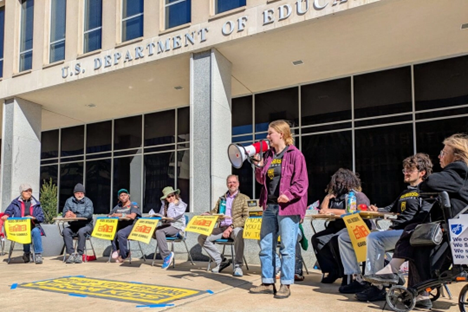
A recent “study-in” protesting the dismantling of the U.S. Department of Education.
Photo: Sunshine Movement.
The creation of the U.S. Department of Education by Congress in 1979 was an effort to ensure access to a quality education nationwide — and a recognition that educational equity needs to be a federal priority.
But this agency now faces a frontal assault on its existence, as multiple executive orders have endangered educational access for millions of students.
Even before its March 20 executive order calling for the closing of the department, the White House had already slashed agency staff, withheld congressionally approved funds, and issued guidance contravening core civil rights, rejecting its legal obligations to ensure equity and inclusion in our schools.
The gutting of the department’s Office for Civil Rights — both by cutting staff and illegally pausing investigations alleging discrimination based on race, sex, and intersectional discrimination — has wiped out OCR’s essential work in addressing and remedying discrimination in schools.
Staffing cuts also jeopardize the delivery of billions of additional dollars in vital federal aid to schools — funds that are earmarked for students impacted by poverty, students with disabilities, multilingual learners, students experiencing homelessness, and students in rural schools. ELC has been speaking out about all these threats to Pennsylvania’s students and has been quoted in multiple news outlets.
While these federal actions face court challenges, it is essential that we voice our opinions to lawmakers. Contact your senators and representative in Congress. Tell them to ensure that our federal government continues to play a vital role in expanding equity in public education through continued federal funding, guidance and oversight of federal laws, and enforcement of civil rights protections for schoolchildren.
Follow ELC for the latest information on the effort to respond to these attacks.
| | Time for PA to Make Another
Historic Investment in Its Public Schools | | |
Spring is when state budget discussions start heating up in Harrisburg. It is an excellent time to be educating our communities and elected officials about the problems still facing students in low-wealth school districts across the state who were illegally denied needed resources as the Commonwealth Court held in its historic 2023 ruling.
We have partnered with the statewide PA Schools Work coalition to put together a comprehensive toolkit of background materials on how the funding system in Pennsylvania works, including information on the $4.5 billion adequacy gap that shortchanges 70% of the state’s schools in 348 districts. Please browse and share these resources.
The necessity to redouble the state’s efforts to deliver additional adequacy funding, as Gov. Josh Shapiro has proposed in his budget, is also driven home by a just-released study of Pennsylvania districts from Research for Action. On virtually every indicator, researchers found that the state’s most underfunded districts “serve students with greater needs, provide less educational opportunity, and experience worse student outcomes than districts with adequate funding.” Money matters. The resource gaps must be addressed.
Legislators are also seeing a growing collection of stories like this, showing that school districts are using last year’s major investment in increased state funding to provide opportunities that students have previously been denied.
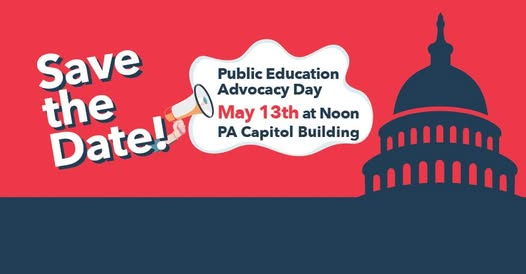
ELC and our allies will be going to Harrisburg for a May 13 advocacy day, including a rally and meetings with legislators to reinforce our message to legislators. Sign up here!
| | Celebrating and Supporting
the Rights of Trans Students | | |
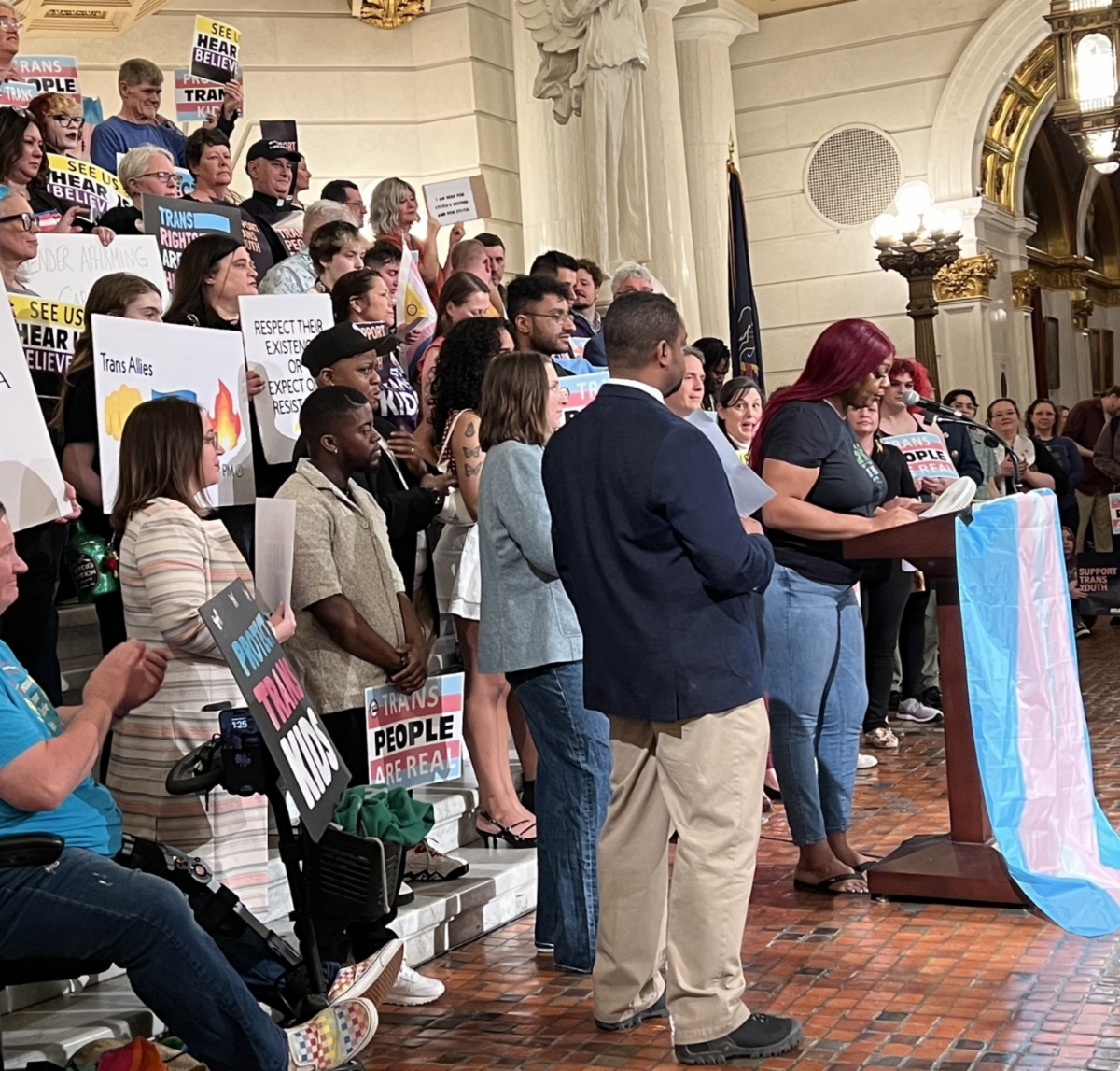
Trans Day of Visibility event March 31 at the Capitol Rotunda; speaker is Ciora Thomas, founder of SisTersPGH.
ELC marked this year’s Trans Day of Visibility at the Pennsylvania Capitol with partner advocates, lawmakers, and families. The gathering affirmed and celebrated that transgender people have always been here and always will be. Our advocacy for trans and nonbinary students continues throughout the year.
ELC advocated in a letter to the Pennsylvania Senate Education Committee that SB-9, a proposed ban on trans girls participating in school sports, would violate federal and state law and do nothing to “protect girls sports.” Bans like this only codify sexist stereotypes about how girl athletes should look or play, which promotes invasive questioning and investigations of all girls’ bodies and violates their privacy. The bill has not been introduced in the state House of Representatives and similar bills have not advanced in the past.
ELC also presented testimony on March 26, supporting the family of a trans high school student athlete from Montgomery County in providing statements to the board of the Pennsylvania Interscholastic Athletic Association (PIAA). This followed up on our joint letter with Women’s Law Project urging the PIAA to clarify their policy and statements to acknowledge that schools have no legal obligation under recent anti-trans presidential executive orders, and all trans students have the right to play sports under federal and state law.
| | CROWN Act: A Step Closer to Banning
Race-Based Hair Discrimination in Pa. | | |
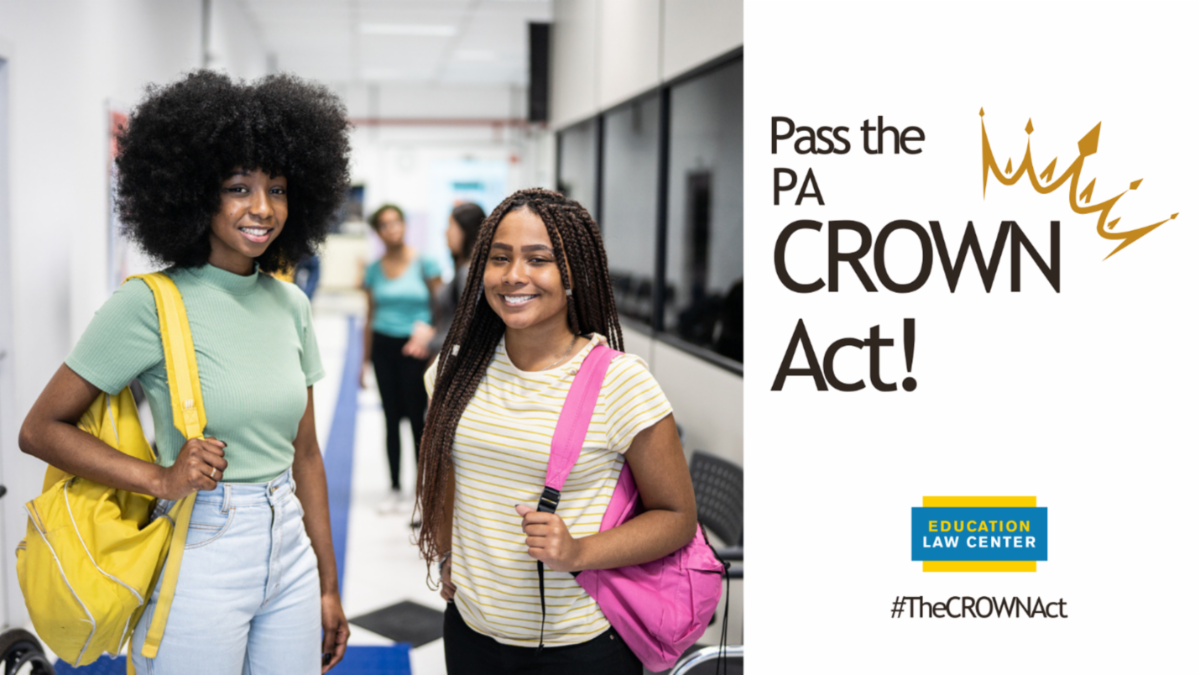
By an overwhelming, bipartisan 194-8 vote, the Pennsylvania House approved the CROWN Act (HB 439) last month, prohibiting discrimination based on a person’s hair type, hair texture, or protective hairstyle. We commend the Pennsylvania House for passing this critical legislation and call on the Pennsylvania Senate to act promptly to move the bill out of committee and pass the CROWN Act this session.
We need a CROWN Act because racial discrimination based on hair texture and protective hairstyles is a real barrier to Pennsylvania’s public school students’ ability to access and engage in their education. Passing the CROWN Act would add language addressing race-based hair discrimination to the Pennsylvania Human Relations Act (PHRA), the commonwealth's anti-discrimination law.
Black girls have reported to us that schools racially discriminated against them and punished them for the texture of their hair or wearing their hair in culturally expressive ways — afros, braids, puffs, locs, and weaves — or for wearing scarves or bonnets over their hairstyles. These harmful practices have no place in our public schools, where students are entitled to the opportunity to learn in an environment free from discrimination.
| | After Community Pushback, Pittsburgh Public Schools Closure Vote Postponed | | |
A school board resolution that would have started the process for closing 10 Pittsburgh public schools is not being brought up for a vote, at least for now.
Along with over one hundred other community members, ELC staff attorney Christine Porter testified before the board of directors of Pittsburgh Public Schools on March 24 about the need to postpone the school closure resolution in order to provide more answers to community questions, center racial equity, and consider the needs of students with disabilities who would be disproportionately impacted by the current planned closures.
Many students, teachers, and parents spoke up in support of their schools and asked for more transparency and a better plan. District leaders responded to the feedback: Two days later, Superintendent Wayne Walters requested that the board postpone a vote on the school closure resolution and promised that PPS will first gather and provide more information on how the plan would work.
ELC agrees with Dr. Walters’ statement that every school must be a “place of opportunity where every student has access to the resources, tools, and experiences they need to succeed.”
| | New Complaint Form: A Tool to Raise Concerns About Youth in Residential Settings | | |
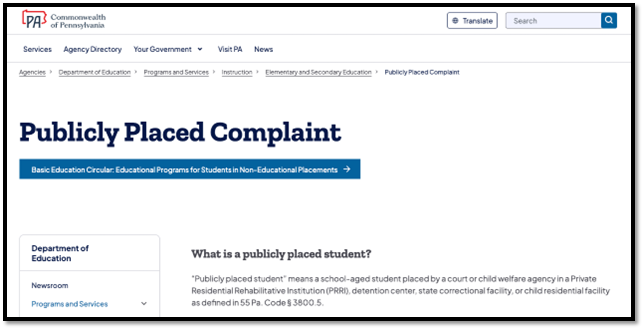
A new Pennsylvania Department of Education (PDE) complaint system — a requirement under the Glen Mills settlement agreement — seeks to ensure that students in residential facilities have access to a “high-quality, safe, and appropriate education, regardless of location.”
The complaint system, which can be used by anyone, applies to “publicly placed students” — meaning children and youth placed in residential settings by the child welfare system, juvenile justice system, or government mental and behavioral health system. This includes students living in juvenile justice facilities, detention centers, and state correctional facilities as well as in residential placements for children in foster care and psychiatric residential treatment facilities. PDE’s Office of Monitoring and Accountability is responsible for reviewing complaints, determining when to investigate, and providing oversight of educational programming.
A complaint may be filed on any topic relating to the quality of education a child is receiving, including education provided at an on-grounds school, lack of access to in-person instruction, or the inability to enroll in a local public school. Complaints may raise special education concerns, educator misconduct allegations, curriculum deficiencies, and/or “other education concerns.”
We urge you to use this new portal to file a complaint about one or more of these issues, by selecting “other education complaints,” which is listed as the last option. Your complaint will be routed to the correct person for review, potential investigation, and resolution.
ELC encourages anyone who files an online complaint to also submit a full explanation of the issues via email to RA-EDPubPlacedCompl@pa.gov and send a copy to ELC at residentialfacilitiescomplaint@elc-pa.org.
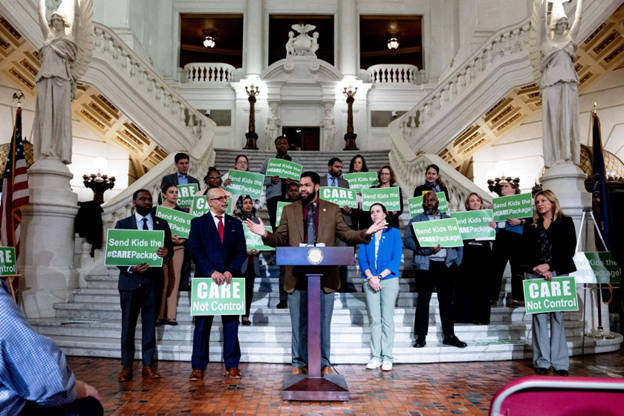
| | ELC Supports ‘Care Package’ to Reduce Referrals to Juvenile Justice | | ELC Urges Pa. Supreme Court to Protect
Against Fines or Imprisonment in Truancy Cases | | |
ELC submitted comments to Pennsylvania Supreme Court’s Criminal Rules Committee in March, focused on ensuring that students and parents are not subject to fines and imprisonment without a fair ability-to-pay determination. ELC urged the committee to revise its rules to ensure that ability-to-pay determinations are conducted in all cases, with prior notice to families and a clear explanation of the criteria for establishing an inability to pay.
While PA’s truancy law, Act 138, mandates that ability-to-pay determinations be conducted in every case prior to imposing any fine, a 2024 report on Act 138 disclosed that only 62% of surveyed magistrates self-reported that they “always” conduct such determinations prior to imposing a fine. In addition, 63% of magistrates reported that they imposed additional punitive consequences if a student or family failed to pay a fine by making a referral to the juvenile probation department.
ELC’s experience has been that magistrates often impose fines on families impacted by deep poverty on the ground that families can pay a portion each month “over years.” ELC’s comments dispute this, explaining how fines and fees undermine families’ ability to meet basic needs and negatively impact well-being.
| | |
Pa. Supreme Court Reverses Adjudications
of Dependency Based on Truancy
| | |
The Pennsylvania Supreme Court recently reversed two Superior Court rulings where children were improperly adjudicated dependent based on truancy. ELC, along with co-counsel Juvenile Law Center filed an amicus brief last year urging reversal due to insufficient evidence, including reliance on attendance records that were never properly admitted. In fact, hearing testimony revealed that the children were never legally truant at all.
Our brief emphasized the importance of verifying attendance records, which are often inaccurate. We highlighted the negative consequences of punitive measures and family separation imposed by courts, which disproportionately impact Black children, who due to systemic racial bias are more likely to be identified as truant and be referred to the dependency system. Rigorous inquiry and intervention at the school level and meaningful court review are essential to safeguard their rights.
| | Make Plans to Join ELC
Sept. 25 to Celebrate 50 Years | | |
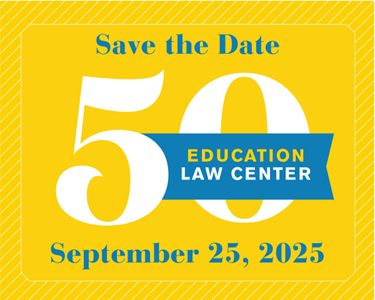
Mark your calendars today! We invite you to join us on Sept. 25, 2025, for the Education Law Center’s 50th anniversary celebration at the Switch House in Philadelphia.
Sponsorships are available now! ELC’s premier fundraiser serves as a unique opportunity to connect with key stakeholders in education advocacy and reform. Please contact Ariella Gregson to learn more about partnership benefits.
We hope you will celebrate this special milestone with us!
| | 1992: State Ordered to Eliminate Gaps in Services for Students With Disabilities | | |
Each month in 2025, we are highlighting an ELC milestone or success as we mark our 50th anniversary. Our timeline of ELC milestones is here.
A federal class action case known as Cordero, litigated by Education Law Center-PA and resolved in 1992, established that the state has an unequivocal responsibility under the federal Individuals with Disabilities Education Act to ensure prompt access to a range of placements for children who may need a more complex set of special education supports — and ensure access to a free appropriate education in the least restrictive environment.
The federal court’s follow-up order in Cordero et al. v. Pennsylvania Department of Education, in 1993, specifically required state agencies to work together to improve the capacity to serve all children by eliminating gaps in services available in local districts.
Judge Sylvia Rambo ordered the state to track students who could not find placement, determine areas of the state that lacked services, increase availability of appropriate local programs, and ensure coordination between state agencies to improve services. She emphasized that regardless of a local school district’s actions, it is “the state's obligation to ensure that the systems it put in place are running properly and that if they are not, to correct them.”
The court order led to a sweeping review of statutes, regulations, and standards that served to impede the placement of children in the least restrictive environments. Follow-up work by ELC helped the state establish protocols and procedures that are still in effect today.
Len Rieser, who litigated the case as co-director of ELC, said the ruling came as “a relief to parents — and for that matter districts — that had struggled to find options for kids with complex disabilities.”
Learn more about our Cordero case here.
| | From Our Video Library: Laying Groundwork for Statewide Advocacy, Fair Funding Case | | |
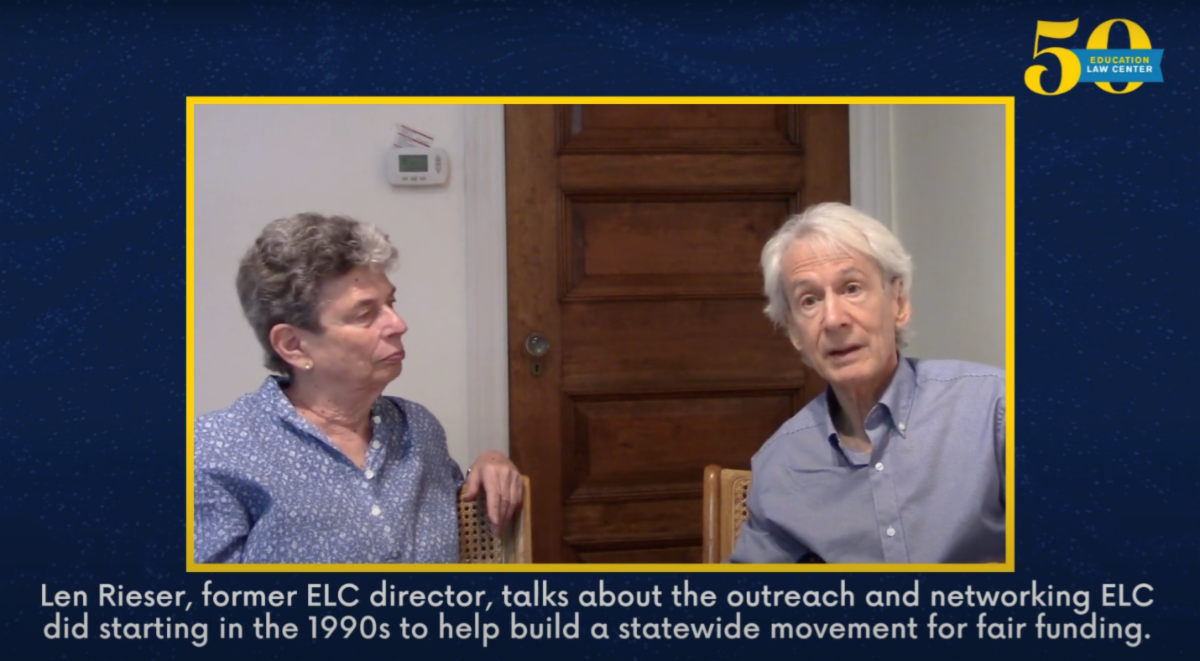
Len Rieser, former ELC co-director, talks about the increased outreach and networking ELC did starting in the 1990s that helped kickstart a statewide movement for fair funding.
This included the creation in 1993 of statewide policy advocacy network under ELC, the Pennsylvania School Reform Network, and a focus on coalition work to influence Harrisburg policymaking. ELC also made strides toward creating working relationships with partners throughout Pennsylvania.
| | In April: National Library Week
and Right to Read Day of Action | | |
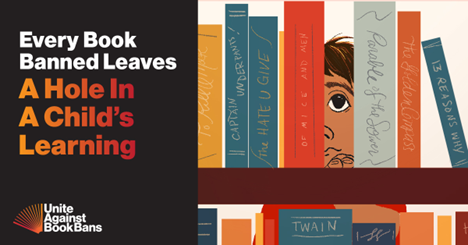
In conjunction with National Library Week, which starts on April 6, an ongoing campaign opposing book bans is organizing the third annual “Right to Read Day,” a national day of action on April 7 around the theme: “Drawn to Freedom.”
The Unite Against Book Bans campaign offers suggested actions for April 7, ranging from contacting your member of Congress to making a plan to attend your school board or city council meeting, which is where many of the battles around book bans are taking place.
One action we recommend is reading and sharing ELC’s fact sheet,
Challenging Book Bans: What You Can Do!
| | Check Out Our Job Postings! | | 50 YEARS: Rooted in Justice, Advancing Equity | |
Education Law Center | 215-238-6970 (Philadelphia) | 412-258-2120 (Pittsburgh)
| | A copy of the official registration and financial information of the Education Law Center may be obtained from the Department of State by calling toll-free, within Pennsylvania, 1-880-732-0999. Registration does not imply endorsement. | | | | |