|
Western Expansion
Kraig Nelson, Cave Creek Museum Historian
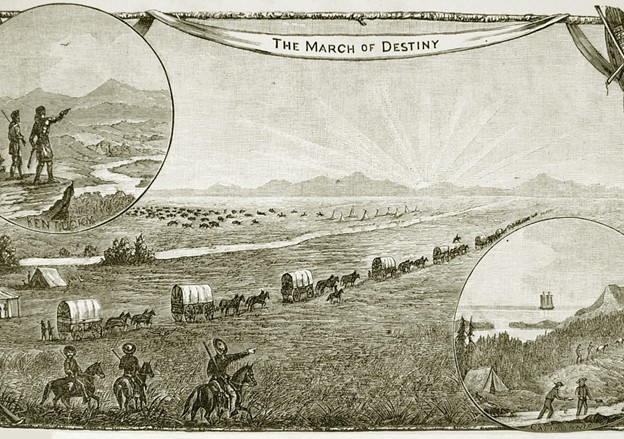
The reasons for America’s western expansion are multi-faceted; however, most historians feel the 1803 Louisiana Purchase, from the government of Napoleon Bonaparte (France), was the catalyst. Thomas Jefferson’s fifteen-million-dollar investment (about $563 million in 2026 dollars) nearly doubled America. Jefferson’s creation and implementation of the Louis and Clark Expedition in 1804 – 1806, the exploration of this important acquisition, was the initial platform for America’s journey west.
This expansion and exploration were coupled with a new and profound American mindset. In 1839, journalist John L. O’Sullivan introduced America to two noble concepts regarding westward expansion including “America’s moral dignity” and “America’s divine destiny.” Several years later, in 1845, in the New York Morning News and the Democratic Review, Mr. O’Sullivan introduced America to the concept of “Manifest Destiny.” Manifest Destiny was defined by the belief that the United States was destined by God to expand its territory across the North American continent, spreading democracy and capitalism from the Atlantic Ocean to the Pacific Ocean.
Horace Greely was the owner and founder of the prestigious New York Tribune, one of America’s great newspapers in the nineteenth century. Additionally, he wrote editorials promoting his belief that the nation could be strengthened through labor, agriculture and westward expansion. On July 13, 1865, Mr. Greely wrote this poignant statement in an editorial, “Go West, young man, Go West and grow up with the country.” This incisive quote was primarily directed to exhausted and returning Civil War veterans.
With time, this advice encouraged generations of Americans to seek exciting and sometimes harrowing opportunities and adventures on the beckoning frontier, and encouraged their taking advantage of the 1862 Homestead Act. Manifest Destiny created a powerful psychological edge for America, providing a moral and righteous justification for western expansion.
When did our frontier end in the lower 48 states? State historian Marshall Trimble feels the western frontier ended in Arizona when two transcontinental railroads, the Sante Fe Railroad (northern Arizona) and the Southern Pacific Railroad (southern Arizona) connected with territorial Phoenix. The historic date for this event and the end of the western frontier, per historian Marshall Trimble, was March 13, 1895.
|