|
Bumble Bee Watch eNews
April 2025
| | |
Spring has sprung, and the bees will soon buzz!
Brush up on your bumble bee ID skills with these tips and tricks.
by Wildlife Preservation Canada
| | |
The winter frost has finally thawed. Spring flowers are poking up from underneath the soil and blooming from the branches of tall trees, eagerly awaiting the return of their invaluable pollinators. We, at Wildlife Preservation Canada, can certainly relate to this anticipation! Soon enough we’ll once again hear the familiar buzz of our favorite fuzzy friends as bumble bee queens awaken from their long winter’s rest.
With so many differences between species and castes of bumble bees, determining who’s buzzing can be a little tricky! Knowing which species you’ve observed is crucial to conservation and monitoring efforts such as BumbleBeeWatch.org, so follow along as we outline the tips and tricks that we use in the field to identify bumble bees.
| | |
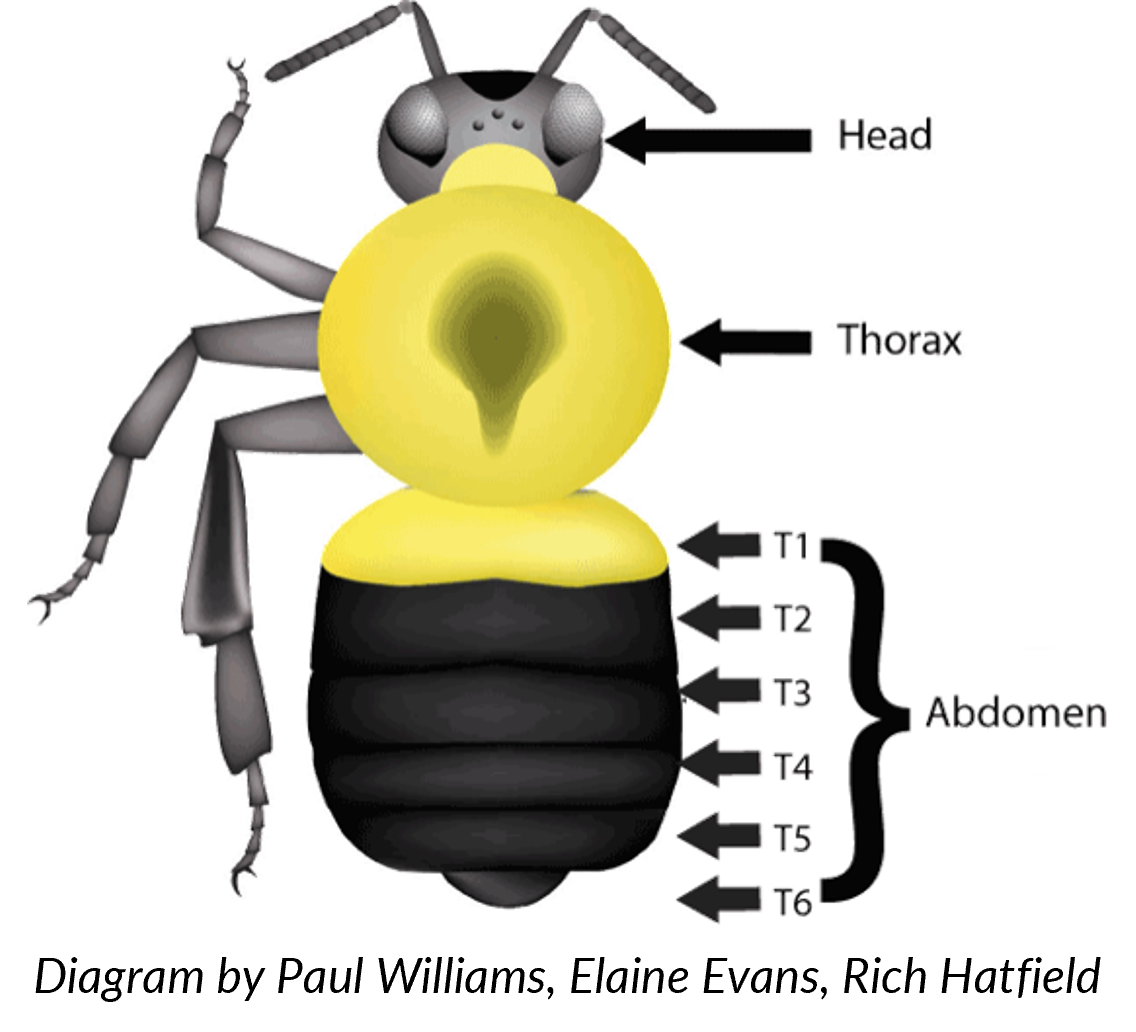
Bumble bees share the same body pattern as other insects, with three distinct parts: head, thorax (middle section where the legs and wings attach), and abdomen. The abdomen is divided into several segments called tergites. In identification guides, these are often abbreviated to T1, meaning tergite 1, through T6, meaning tergite 6. When identifying a bumble bee, you need to look at the hair color on each body part. This can help differentiate between species as well as females from males.
Using the above diagram as an example, we see 1) that there are black hairs on the front of the face between the antennae, and yellow hairs on the top of the head, 2) the thorax is mostly yellow with some black hairs in the center, and 3) the first tergite (T1) on the abdomen is yellow, and tergites 2-6 (T2-T6) are black. Based on the color pattern of all three body parts, we would identify the species as the common eastern bumble bee (Bombus impatiens).
| Female vs. Male Bumble Bees | |
Learning to differentiate between female and male bumble takes practice. Field observations can help, for example if you see a bumble bee carrying pollen you know it is a female, because males don't carry pollen. Seasonality is also a good factor to consider because males are typically not active on the landscape until mid-to-late summer. But how else can you differentiate females from males?
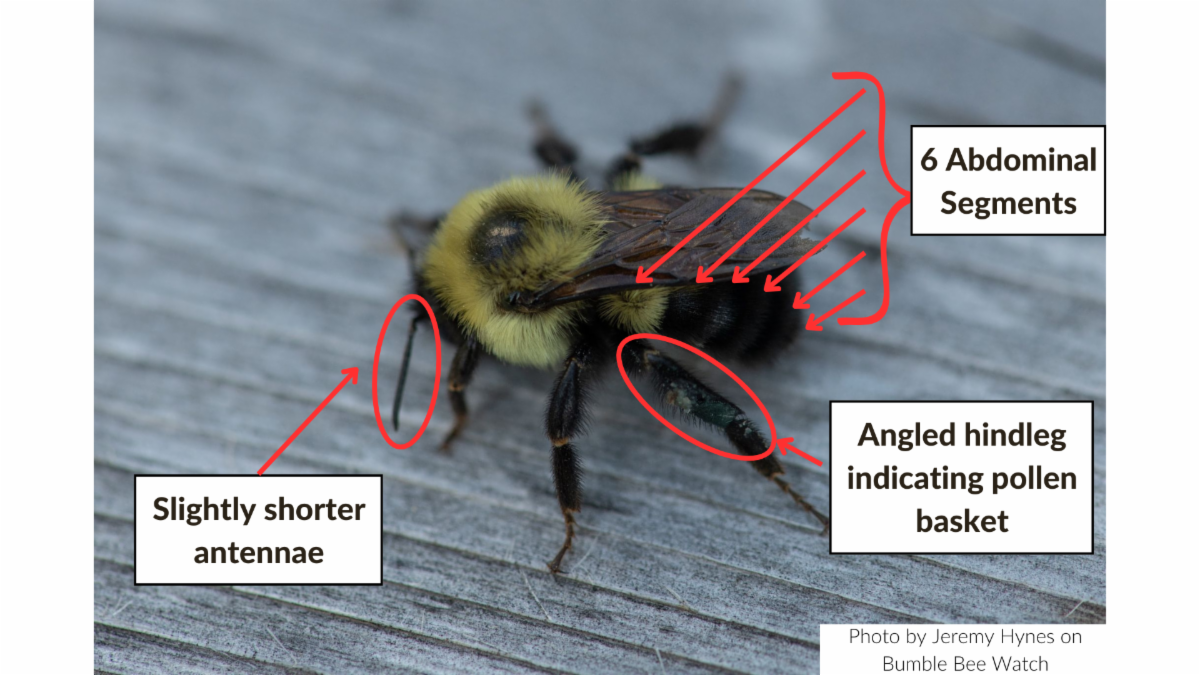
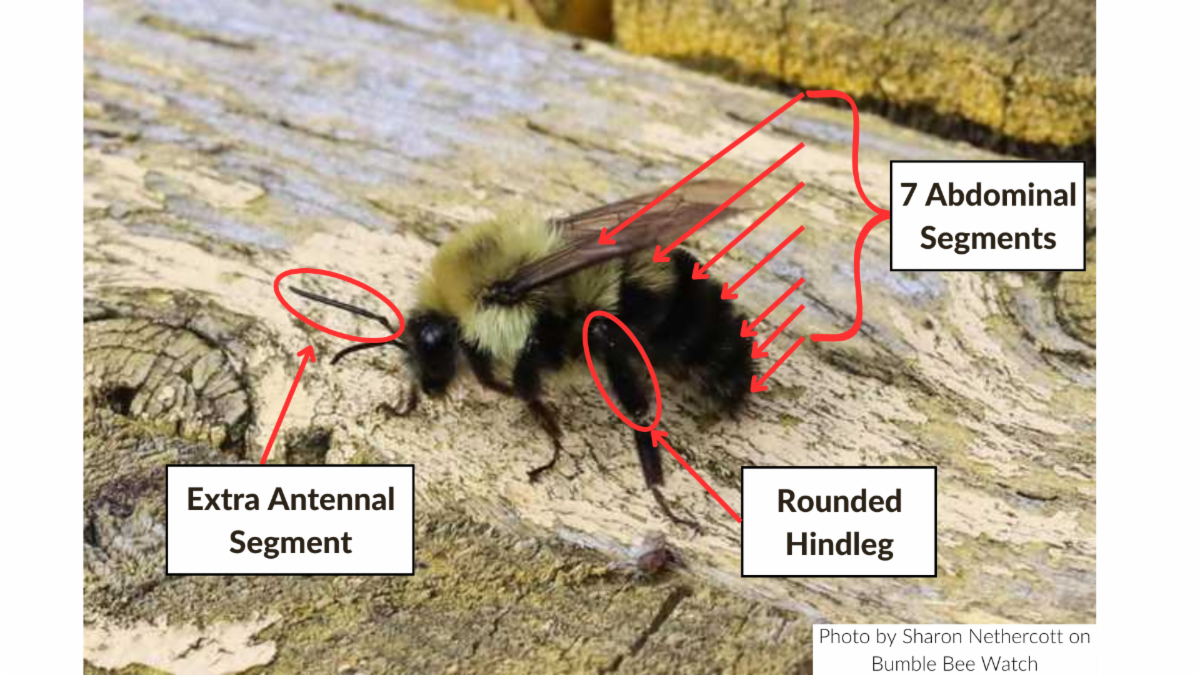
Perhaps the most reliable way to differentiate females from males is by counting the number of tergites (abdominal segments). Females (shown below in top photo) have six tergites, while males (bottom photo) have seven tergites. Their antennae differ in the same way, with males possessing an extra thirteenth antennal segment compared to the females’ twelve. Counting these is incredibly difficult, however when viewed side-by-side, you can often see a difference in the overall antenna length. Males also tend to have longer, shaggier hair and smaller, slimmer bodies compared to their female counterparts—This makes males look extra fluffy!
| |
The final way in which male and female bumble bees differ is in the middle section of their hindlegs, you want to look for the presence or absence of a pollen basket, also called corbicula (singular) or corbiculae (plural). Female bumble bees usually have a corbicula on each hindleg that they use to carry and transport pollen back to their nest. When the corbiculae are empty, the leg segment appears flat, shiny, and angular. When the corbiculae are full, the pollen is clearly visible as yellow or orange lumps on the hindlegs.
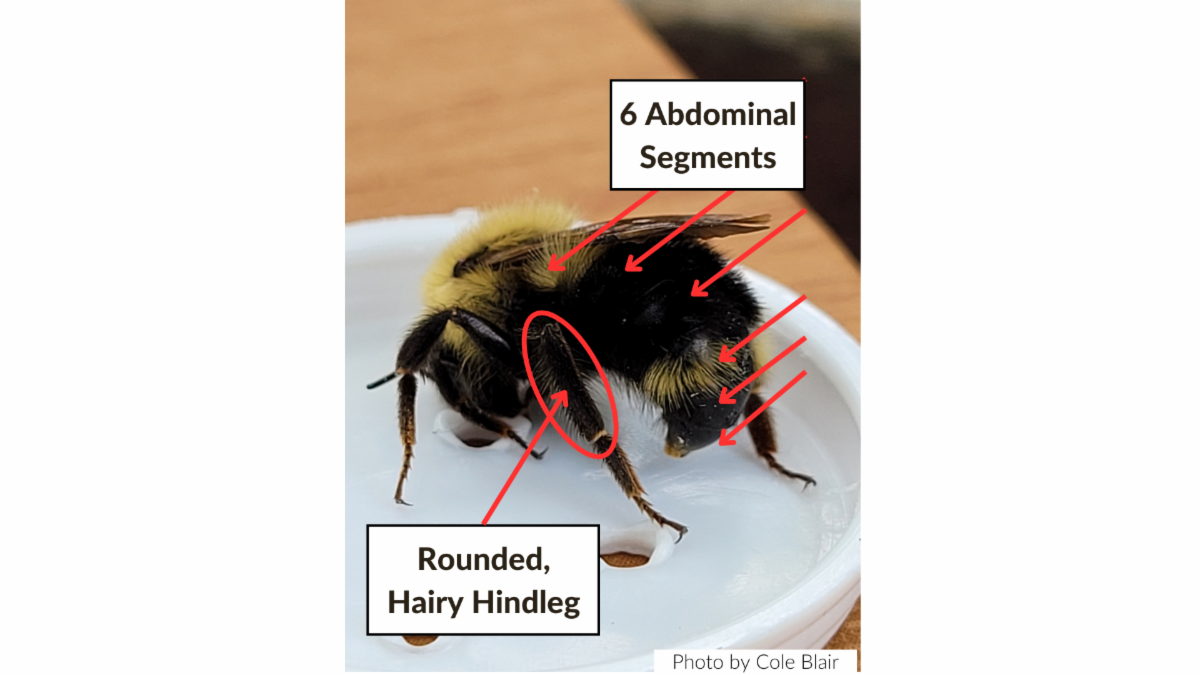
Males, whose purpose is geared towards reproduction rather than resource acquisition, do not possess corbiculae. As a result, the midsection of their hindleg is rounded and hairy. So, if you observe a bumble bee with pollen on its legs, you’ll be able to tell right away that it’s a female! However, we did say that females usually have corbiculae on their hindlegs. They don’t always have one – that complication can be attributed to…
| |
Cuckoo bumble bees break one of the ID rules we just established regarding males vs females: the shape of the hindleg. Female cuckoo bumble bees do not possess corbiculae, so the midsections of their hindlegs are rounded and hairy like male bumble bees.
Much like males, cuckoo females lack corbiculae because they simply don’t need them. Cuckoo bumble bees are social parasites, meaning they require another colony to provide it with resources. A cuckoo female will infiltrate an existing colony of its host bumble bee species, oust the colony's foundress queen, and rely on the colony’s existing workers to feed and raise the cuckoo’s brood. This strategy eliminates the need for cuckoos to gather their own resources, which renders corbiculae unnecessary. Cuckoos also possess enlarged heads as well as stingers that curve around the underside of their abdomen. These features presumably help them overthrow the colony's foundress queen.
Luckily for us, the other distinctions between sexes still apply, such as the number of tergites, the length of the antennae, and the length of their hair. There are no cuckoo bumble bees, male or female, that can carry pollen. If you find a bumble bee with six tergites but no corbiculae, you’ve found a cuckoo!
| | Resources to Boost your Bumble Bee Identification Skills | | With 46 species of bumble bees across North America, there are bound to be a few species that are difficult identify. Thankfully, there are some great resources to help community scientists identify bumble bees. | | |
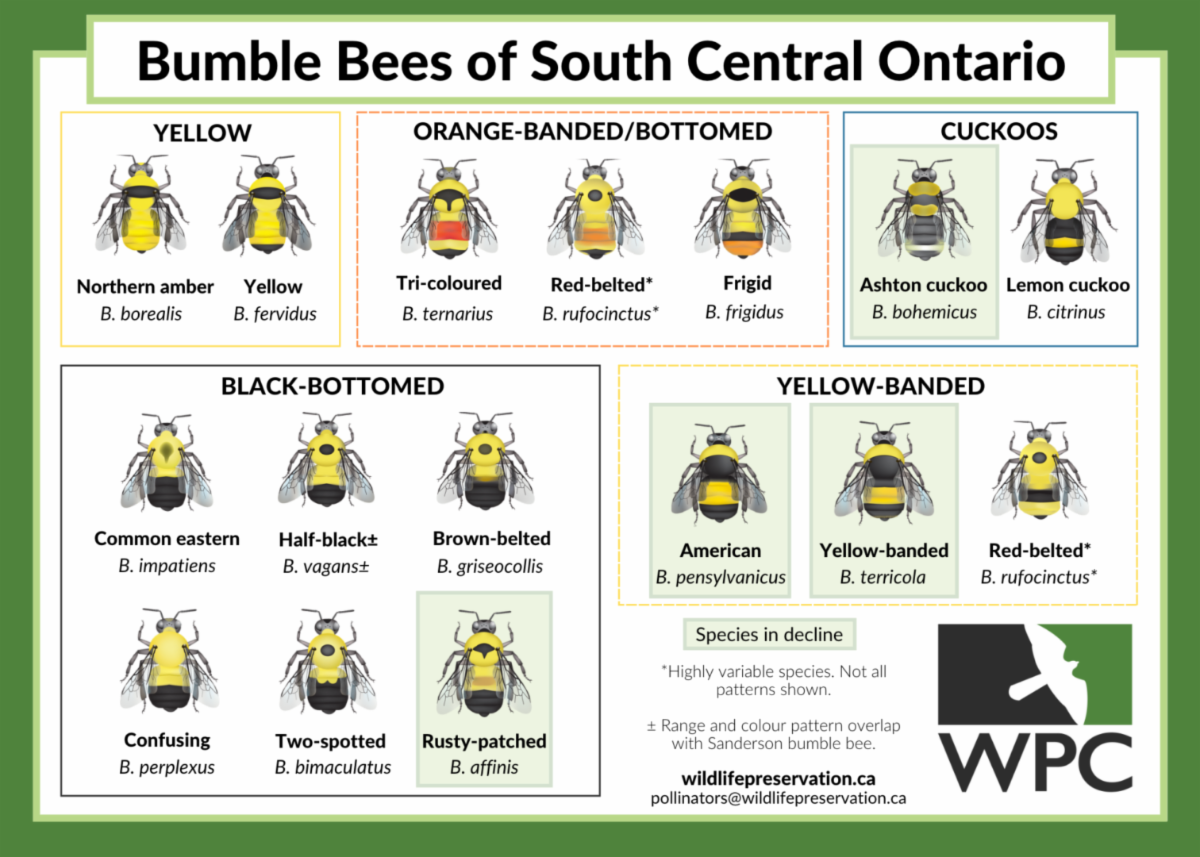
Wildlife Preservation Canada has curated bumble bee identification cards that highlight different regions across Canada. There are cards for South-Central Ontario, Alberta, and British Columbia (Coastal and Interior).
These ID cards are free to download or print on our website, making them great tools to bring on hikes and other expeditions!
| | |
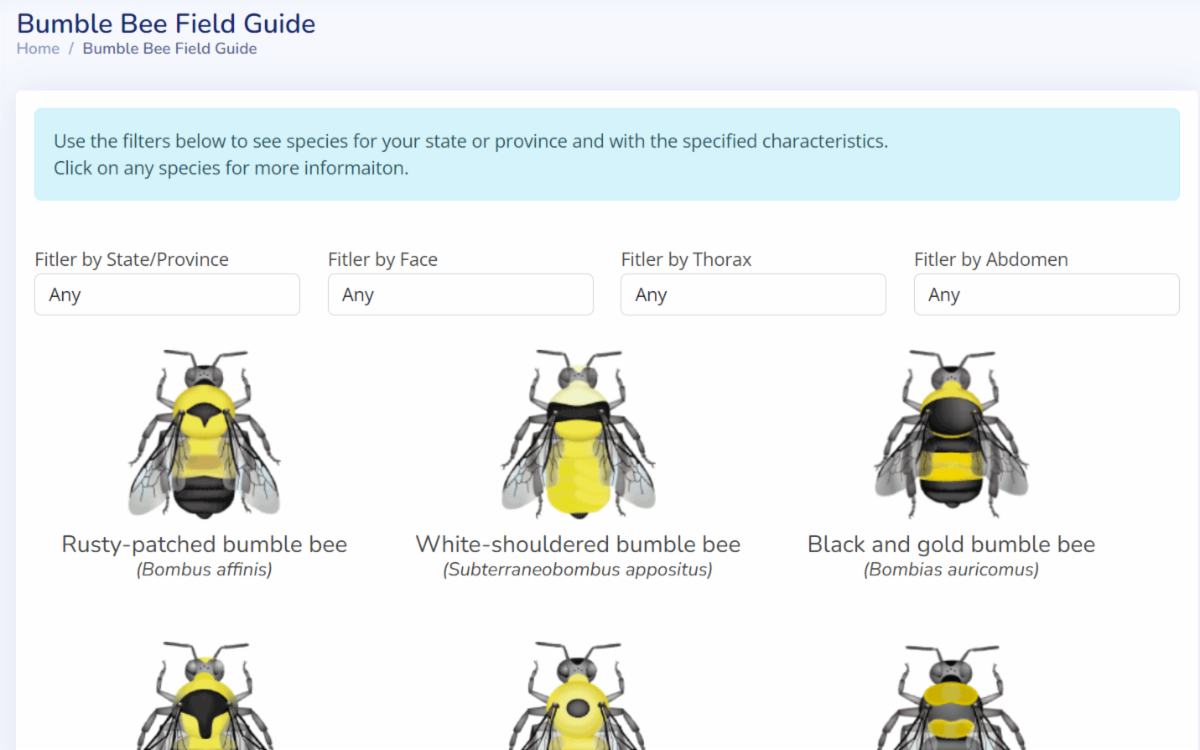
An interactive Bumble Bee Field Guide is available on BumbleBeeWatch.org. The guide allows you to filter bumble bees based on your location and the bee's color patterns. As you select filters, the guide narrows down to which species you may have observed.
Our favorite feature is that the guide is built into the bumble bee submission process! After you upload photos, you can use the interactive guide to identify your bees.
| | |
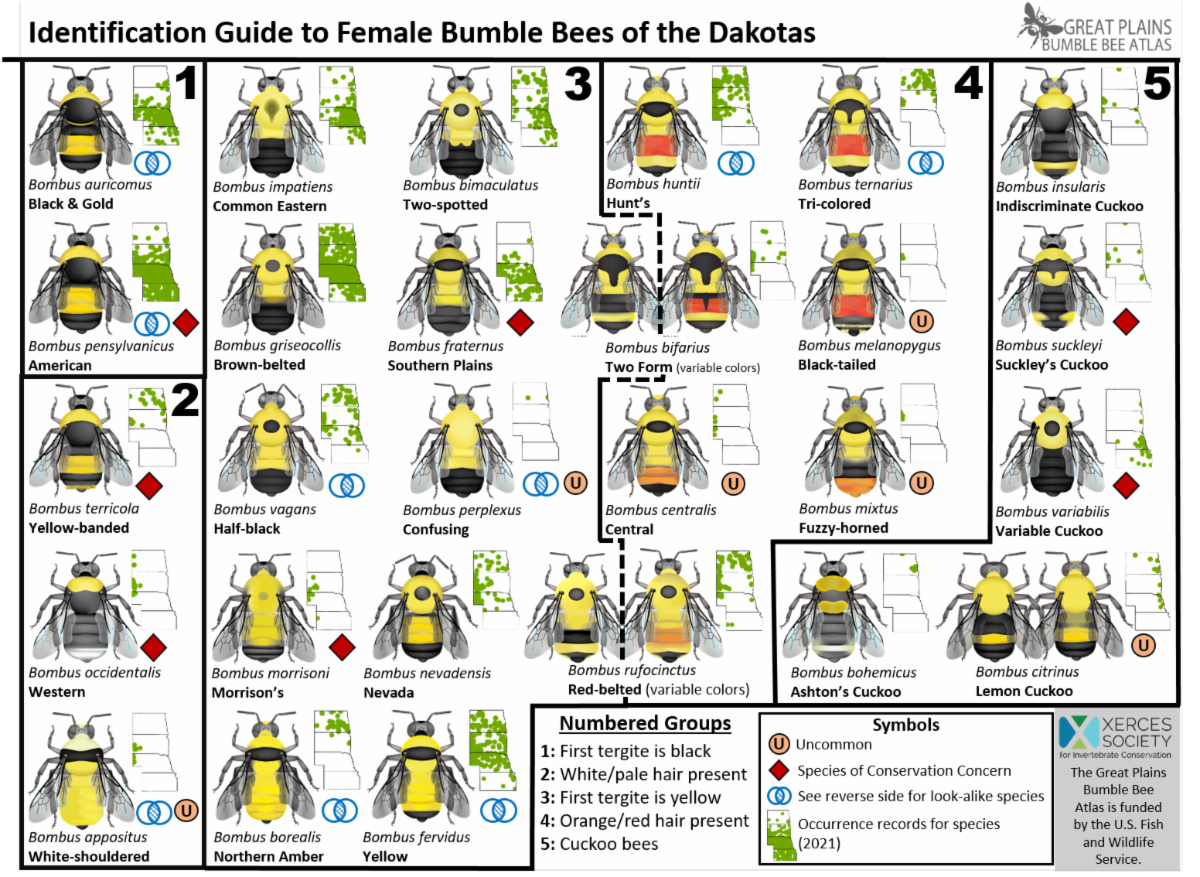
If you're in the United States, you can check out Xerces Society's state or regional Bumble Bee Atlas ID guides.
There are guides for California, Colorado, Idaho, Iowa, Kansas, Minnesota, Missouri, Montana, Nevada, North Carolina, North Dakota, Oregon, South Carolia, South Dakota, Tennessee, Utah, Washington, and Wyoming.
| | |
Please keep in mind that the above guides use female color patterns. Males can be highly variable in coloration compared to females of the same species. A good resource for male bumble bee color patterns is the Bumble Bees of North America: An Identification Guide.
When you see a bumble bee this spring, we encourage you to take photos and try out the Bumble Bee Field Guide on BumbleWeeWatch.org. You might learn something new about the bumble bees around you while contributing valuable seasonal data!
Thank you!
| When you participate in Bumble Bee Watch, be assured that your submissions contribute to something meaningful. We hope these insights inspire you further, and that these ID tips prove useful in your endeavors. There are many conservation efforts that benefit from your submissions, and experts are working diligently to find new and unique ways to use them. We are grateful for your participation in this initiative, and it is participants like you that help make all of this possible! | | |
Become a member of The Xerces Society by making a tax-deductible contribution at
xerces.org/donate.
Copyright © 2024 The Xerces Society. All rights reserved.
| | | | |