|
Greetings!
Here is your monthly update for those participating in the Time to Restore project in New Mexico, Oklahoma, Texas, and Louisiana. If you know others who may be interested in this newsletter, please send it their way! If you were forwarded this message, you can sign up on our list here.
| | | Upcoming virtual trainings | | |
Join us for a virtual training April 1 at 5:30pm MT / 6:30pm CT. This April call is your last opportunity for a LIVE 1.5 training on how to participate in the project. This call will also provide a Q&A with project leaders, and a chance to meet fellow Time to Restore participants!
Our May 6 training will be our final Time to Restore monthly call and will provide a summary of data collected so far. We will also discuss what happens next as our outreach and training for this project come to a close this summer. We'd love for you to stick with us and keep collecting data on your plants. We'll have more details on this at our May training!
| | Plant of the Month: Eastern redbud, Cercis canadensis | | |
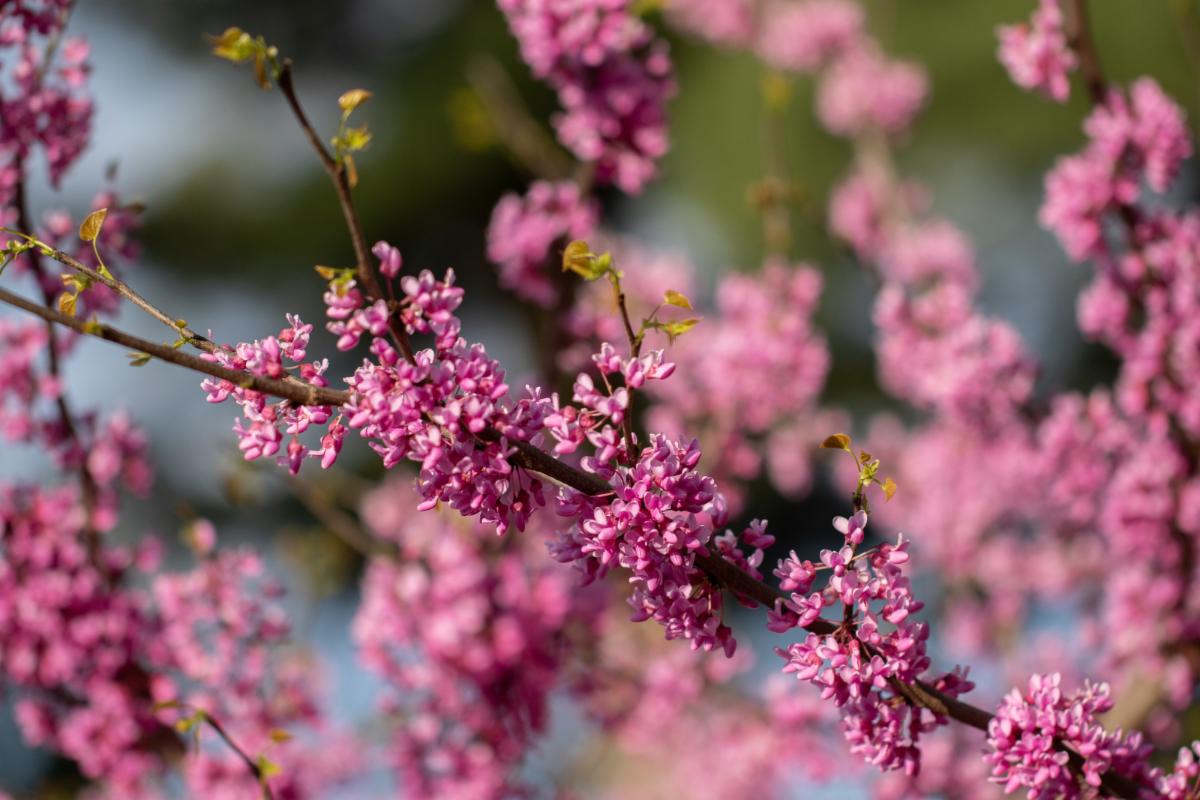
Photo above: Dulcey Lima, The Morton Arboretum, CC BY-NC-SA 4.0
Each month, we feature one of the plants on the Time to Restore list. You can see all past editions here. For our final Plant of the Month feature, we focus on Eastern rebud, Cercis canadensis, the only tree on our priority species list for Texas. Redbuds are an icon of spring, with bright pink flowers appearing before the leaves. The flowers are edible, and can be eaten raw or cooked.
In the South Central region you will find both Cercis canadensis var. canadensis and Cercis canadensis var. mexicana, the Mexican redbud. Both should be registered as Cercis canadensis in Nature's Notebook. If you know the variety you can add that detail to the Comment field for your plant when you register it online in Nature's Notebook.
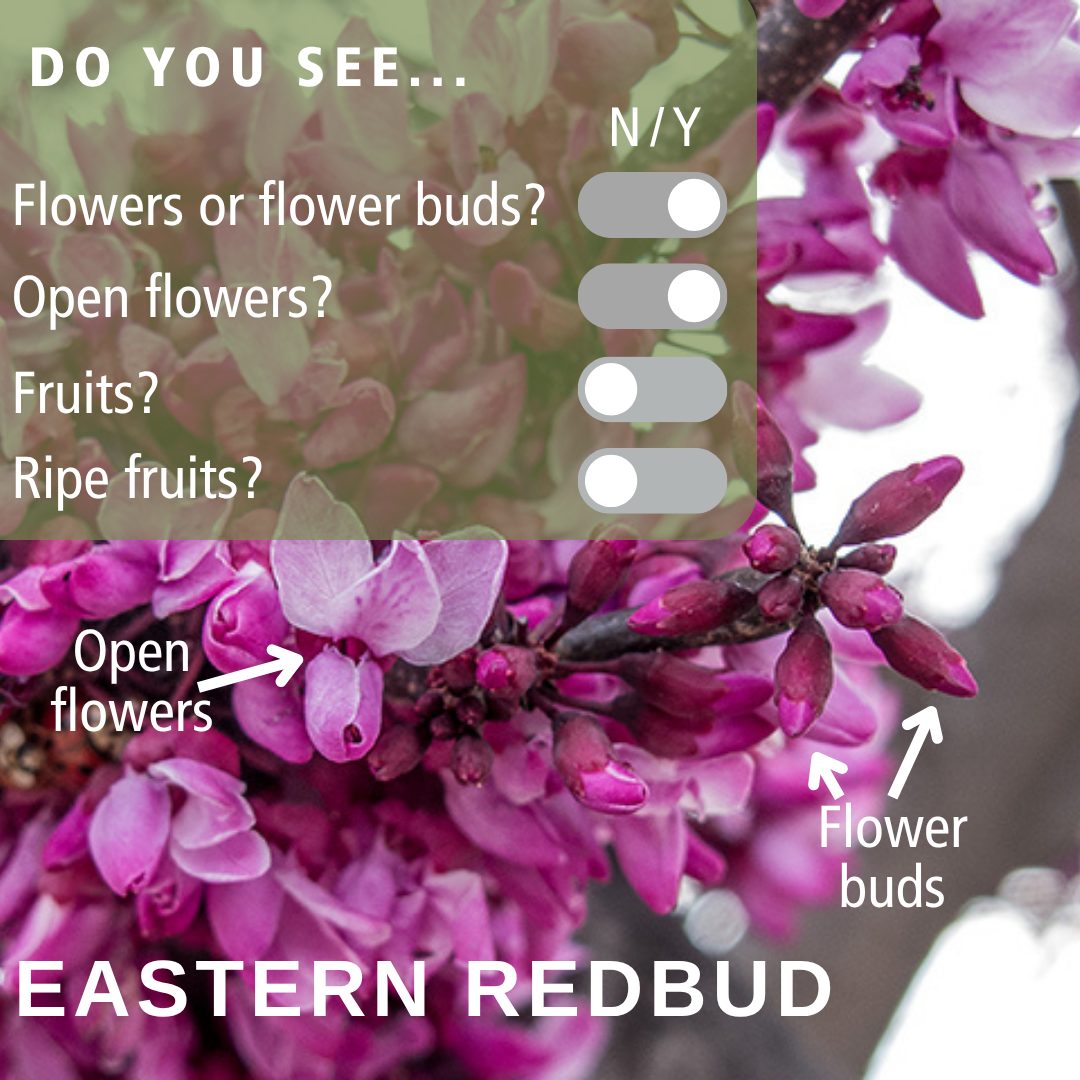
For the plant pictured below, you would report:
Flowers or flower buds - yes
Open flowers - yes
Fruits - no
Ripe fruits - no
| | Photo above: Stephanie Brundage, via Ladybird Johnson Wildflower Center | | |
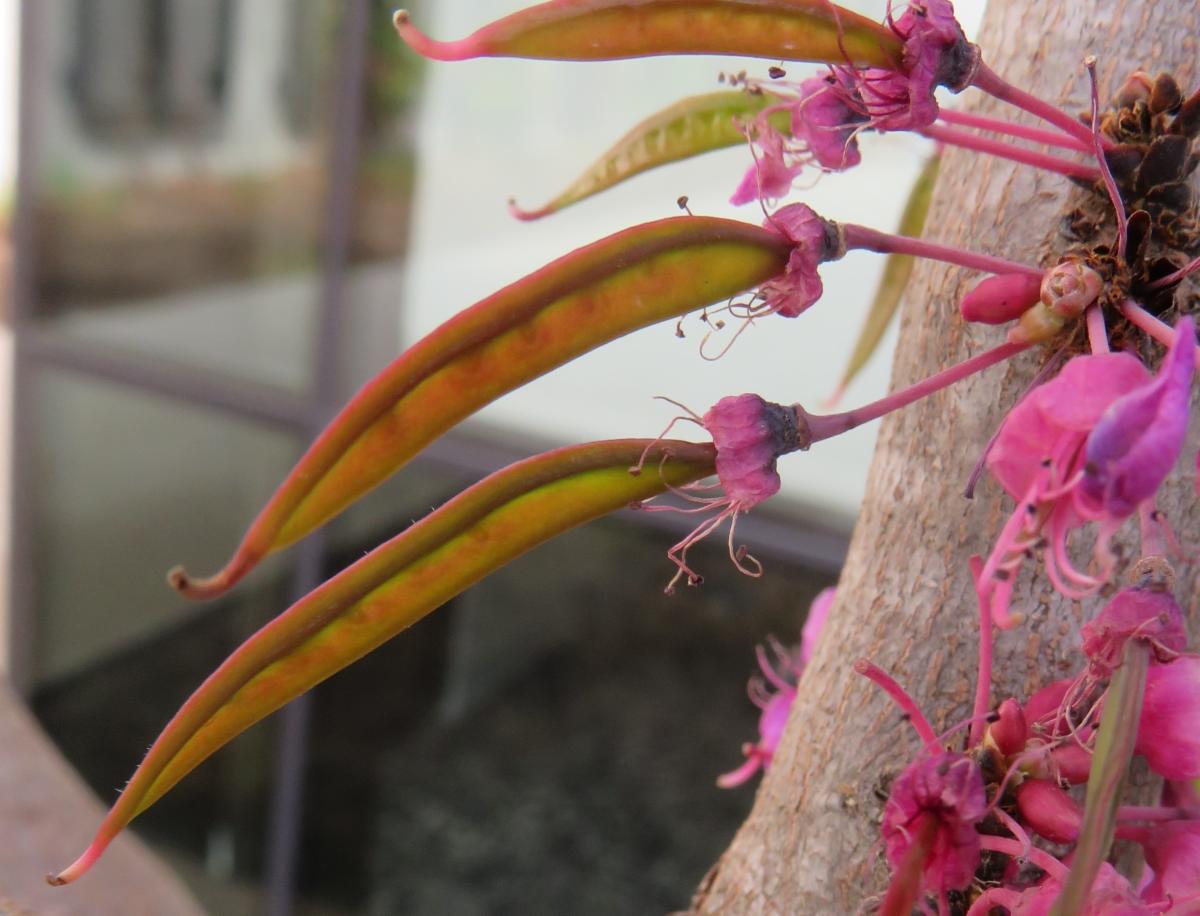
Redbuds exhibit "cauliflory", with flowers and fruits that attach directly onto the main stem or woody trunk of the plant.
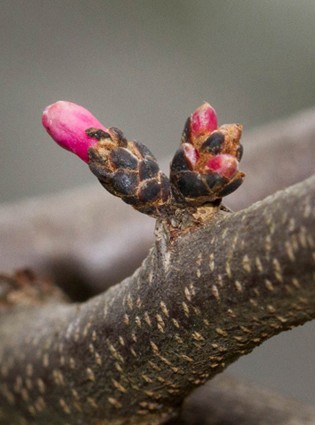
Redbuds produce dormant flower buds in the fall or winter. You should wait to report a "yes" for flowers or flower buds until you see the flower buds starting to swell and expand and bright pink flower buds emerging from between the bud scales.
In the photo at right by James Garland Holmes (via Ladybird Johnson Wildflower Center), you can see flower buds just starting to grow out of their scales. The bud on the right has just entered the stage where you would report "yes" for flowers or flower buds.
Each redbud flower has 5 petals, three upper petals and two lower "keel" petals that may be clasped together. To know when redbud flowers are open, look for the reproductive parts, which may be tucked between the two lower keel petals.
| | | |
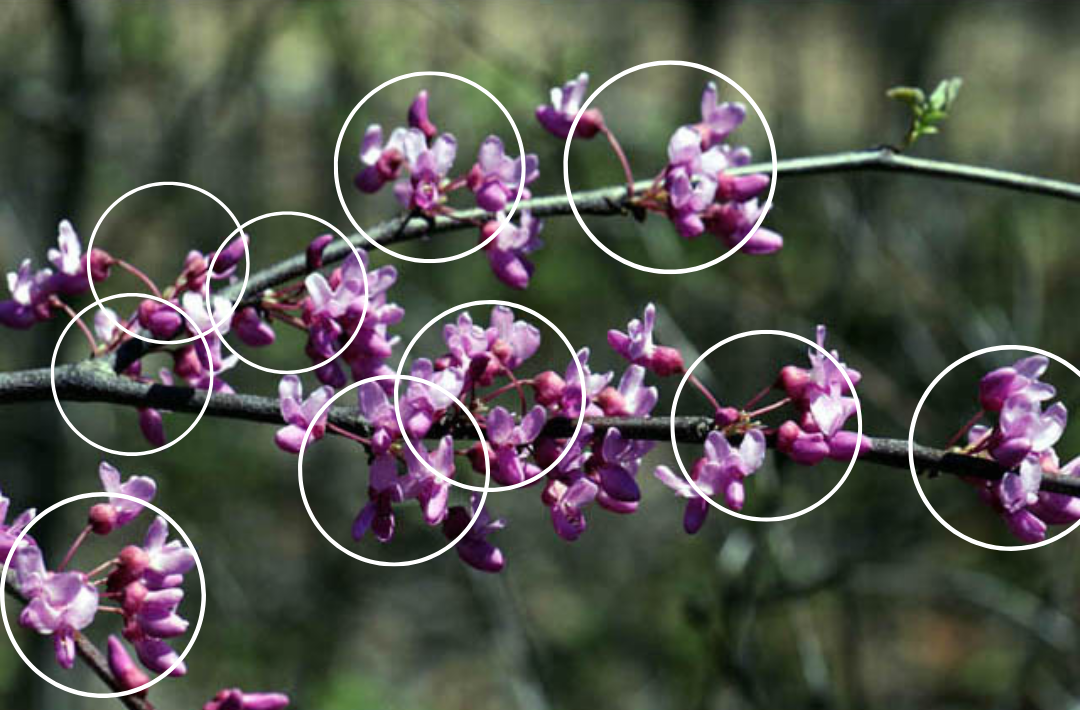
As for the optional intensity questions, you are answering the question "How many flowers or flower buds are present?" Remember that for this species, you should count the number of inflorescences on the plant, or patch of plants.
On the branch below there are 10 inflorescences (each circled in white). We would report 3-10 flowers or flower buds. Optionally, you could put the actual number of flowers you counted in the comments for your observation.
For trees, it's often useful to estimate how many inflorescences are on one branch, then multiply by the number of branches on the tree.
| | |
Photo above: James L Reveal via Ladybird Johnson Wildflower Center
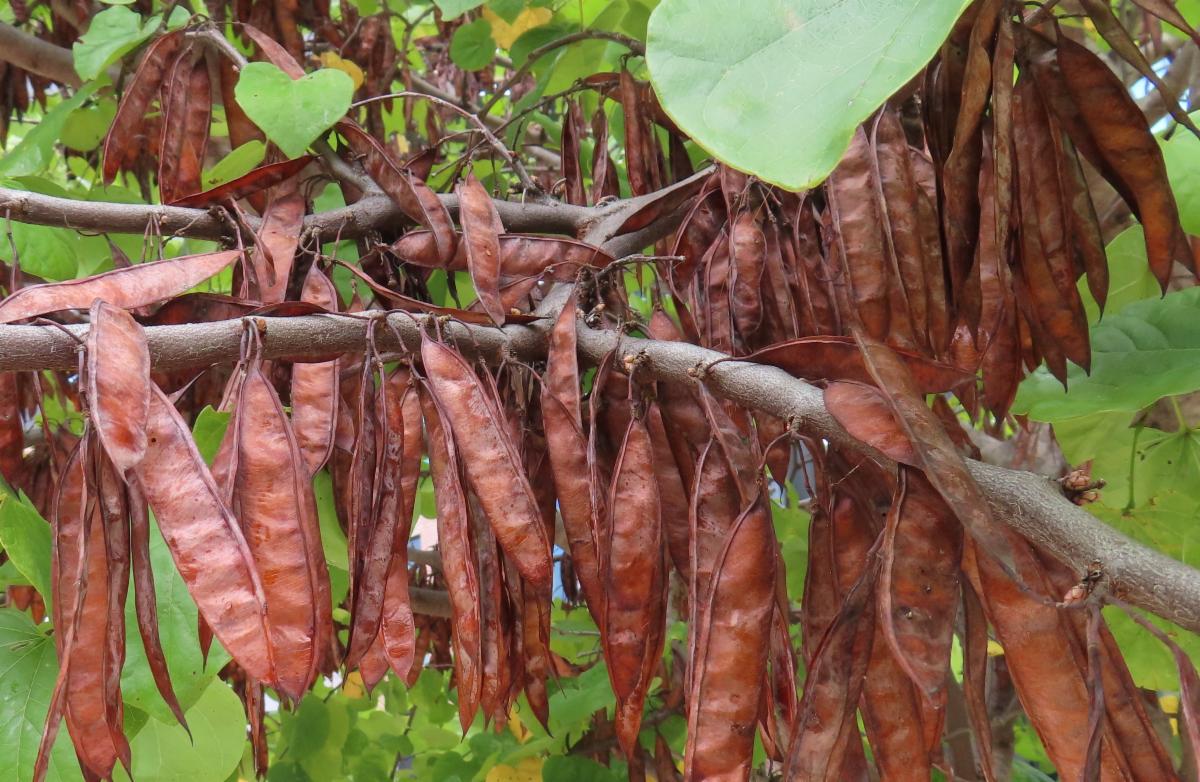
Redbud fruits are seed pods that are initially green and then eventually turn brown and dried. Fruits may remain on the tree for many months, sometimes persisting until the new growth begins in springtime. You should continue to report "yes" for both fruits and ripe fruits while these persist on the plant, as long as the fruits have not dropped all of their seeds.
| | Photos above: Keith Babberney | | |
Nature's Notebook Campaigns to join
Did you know that the species that you track as part of the Time to Restore Project also count toward Nature's Notebook campaigns? Two of these campaigns include Nectar Connectors, which focuses on flowering timing of nectar plants across the country and now includes all Time to Restore species, and The Redbud Phenology Project, which aims to better understand redbud flowering and fruiting timing.
This means that there are even more ways your data can be used by researchers and natural resource managers! If you want to stay up to date on the findings from these campaigns and take advantage of even more training tips, reminders to observe, and more, visit the pages below to learn more and sign up for campaign messages.
Learn about Nectar Connectors »
Learn more about the Redbud Phenology Project »
| | | |
How do I get started again after a winter break from observations?
We're still receiving quite a few questions about how to get started again with regular observations after taking some time off for the winter. If you have taken a break from observing, start observing your plants weekly now. Your data are even more valuable when you can capture that final "no" report just before your first "yes."
If you have missed the first flower buds or first open flowers, don't worry! You data can still be useful, so start capturing those "yes" observations now.
What should I do if my plant died or I don't want to observe it anymore?
You can use the Add or Edit Plants link on your Observation Deck to remove or add species.
If you decide to stop observing a plant, simply pick "No longer observing" for the reason for deletion.
If your plant died, you can also indicate that on the same Add or Edit Plants page.
If you are monitoring a plant as a patch, there is no need to mark plants as dead if they come back again in the same general area. Just continue to observe the new plants that emerge in your registered patch.
| | |
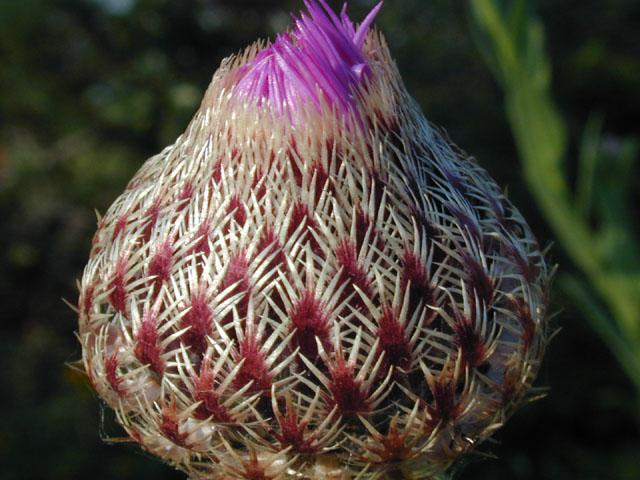
American star-thistle/basketflower (Plectocephalus americanus)
Photo credit:
Joseph A Marcus via Ladybird Johnson Wildflower Center
| | |
Nature's Notebook Nest
Stay connected with fellow observers and Local Phenology Leaders at the Nature's Notebook Nest! These standing monthly meetings on the first Monday of the month at 12pm PT / 3pm ET are a great chance to ask your questions and get advice from fellow observers. Mark your calendars, next Nest is April 6! If you sign up for reminders we'll send you an email a few days before and then the morning of the call.
Sign up for the Community »
| | | Training options in your state | | |
Participants in all states are invited to join us for monthly training series on the first Wednesday of the month. The next live 1.5 hour training will be Wednesday, April 1, 2026 @ 6:30 p.m. CT and our final training will be May 6. Register here.
Louisiana
Interested in organizing a training for your group in Louisiana? Reach out to Gina Lloyd to schedule.
New Mexico
Interested in organizing a training for your group in New Mexico? Reach out to Kim Eichhorst to schedule.
Oklahoma
Interested in organizing a training for your group in Oklahoma? Reach out to Jane Breckinridge to schedule.
Texas
The table below shows the Texas counties that are represented by Master Naturalist and NPSOT chapters that have already approved the project. We are now up to 74 counties! Let us know if you are already planning on participating in the project but your county is not represented below!
| | | North Texas Counties | Collin, Cooke, Dallas, Denton, Erath, Fannin, Hunt, Kaufman, Montague, Parker, Rockwall, Tarrant, Parker, Wise | | Central Texas Counties | Bell, Caldwell, Bastrop, Blanco, Burnet, Comanche, Erath, Hamilton, Hays, Lampasas, Llano, Milam, Palo Pinto, Travis | | East Texas Counties | Polk, San Jacinto, Trinity, Tyler | | Southeast Texas Counties | Austin, Brazoria, Brazos, Burleson, Colorado, Fayette, Fort Bend, Galveston, Grimes, Harris, Lee, Leon, Madison, Montgomery, Nueces, Robertson, Walker, Waller, Washington, Wharton | | Southwest Texas Counties | Bexar, Comal, Guadalupe, Kinney, Medina, Uvalde | | West Texas Counties | Bailey, Borden, Cochran, Cottle, Crosby, Dawson, Dickens, Floyd, Garza, Hale, Hockley, Kent, King, Lamb, Lubbock, Lynn, Motley, Scurry, Stonewall, Terry, Yoakum | | | | | |
Gina Lloyd
Time to Restore Louisiana Coordinator
ginalloyd113@gmail.com
| | | | |
Kim Eichhorst
Co-Director of the Bosque Ecosystem Monitoring Program (BEMP)
New Mexico contact for Time to Restore
kimde@unm.edu
| |
Jane Breckinridge
Director of the Euchee Butterfly Farm and Tribal Alliance for Pollinators
Oklahoma contact for Time to Restore
jane@nativebutterflies.org
| | | | |