Volume 104

Green Heat News
April 2018
4th Wood Stove Design Challenge

DOE press release : The Olympic Games may have cooled off, but the 2018 Wood Stove Design Challenge is just starting to heat up. The second round of finalists for this global competition have officially been chosen, so get ready to watch teams from around the world compete to design the next big thing in renewable energy.

Fairly testing a wood stove for EPA certification as we use wood stoves in our homes is vital -- and elusive -- until now. We will be part of the process of testing that test method when we use a Cordwood Integrated Duty Cycle method on the National Mall in November.

The answer is yes. The only question is when they will be on the market, how much they will cost and how much electricity they can make. Our stove competition in November will answer many of these questions.

The EPA is funding two of the companies competing in the 2018 Stove Design Challenge to build stoves for the developing world that cook, heat and make electricity. The DOE’s funding, routed through the Alliance for Green Heat, is for those companies to build stoves for the US market.

Welcome to the latest sponsor of the 2018 Wood Stove Design Challenge! The National Fireplace Institute (NFI) and Chimney Safety Institute of America (CSIA) are bringing volunteer certified technicians to install the stoves safely and properly. Thanks to our other sponsors - the Bioenergy Technology Office at the DOE, Osprey Foundation, the Masonry Heater Association, HPBA, Myren Labs, and Schott Robax glass and others.


‌


Focus on the NSPS
The House of Representatives passed legislation to delay the 2020 deadlines in the NSPS to 2023. The Senate will be a much, much tougher fight and may never get to a vote. AGH does not support a 3 year delay, partly because its just one piece of a larger legal and administrative challenge to a law that advances cleaner and more efficient heaters. Re-opening the NSPS under this Administration may be riskier even for industry, than complying with the existing NSPS.
‌
AGH People
AGH Advisory Board member Scott Williamson is an independent stove technician, giving him a unique and deep perspective on the pellet stove industry and how it should change to be more successful.


Focus on the EPA
Congress averted big cuts to the EPA and DOE. The package protects EPA staff, including scientists, from large-scale buy outs. Trump wanted to cut the DOE's Office of Energy Efficiency and Renewable Energy budget by 75%, but it got 14% increase. (That is the office funding the Wood Stove Design Challenge.)

NESCAUM posted the 24 powerpoint presentations from the workshop held in Nashville during the HPBA Expo. These are a wealth of information about change outs, stove regulations & case studies. The AGH powerpoint is titled "PM and Efficiency Criteria."


Focus on Change-outs
Probably the most innovative change out in the country: highest rebates go to automated wood stoves like the MF Fire Catalyst, and households get up to $500 more for choosing stoves with actual efficiencies of 65% or more. Program announced that only stoves at 2 grams an hour or under would be eligible as of 2020.

Many new change out programs seek to install cleaner and more efficient stoves, but old-fashioned ones like this make every certified stove eligible. Even though the EPA approves settlement contracts, they sometimes have little leverage.
‌
‌
‌
Coal: The 19th century heating fuel that lingers on
This Four Corners business serves about 5,000 customers, mostly from the Navajo Nation. Coal typically has a higher content of sulfur and nitrogen, and can release potentially toxic and carcinogenic pollutants such as fluorine, arsenic, selenium, mercury and lead that can be trapped indoors.

This family switched from cordwood to coal that they collected on beaches in Alaska. But doesn't coal absorb water too, and wouldn't you have to dry it first? And doesn’t salt water make things more toxic to burn?

Great photos in this New York Times feature on heating with coal in Mongolia, but little discussion of solutions. Air to air heat pumps now have potential. “If you take coal out, people will burn anything,” Mr. Shirgal said. “The tires on their cars, their neighbors’ fences. It’s hard to survive in minus 30 degrees.”


Focus on Studies and Standards
The biggest challenges in stove operation are the unknown user behaviour.  Advanced automated control systems provide the basis for a low emission stove operation at increased efficiency since they also contribute to a minimisation of user induced operation errors. Therefore, the optimisation and introduction of such systems, which are presently not widely-used, can have a huge impact on emission reduction from stoves.

“Every other fuel is subject to industry standards, and we want wood chips to be viewed as a mainstream heating option for homeowners, businesses, municipalities, institutions, etc.,” Charlie Niebling said. The standard was developed by BTEC, US Forest Service, ASTM and others.

The test showed that the use of storage strongly reduces cycling rates under part load conditions. This contributes to increased particulate emissions and reduced efficiency. The impact was most significant at the low load levels. Storage tank heat loss is shown to be a significant factor in thermal efficiency, particularly at low load.
Antique wood stoves
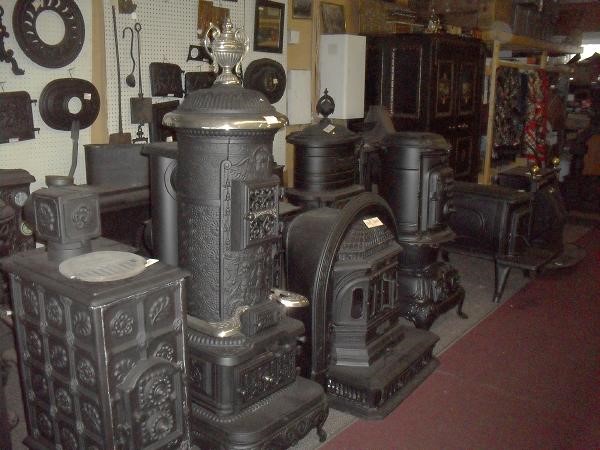
The Bryants or Thorndike Maine, have built one of the best collections of antique stoves in the world and are now looking to sell 200 of them to a museum or collector who will preserve them for many years to come as wonderful works or art." Anyone know a potential buyer?


State news
MT: The U.S. House recently passed two bills that would undermine critical health protections. One bill, the “BRICK” Act, would allow an indefinite delay of standards to reduce toxic air emissions from brick kilns and delay protective emissions standards for wood-burning stoves and heaters.

NH: "Maine leads the way with 59 automated wood pellet heating systems. New Hampshire has 50, Vermont 40, and New York seven. In total, 115 systems are residential installations and 42 are in businesses, schools and other institutions.

NM: In 2008, then Taos Pueblo Tribal Sheriff Jeff Romancito demonstrated a state-of-the-art biomass heater at the Taos Pueblo Red Willow Center. The biomass heater is still in use today.

NY: Wood heat is common in New York homes, but there's a need for higher-efficiency, lower-emitting devices, and ongoing support for new residential and commercial installations.

UT: 800 students from fifth to 12th grade rallied at the capitol for clean air legislation to pass that would include reducing wood smoke. Musician Tom Bennett was there to entertain and sing his song called “Governor we cannot breathe.”


Best of January Facebook
. Many said it was impossible. Develop a change out program for Navajo wood and coal stoves when no certified coal stove exists?

FOLLOW US ON FACEBOOK
Conferences and webinars
Randolph Center, VT, April 3, 2018
Pellet Boiler Boot Camp is a one-day “deep dive” into the operating characteristics of modern pellet-fueled boilers.

Switzrlnd, NC, April 9, 2018
Annual meeting of the Masonry Heater Association of North America at Wildacres.

Portland, OR, April 18-21, 2018
Over 30 hours of business and tech breakout session, trade show featuring more than 80 booths, and much more.

Philadelphia, PA, April 23-26, 2018
The HPC National Conference is where you will join over one thousand residential energy efficiency professionals for four days of outstanding educational sessions, networking, and inspiration.

Morgantown, WV, May 1, 2018
Underutilized wood, sometimes called “low use wood,” can be used for improving forest management in the eastern United States and an opportunity for businesses.
Denmark, May 14-18, 2018
The EUBCE brings together industry, scientists, research labs and agencies, and always has a focus on biomass thermal.

Durham, NC, June 26-27, 2018
On the rapid adoption and technological advances of new air sensor technologies, how well they perform and how lower-cost technologies can be used for certain non-regulatory applications.   

Westport, MA, July 15-18, 2018
The 2018 Convention stove is: The 1893 Model Grand Range by Spicers and Peckham of Providence, Rhode Island.

Philadelphia, PA, July 22-27, 2018
Join us in Philadelphia to meet with the international indoor air and climate community in an exciting week of networking, exchange of ideas, and discussion of the latest indoor air science.

Davis, CA, September 10, 2018
ASIC brings together stakeholders from academia, government, and communities to promote and advance air pollution sensors.

Berlin, Germany, October 10-11, 2018
The International Biomass Congress & Expo brings together leading producers, suppliers, regulators and others over a two day period to address issues relating to the biomass sector.

Burlington, VT, October 18-19, 2018
REV2017 brought together leaders and experts from throughout the region to address the challenges and opportunities ahead.

Washington DC, November 9-13, 2018
The 2018 event will be free and open to the public and includes rigorous testing of the next generation of technology.




‌


Please support our work!
The Alliance for Green Heat is an independent non-profit organization working to promote cleaner and more efficient biomass heating. Please consider making a generous contribution. The Alliance is a tax exempt 501 (c)(3) organization.

  Become a Green Heat Supporter: Make a donation here  
Alliance for Green Heat | (301) 204 9562 | contact@forgreenheat.org | | www.forgreenheat.org