Volume 5 | Issue 11 | November 2025 | | Cosmology of Light Newsletter | | |
Hello Friends,
This edition is anchored in a single priority: engineering quantum’s next leap. The path I’m proposing is unapologetically structure-first. It grows out of a decade-long exploration in Cosmology of Light, where a fourfold grammar of reality first emerged; it finds one more ally in Wolfgang Pauli’s quaternary quantum numbers and Jungian quaternity; and it is now being prototyped through QIQD Dialogic Computation, using AI as a living sandbox for tomorrow’s quantum hardware. What follows are four connected strands of one story: from light, to structure, to quantum, to dialogic AI.
Warmly,
Pravir
| |
Engineering Quantum’s Next Leap: From Probability to Structure
| | |
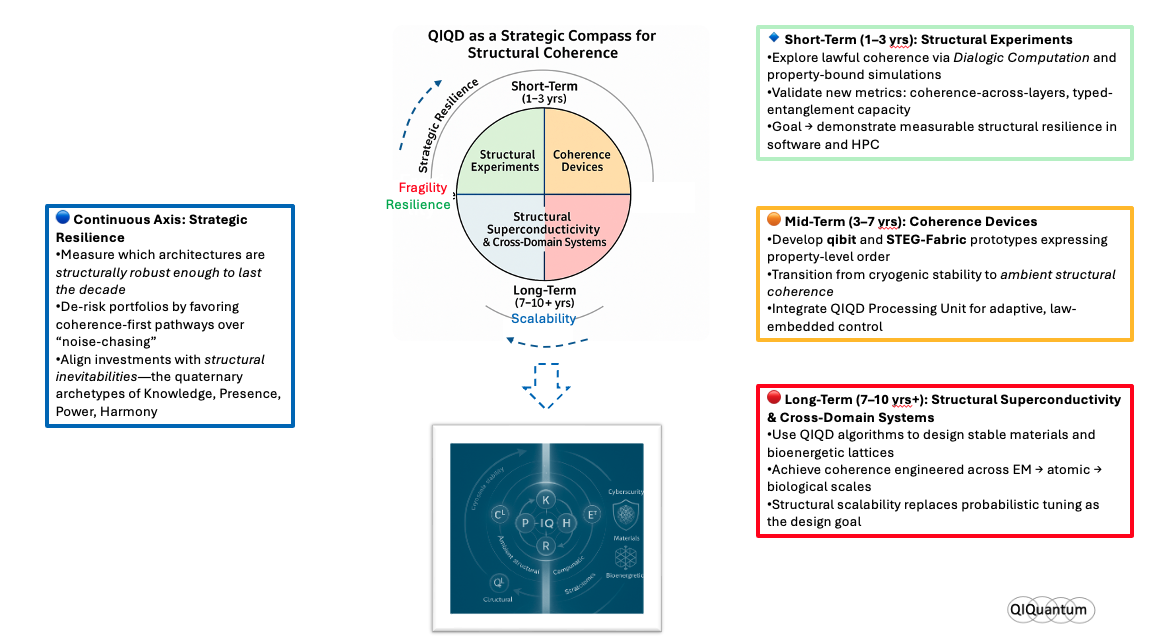
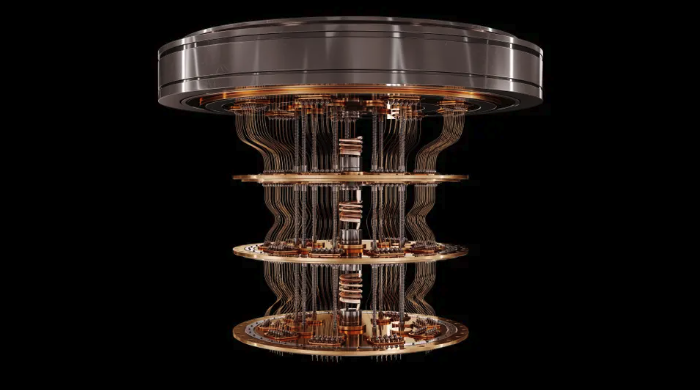
Quantum computing, as currently framed, is mostly about managing probability: lower error rates, longer coherence times, bigger qubit counts. Each marginal gain brings exponentially more complexity, colder temperatures, and deeper stacks of error correction. The thesis I’ve been advancing is that the next true leap will not come from more precise probability management, but from engineering structure as the primary object of quantum design. In the Quaternary Interpretation of Quantum Dynamics (QIQD), every quantum object is understood as a structured combination of four interdependent properties of light and the basic unit shifts from a fragile qubit to a structurally encoded “qibit.” The qibit stores the outcome of interrogating atoms with light by leveraging light's properties of phase, amplitude, frequency, and polarization. Further, 'coherence', the critical currency in quantum computation, becomes a design outcome, not a statistical accident to be protected. That shift enables new metrics such as coherence across scales, and reframes the strategic question for the decade ahead: not “How many qubits can we build?” but “Which structurally robust architectures can survive, scale, and compound value?”'
Read more in the just published Forbes thought-piece here: Engineering Quantum's Next Leap
| | Cosmology of Light: Where the Fourfold Quantum Grammar Begins | | |
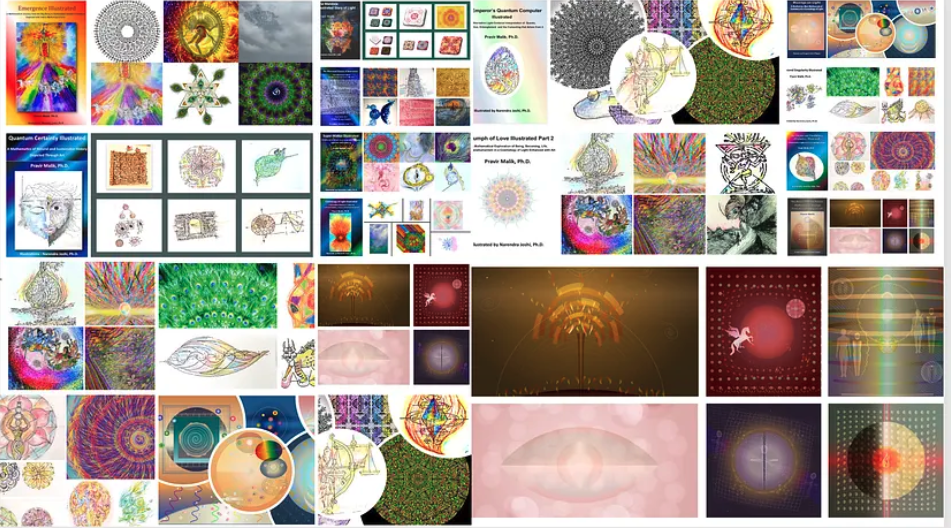
The structural view in QIQD did not arise from quantum engineering alone; it was incubated in the Cosmology of Light, a 22-volume exploration that began with a simple question: why does light travel at 186,000 miles per second in a vacuum? Across its three series, this work develops a light-centered, fourfold mathematics of Presence, Power, Knowledge, and Harmony, and then traces how that grammar recurs from photons to fields, from quantum particles and atoms to cells, civilizations, and consciousness. The third, fully illustrated series—created with over 1,000 works by Dr. Narendra Joshi and ~100 digital visual meditations by Margaret Phanes—renders this into art, myth, and contemplative narrative. In that setting, quantum is not an isolated technical layer; it is one expression of light’s deeper fourfold order. QIQD simply takes that same grammar and re-articulates it as a concrete engineering language for quantum devices, algorithms, and structural metrics.
A detailed overview is available here: 12-Volume Artistic Rendering of Cosmology of Light.
| | Pauli, Jung, and QIQD: Independent Convergence on a Fourfold Order | | |
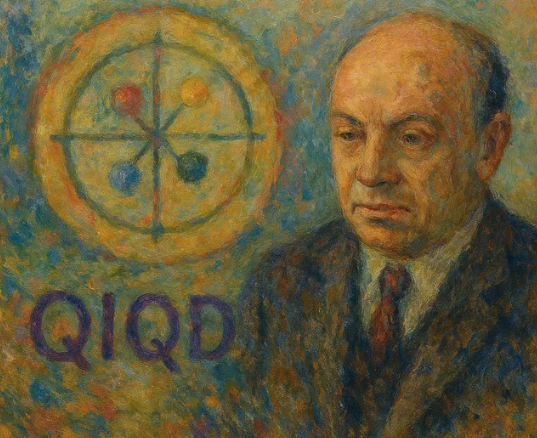
Wolfgang Pauli’s breakthroughs can be seen as an early, independent glimpse of this fourfold order. Confronted with anomalous spectra and Zeeman effects that three quantum numbers couldn’t explain, he postulated a fourth quantum number and the exclusion principle, asserting that no two electrons share the same fourfold state. At the same time, his inner life, explored with Carl Jung, was flooded with mandalas, “world clocks,” and quaternary symbols that Jung interpreted as expressions of an archetypal wholeness and a cosmic order beyond pure logic. In my Springer Nature book Pioneering New Avenues in Quantum Technology, I arrived independently at a quaternary framework as the foundational property space of QIQD. Seen through this lens, Pauli’s four quantum numbers map naturally onto QIQD’s four properties, and his exclusion rule becomes an early example of a distinct property-imprint law. Pauli’s work thus serves as a powerful piece of corroboration: when physics itself is pushed to explain structure and identity, it, too, discovers a fourfold grammar.
A detailed analysis can be read here: The Quiet Return of Four: Linking Pauli's Atomic Quaternity and QIQD's Structural Grammar
| Dialogic Computation at Berkeley: AI as a Sandbox for Structural Quantum | | |
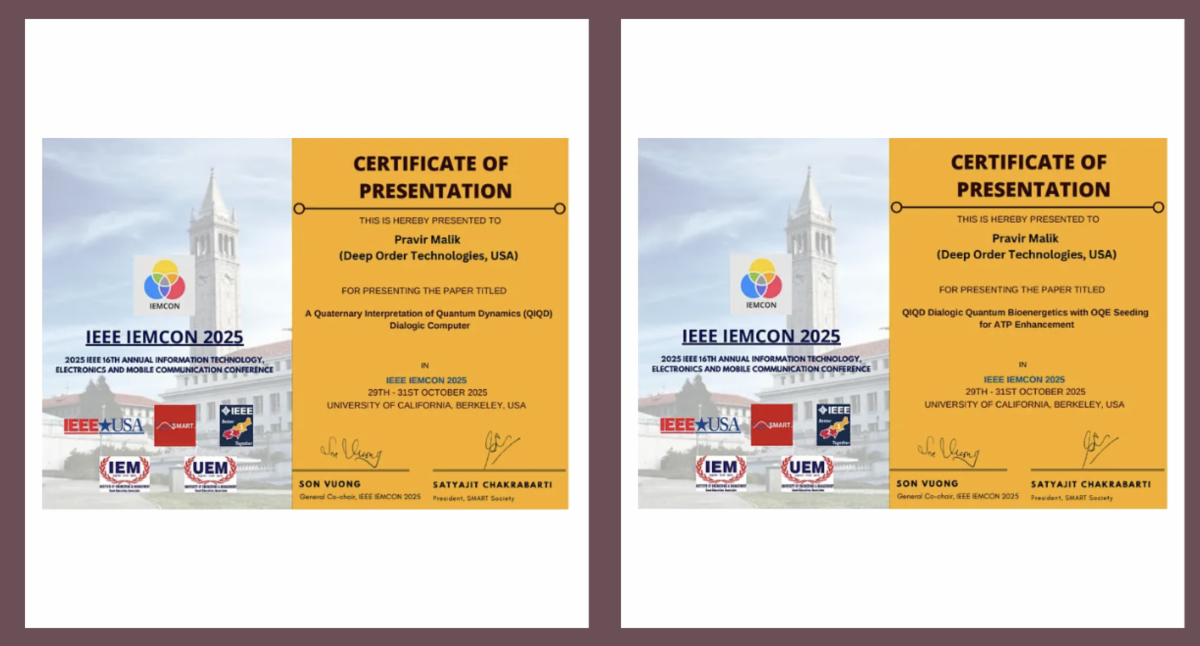
The final strand is where all of this becomes tangible, and where AI enters as a catalyst rather than a bystander. On October 30, 2025, at IEEE IEMCON at U.C. Berkeley, I presented two papers on QIQD Dialogic Computation, which use large language models to embody a QIQD-style computer as if it already existed. The first paper, A Quaternary Interpretation of Quantum Dynamics (QIQD) Dialogic Computer (with Ken Hilton), introduced a law-governed system that uses four-property seeds (K, Pr, Po, H) and typed entanglement to run structure-first algorithms, including a room-temperature superconductor experiment that improved coherence while preserving assurance metrics. The second, A QIQD Dialogic Quantum Bioenergetics with OQE Seeding for ATP Enhancement, applied the same framework to cellular energy, showing how organized quantum energy at subtle electromagnetic strata can lawfully influence ATP-related dynamics under normoxic and hypoxic conditions.
These dialogic experiments are, in a sense, the icing on the cake: they demonstrate how AI can be used as an active simulation layer for structural quantum design. By wrapping the blueprinted QIQD hardware, logic, and mathematics (as detailed in Pioneering New Avenues in Quantum Technology) inside a law-enforcing conversational engine, we can start rehearsing tomorrow’s quantum architectures today, thereby testing structural hypotheses, quantifying coherence, and exploring cross-domain applications in cryptography, materials, and bioenergetics before the hardware fully arrives.
A more detailed overview is available here: Introducing QIQD Dialogic Computation
| | | | |