| |
|
|
|
|
|
|
|
|
Arctic Reading for the Quarantine:
Newly shared reports this week.
 (The Polar Institute and the Belfer Center's Arctic Initiative) Policy and Action on Plastic in the Arctic Ocean, 2020. The Polar Institute and the Belfer Center's Arctic Initiative co-hosted a workshop in October 2019 with the Icelandic Chairmanship of the Arctic Council at the Harvard Kennedy School of Government entitled, Policy and Action on Plastic in the Arctic Ocean. The event convened global thought leaders, diverse stakeholders, and subject matter experts to begin developing a framework for tackling Arctic marine plastic pollution as one of the focus areas for the Icelandic Chairmanship.
 (Alaska Arctic Observatory & Knowledge Hub) AAOKH Presentation at the Alaska Forum on the Environment, 2020 . It was a pleasure and privilege to share observations and information about AAOKH. Taikuu and quyanaqpak!! Graduate student Roberta Glenn made the room stop with her Iñupiaq introduction and then told us about her upcoming coastal erosion monitoring research, Kotzebue Observer Bobby Schaeffer made clear the "unheard of" ice and ocean conditions in his region during 2019, UAF climatologist Rick Thoman gave us the broader context, and Elena Sparrow explained youth and education opportunities. Donna Hauser moderated and introduced AAOKH to the audience.
|
We Could Release Herds of Animals in the Arctic to Fight Climate Change, Says Study. Herds of horses, bison and reindeer could play a significant part in saving the world from an acceleration in global heating. That is the conclusion of a recent study showing how grazing herbivores can slow down the pace of thawing permafrost in the Arctic.The study - a computerized simulation based on real-life, on-the ground data - finds that with enough animals, 80 percent of all permafrost soils around the globe could be preserved through 2100.
Science Alert
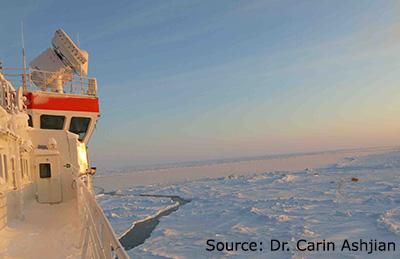 Arctic Research Expedition Likely Faces Extreme Conditions in Fast-Changing Arctic . In October 2019, scientists trapped a ship filled with equipment in Arctic sea ice with the intention of drifting around the Arctic Ocean for a full year, gathering data on the polar regions and sea ice floes. However, a new study indicates there is a chance the expedition may melt out months before the year-end goal.The MOSAiC (Multidisciplinary drifting Observatory for the Study of Arctic Climate) research team went through extensive preparation and training for the expedition, including analyzing historic conditions.
Phys.org
Russian Navy Receives First Project 20183 Survey and Research Ship for Arctic Operations. The Project 20183 survey and research ship Akademik Aleksandrov was handed over to the Russian Navy during March, Russia's state news agency TASS reported on 12 April. The multipurpose ice-class ship was built by Zvezdochka Shipyard in Severodvinsk. Its construction was ordered by the Ministry of Defence's Main Directorate for Deep-Sea Research (GUGI), a unit directly subordinate to the General Staff.
IHS Jane's 360
[Russia] Experts to Develop Support Program for Indigenous Peoples Living in the Arctic. The Far East Human Capital Development Agency has established a working group which will develop a draft program to support the economic activities of the indigenous peoples of the North, Siberia and the Far East living on the land territory of the Russian Arctic zone. The working group consists of 49 experts, including representatives of the Federation Council, the State Duma, the Ministry for the Development of the Russian Far East and the Arctic, the Federal Agency for Ethnic Affairs, and the executive authorities of all regions that make up the Russian Arctic zone.
The Arctic
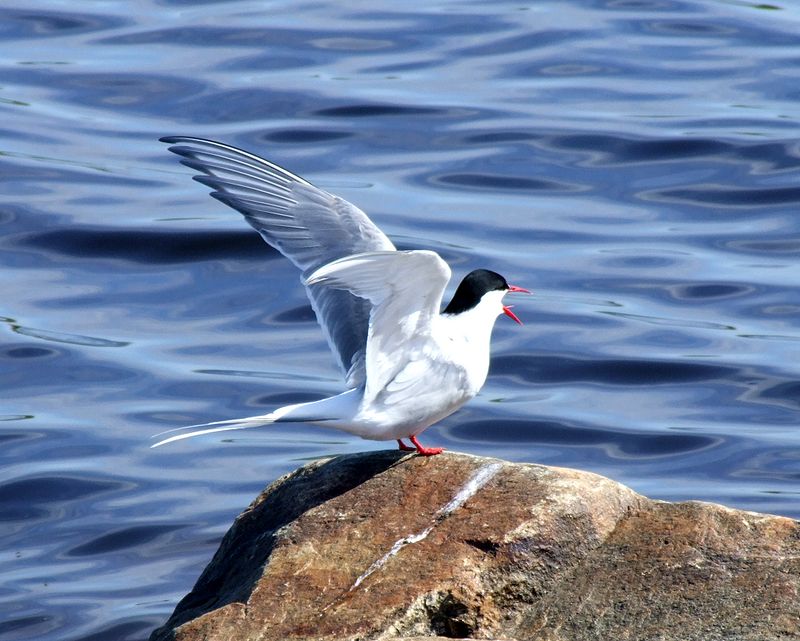 Arctic Tern Arrives Early in Iceland. The first two arctic terns of the season were spotted in Southeast Iceland on Saturday morning, according to the Southeast Iceland Bird Observatory. Their arrival is two or three days earlier than usual. Bird enthusiasts across the country are following along with migratory species as they return to their breeding grounds in Iceland. The arctic tern makes the longest known migration of any animal, travelling between Arctic and sub-Arctic regions, where it breeds, to the Antarctic, where it winters, each year.
Iceland Review
 Russia's New Arctic Policy Document Signals Continuity Rather Than Change- Analysis. On 6 March 2020, Russian President Vladimir Putin approved the 'Basic Principles of Russian Federation State Policy in the Arctic to 2035' (Basic Principles 2035). The new policy document defines Russia's Arctic interests, goals and mechanisms of implementation for the next 15 years. The document is published at a time where tensions between Russia and its Arctic neighbours are increasing and just ahead of Russia chairing the Arctic Council in 2021. One way to understand Basic Principles 2035-what new elements the policy document introduces and what it means for the future of Arctic cooperation-is by directly comparing it with Russia's most recent strategic document that addresses the polar region: Basic Principles 2020, adopted in 2008.
Eurasia Review
|
|
Future Events
Ground Truth Briefing: Policy and Action on Plastic Pollution in the Arctic Ocean, April 23, 2020 (Teleconference). The Wilson Center's Polar Institute and the Harvard Kennedy School's Arctic Initiative recently released a report entitled "Policy and Action on Plastic Pollution in the Arctic Ocean." This report describes the nature of challenges posed by Arctic marine plastic pollution and provides targeted recommendations to policymakers and researchers; it is based on a workshop the two organizations co-hosted with the Icelandic Chairmanship of the Arctic Council. Ambassador David Balton, Brittany Janis, Halla Hrund Logadóttir, and Marisol Maddox will discuss the report, the challenges of Arctic marine plastic pollution, and recommendations to combat plastic pollution in the Arctic Ocean.
ICESAT-2 Cryospheric Science Hackweek, June 15-19, 2020 (Seattle, Washington USA). ICESat-2 Cryospheric Science Hackweek is a 5-day hackweek to be held at the University of Washington. Participants will learn about technologies used to access and process ICESat-2 data with a focus on the cryosphere. Mornings will consist of interactive lectures, and afternoon sessions will involve facilitated exploration of datasets and hands-on software development.
Arctic Circle Assembly, October 8-11, 2020 (Reykjavik, Iceland). The annual Arctic Circle Assembly is the largest annual international gathering on the Arctic, attended by more than 2000 participants from 60 countries. It is attended by heads of states and governments, ministers, members of parliaments, officials, experts, scientists, entrepreneurs, business leaders, indigenous representatives, environmentalists, students, activists and others from the growing international community of partners and participants interested in the future of the Arctic.
3rd Arctic Science Ministerial, November 21-22, 2020 (Toyko, Japan). Since the last Arctic Science Ministerial in 2018, changes in the Arctic ecosystem and the resulting impacts locally and globally have been severely felt. While the reasons for these changes in climate largely stem from activities outside of the Arctic, the Arctic is warming at a rate of nearly double the global average. Considering the need for climate change mitigation, adaptation, and repair measures, the relevance of an international Arctic Science Ministerial has never been greater. It is necessary to strengthen scientific cooperation and collaboration among both Arctic and non-Arctic States in order to develop our understanding of the rapid changes impacting the Arctic. The First Arctic Science Ministerial (ASM1) was hosted by the United States in 2016, and two years later, the Second Arctic Science Ministerial (ASM2) was co-hosted by Germany, Finland, and the European Commission. The Third Arctic Science Ministerial will be co-hosted by Iceland and Japan.
Arctic Science Summit Week, March 20-26, 2021 (Lisbon, Portugal). The Portuguese Minister of Science, Technology and Higher Education, the Portuguese Foundation for Science and Technology (FCT) and the Local Organizing Committee will host the Arctic Science Summit Week 2021. The Conference is organized by FCT, Ciência Viva, AIR Center, the Portuguese Arctic Community and by IASC and partners. Framed by the overarching theme for the Science Conference "The Arctic: Regional Changes, Global Impacts," Lisbon invites International experts on the Arctic and Indigenous Peoples to discuss the "New Arctic" and also its impacts and interactions to and with the lower latitudes.
|
| 
  
4350 N. Fairfax Drive, Suite 510
Arlington, VA 22203, USA
External links in this publication, and on the USARC's World Wide Web site (
www.arctic.gov) do not constitute endorsement by the US Arctic Research Commission of external Web sites or the information, products or services contained therein. For other than authorized activities, the USARC does not exercise any editorial control over the information you may find at these locations. These links are provided consistent with the stated purpose of this newsletter and the USARC Web site.
|
|
| |
|
|
| |
|
