

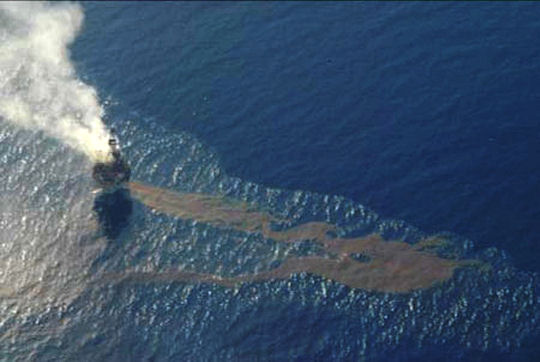
 Coastal Response Research Center Requests Input on the State of Science on Dispersant Use in the Arctic. The Coastal Response Research Center (CRRC) recently collected statements and reports on five topic areas related to dispersant use in the Arctic: efficacy and effectiveness; physical transport and chemical behavior; degradation and fate; eco-toxicity and sublethal impacts; and, public health and food safety. CRRC request written input on the statements the scientists made on the state-of-the-science regarding dispersant use, particularly as it applies to Arctic waters.
As the Arctic Warms, a Changing Landscape on the Chukchi Sea. It's well established that Arctic ice is changing in dramatic ways. As the climate warms, ice coverage is decreasing
, the amount of multiyear ice has gone down significantly and in Alaska, many communities are seeing the ice come in later, and leave sooner. So, what do those changes look like up close? On a late-May evening, about a dozen grad students and postdocs gather at the north edge of Utqiaġvik, by the Barrow Arctic Research Center.
Alaska Public Radio
 Norway's Coast Guard Stares Down Big Challenges in Arctic. During the three weeks the Norwegian Coast Guard vessel Harstad sailed around Svalbard in late May, it was the only military ship available to respond to a crisis in the vast waters surrounding the island. But that reality is the norm and likely will be for a long time, even as demands on the service grow by leaps and bounds, said the Harstad's commanding officer, Lt. Cmdr. Kyrre Einarsen, on May 23. Svalbard is Norway's northernmost island, a landmass about the size of Ireland situated in the Arctic Circle.
Defense News
Oceanographers Select Wave Glider Ocean Robot for Scientific Research. Top oceanographers have selected Wave Gliders, the most experienced, long duration ocean robots, as their sensor platform to conduct advanced scientific research in the most inhospitable and remote regions of the Arctic and Southern Oceans. The US scientists, from Scripps Institution of Oceanography (Scripps) and the Applied Physics Laboratory of the University of Washington (APL-UW), will integrate sophisticated oceanographic and atmospheric sensors onto the Wave Gliders to measure extreme wave states, winds, temperature, and salinity in the upper layers of the ocean.
Robotics and Automation
News: Cave Scientist Gina Moseley Receives 1.2 Million Research Prize. Dr Gina Moseley from the Innsbruck Quaternary Research Group will receive one of this year's prestigious Austrian Science Foundation (FWF) START prizes. The START program is an Austrian initiative to support and strengthen outstanding research projects in science and humanities. Gina, a member of the University of Bristol Spelaeological Society and current Symposium Lecture Secretary of the BCRA has been chosen for her research into climate change in the Arctic, as part of the Greenland Caves Project. This work began in 2015 with the visit of a 5-person team to the Arctic to explore, survey, photograph and take samples from caves in Northeast Greenland. In 2018, this work has extended into a new area as part of a Top to Top Global Climate Expedition where they will be exploring potential new cave sites.
Darkness Below
New Study Provides the First Comprehensive, Long-term Look at Alaska's Changing Ecosystems. New research has revealed significant changes to Alaska's landscape in recent decades. During the past 32 years, about 13 percent of the state -- 67,000 square miles or an area larger than the state of Wisconsin -- has changed, according to a new USGS-led study in collaboration with researchers from academia and other federal agencies. This is the first study to document more than three decades of land and water changes across Alaska, and it is the first study to quantify the underlying drivers of those changes, which is vital for understanding how these systems may continue to change.
Sit News
 The Strange, Fading Call of the Narwhal. Among the many splendid creatures certain to be affected by a warming climate is the narwhal, the unicorn of the sea. The narwhal, a pale, porpoise-like resident of Arctic waters, and a close relative of the beluga whale, takes its name from the Old Norse word nahvalr, or "corpse-whale," for its resemblance to the bodies of dead sailors. It is best known for the long horn-in fact a tooth, one of just two in the animal's head-that extends through its upper lip. Last year, scientists discovered that narwhals use the tusk, a sensory tool loaded with nerve endings, to whack and stun fish before eating them. But little is known about the narwhal's day-to-day life. Narwhals are skittish in the wild and don't thrive in captivity.
The New Yorker



