Here's How This Ghostly Fogbow Formed Over the Arctic Ocean. Do rainbows have ghosts? If you have ever seen a fogbow, then odds are your answer is "yes." Although it sounds crazy, fogbows are a real thing - and form in a similar fashion to rainbows. But unlike rainbows, these ghostly white fogbows are pale in comparison - quite literally! Ordinary rainbows occur when light enters a water droplet. Sunlight is a mix of all colors - but because they are all jumbled together, our eyes cannot pick out individual shades.
The Washington Post
In Memoriam: Caitlyn Antrim. It is with profound sadness that the Stimson Center announces the death of one of our own, Caitlyn Antrim. Caitlyn passed away on July 28th, in Kingston, Jamaica where she was attending the 24th session of the International Seabed Authority Assembly. Caitlyn was a Nonresident Fellow of the Stimson Center and the Executive Director of the Rule of Law Committee on the Oceans, a group of scholars and practitioners in ocean law and
diplomacy.
Previously, Caitlyn represented the US Department of Commerce at the Third UN Conference on the Law of the Sea in 1982, served as Repair Officer and Damage Control Assistant on the USS Schofield (FFG-3), and earned the professional degree of Engineer from the Department of Ocean Engineering at the Massachusetts Institute of Technology.
Stimson Center
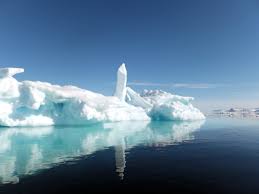 An Ice-Free Oasis in the Arctic Sheltered Life During the Last Ice Age. The Arctic during the last ice age was essentially a desert. Land and ocean were both hidden under a thick sheet of ice. But scientists have long wondered if there were ice-free openings between land ice and sea ice, called polynyas, in which life could flourish. Now, researchers from the Geological Survey of Norway, and the UK, report evidence of these ice-free gaps from 20,000 years ago, during what is called the Last Glacial Maximum.
ScienceNordic
How We Solved an Arctic Mercury Mystery. In the Canadian Arctic, a mystery has troubled scientists and local communities for decades: Why do marine animals in the western Arctic have higher mercury levels than those in the east? The trend is seen throughout the food web, from the tiny zooplankton that drift along ocean currents to large mammals like polar bears. It matters because mercury is a contaminant of global concern and communities in the North rely on the ocean for food. Mercury can cause reproductive problems in some animals, severe neurological damage in people and hamper the development of infants.
Phys.org
Alaska Takes Center Stage at International Arctic Circle Assembly. Although Alaska is part of the United States, it is also among the few regions which inhabit the Arctic circle. To that end, Alaskan ambassadors are also world ambassadors when meeting with those other Arctic countries. At a symposium in Reykjavik, Iceland, Alaska senior Senator Lisa Murkowski spoke on the impact of Alaska to the Arctic region, as well as what she sees as the role of Alaskans in a broader sense as we fit in with the international community.
KTUU
UTSA Creates Web-Based Open Source Dashboard of North Pole. It's called ArcCI (or Arctic CyberInfrastructure) and promises to combine the thousands of images that have been taken along the years of the Arctic Ocean into one global database that will help scientists and the world see the physical changes occurring in the region including ice loss. The hope is that this web-based repository will allow researchers to spend more time analyzing information rather than just collecting and processing data. "This is to help scientists spend more time doing the science," says Professor Alberto Mestas-Nuñez, one of two researchers at The University of Texas at San Antonio working on the on-demand data mining module.
Phys.org
 Coast Guard Icebreaker Crew Completes Second Arctic Mission. The crew of the U.S. Coast Guard Cutter Healy completed their second mission of their Arctic West Summer 2018 deployment Thursday. Mission 1802 was a scientific mission to study stratified ocean dynamics in the Arctic (SODA) for the Office of Naval Research. The project, led by Dr. Craig Lee of the Applied Physics Laboratory at the University of Washington, Seattle, aims to better understand how the Arctic environment affects the different water layers of the Arctic Ocean. Understanding these environmental factors may help better predict ice coverage in the region.
Alaska Native News
 must-attend event to gain a wide perspective on challenges, opportunities and policies related to the Arctic and North Atlantic maritime environments. The
 leaders in Washington, D.C. As the largest Earth and space science gathering in the world, the Fall Meeting places you in the center of a global community of scientists drawn from myriad fields of study whose work protects the health and welfare of people worldwide, spurs innovation, and informs decisions that are critical to the sustainability of the Earth.