|
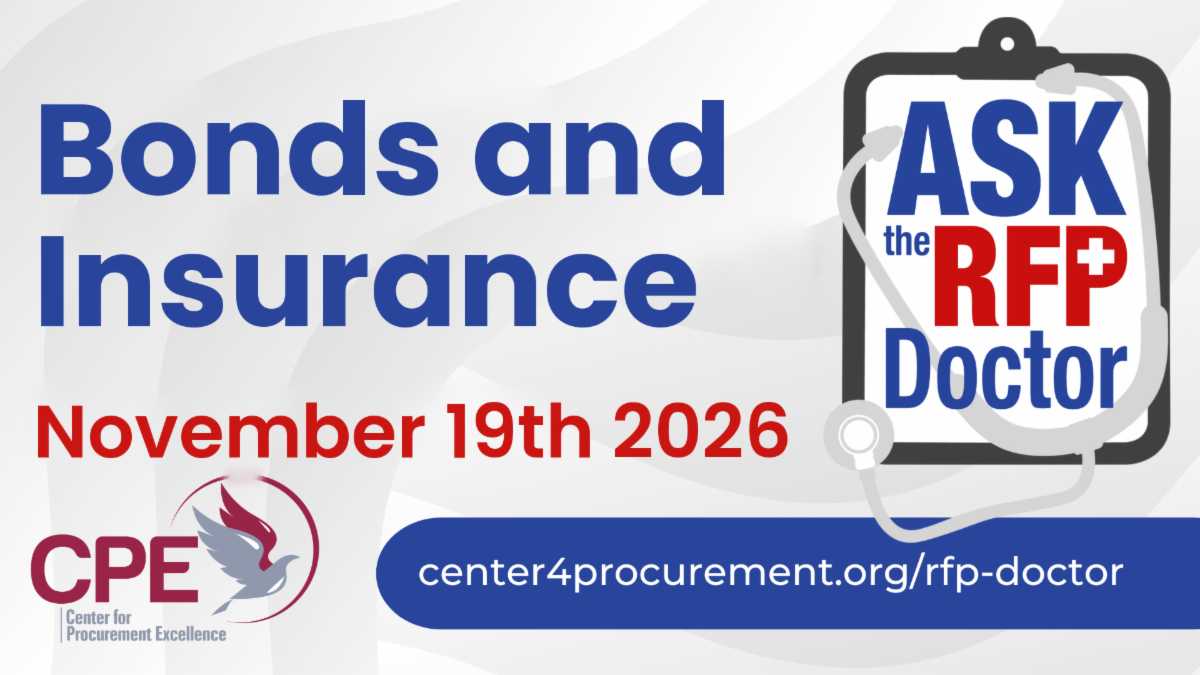
Ask the RFP Doctor® | November 19, 2026 | Noon CT
Your agency requires insurance and bonding to manage risk. But how do you know whether those requirements are reasonable—or whether they're costing you qualified bidders and driving up contract prices?
It's a question every procurement professional should be asking, and one we're putting front and center in this month's Ask the RFP Doctor® webinar.
Insurance and bonding requirements are familiar territory in public procurement. They're included in solicitations, reviewed by legal and risk management departments, and often carried forward from one RFP to the next with little discussion.
After all, if the requirements worked for the last procurement, why change them?
Because the cost of getting them wrong may be greater than you realize.
Every requirement has consequences. Insurance limits that exceed a project's actual exposure can increase vendor costs. Bonding requirements that are unnecessarily restrictive can discourage smaller firms, emerging businesses, and otherwise qualified contractors from competing.
And when fewer vendors compete, agencies may lose opportunities for better pricing, innovative solutions, and stronger project outcomes.
So where do you draw the line between responsible risk management and unnecessary barriers to competition?
On Thursday, November 19, at Noon CT, Ask the RFP Doctor® takes a closer look at the assumptions, practices, and real-world consequences behind bonding and insurance requirements.
During this free, one-hour webinar, we'll explore:
- The true cost of insurance requirements. How coverage limits affect vendor pricing and what agencies ultimately pay.
- Bonding requirements and vendor participation. When financial safeguards become obstacles for capable, qualified competitors.
- What other agencies are actually requiring. Survey findings that offer an opportunity to compare your organization's requirements with those of your peers.
- Matching requirements to real risk. Why higher limits don't automatically translate into better protection—and how to approach requirements more thoughtfully.
We'll also consider how procurement, legal, and risk management professionals can work together to develop requirements that are appropriate, defensible, and consistent with the goal of maintaining open competition.
The objective isn't less protection. It's smarter protection.
Public agencies have a responsibility to manage risk. They also have a responsibility to spend public funds wisely and provide qualified vendors with a fair opportunity to compete. Those goals shouldn't be at odds.
If you've ever wondered whether your agency's standard bonding and insurance provisions are truly necessary—or simply standard because nobody has questioned them—this discussion is for you.
Join us Thursday, November 19, at Noon CT for "Bonds and Insurance: Are You Asking for Too Much?"
Bring your questions for our live Q&A, and leave with a fresh perspective on whether your agency's requirements are protecting its interests—or unnecessarily limiting its options.
|