Public Policy Center | uaex.uada.edu/ballot

Facebook  Instagram  LinkedIn

December 2025

Supreme Court Empowers Legislature to Change Citizen Initiatives in Sessions

Arkansas legislators now have the authority to amend or repeal citizen-initiated constitutional amendments without asking voters for their approval. A November Arkansas Supreme Court opinion means ballot issues such as the 2024 amendment to expand the lottery scholarship program could have been enacted without a statewide election.


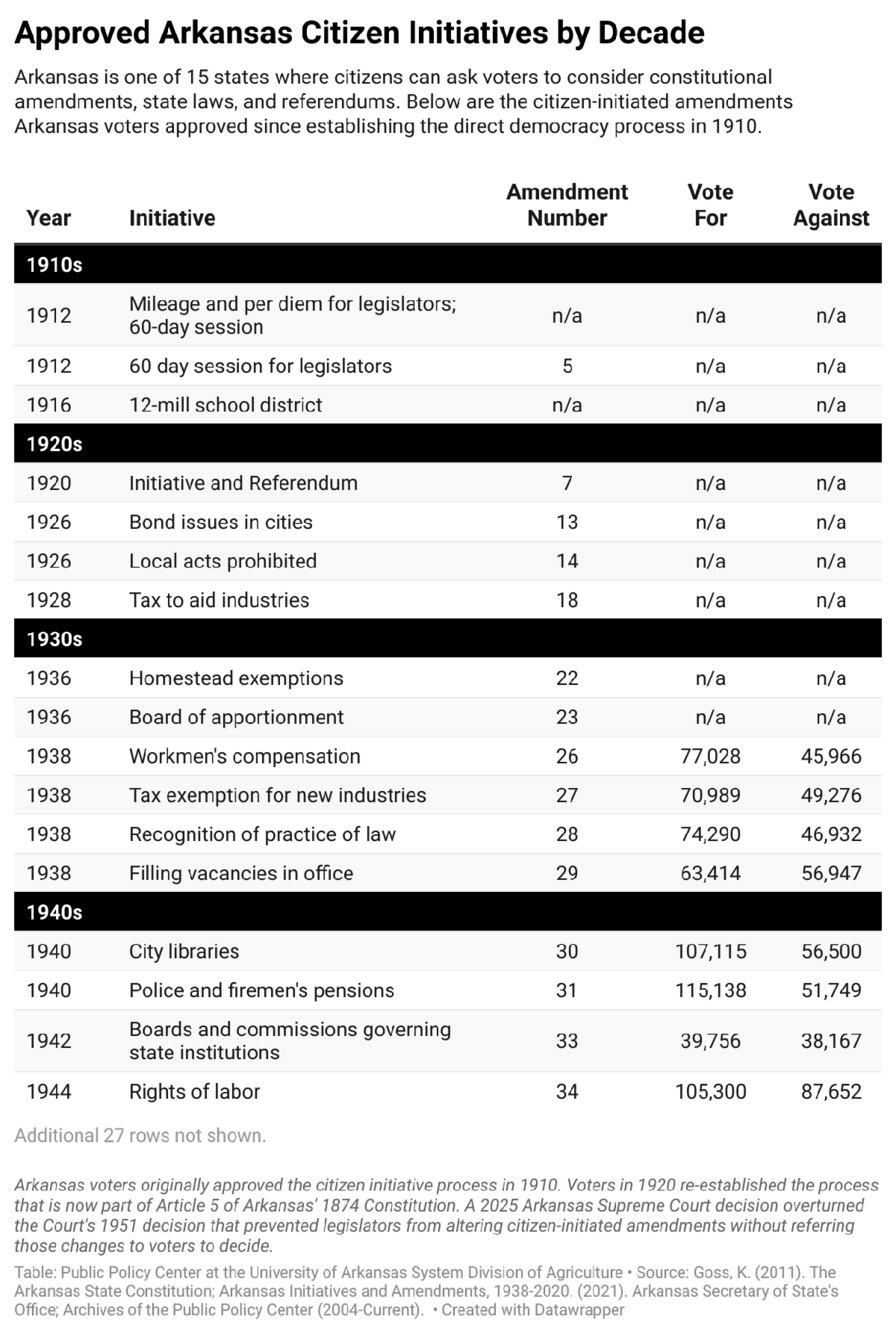
Arkansas voters have approved 37 citizen-initiated constitutional amendments since creating the state's direct democracy process in 1910, according to historical sources. For example, a citizen initiative granted greater policing authority and independent oversight to the Arkansas Game and Fish Commission and led to some independence for other boards and commissions under Amendment 33.


See our table below to scroll through those 37 initiatives.


A lawsuit involving rules for the Arkansas Game and Fish Commission resulted in a 1951 Arkansas Supreme Court opinion that state officials have followed for the past 74 years. The Court opinion at that time said it was "inconceivable" that Arkansans in 1920 meant to give legislators the ability to repeal or change constitutional amendments in the very amendment that allowed them to refer measures to voters.


"These amendments are spoken of as 'measures,' hence if the definition in Amendment and Repeal is applied throughout, then any and all of the more than forty amendments to the constitution can be repealed by the required vote of the legislature," the 1951 opinion states.


"The clear intent of the Initiative and Referendum Amendment was to give the people enlarged legislative and constitutional powers. Certainly if the purpose had been to take away fundamental security then enjoyed or to be acquired under the Amendment, the right of two-thirds of those elected to the General Assembly to treat amendments as though they had been referred to it would have been expressed in more emphatic terms," the court opinion states.


Arkansas Supreme Court justices of 2025 disagree.


"It is perfectly conceivable that the authors of said provision provided yet another opportunity for further diffusion of power that is emblematic of our system of checks and balances. While the wisdom of this particular grant might be questioned and while such authority may be perceived as inconvenient give one's perspective on the role and power of the legislative branch, such public policy arguments underlying these criticisms appropriately lie outside the scope of this court's prerogative. We remain steadfast in rejecting any effort to substitute our own judgment for that of the plain, unambiguous constitutional language, especially when that judgment has the effect of achieving a preferred public policy," the 2025 Court opinion states.


Direct Democracy Campaigns React

Ballot issue groups seeking to undo several recent laws changing the citizen initiative process said the Court's ruling shows the need for their proposals.


"To the voters - don't lose hope," said Bonnie Miller, president of the League of Women Voters of Arkansas, after the Dec. 11 ruling.


The league which along with several affiliates and ballot group Save AR Democracy are pursuing a 2026 constitutional amendment to clarify the petition process. They're wanting voters to consider a constitutional amendment that would among other things enact a deadline for challenging ballot titles, prevent lawmakers from changing the Arkansas Constitution, and requiring a statewide vote on any laws affecting the citizen initiative process.


Protect AR Rights, a coalition of seven Arkansas organizations, also has a measure seeking changes to the citizen initiative process.


"Our proposal states only the people - not politicians - can change a voter-approved amendment. We crafted this language intentionally. And today's decision to green-light additional legislative power grabs proves how essential protecting the will of the voters is," the organization stated on its Facebook page on Dec. 11.


Both groups are involved in a federal lawsuit against the state over the constitutionality of new canvasser laws, such as requiring voters to show canvassers their photo ID before signing a petition. The law and several others are currently on hold as the lawsuit makes it way through court. A federal appeals court on Dec. 15 declined to remove the temporary injunction.


Legislature Meets in April

State legislators convene as the General Assembly on April 8 for a fiscal session, itself the result of a legislatively referred constitutional amendment in 2008. Fiscal sessions occur in even-numbered years and is a time for legislators to consider budgetary issues and appropriation bills.


Non-appropriation bills can be considered if two-thirds of the House and Senate approve a resolution allowing their consideration. In 2022, legislators rejected attempts to introduce abortion bills during the fiscal session. For the 2026 session, non-appropriation bills can be filed for consideration between April 8 and April 22. The next regular session of the Arkansas General Assembly is in 2027.


Senate President Bart Hester and House Speaker Brian Evans told the Arkansas Democrat-Gazette there are no plans yet to make changes to the constitution before the 2027 session. Hester did express an interest in more changes to the medical marijuana amendment while Evans said he thought lawmakers would be careful about future constitutional changes.


"And most especially to anything that was initiated by the people, I think the House would be very cautious and very thorough and thoughtful when it came to anything that might come before us to make a change," he told the newspaper in a Dec. 13 article.


Status Update - Arkansas Ballot Issue Lawsuits

Name: League of Women Voters of Arkansas, Save AR Democracy, Bonnie Heather Miller and Danielle Quesnell vs. Secretary of State Cole Jester (5:25-cv-05087)


Intervening Plaintiffs: Protect AR Rights and For AR Kids


Date Filed: April 21, 2025


Court: Judge Timothy L. Brooks, U.S. District Court for the Western District of Arkansas in Fayetteville


Complaint: The lawsuit challenges Act 218, Act 240, Act 241 and Act 274 of 2025. The complaint also lists specific state laws, including § 7-9-601, § 7-9-103(a)(6), § 7-9-126(4), and § 7-9-113(a)(2)(A). Intervenors are also challenging: Act 602 of 2025, § 7-9-126(e), and § 7-9-601(a)(2)(C).


Status: The Eighth Circuit Court of Appeals on Dec. 15 declined to remove a temporary injunction put in place on Nov. 19 by Judge Timothy Brooks. Arkansas Attorney General Tim Griffin had appealed Brooks' decision. He has also asked Brooks to reconsider. The laws on hold include the requirement for voters to show their photo IDs to canvassers before signing a petition, a requirement for voters to read the ballot title or have it read to them, and for canvassers to tell signers that petition fraud is a crime.


Note: The federal court system uses an online record system that is behind a paywall. Some lawsuit documents that have already been "purchased" are publicly available at https://www.courtlistener.com/docket/69919853/league-of-women-voters-of-arkansas-v-jester/.

Name: Bryan King and The League of Women Voters of Arkansas vs. Secretary of State John Thurston (presumably now Cole Jester) (60CV-23-1816)


Date Filed: March 10, 2023


Court: Circuit Court Judge Shawn Johnson, Pulaski County Circuit Court


Complaint: The lawsuit challenges Act 236 of 2023, which increased the number of counties that citizens needed to collect voter signatures from to qualify constitutional amendments and state laws for the statewide ballotfrom 15 counties to 50 counties.


Status: On Nov. 5, attorney David Couch submitted a letter to the court along with an Arkansas Supreme Court opinion and a law journal article to support the League of Women Voters of Arkansas' argument that the law is unconstitutional. Judge Johnson held a court hearing on Sept. 3. No decision has been filed with the court yet. Johnson inherited the two-year-old lawsuit after the original judge changed elected office.


Note: Sen. King is no longer a party to the lawsuit as his role was dismissed, but his name remains on the case.

Name: State of Arkansas vs. Good Day Farm (CV-24-704)


Date Filed: Oct. 21, 2024


Court: Arkansas Supreme Court


Complaint: The state appealed a Pulaski County Circuit Court judge's 2023 decision that Arkansas legislators did not have the authority to make changes to the medical marijuana amendment voters approved in 2016. Good Day Farm and Capital City successfully argued that legislators were required to ask voters through the statewide ballot to make changes to Amendment 98. Amendment 98 allowed legislators to make limited changes without voter approval but the two licensed marijuana businesses said the legislature went beyond their scope. The legislature has made 28 changes to the medical marijuana amendment since 2016.


Status: On Dec. 11, the Arkansas Supreme Court ruled in favor for the state. The Court overturned a 1951 opinion preventing legislators from making changes to amendments without another vote of the people and determined there was an error in language of the Medical Marijuana Amendment of 2016 regarding what sections legislators were permitted to amend.

On the 2026 Ballot - From the Legislature

Arkansas legislature

Arkansas voters will see three proposed constitutional amendments from the legislature on their November 2026 statewide ballot along with one bond issue question. The Arkansas Secretary of State will assign ballot issue numbers to the three amendments in 2026.


HJR1018 - The Citizens Only Voting Amendment


SJR11 - A Constitutional Amendment to amend Arkansas Constitution, Article 2, § 5, to protect the right to keep and bear arms.


SJR15 - A Constitutional Amendment concerning economic development in the state of Arkansas; and authorizing the General Assembly to provide for the creation of economic development districts to promote economic development.


Question 1 - Arkansas Water, Waste Disposal, and Pollution Abatement Facilities Financing Act of 2025

Citizen Proposals for the 2026 Ballot

A man sitting in a truck signs a petition while the canvasser stands next to the truck window.

Arkansas is one of 15 states where citizens have the right to put constitutional amendments, state laws and referendums on the ballot for voters to decide. It is the only state in the south with this robust form of direct democracy.


The citizen initiative process involves filing a ballot title with the Attorney General's Office, collecting voter signatures across the state and submitting the petitions to the Secretary of State's Office for verification.


Referendums require voter signatures equaling 6% of the number of people who voted in the last governor's election. State laws require 8%, and constitutional amendments require 10%


Attorney General Opinions

The Attorney General is responsible for reviewing the language and titles of potential ballot issues submitted to voters by the public. Ballot issue groups can circulate petitions only after the Attorney General verifies that the ballot title and popular name honestly, intelligibly and fairly describe the purpose of a proposed constitutional amendment or act, and that the wording of ballot titles scores at an eighth grade reading level on the Flesch-Kincaid test.


Find the full list: Tracking Arkansas 2026 Ballot Issues


Ballot Proposals Rejected


No ballot titles have been rejected since the November newsletter.


Ballot Proposals Approved for Signature Gathering


July 28, 2025 - The Arkansas Ballot Measure Rights Amendment

A proposed constitutional amendment regarding changes to the citizen initiative process was approved for signature gathering, according to Opinion No 2025-056. Jennifer Waymack Standerfer with Protect AR Rights submitted the proposed amendment.


May 21, 2025 - An Amendment Concerning Constitutional Amendments, Initiated Acts, and Referendums

A proposed constitutional amendment regarding changes to the citizen initiative process was approved for signature gathering, according to Opinion No. 2025-033. David Couch of Little Rock submitted the proposed amendment. 


Feb. 26, 2025 - The Arkansas Educational Rights Amendment of 2026

A proposal to require identical academic and accreditation standards for schools receiving state or local funds was approved for signature gathering, according to Opinion No. 2025-016. April Reisma and Kwami Abdul-Bey of Little Rock submitted the proposed amendment. Note: This proposal is identical to the ballot title approved Sept. 19, 2024.


July 18, 2024 - The Arkansas Government Disclosure Amendment of 2026

A proposal establishing government's obligation to share and deliver information to citizens as a right was approved for signature gathering, according to Opinion No. 2024-070. Robert Steinbuch submitted the proposed amendment.


July 18, 2024 - An Act to Exempt Feminine Hygiene Products and Diapers from Sales and Use Tax

A proposal to exempt period products and diapers from local and state sales tax was approved, according to Opinion No. 2024-068. David Couch of Little Rock submitted the proposed law.

Arkansas Volunteer Canvasser Guide Available

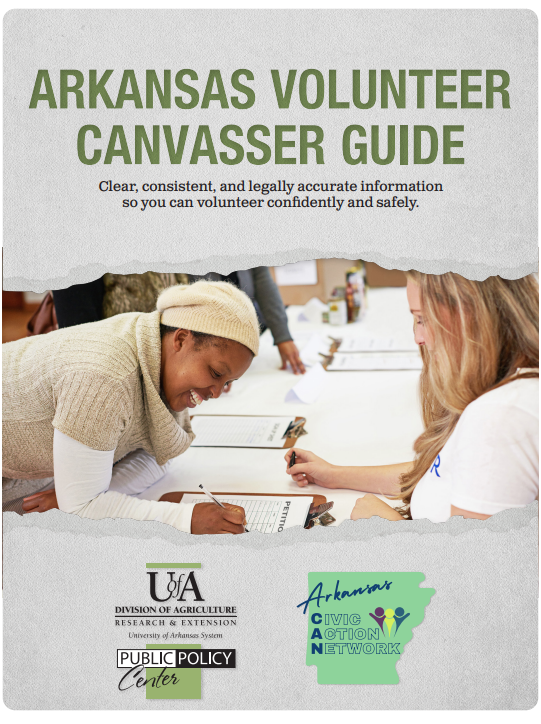
Volunteer canvassers have access to a new guide discussing the ins and outs of the signature collecting process in Arkansas


The Public Policy Center partnered with Arkansas Civic Action Network to produce the guide, which can be used in training sessions for volunteer canvassers.


The guide includes helpful tips and information about new state laws so volunteers can better navigate the signature collection process.


Download the Guide from the Public Policy Center.

County Government 101 Course Now Online

Want to learn more about the roles and responsibilities of elected county officials? Sign up for Introduction to County Government in Arkansas, a free online course offered by the University of Arkansas System Division of Agriculture.


This self-guided course includes four sections.


  • An overview of county government
  • Mandated and non-mandated services
  • Roles and responsibilities of elected county officials
  • How counties are funded


Create a free account at https://learn.uada.edu.

New On Our Blog

The Public Policy Center is part of the Community, Professional and Economic Development unit at the Arkansas Cooperative Extension Service in Little Rock. As the blog's editor, we wanted to share recent publications.


We use #ARballot on Social Media

Voter Education Resources


State Ballot Issues

Access Our Information

Learn About Arkansas Process


Voter Resources

Link to Arkansas Election Resources & Handouts


Local Ballot Issues

Access Local Election

Fact Sheets


Blog

Read our department blog at Strengthening Arkansas Communities


Ballot Issue Tracker

Links to AG Opinions for 2026 ballot

Approved & Rejected Ballot Titles

Archive

Research past Arkansas ballot issues in our Archive


Did someone share this email with you? 

Subscribe to find Arkansas Ballot Issues News & Notes in your inbox every month.


The Public Policy Center was established in 2004 to provide Arkansans with timely, credible, unaligned and research-based information and education about public issues. Public issues are defined as pressing and emerging issues that involve multiple points of view and have widespread consequences.


Our goals are to:

  • Increase citizen knowledge, awareness and understanding of public issues;
  • Enhance public participation in decisions regarding public issues, and
  • Help citizens craft, evaluate and implement alternative solutions to public issues.


We are part of the Community, Professional and Economic Development unit at the University of Arkansas System Division of Agriculture, Cooperative Extension Service in Little Rock.


News & Notes Volume 12, Issue 12. This e-mail newsletter is shared with Cooperative Extension Service agents, subscribers from the general public and election officials or educators identified by the Public Policy Center. To unsubscribe, click below on "instant removal with SafeUnsubscribe."


Pursuant to 7 CFR § 15.3, the University of Arkansas System Division of Agriculture offers all its Extension and Research programs and services (including employment) without regard to race, color, sex, national origin, religion, age, disability, marital or veteran status, genetic information, sexual preference, pregnancy or any other legally protected status, and is an equal opportunity institution.