Public Policy Center | uaex.uada.edu/ballot

 
Facebook  Instagram  LinkedIn
 

September 2025

Group Forms to Support Legislature's Economic Development Amendment


Legislative sponsors of a November 2026 constitutional amendment focused on creating economic development districts in Arkansas have joined forces with state chamber, banking and real estate professionals to form an official legislative question committee responsible for convincing voters to pass SJR15 next year.


Arkansans for Strong Communities registered with the Arkansas Ethics Commission in July. As of Sept. 5, 2025, the group reported raising $40,713 to support the amendment's passage. The committee's filing refers to the proposed amendment as Issue 3.


Arkansans for Strong Communities is made up of:

  • Randy Zook, director of the Arkansas State Chamber of Commerce
  • Brad Hegeman, vice chairman and chief strategy officer at Nabholz Construction
  • Kenneth Hall, executive vice president of the Arkansas State Chamber of Commerce
  • Cliff McKinney II, a real estate attorney for Quattlebaum, Grooms & Tull
  • Sen. Jonathan Dismang, who sponsored SJR15 and has a background in real estate finance
  • Rep. Howard Beaty, the House sponsor of SJR15, who has a background in banking and economic development


The committee itself does not currently have a website or social media presence.


As soon as a group raises or spends $500, they are required to file committee paperwork with the Arkansas Ethics Commission. Arkansans for Strong Communities is the only group registered so far that is affiliated with the three proposed constitutional amendments from the legislature.


Read SJR15.


See further below in the newsletter for links to the other two proposed constitutional amendments and a bond question on the 2026 ballot.


How to Find Committee Paperwork

The Arkansas Ethics Commission lists the names of groups that filed with the office. Click on the "New Ballot and Legislative Question Committees" tab to see the list.


On a separate part of the website, the commission posts PDFs of the financial paperwork filed by those groups. Click on the "LO-BQC, BQC, and LQC Filings" tab to search for committees.


You can search by statewide amendments, local, or local-option. Local option typically involves campaigns related to alcohol sales, but more recently the section has also included committees supporting or opposing local ballot issues.

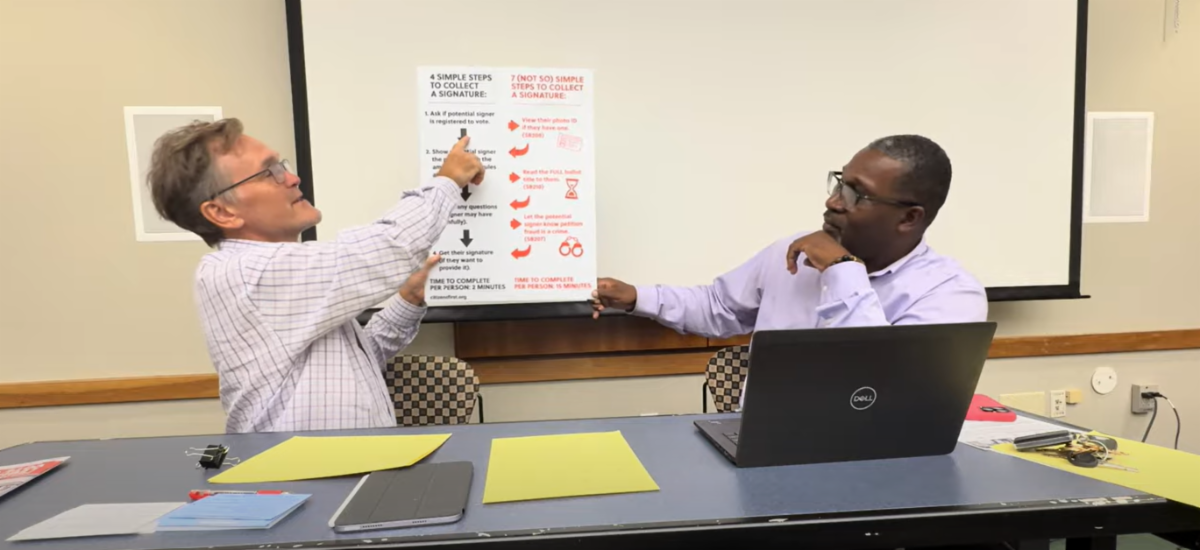
Two men sit at a table. One man holds and points at a poster. The other man has a laptop before him on the table.

Ballot Issue Sponsors Host Town Halls Across State


Representatives of two ballot issue committees are hosting town halls across Arkansas to explain to voters the citizen initiative process, legal challenges to recent state laws, and background on two proposed constitutional amendments they'd like to put before voters in 2026.


Bill Kopsky of the Arkansas Public Policy Panel joined Barry Jefferson, president of the Arkansas State NAACP, on Sept. 23 in Fort Smith for the second town hall meeting.


Kopsky and Jefferson are part of the campaigns behind The Arkansas Educational Rights Amendment of 2026, sponsored by For AR Kids, and The Arkansas Ballot Measure Rights Amendment, sponsored by Protect AR Rights. A previous town hall took place in Little Rock and representatives also provided an update via a webinar.


According to the For AR Kids Facebook page, town halls are also planned for 6 p.m., Oct. 14 in Conway and Nov. 4 in Clinton.


Campaigns must collect at least 90,704 signatures from voters in at least 50 counties to qualify constitutional amendments for the statewide ballot.

Status Update - Arkansas Ballot Issue Lawsuits

Name: League of Women Voters of Arkansas, Save AR Democracy, Bonnie Heather Miller and Danielle Quesnell vs. Secretary of State Cole Jester (5:25-cv-05087)


Intervening Plaintiffs: Protect AR Rights and For AR Kids


Date Filed: April 21, 2025


Court: Judge Timothy L. Brooks, U.S. District Court for the Western District of Arkansas in Fayetteville


Complaint: The lawsuit challenges Act 218, Act 240, Act 241 and Act 274 of 2025. The complaint also lists specific state laws, including § 7-9-601, § 7-9-103(a)(6), § 7-9-126(4), and § 7-9-113(a)(2)(A). Intervenors are also challenging: Act 602 of 2025, § 7-9-126(e), and § 7-9-601(a)(2)(C).


Status: The Attorney General's Office on Sept. 22 asked Judge Brooks to dismiss the complaints of Protect AR Rights and For AR Kids, who are intervening to join the lawsuit. The first hearing in this case is set for 9:30 a.m. on Sept. 30 in the federal courthouse in Fayetteville.


Note: The federal court system uses an online record system that is behind a paywall. Some lawsuit documents that have already been "purchased" are publicly available at https://www.courtlistener.com/docket/69919853/league-of-women-voters-of-arkansas-v-jester/.

Name: Bryan King and The League of Women Voters of Arkansas vs. Secretary of State John Thurston (presumably now Cole Jester) (60CV-23-1816)


Date Filed: March 10, 2023


Court: Circuit Court Judge Shawn Johnson, Pulaski County Circuit Court


Complaint: The lawsuit challenges Act 236 of 2023, which increased the number of counties that citizens needed to collect voter signatures from to qualify constitutional amendments and state laws for the statewide ballot—from 15 counties to 50 counties.


Status: Judge Johnson held a court hearing on Sept. 3. No decision has been filed with the court yet. Johnson inherited the two-year-old lawsuit after the original judge changed elected office.


Note: Sen. King is no longer a party to the lawsuit as his role was dismissed, but his name remains on the case.

Name: State of Arkansas vs. Good Day Farm (CV-24-704)


Date Filed: Oct. 21, 2024


Court: Arkansas Supreme Court


Complaint: The state appealed a Pulaski County Circuit Court judge's 2023 decision that Arkansas legislators did not have the authority to make changes to the constitutional amendment voters approved in 2016 that allowed medical marijuana sales and possession in Arkansas. Good Day Farm and Capital City successfully argued that legislators were required to ask voters through the statewide ballot to make changes to Amendment 98. They based their claim on a 1951 Arkansas Supreme Court decision that said it was "inconceivable" that Arkansans meant to give legislators the ability to repeal or change constitutional amendments in the very amendment that allowed citizens to refer measures to the voters to decide. Amendment 98 allowed legislators to make limited changes without voter approval but the two licensed marijuana businesses said the legislature went beyond that scope. The legislature has made 28 changes to the medical marijuana amendment since 2016.


Status: On Sept. 3, the governor appointed Don Curdie as a special judge to replace Judge Nicholas J. Bronni, who recused himself from the lawsuit.

On the 2026 Ballot - From the Legislature

Arkansas legislature

Arkansas voters will see three proposed constitutional amendments from the legislature on their November 2026 statewide ballot along with one bond issue question. The Arkansas Secretary of State will assign ballot issue numbers to the three amendments in 2026.


HJR1018 - The Citizens Only Voting Amendment


SJR11 - A Constitutional Amendment to amend Arkansas Constitution, Article 2, § 5, to protect the right to keep and bear arms.


SJR15 - A Constitutional Amendment concerning economic development in the state of Arkansas; and authorizing the General Assembly to provide for the creation of economic development districts to promote economic development.


Question 1 - Arkansas Water, Waste Disposal, and Pollution Abatement Facilities Financing Act of 2025

Citizen Proposals for the 2026 Ballot

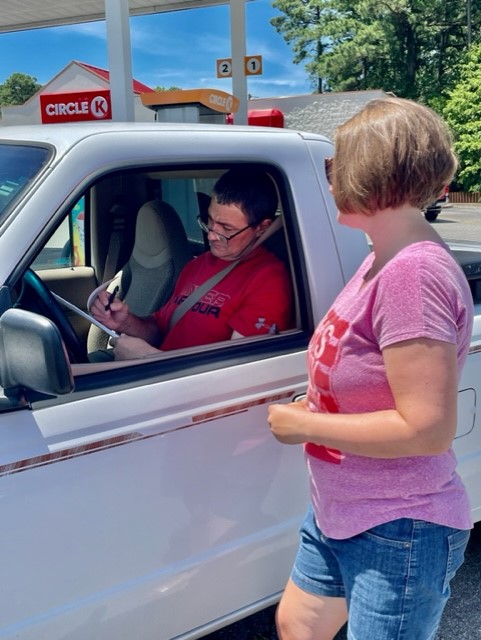
A man sitting in a truck signs a petition while the canvasser stands next to the truck window.

Arkansas is one of 15 states where citizens have the right to put constitutional amendments, state laws and referendums on the ballot for voters to decide.


The citizen initiative process involves filing a ballot title with the Attorney General's Office, collecting voter signatures across the state and submitting the petitions to the Secretary of State's Office for verification.


Referendums require voter signatures equaling 6% of the number of people who voted in the last governor's election. State laws require 8%, and constitutional amendments require 10%


Attorney General Opinions

The Attorney General is responsible for reviewing the language and titles of potential ballot issues submitted to voters by the public. Ballot issue groups can circulate petitions only after the Attorney General verifies that the ballot title and popular name honestly, intelligibly and fairly describe the purpose of a proposed constitutional amendment or act, and that the wording of ballot titles scores at an eighth grade reading level on the Flesch-Kincaid test.


Find the full list: Tracking Arkansas 2026 Ballot Issues


Ballot Proposals Rejected

No new proposals have been rejected since the August newsletter.


Ballot Proposals Approved for Signature Gathering


July 28, 2025 - The Arkansas Ballot Measure Rights Amendment A proposed constitutional amendment regarding changes to the citizen initiative process was approved for signature gathering, according to Opinion No 2025-056. Jennifer Waymack Standerfer with Protect AR Rights submitted the proposed amendment.


May 21, 2025 - An Amendment Concerning Constitutional Amendments, Initiated Acts, and Referendums

A proposed constitutional amendment regarding changes to the citizen initiative process was approved for signature gathering, according to Opinion No. 2025-033. David Couch of Little Rock submitted the proposed amendment. 


Feb. 26, 2025 - The Arkansas Educational Rights Amendment of 2026

A proposal to require identical academic and accreditation standards for schools receiving state or local funds was approved for signature gathering, according to Opinion No. 2025-016. April Reisma and Kwami Abdul-Bey of Little Rock submitted the proposed amendment. Note: This proposal is identical to the ballot title approved Sept. 19, 2024.


July 18, 2024 - The Arkansas Government Disclosure Amendment of 2026

A proposal establishing government's obligation to share and deliver information to citizens as a right was approved for signature gathering, according to Opinion No. 2024-070. Robert Steinbuch submitted the proposed amendment.


July 18, 2024 - An Act to Exempt Feminine Hygiene Products and Diapers from Sales and Use Tax

A proposal to exempt period products and diapers from local and state sales tax was approved, according to Opinion No. 2024-068. David Couch of Little Rock submitted the proposed law.

PPC and Extension Receive National Awards

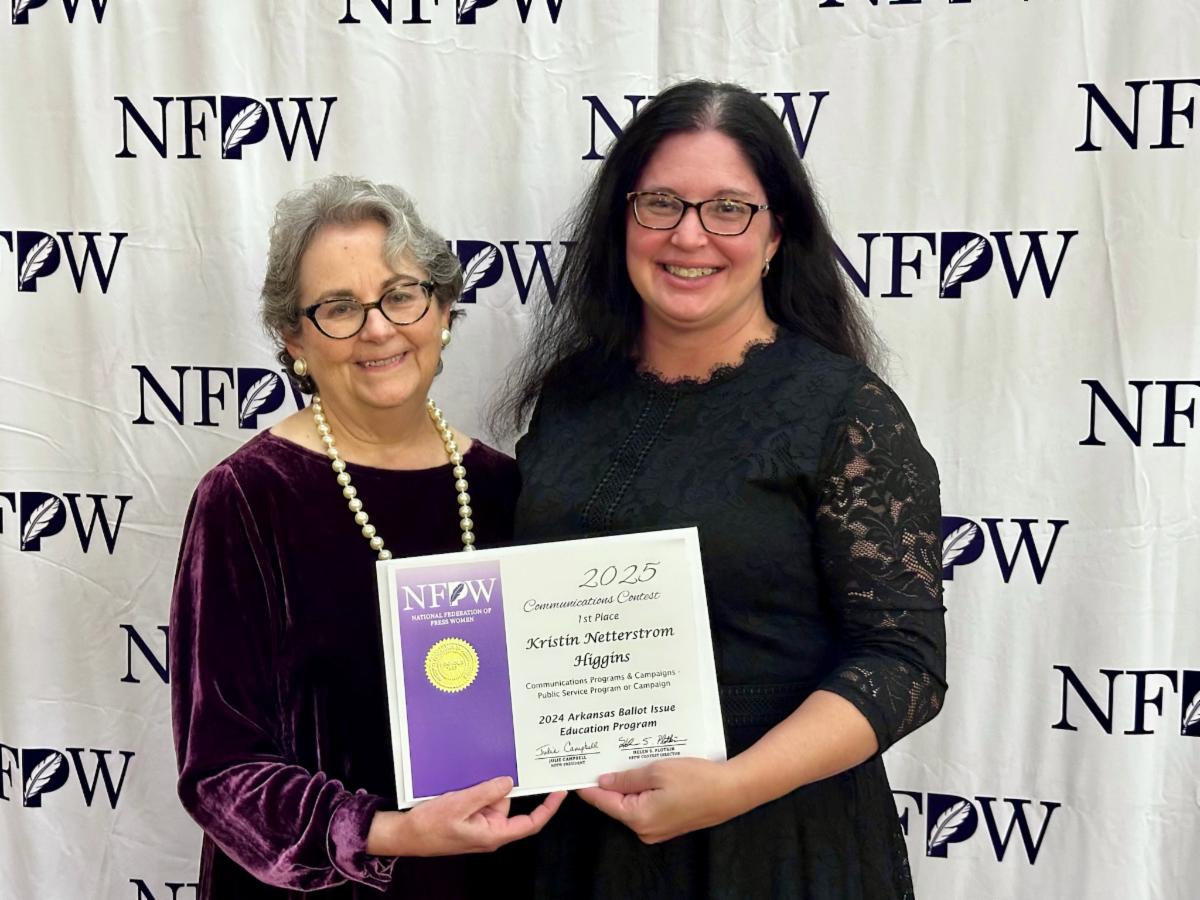
Two women stand next to each other with woman woman holding an award certificate.

The National Federation of Press Women recognized the Public Policy Center's Kristin Netterstrom Higgins as Arkansas Press Women's Communicator of Achievement at its September 2025 conference in Golden, Colorado.


Netterstrom Higgins also won first place for her 2024 Arkansas Ballot Issue Education Program, which was entered in the public service program or campaign. Co-entrants included graphic designers Julie Thompson and Chris Meux and videographer Kerry Rodtnick.


Read Press Release

PPC In the Community


Several Arkansas communities will have elections Nov. 18. We're building a list of local election issues to publish next month.


Let us know if your community is having an election next month by emailing us at: publicpolicycenter@uada.edu.


We are working on a fact sheet for elections in Clark, Franklin and Marion counties that will be on our website before early voting begins.

2025 Arkansas Agricultural Profile

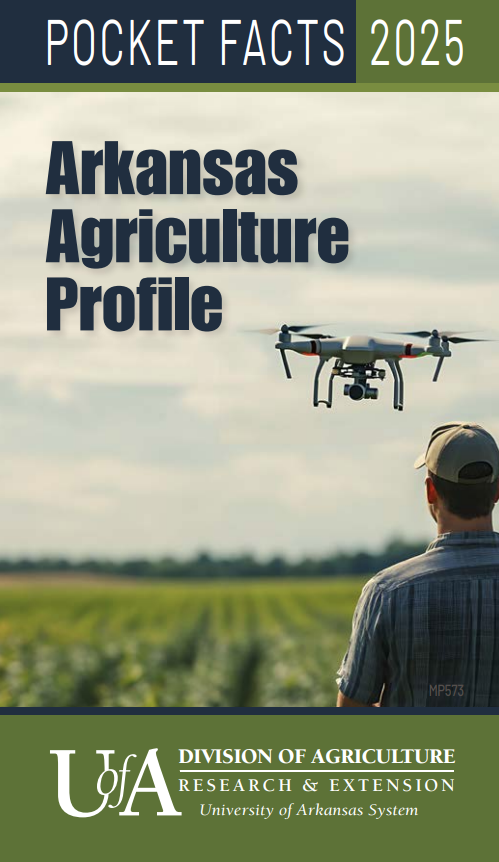
Pocket Facts 2025 Arkansas Agriculture

With over 37,200 farms spread across 13.6 million acres, agriculture remains a cornerstone of Arkansas' identity and prosperity.


Our colleagues in the Community, Professional and Economic Development unit recently published the 2025 Arkansas Agriculture Profile pocket guide.


Dive in to explore:


• Top commodities and production stats

• Land use and farm demographics

• Organic growth trends

• Arkansas’ national rankings in ag production


Get the Pocket Guide


New On Our Blog

The Public Policy Center is part of the Community, Professional and Economic Development unit at the Arkansas Cooperative Extension Service in Little Rock. As the blog's editor, we wanted to share recent publications.


We use #ARballot on Social Media


Voter Education Resources


State Ballot Issues

Access Our Information

Learn About Arkansas Process


Voter Resources

Link to Arkansas Election Resources & Handouts


Local Ballot Issues

Access Local Election

Fact Sheets


Blog

Read our department blog at Strengthening Arkansas Communities


Ballot Issue Tracker

Links to AG Opinions for 2026 ballot

Approved & Rejected Ballot Titles

Archive

Research past Arkansas ballot issues in our Archive


Did someone share this email with you? 

Subscribe to find Arkansas Ballot Issues News & Notes in your inbox every month.


The Public Policy Center was established in 2004 to provide Arkansans with timely, credible, unaligned and research-based information and education about public issues. Public issues are defined as pressing and emerging issues that involve multiple points of view and have widespread consequences.


Our goals are to:

  • Increase citizen knowledge, awareness and understanding of public issues;
  • Enhance public participation in decisions regarding public issues, and
  • Help citizens craft, evaluate and implement alternative solutions to public issues.


We are part of the Community, Professional and Economic Development unit at the University of Arkansas System Division of Agriculture, Cooperative Extension Service in Little Rock.


News & Notes Volume 12, Issue 9. This e-mail newsletter is shared with Cooperative Extension Service agents, subscribers from the general public and election officials or educators identified by the Public Policy Center. To unsubscribe, click below on "instant removal with SafeUnsubscribe."


Pursuant to 7 CFR § 15.3, the University of Arkansas System Division of Agriculture offers all its Extension and Research programs and services (including employment) without regard to race, color, sex, national origin, religion, age, disability, marital or veteran status, genetic information, sexual preference, pregnancy or any other legally protected status, and is an equal opportunity institution.