Public Policy Center | uaex.uada.edu/ballot

 
Facebook  Instagram  LinkedIn
 

February 2026

Judge Rules in Favor of 15-County

Requirement for Gathering Voter Signatures

For the past three years, the League of Women Voters of Arkansas has been waiting on a judge to decide whether it was legal for state legislators to bump up the number of counties where they had to collect voter signatures on citizen-initiated petitions.


An election cycle and entirely new judge later, a February 2026 ruling upheld their argument that Act 236 of 2023 unconstitutionally increased the minimum number of counties from 15 to 50.


"While the enactments of the Arkansas General Assembly—a body of distinguished public servants charged with setting the policy of the State of Arkansas—are presumed constitutional, we cannot under any set of facts find Act 236 of 2023 to survive constitutional scrutiny. In faithful adherence to the precedents of our appellate courts, this measure impermissibly restricts the right of the people to petition for initiated acts—a reserved power expressly guaranteed by the Arkansas Constitution," Pulaski County Circuit Court Judge Shawn Johnson wrote in his opinion released Feb. 12.


Johnson inherited the lawsuit after the original judge changed elected office and held a new hearing of his own. The Arkansas Constitution says citizen initiative groups must collect voter signatures from "at least" 15 counties of the state.


"The phrase “at least” is defined by the Cambridge Dictionary to mean “as much as, or more than, a number or amount.” Other sources have defined the term as “the number or amount [that] is the smallest that is possible or likely and that the actual number or amount may be greater," or “at the minimum," the judge's opinion states. Act 236 differs from the state constitution, he concluded.


Despite what they consider good news from the Circuit Court, the League of Women Voters of Arkansas expects to try for as many signatures from as many counties as possible for their proposed 2026 constitutional amendment, said David Couch, the attorney who filed the lawsuit and who is now a board director for the League.


The League of Women Voters of Arkansas is sponsoring one of two circulating proposals for the November 2026 ballot to change the Arkansas Constitution so that voters must approve any changes to the ballot issue process. The Arkansas Ballot Measure Rights Amendment also specifies the role of the Attorney General, Supreme Court and Secretary of State in certifying, reviewing and publishing citizen initiated ballot measures.


"Depending on how fast it gets appealed, I don’t know if the Supreme Court would decide it by July 3. On July 3 you have to turn in signatures from either 15 or 50 counties of course were going to go ahead and still try to collect from 50 counties because the Supreme Court has not decided the case," Couch said.


A spokesperson for the Attorney General's office told news media after the ruling the state would appeal the circuit court decision. Court records as of Feb. 24 do not show an appeal filed.


Last month we shared that signatures would be due July 6 because all state offices are closed Friday, July 3 in celebration of July 4. However, Couch said he was told that the Secretary of State's Office would be open July 3 to receive the signatures instead of the deadline falling to the next business day, Monday, July 6. An email and phone call to the election director at the Secretary of State's Office seeking clarification were not returned. The Secretary of State's Office Initiative and Referenda Handbook lists July 3 as the signature deadline.


Canvassers for two other potential citizen initiatives will also continue to collect signatures in as many counties as possible because of the plans for an appeal.


"We do understand that this is a circuit court decision that has the potential of being appealed so right now we are going to stick with the 50 county until an appellate court and possibly the Supreme Court weighs in. We just want to be safe and [are] not having to go back and forth and back and forth," said Kwami Abdul-Bey, campaign manager for the Arkansas Educational Rights Amendment of 2026 and The Arkansas Ballot Measure Rights Amendment


Abdul-Bey said they are also waiting to hear from the state whether their proposed amendments would carry with them fiscal impact statements if they made the ballot. Act 457 of 2025 requires fiscal impact statements for legislatively-referred or citizen-initiated proposals that would increase the cost of state government.


The group is also waiting to hear back from the Secretary of State's Office about a new petition fraud investigator who approached canvassers in Little Rock earlier this month. The investigator asked the canvassers for their identification and took a photo of the IDs, according to media reports. Abdul-Bey said he sent an email to Secretary of State election officials asking for more information but never received a reply. He's since filed a Freedom of Information Act request seeking information about the position and the investigator's statutory authority.

Roles and Responsibilities of Elected County Positions

Looking at your sample ballot for March 3 and not sure what some of those offices on the ballot are?


We have several online resources to help, including a dedicated website explaining county administrative, legislative and legal roles. Read more at https://uaex.uada.edu/business-communities/voter-education/local-offices.aspx.


We also published individual blog posts on these elected roles:


Want to learn more about the roles and responsibilities of elected county officials? Sign up for Introduction to County Government in Arkansas, a free online course offered by the University of Arkansas System Division of Agriculture.


This self-guided course includes four sections:


  • An overview of county government
  • Mandated and non-mandated services
  • Roles and responsibilities of elected county officials
  • How counties are funded


Create a free account at https://learn.uada.edu.


Status Update - Arkansas Ballot Issue Lawsuits

Name: League of Women Voters of Arkansas, Save AR Democracy, Bonnie Heather Miller and Danielle Quesnell vs. Secretary of State Cole Jester (5:25-cv-05087)


Intervening Plaintiffs: Protect AR Rights and For AR Kids


Date Filed: April 21, 2025


Court: Judge Timothy L. Brooks, U.S. District Court for the Western District of Arkansas in Fayetteville


Complaint: The lawsuit challenges Act 218, Act 240, Act 241 and Act 274 of 2025. The complaint also lists specific state laws, including § 7-9-601, § 7-9-103(a)(6), § 7-9-126(4), and § 7-9-113(a)(2)(A). Intervenors are also challenging: Act 602 of 2025, § 7-9-126(e), and § 7-9-601(a)(2)(C).


Status: Plaintiffs recently filed an amended complaint to add two more people to the lawsuit: Lee Evans and Amy Cruz, who are prevented under new laws from collecting voter signatures because of criminal convictions from more than 20 years ago. State attorneys object to adding them to the lawsuit. Judge Brooks has not ruled on the request and filed paperwork that says he will hold a bench trial during his scheduled two weeks for trials starting July 20. This means Brooks will meet with attorneys to hear their full legal arguments at some point over those two weeks. He said he will set a specific court date closer to July.


Note: The federal court system uses an online record system that is behind a paywall. Some lawsuit documents that have already been "purchased" are publicly available at https://www.courtlistener.com/docket/69919853/league-of-women-voters-of-arkansas-v-jester/.

Name: Bryan King and The League of Women Voters of Arkansas vs. Secretary of State John Thurston (presumably now Cole Jester) (60CV-23-1816)


Date Filed: March 10, 2023


Court: Circuit Court Judge Shawn Johnson, Pulaski County Circuit Court


Complaint: The lawsuit challenges Act 236 of 2023, which increased the number of counties that citizens needed to collect voter signatures from to qualify constitutional amendments and state laws for the statewide ballot—from 15 counties to 50 counties.


Status: On Feb. 12, Johnson ruled the law unconstitutional and disagreed that the state should have sovereign immunity, which would have prevented the legal challenge.


Note: Sen. King is no longer a party to the lawsuit as his role was dismissed, but his name remains on the case.

On the 2026 Ballot - From the Legislature

Arkansas legislature

Arkansas voters will see three proposed constitutional amendments from the legislature on their November statewide ballot along with one bond issue question. The Arkansas Secretary of State will assign ballot issue numbers to the three amendments later this year.


HJR1018 - The Citizens Only Voting Amendment


SJR11 - A Constitutional Amendment to amend Arkansas Constitution, Article 2, § 5, to protect the right to keep and bear arms.


SJR15 - A Constitutional Amendment concerning economic development in the state of Arkansas; and authorizing the General Assembly to provide for the creation of economic development districts to promote economic development.


Question 1 - Arkansas Water, Waste Disposal, and Pollution Abatement Facilities Financing Act of 2025


Download our new handout

Citizen Proposals for the 2026 Ballot

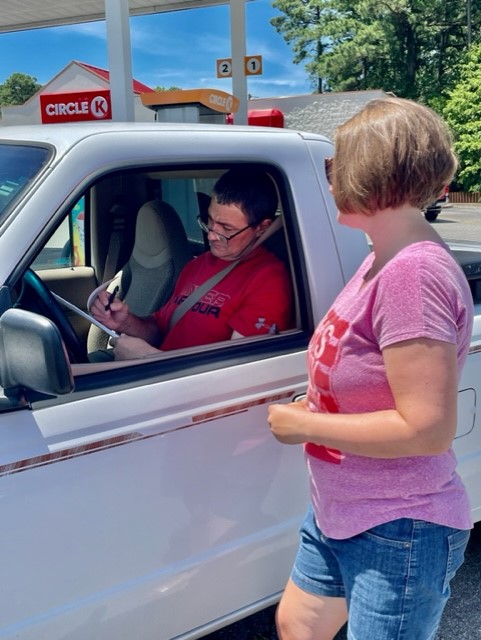
A man sitting in a truck signs a petition while the canvasser stands next to the truck window.

Arkansas is one of 15 states where citizens have the right to put constitutional amendments, state laws and referendums on the ballot for voters to decide. It is the only state in the south with this robust form of direct democracy.


The citizen initiative process involves filing a ballot title with the Attorney General's Office, collecting voter signatures across the state and submitting the petitions to the Secretary of State's Office for verification.


Referendums require voter signatures equaling 6% of the number of people who voted in the last governor's election. State laws require 8%, and constitutional amendments require 10%


Attorney General Opinions

The Attorney General is responsible for reviewing the language and titles of potential ballot issues submitted to voters by the public. Ballot issue groups can circulate petitions only after the Attorney General verifies that the ballot title and popular name honestly, intelligibly and fairly describe the purpose of a proposed constitutional amendment or act, and that the wording of ballot titles scores at an eighth grade reading level on the Flesch-Kincaid test.


Find the full list: Tracking Arkansas 2026 Ballot Issues


Ballot Proposals Rejected


No ballot titles have been rejected since the January newsletter.


Ballot Proposals Approved for Signature Gathering


July 28, 2025 - The Arkansas Ballot Measure Rights Amendment

A proposed constitutional amendment regarding changes to the citizen initiative process was approved for signature gathering, according to Opinion No 2025-056. Jennifer Waymack Standerfer with Protect AR Rights submitted the proposed amendment.


May 21, 2025 - An Amendment Concerning Constitutional Amendments, Initiated Acts, and Referendums

A proposed constitutional amendment regarding changes to the citizen initiative process was approved for signature gathering, according to Opinion No. 2025-033. David Couch of Little Rock submitted the proposed amendment. 


Feb. 26, 2025 - The Arkansas Educational Rights Amendment of 2026

A proposal to require identical academic and accreditation standards for schools receiving state or local funds was approved for signature gathering, according to Opinion No. 2025-016. April Reisma and Kwami Abdul-Bey of Little Rock submitted the proposed amendment. Note: This proposal is identical to the ballot title approved Sept. 19, 2024.


July 18, 2024 - The Arkansas Government Disclosure Amendment of 2026

A proposal establishing government's obligation to share and deliver information to citizens as a right was approved for signature gathering, according to Opinion No. 2024-070. Robert Steinbuch submitted the proposed amendment.


July 18, 2024 - An Act to Exempt Feminine Hygiene Products and Diapers from Sales and Use Tax

A proposal to exempt period products and diapers from local and state sales tax was approved, according to Opinion No. 2024-068. David Couch of Little Rock submitted the proposed law.

PPC in the Community - Marion County Fact Sheet

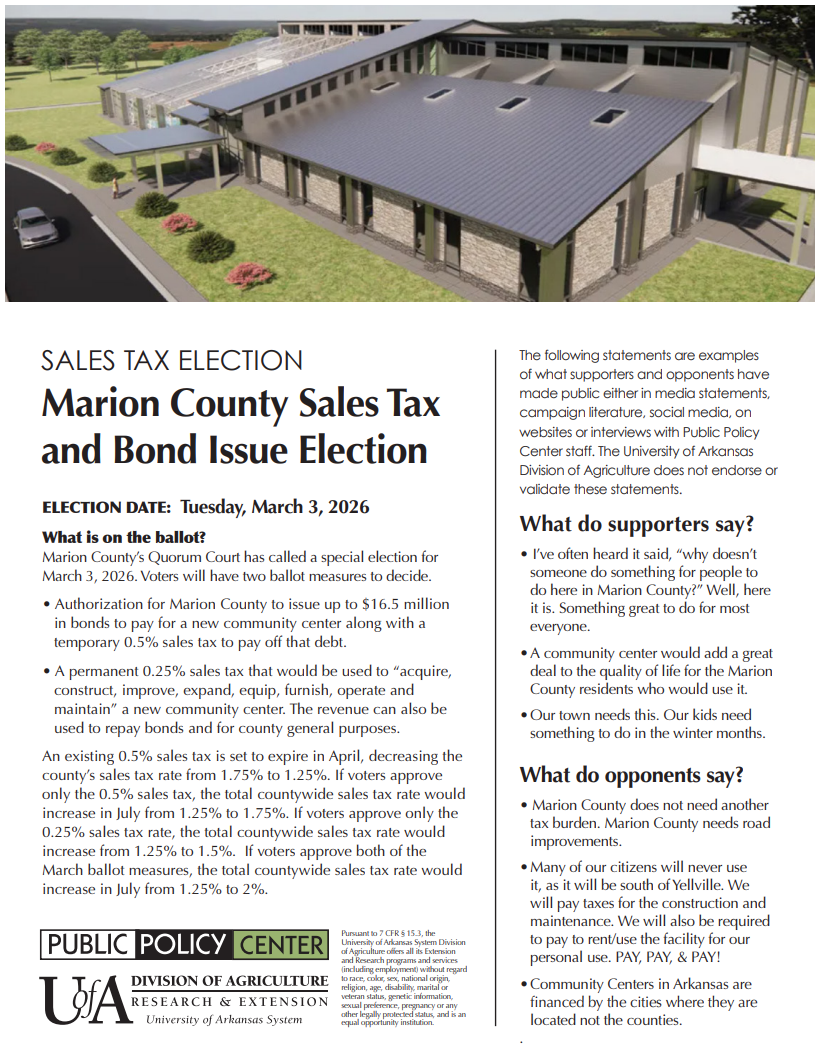
Voters in Marion County are deciding whether to approve two sales taxes and a $16.5 million bond issue that combined would help pay for a building a countywide community center.


The Public Policy Center partnered with the Marion County Extension Office to produce a fact sheet explain the proposal on the March 3 ballot.


Download our Fact Sheet


Marion County is one of several communities with a local ballot issue question to decide March 3.


Read more about local ballot issues we are aware of this election cycle.

New On Our Blog

The Public Policy Center is part of the Community, Professional and Economic Development unit at the Arkansas Cooperative Extension Service in Little Rock. As the blog's editor, we wanted to share recent publications.


We use #ARballot on Social Media


Voter Education Resources


State Ballot Issues

Access Our Information

Learn About Arkansas Process


Voter Resources

Link to Arkansas Election Resources & Handouts


Local Ballot Issues

Access Local Election

Fact Sheets


Blog

Read our department blog at Strengthening Arkansas Communities


Ballot Issue Tracker

Links to AG Opinions for 2026 ballot

Approved & Rejected Ballot Titles

Archive

Research past Arkansas ballot issues in our Archive


Did someone share this email with you? 

Subscribe to find Arkansas Ballot Issues News & Notes in your inbox every month.


The Public Policy Center was established in 2004 to provide Arkansans with timely, credible, unaligned and research-based information and education about public issues. Public issues are defined as pressing and emerging issues that involve multiple points of view and have widespread consequences.


Our goals are to:

  • Increase citizen knowledge, awareness and understanding of public issues;
  • Enhance public participation in decisions regarding public issues, and
  • Help citizens craft, evaluate and implement alternative solutions to public issues.


We are part of the Community, Professional and Economic Development unit at the University of Arkansas System Division of Agriculture, Cooperative Extension Service in Little Rock.


News & Notes Volume 13, Issue 2. This e-mail newsletter is shared with Cooperative Extension Service agents, subscribers from the general public and election officials or educators identified by the Public Policy Center. To unsubscribe, click below on "instant removal with SafeUnsubscribe."


Pursuant to 7 CFR § 15.3, the University of Arkansas System Division of Agriculture offers all its Extension and Research programs and services (including employment) without regard to race, color, sex, national origin, religion, age, disability, marital or veteran status, genetic information, sexual preference, pregnancy or any other legally protected status, and is an equal opportunity institution.