|
Public Policy Center | uaex.uada.edu/ballot | |
| Celebrating a Milestone with You | | |
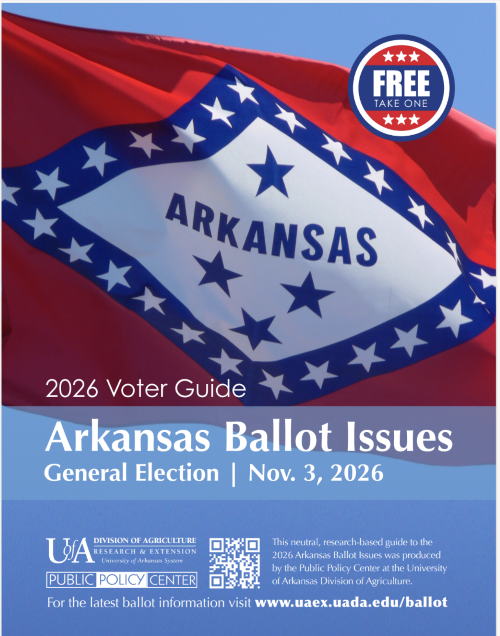
With this edition, we celebrate the 200th edition of the Public Policy Center's Arkansas Ballot Issues News & Notes. Since 2012, this newsletter has served as a trusted source of timely, credible, unaligned and research-based information about ballot issues, including constitutional amendments, citizen initiatives, referenda, and the processes that shape them in Arkansas elections.
Reaching 200 editions is no small achievement. It reflects the dedication of Kristin Higgins, the newsletter's editor, and the support of many individuals who have contributed content, provided feedback, and shared the newsletter with others over the years. This milestone also belongs to you, our readers. Whether you have read every edition or recently discovered the publication, your interest in informed civic participation is what gives this work meaning and purpose.
As we celebrate the 200th edition of Arkansas Ballot Issues News & Notes, we extend our sincere gratitude to everyone who has contributed to its success and to the thousands of readers who rely on it as a trusted resource. Looking towards the future, the Public Policy Center maintains its commitment to informing conversations and supporting voter education in Arkansas.
Do you know someone who would like to learn more about ballot issues in Arkansas? Invite them to subscribe to Arkansas Ballot Issues News & Notes today!
- Dr. Stacey McCullough, director of the Public Policy Center
| |
2026 Arkansas Election Results:
Voters Revamp Wording for Voting Requirement and Gun Rights But Reject Development Districts
| | |
Arkansas voters approved two of three constitutional amendments legislators sent their way this year, and rejected a third proposal that would have allowed local governments to offer financial incentives to attract development.
Unofficial elections results show 48% of the 1.8 million registered voters in Arkansas combined cast a ballot during early voting and on Nov. 3. Fewer people turned out to vote in 2026 than they did in the 2024 and 2022 midterms, according to election results from the Secretary of State's Office.
Counties should certify 2026 election results by the end of the week, though any outstanding ballots aren’t expected to change the outcome of the constitutional amendments on the ballot or turnout percentages.
Issue 1, a proposal to restrict voting in Arkansas to U.S. citizens, and Issue 2, an amendment that expanded the right to keep and bear arms, passed in all 75 counties.
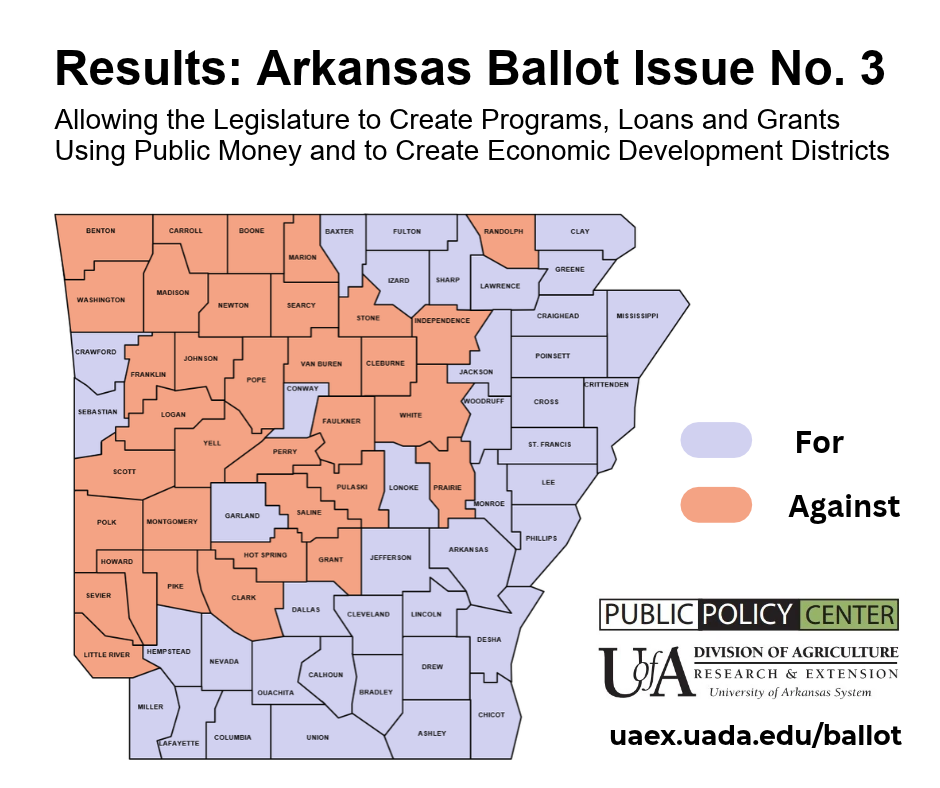
Issue 3, which would have allowed legislators to pass laws permitting economic development districts, passed in 41 counties but failed with voters overall. On Nov. 4, a representative of the Secretary of State's Office told us 42,680 people across Arkansas skipped Issue 3 when casting their ballot. The outcome for this issue could have been different had those people voted.
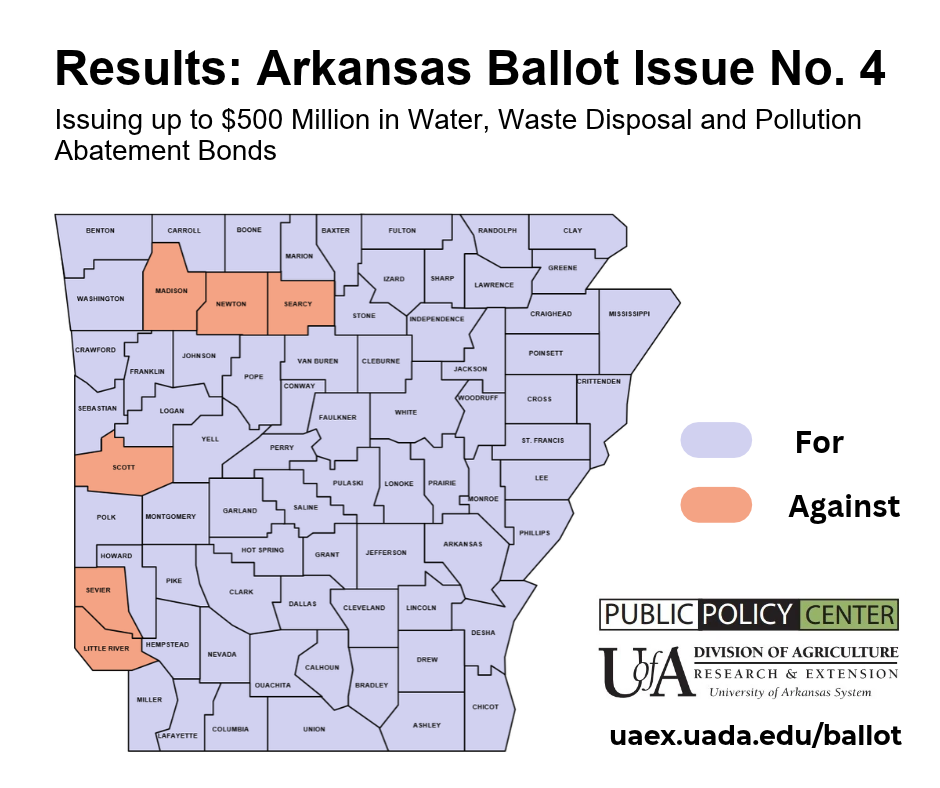
Voters also approved Issue 4, a request to allow the Arkansas Natural Resources Commission to issue up to $500 million in bonds for water, waste water, and pollution abatement projects, in all but six counties. Bond issues backed by state general funds require voter approval.
Arkansans elected Sen. Kim Hammer to be the next Secretary of State. Hammer will oversee the 2028 elections, which is the next time voters would decide statewide ballot issues.
Issue 1
Statewide vote tallies on Monday morning (Nov. 9) show Issue 1 passed by a vote of 597,403 (69%) FOR to 267,317 (31%) AGAINST.
Referred by the legislature, Issue 1 changes the wording in the Arkansas Constitution to say that only citizens can vote in state and local elections.
There were no supporters or opponents registered with the Arkansas Ethics Commission for this ballot measure. Groups must file with the Ethics Commission when they raise or spend $500 to support or oppose a ballot issue.
Issue 2
Voters approved adding to the right to keep and bear arms in the Arkansas Constitution to include lawful hunting and recreational use, and the possession and use of ammunition, firearm accessories, and firearm components. Issue 2 also included the recognition that the right to keep and bear arms is a "natural, fundamental, and individual right that shall not be infringed."
Statewide tallies show Issue 2 passed by a vote of 613,973 (71%) FOR to 253,174 (29%) AGAINST.
Go-AR for Issue 2 and the Scott County Republican Party Committee registered with the Arkansas Ethics Commission to support the measure. On its Oct. 27 financial filing, Go-AR for Issue 2 reported raising and spending $20,191.73. Scott County Republican Party Committee, which also opposed Issue 3, reported a total of $8,693 in October. There was no registered opposition group.
| |
Issue 3
Issue 3 narrowly failed in Arkansas. Despite passing in more counties than not, Issue 3 failed overall by a vote of 419,440 (49%) FOR to 431,273 (51%) AGAINST.
Issue 3 failed in Benton, Boone, Carroll, Clark, Cleburne, Faulkner, Franklin, Grant, Hot Spring, Howard, Independence, Johnson, Little River, Logan, Madison, Marion, Montgomery, Newton, Perry, Pike, Polk, Pope, Prairie, Pulaski, Randolph, Saline, Scott, Searcy, Sevier, Stone, Van Buren, Washington, White and Yell counties.
Arkansas legislators referred the constitutional amendment to voters saying that it would help the state attract more development that's lost to other states that offer financial incentives. Issue 3 would have allowed legislators to create programs, loans and grants using public money for the purposes of (1) development and diversification of the state’s economy; (2) elimination and prevention of unemployment or underemployment; (3) development or expansion of transportation or commerce; or (4) development or improvement of property that contributes to economic development in the state.
The text of Issue 3 said properties within an economic development district would be exempt from property tax, but that the district could levy taxes and fees on properties.
Arkansans for Strong Communities filed with the Arkansas Ethics Commission to support Issue 3, where as the Scott County Republican Party Committee and Truth in Politics Against Issue 3 opposed the measure.
Sponsor and Arkansas State Chamber President Randy Zook told the Arkansas Advocate, "we're not giving up. We're just going to regroup and figure out another game plan."
Arkansans for Strong Communities raised and spent nearly $2.5 million to campaign for Issue 3, according to an Oct. 27 filing. Meanwhile, Truth in Politics Against Issue 3 raised $16,204 and reported spending $11,204.
|
Issue 4
Arkansas voters again approved a bond issue backed by state general funds to pay for water, wastewater, irrigation and other types of projects supported by the Arkansas Natural Resources Commission.
The state agency will have permission starting July 1, 2027, to issue up to $60 million in bonds every two years. Overall, Issue 4 allows the agency to issue up to $500 million in bond issues subject to the approval of the governor.
Of the $500 million, $165 million would be earmarked for irrigation projects.
Voters approved a similar but smaller bond issue in 2008. Issue 4 this year passed in every county except Little River, Madison, Newton, Scott, Searcy and Sevier counties. Statewide tallies on Nov. 9 show Issue 4 passed by a vote of 474,799 (56%) FOR to 367,695 (44%) AGAINST.
The Committee For Water Infrastructure Now (WIN) For Arkansas and Water Infrastructure for AR filed with the Arkansas Ethics Commission to support Issue 4. There were no registered opponents.
The committee reported raising $88,500 as of October while Water Infrastructure for AR filed a report showing no money raised or spent as of October.
| Where Voters Showed Up and Where They Stayed Home | |
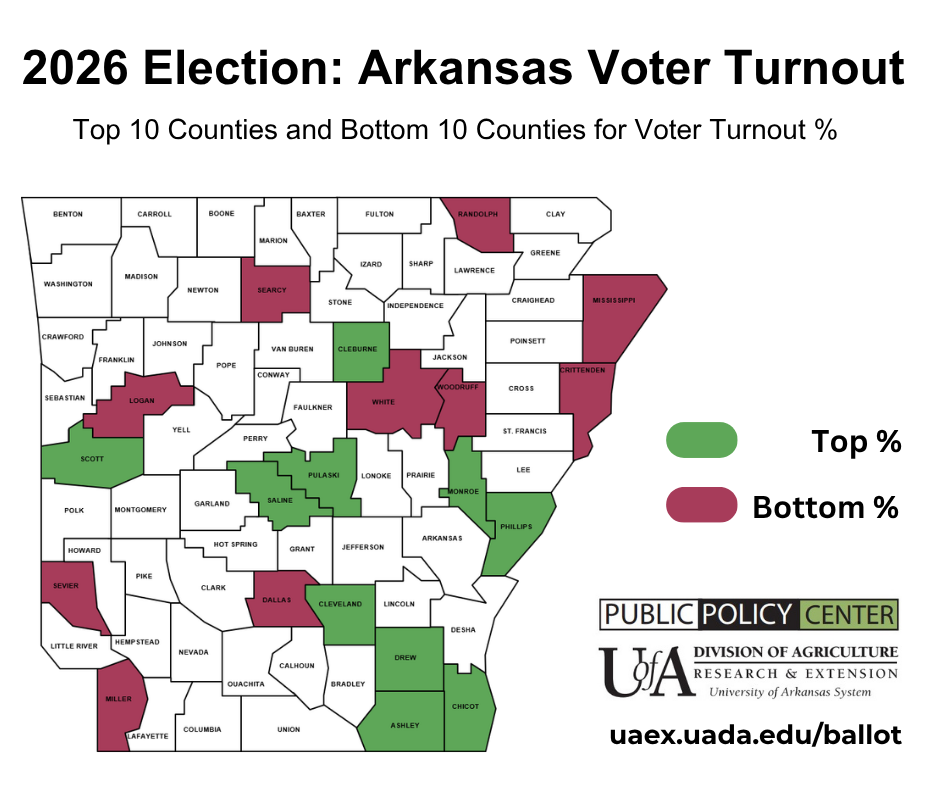
The 2026 midterm election in Arkansas attracted the fewest voters in a more than a decade of elections.
These numbers are unofficial and may change by the time counties officially certify the results because of outstanding absentee ballots from Arkansas voters currently living outside the United States:
-
Pulaski County, Arkansas' largest county, cracked the Top 10 List and took the #1 spot. The county did not make our 2024, 2022, or 2020 lists.
- Two counties, Crittenden and Miller, tied for the lowest voter turnout this year. Crittenden County, home to West Memphis, keeps making the Bottom 10 List.
- Calhoun County, home to Hampton in the state's south central area, had the lowest number of ballots cast in Arkansas. Voters cast 1,398 ballots (a 47% turnout).
As of Monday, the Secretary of State's Office website reports 48.13% of Arkansas' 1,856,404 registered voters turned out for early voting and Election Day voting. That represents 893,431 ballots cast. This is slightly below Secretary of State Cole Jester's prediction that at least 50% of the state’s voters would cast a ballot, and represents 39.77% of the state's estimated citizen voting age population.
Read our blog post for the election's Top 10 and Bottom 10 County Lists and to find your county's results.
| | How Did We Do? We Kindly Ask for Feedback | | |
It's your turn! We want your feedback. Did this monthly newsletter help you or annoy you? Did you find the information you needed to cast your vote on the ballot issues?
Take the survey below and tell us how we did.
Your responses also tell us who we reached in Arkansas and where we may need to do a better job in 2028.
TAKE SURVEY
The Public Policy Center has provided a neutral voter guide on all statewide ballot issues since 2004. We have offered our newsletter to readers since 2012.
| | |
The Public Policy Center was established in 2004 to provide Arkansans with timely, credible, unaligned and research-based information and education about public issues. Public issues are defined as pressing and emerging issues that involve multiple points of view and have widespread consequences.
Our goals are to:
- Increase citizen knowledge, awareness and understanding of public issues;
- Enhance public participation in decisions regarding public issues, and
- Help citizens craft, evaluate and implement alternative solutions to public issues.
We are part of the Community, Professional and Economic Development unit at the University of Arkansas Division of Agriculture, Cooperative Extension Service in Little Rock.
News & Notes Volume 13, Issue 12. This e-mail newsletter is shared with Cooperative Extension Service agents, subscribers from the general public and election officials or educators identified by the Public Policy Center. To unsubscribe, click below on "instant removal with SafeUnsubscribe."
Pursuant to 7 CFR § 15.3, the University of Arkansas System Division of Agriculture offers all its Extension and Research programs and services (including employment) without regard to race, color, sex, national origin, religion, age, disability, marital or veteran status, genetic information, sexual preference, pregnancy or any other legally protected status, and is an equal opportunity institution.
| | | | |