Weekly update from the National Housing Conference | | News from Washington | By Brittany Webb | | |
Civil rights groups sue CFPB on ECOA changes
The National Fair Housing Alliance (NFHA) filed a lawsuit against the Consumer Financial Protection Bureau (CFPB) and its Acting Director Russell Vought after the Bureau issued a final rule applying to Regulation B of the Equal Credit Opportunity Act (ECOA) that upends decades of precedent for analyzing and addressing civil rights issues in lending. The contested final rule makes three distinct changes. First, it ends disparate impact liability, which recognizes discriminatory impacts regardless of intent. Second, it narrows protections against discouraging people from applying for loans, heightening the potential for digital redlining. Third, it severely limits the use of Special Purpose Credit Programs, which have generated billions in positive economic impact.
Rise Economy, BLDS LLC, and SolasAI are also named plaintiffs. The group argues that the CFPB’s decision unlawfully weakens longstanding anti-discrimination protections and undermines enforcement against biased lending practices that can occur through automated underwriting systems and other financial technologies. Plaintiffs note that disparate impact liability under ECOA has been a critical tool for addressing discrimination in housing and credit markets, particularly as lenders increasingly rely on AI-driven decision-making systems.
The CFPB under the Trump administration has defended the rollback as part of a broader effort to reduce regulatory burdens and reevaluate prior agency interpretations of federal law. However, fair housing, consumer, and housing policy advocates warned during the comment period on ECOA that weakening disparate impact standards could reduce accountability for discriminatory lending practices and create additional barriers to equitable access to credit and homeownership opportunities. The CFPB has not yet commented on the suit, and reports of new field staff reassignments are the latest indication of continued efforts to disband the agency entirely.
“This is the deliberate dismantling of 50-years of legal jurisprudence, regulatory guidance, and bipartisan consensus that lending discrimination has no place in America. The statute did not change. The legal decisions did not change. Washington’s commitment did. This reversal by the CFPB is a continuation of this Administration’s efforts to gut fair housing and lending protections,” said Lisa Rice, President and CEO of NFHA. “Eviscerating these guardrails will ultimately result in less credit access for many people, make our markets less sound, and cause our economy to be less productive. When the agency built to enforce civil rights and protect consumers walks away from the job, the rule of law remains. That is why we are in court.”
| | | |
Senators pen letter against work requirements
A group of 22 Senate Democrats sent a letter to U.S. Department of Housing and Urban Development (HUD) Secretary Scott Turner urging the Department to rescind a proposed rule that would impose work requirements on certain federally assisted housing residents. The group, led by Senators Elizabeth Warren (D-Mass.), Jack Reed (D-R.I.), Lisa Blunt Rochester (D-Del.), and Raphael Warnock (D-Ga.), argue that the proposal could increase housing instability for vulnerable households while creating additional administrative burdens for local housing agencies already facing staffing and funding constraints.
According to the letter, work reporting requirements could lead eligible households to lose housing assistance due to paperwork issues or administrative errors rather than actual ineligibility. It also highlights that many households receiving housing assistance already include individuals who work, are elderly, have disabilities, or serve as caregivers. The lawmakers expressed concerns that new compliance obligations would divert limited housing agency resources away from efforts to expand housing access and address affordability challenges. It goes on to cite the proposed rule’s regulatory impact analysis that estimates administering the policy would cost “between $15.3 million and $255.8 million in the first year, and between $2 million and $29 million every year thereafter” and “up to an additional $54.3 million annually in implementation costs for PHAs, PBRA owners, HCV landlords, and households in comparison to the baseline costs of current regulations.”
The group urged HUD to instead focus on policies that increase affordable housing supply, improve housing stability, and reduce barriers to assistance. HUD has maintained that the requirements will promote self-sufficiency and address long waiting lists for housing assistance.
| |
HUD changes stance on emotional support animals
HUD has removed guidance requiring federally assisted housing providers to accommodate emotional support animals (ESAs) for tenants with disabilities. The move rescinds prior interpretations tied to the Fair Housing Act that treated ESAs, which are generally untrained, as reasonable accommodations for individuals with disabilities, even when properties maintained no-pet policies. Housing providers will now have greater discretion in determining whether to approve such requests and will be able to charge pet fees for ESAs.
Advocates for people with disabilities critiqued the decision, noting that ESAs provide companionship and therapeutic benefit to a person simply through their presence. Veterans experiencing post-traumatic stress disorder were noted by prior HUD staff as a group likely impacted by the policy change, who make up many cases HUD would have investigated in prior years. At the same time, some housing providers expressed support for the narrowed approach, arguing that fraudulent ESA accommodation requests create significant concern for owners and operators.
The changes are expected to affect both public housing and privately owned properties receiving federal assistance, with housing providers now awaiting additional implementation guidance from HUD regarding how accommodation requests involving assistance animals should be evaluated moving forward.
| | | |
Housing market again adjusts to higher rates
The housing market continues to adjust to a higher interest rate environment, with home price growth moderating and buyers becoming increasingly sensitive to borrowing costs. New data from the Federal Housing Finance Agency (FHFA) showed U.S. house prices rose 1.7% year-over-year in the first quarter and 0.5% from the previous quarter, while the S&P Cotality Case-Shiller National Home Price Index similarly indicates that appreciation has slowed from the rapid gains seen in recent years. At the same time, Freddie Mac reported the average 30-year fixed-rate mortgage rose to 6.53%, another upswing for interest rates despite showing improvement compared to last year.
Recent weekly mortgage application data showed refinancing activity falling by 18% as rates moved higher, while mortgage applications have decreased 8.5%. However, analysts note that buyers and sellers are increasingly adapting to higher rates as the new normal, helping support transaction activity even as affordability remains strained. Local markets are highlighting regional differences in price changes more dramatically, with Midwest and Northeast regions continuing modest growth while Sun Belt and Western regions are declining. More than half of the major metropolitan areas measured by the Case-Shiller index saw price declines compared to last year.
“The latest six months saw only a negligible 0.3% rise in national home prices, barely keeping pace with the 0.3% in the prior half-year — a sign of a housing market nearly at a standstill,” said Nicholas Godec, head of fixed income tradables and commodities at S&P Dow Jones Indices.
Meanwhile, slowing home price appreciation has widened the gap between inflation and home price growth, suggesting that housing markets could show signs of rebalancing after years of rapid price increases.
| | | |
Homebuying optimism remains low
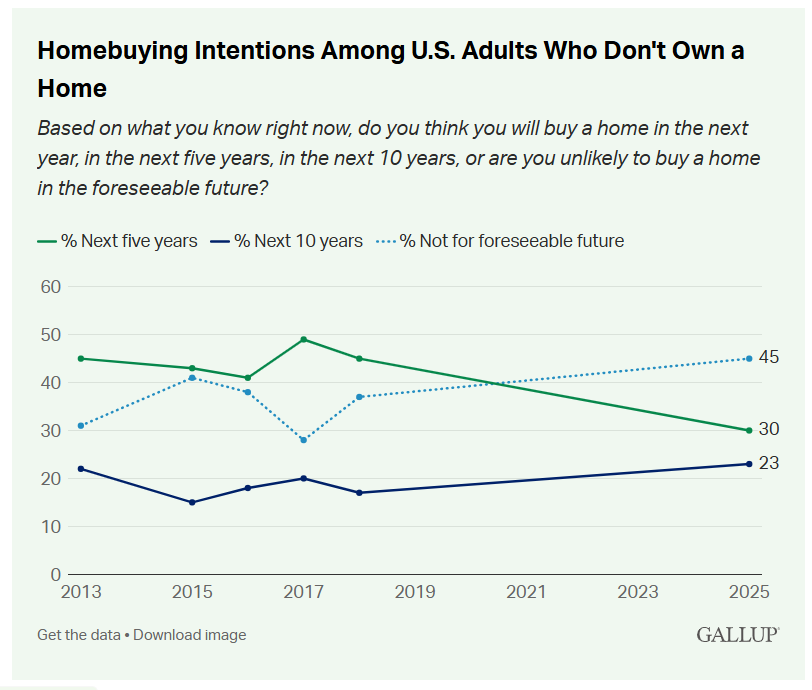
A Gallup survey of non-homeowners found that just 30% expect to purchase a home within the next five years, the lowest level recorded since the question was first asked in 2013. At the same time, 45% said they do not expect to buy a home in the foreseeable future, while 23% believe they may be able to purchase one within the next 10 years. The findings suggest that many prospective buyers are delaying or abandoning near-term homeownership plans. The results highlight a significant shift from prior years, when between 41% and 49% of non-homeowners expected to buy a home within five years. Gallup found that affordability remains the primary barrier, with renters who do not expect to buy most often citing an inability to afford a home or save enough for a down payment.
| | |
The Urban Institute launched a new interactive tool that tracks federal spending through place-based programs designed to support economic development, housing, infrastructure, and community revitalization. Users can explore how funding is distributed across states, counties, congressional districts, and tribal areas, providing a clearer picture of where federal investments are concentrated. The tool may help policymakers and local leaders identify gaps, assess the reach of existing programs, and better align future investments with community needs. As housing affordability and economic development remain top priorities nationwide, the resource offers a useful lens into how federal dollars are shaping local outcomes.
A new article from Fed Communities examines how some organizations are adapting the investor-owned single-family rental model to support affordability, preservation, and community ownership goals. While investor activity in the single-family housing market has drawn scrutiny over concerns about homeownership access and neighborhood impacts, the article highlights emerging efforts to acquire investor-owned homes, rehabilitate them, and sell or rent them at affordable rates. Examples include partnerships that target lower-income households and seek to preserve long-term affordability rather than maximize returns. The piece suggests these models could offer a pathway to expand affordable housing opportunities as some large investors reduce their holdings in the single-family rental market.
A Wisconsin Public Radio article highlights how rural communities in Wisconsin are turning to creative partnerships and financing tools to address persistent housing shortages. Local governments, nonprofits, and organizations such as Habitat for Humanity are leveraging mechanisms like tax increment financing districts and embracing factory-built housing to support workforce and affordable housing development in areas where traditional market incentives are often insufficient. Community leaders noted that housing shortages are making it harder to attract workers, retain residents, and support local economic growth.
| | |
Monday, June 1
National Homeownership Month
U.S. Housing Community Development Conference & Expo, June 1 - 2
MISMO Summit 2026 Spring | MBA, June 1 - 4
Tuesday, June 2
2026 Housing Credit Connect | NCSHA, June 2 - 5
The Powell years at the Fed: A retrospective | Brookings Institution, 9:30 AM – 12:15 PM ET
Building a Data-Informed Opportunity Zone Case Webinar | HUD, 2 - 3:30 PM ET
Wednesday, June 3
How AI Is Reshaping American Enterprise, and Being Shaped by It | AEI, 9 – 10:30 AM ET
Hearing: Full Committee Markup of Fiscal Year 2027 Interior, Environment, and Related Agencies Bill and Fiscal Year 2027 Transportation, Housing and Urban Development, and Related Agencies Bill | House Appropriations Committee, 11 AM ET
Thursday, June 4
2026 Spring New Markets Tax Credit Conference | Novogradac, June 4 - 5
House Financial Services Committee Hearing: Oversight of Prudential Regulators, 10 AM ET
Permanent Supportive Housing at a Crossroads: Strengthening Resident Outcomes Amid Growing System Challenges | Terner Center for Housing Innovation, 10 – 11 AM PT
Housing Updates from Washington | NAHRO, 1:30 PM ET
Land of Opportunity: Advancing the American Dream | AEI, 4 – 6 PM ET
Friday, June 5
Regional Connect: Northeast | NAHREP, 12:30 – 5 PM ET
| | The National Housing Conference is a diverse continuum of affordable housing stakeholders that convene and collaborate through dialogue, advocacy, research, and education, to develop equitable solutions that serve our common interest. | | Defending Our American Home since 1931 | | Copyright © 2024. All Rights Reserved. | | | | |