Keeping patients healthy and pain-free without resorting to surgery or long-term medications.


Did You Know
Lectins - Hidden in Your Produce

Lectins  - sugar-binding plant proteins that attach to cell membranes - may be a hidden source of weight gain and ill health, even in an otherwise healthy diet. In fact, since lectins are present in most plant foods, if you're eating a whole food diet yet find yourself still struggling with weight gain and/or stubborn health problems, lectins may well be a hidden culprit.

Many lectins are proinflammatory, immunotoxic, neurotoxic and cytotoxic. Certain lectins may also increase blood viscosity, interfere with gene expression and disrupt endocrine function.

The problem with recommending an altogether lectin-free diet is that this would eliminate most plant foods, which should ideally make up the bulk of your diet. Moreover, in small amounts, some lectins can be quite beneficial, so 100 percent avoidance is likely neither possible nor ideal. The key then becomes finding a happy medium where the worst lectins are avoided, and the effect of others are tempered through proper preparation and cooking.

Among the most problematic lectin-containing foods are corn, corn-fed meats, casein A1 milk, peanuts, cashews and unfermented soybeans. These are best avoided altogether. High-lectin foods such as legumes and grains can be made safe to eat by proper soaking and cooking. Sprouting, fermenting and removing skins and seeds will also help reduce lectins in your diet.


Find out which plants have lectins and how to avoid them from 

Cause Disease and Weight Gain by Dr. Steven Gundry, MD

Try New Things
Discover the Joy of Movement with Dr. Kelly McGonigal
by Dr. Rangan Chatterjee

One of the positives we're seeing during the current "lockdown" is many people's renewed appreciation for getting out, active and connected. Having to stay home is making us really value that small window in our days when we can step outside to exercise, interact with nature and say a (distanced) hello to people we pass on the street or in the park.

In this podcast, Dr. Kelly McGonigal and Dr. Rangan Chatterjee talk about the importance of music for movement, and how moving with others can improve social connections and foster a sense of support and community. They discuss how going beyond what you think you're capable of - whether that's an endurance event, lifting heavy weights or taking on an epic hike in nature - can provide a spiritual experience that changes the brain in positive ways.

It doesn't have to be hard, though. Kelly explains how even the simplest of movements provide an immediate reset for your mood and brain chemistry. And she shares ground-breaking new research that shows how repeatedly contracting any muscles, through continuous exercise, releases antidepressant substances called myokines that scientists have dubbed 'hope molecules'.
Whether you're someone who wants to move more but isn't sure where to start - or you're already a confirmed fitness fanatic - you may find this conversation uplifting.


Supplement Corner
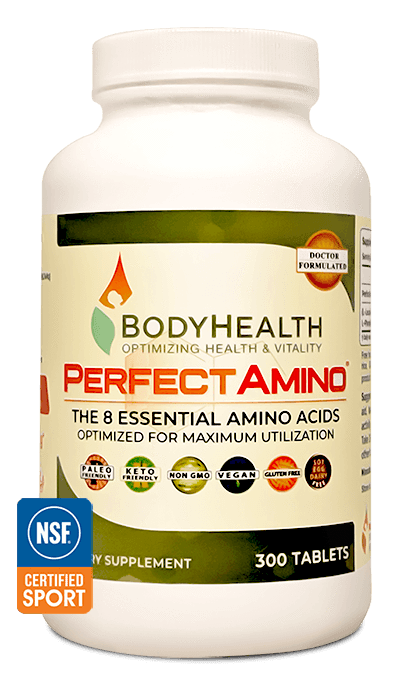
Perfect Amino

After a long day on the trail, are you giving your body enough time to recover? Are you getting the right amount of protein to rebuild those muscles that are worked so hard?

Of the twenty-two amino acids that the body uses to make proteins, eight of them are classified as essential. This means that we must get these from food or supplements, because the body is unable to make them. If the body has the eight essential amino acids in the proper quantities and in the right proportion, then it can make the remaining fourteen non-essential acids. This is important because more than 50 percent of most proteins are made of these essential ones.

When the pancreatic cells get enough of the eight essential amino acids, they can make the protein insulin, which consists of two chains: thirty-one amino acids in one, and twenty in the other. All of the critical enzymes needed for energy, repair, detoxification, and growth are proteins made of amino acids. This allows the thyroid to make thyroid hormone, the pituitary to make growth hormone, etc.

Each protein, whether it be from a vegetable or animal source is made up of from tens to thousands of amino acids. Many of them are not the ones that are needed by the cell at the moment they arrive. The cell has no storage depot for amino acids, and the unnecessary ones are quickly shunted down the catabolic pathway. Since the most valuable amino acids are the essential ones, the body will take them and turn them into proteins if there are adequate amounts to make the given protein that the cell is working on. The beauty of Perfect Amino is that it's a mixture of the eight essential amino acids with an ideal ratio of one to another.

  • Tryptophan encourages the release of serotonin and melatonin.
  • Lysine deficiency can result in a deficiency in niacin (Vitamin B). It is beneficial in treating and preventing herpes.
  • Methionine supplies sulphur and other compounds required by the body for normal metabolism and growth.
  • Valine is needed for muscle metabolism, tissue repair, and for the maintenance of proper nitrogen balance in the body.
  • Leucine stimulates muscle protein synthesis and may be the major fuel involved in anabolic (tissue building) reactions.
  • Isoleucine is important for blood sugar regulation, muscle development and repair and energy regulation.
  • Threonine is important for antibody production. It can be converted into glycine and serine.
  • Phenylalanine stimulates certain hormones including adrenaline and noradrenaline, which are activating substances in the central and peripheral nervous systems.
                  
OUR PARTNERS


Like us on Facebook
Aspen Integrative Medicine | 970-927-0308