|
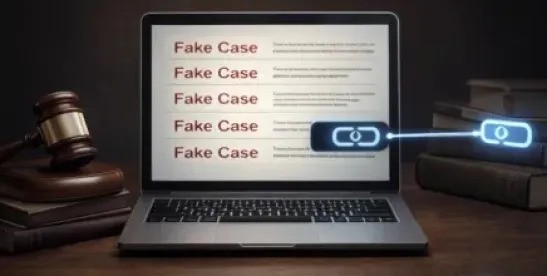
26 March 2026 (New York, NY) - A new legal requirement to hyperlink case law is drawing support from legal professionals as a counter to artificial intelligence-generated fake cases in court submissions, but some aren't sure that it is enough to solve the problem and worry that it will be an added burden on lawyers.
Note to readers: the Illinois Supreme Court is among the first state court systems in the United States to implement formal, proactive AI policies to address "hallucinated" or fake case law. Illinois will be the first court system to formalize "the Hyperlink Rule".
As of March, there have been over 1,100 documented instances of attorneys submitting court filings containing fake legal cases or citations generated by AI, according to a database created by Damien Charlotin, a lawyer and senior research fellow at HEC Paris, a suburban Paris business school. Generative AI fabricates case law under a phenomenon known as a "hallucination."
Oliver Roberts, former co-head of the AI practice group at Holtzman Vogel Baran Torchinsky & Josefiak PLLC, is the author of an op-ed in the National Law Review in December 2025 that was the first article I had read calling for courts to require that all electronic filings include hyperlinked citations to "authoritative legal sources" to address the growing number of citations to nonexistent law.
Roberts writes that the "hyperlink rule" would require all cited judicial opinions, statutes and regulations to be hyperlinked to a reputable legal database, arguing that this prerequisite to verify the citations deters "careless reliance" on AI without prohibiting its use entirely.
While the proposal hasn't been formally implemented, it calls for hyperlinks to be included in nearly every case. The procedural proposal calls for attorneys to provide hyperlinks and affirm the existence of the cases. There would be some exceptions, including for pro se litigants.
The reaction to his op-ed has been strong and positive, with several judges expressing interest in the concept, and several judges saying they will watch the Illinois court system implementation of the rule for guidance. Roberts himself said:
"I believe the rule would provide a meaningful benefit both to the judiciary and to legal practice by making verification of cited authority faster and more reliable. Where a court has reason to question a party's reliability or diligence, the rule can help prevent repeat issues while conserving judicial resources".
Charlotin also supports the proposed hyperlink requirement, because some AI platforms do not provide them by default. He has said:
"This will require extra steps from you which should help catch obvious errors and hallucinations from the litigant's side before they enter the judicial system".
Others agree, finding the proposal promotes innovation and responsible use of AI across the legal profession. It is believed the hyperlink rule provides one practical solution to hallucinations that helps conserve court resources and makes it easier for judges and litigants to verify cited authority quickly and accurately.
But . . . not every lawyer supports the proposed requirement.
Tyler Maulsby, deputy managing partner at the New York City-based boutique firm Frankfurt Kurnit Klein & Selz PC and a legal ethics specialist, questions whether the requirement would actually curb the filing of hallucinated cases - or would instead weigh down overworked attorneys.
The challenge with requiring hyperlinks is that generative AI tools can create a fake URL that shows the case, according to Maulsby. Another issue is that most leading legal AI tools already include citation links, and that hasn't stopped attorneys from submitting briefs with fake cases because lawyers might neglect to verify the links.
Maulsby has firsthand experience dealing with instances of attorneys accused of citing fake cases. He represented Steven Schwartz of Levidow Levidow & Oberman PC, who is widely recognized as the first attorney to gain notoriety for submitting a legal brief filled with fake, AI-generated case citations. Schwartz and his partner, Peter LoDuca, cited nonexistent cases generated by OpenAI's ChatGPT.
The argument is that while AI tools can save time, requiring hyperlinks might create burdens for lawyers from small firms who lack support to verify them while shielding large law firms that have the resources to include and verify the hyperlinks.
So mandating hyperlinks can be a good idea to address hallucinations of citations. But not every attorney has access to those hyperlinks, which are often found in pricey legal research databases. Links to sources in proprietary systems can make cross-platform and open verification difficult.
So a counter argument is being made that courts shouldn't try to curb AI-created briefs as a whole, because the real issue is the use of sloppily prepared and unchecked briefs. Many instances involving attorneys submitting fake briefs are similar to past mistakes and unauthorized conduct by lawyers. The new aspect in these instances is the lack of understanding of how the technology works. These are all problems that have been plaguing the legal industry for years. No court has had difficulty finding a rule under which to sanction the lawyer or to fashion a remedy. Attorneys who submitted briefs with fake cases were dealt sanctions that include big fines and temporary suspensions. Or so the argument goes.
But it reminds me of a post yesterday by my colleague Casey Newton: educational resources for lawyers. Training current staff for new AI-centric positions, addressing the specific skills gaps.
|