|
 |
Greetings! I hope everyone is having a great summer!
On behalf of SK PCAP Partnership, I would like to thank Kerry Gaillard very much for her amazing job coordinating the PCAP Education Programs during the last 2 years!
I am also pleased to announce Julie-Anne Howe as the new SK PCAP's Education Coordinator. Julie-Anne has a Master degree in ruminant nutrition at the University of Saskatchewan, and extensive experience in rangeland management and forage production through her own beef and dairy farm, and consulting company. She also has valuable experience working in prairie conservation with some of the PCAP partners. Julie-Anne will be coordinating on our two educational programs "Taking Action for Prairie" and "Adopt a Rancher", so please join me in welcoming her to the SK PCAP team!
As for our Native Prairie Speaker Series webinars
,
we were pleased to have had
Kim Pearson from Waterton Lakes National Park last week, presenting the results of conservation and restoration projects on Northern Leopard Frog population. You can watch this and all previous presentations on the PCAP YouTube channel!
I would also like to draw your attention to a call for nominations for the Prairie Conservation Award, in recognition of significant long-term contributions to native habitat or species at risk conservation. The Prairie Conservation Award is granted to a deserving recipient from each of the three Prairie Provinces once every three years. Individuals from any walk of life, organizations or Indigenous groups can be nominated for this award. Awards will be presented at the 12th Prairie Conservation and Endangered Species Conference in Winnipeg, MB. F
or more details
on the nomination guidelines please click
here.
Finally, we are planning our Partner Steering Committee Meeting for
the 2019-2023 Framework Renewal
, which will be held on October 15 and 16, 2018, in Riverhurst
. This five-year planning process will provide an opportunity for reviewing the ongoing PCAP plans and actions, as well as outlining the intended areas of focus for the mid-term future. We look forward to seeing all the PCAP Partners represented in Riverhurst!
Please feel free to contact me at any time; I'm pleased to receive your questions, comments or ideas.
Diego Steinaker
SK PCAP Manager
306 352 0472
pcap@sasktel.net
|
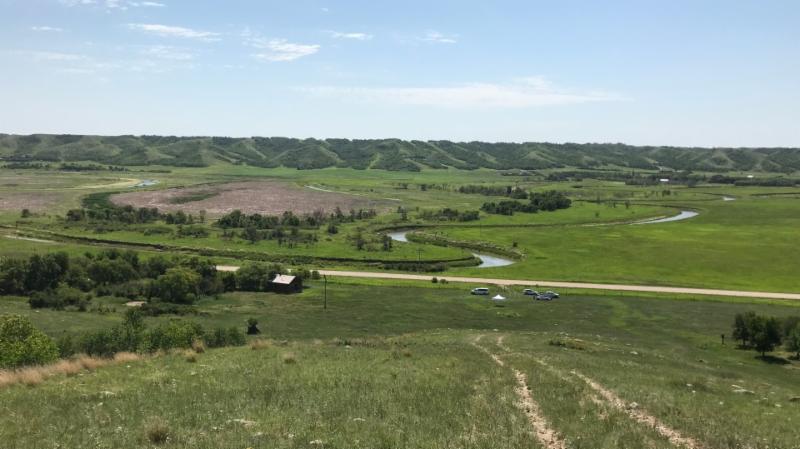
At-risk habitat within the Qu'Appelle Valley saved from subdivision and development
The Nature Conservancy of Canada protects one of the most significant habitat corridors near Craven, SK
The Nature Conservancy of Canada (NCC) and its partners
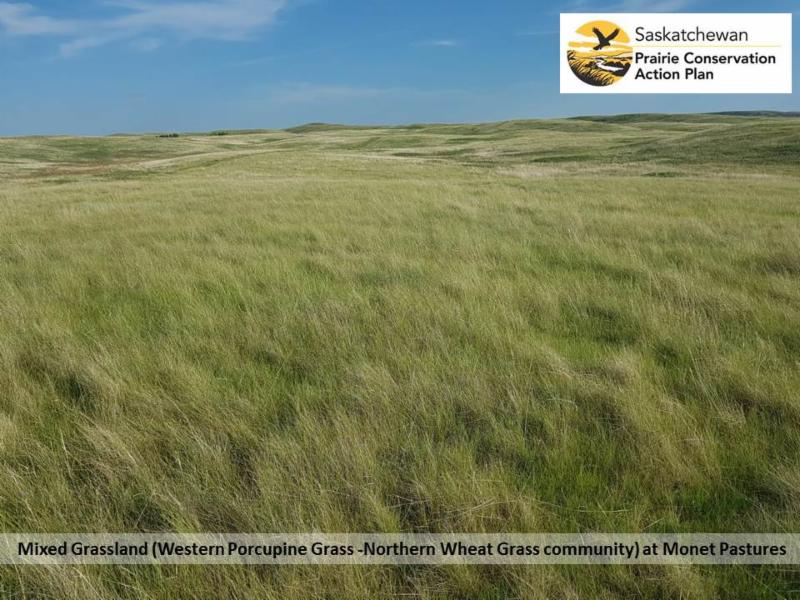
announced the purchase of 135.7 hectares (335 acres) of native grasslands and seasonal wetlands in the Upper Qu'Appelle Natural Area, approximately 40 minutes from Regina.
The Upper Qu'Appelle Natural Area provides important habitat for a number of species listed under the federal Species at Risk Act. Birds such as Sprague's pipit and chestnut-collared longspur, both threatened, and Baird's sparrow, special concern, are likely to be found at Valley View.
The Valley View conservation project enhances one of the most significant wildlife habitat corridors across southern Saskatchewan due to its location within the Qu'Appelle Valley, which stretches west to east across the province. The closeness to the towns of Craven and Lumsden and the city of Regina puts the acquired property at a high threat level for rural subdivision and acreage development. The area's native habitat is also at risk of conversion for annual cropping. The Valley View project is near several protected areas and other natural lands. For more information on this project please click here.
|
|
Wetlands and Climate Change
by Charles Deschamps
(Resource Specialist at Ducks Unlimited Canada)
Climate change is part of our new reality.
Carbon dioxide and other greenhouse gas emissions contribute to more frequent and extreme weather events across our province. These weather events are devastating and result in billions of dollars in property damages, reduced crop yields, and increased nutrient runoff that pollutes our lakes and rivers.
Over the past several months there have been discussions on Saskatchewan Natural Systems, commercial forest and the cattle sector and the amount of carbon they sequester, the increased acreage of pulse crops and the carbon sequestration in agricultural soils through reduced tillage - all good points to discuss. What has been omitted from any discussion is the role that prairie wetlands play in our climate change strategy, the amount of carbon they sequester in Saskatchewan, or that they are a significant source of emissions when they are converted to cropland. Prairie wetlands, or sloughs, should be key player in the climate change discussion.
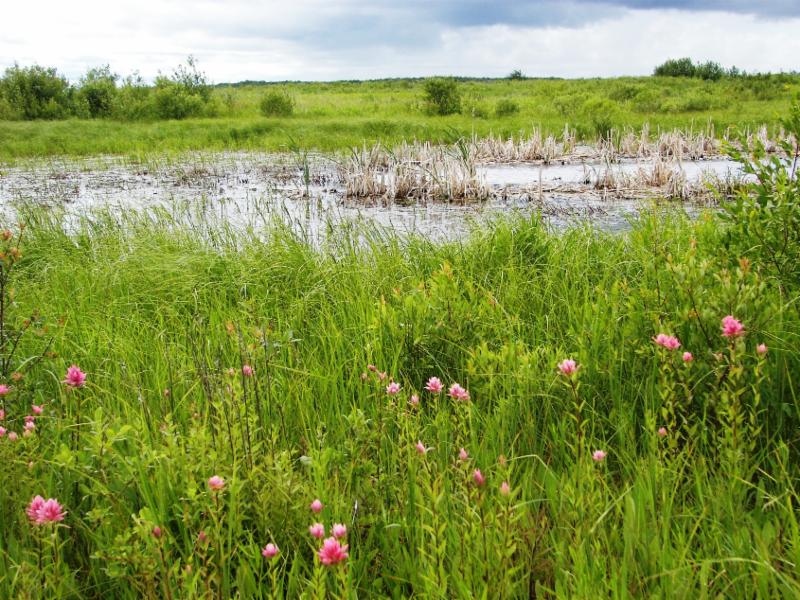
Wetlands are optimum natural environments for sequestering and storing carbon from the atmosphere.
Saskatchewan's remaining wetlands store approximately 1.3 million tonnes of carbon, the equivalent of seven times the total carbon emissions of all vehicles in Canada. Draining as little as 15 acres of wetlands can release the same amount of greenhouse gas equivalent as the carbon sequestered in one year from no-till farming almost 5,000 acres. Wetlands also store nitrous oxide, a strong greenhouse gas.
Each year approximately 10,000 acres of wetlands are converted to cropland, releasing almost the equivalent amount of carbon that is captured by the SaskPower Boundary Dam Carbon Capture and Storage Project.
Solutions to climate change are complex,
but one of the simplest and
most cost-effective actions we can take
is to work
with
nature. Protecting the remaining wetlands and native areas in Saskatchewan provide green infrastructure and need to be a key component of Saskatchewan's Climate Change Strategy.
For more information please contact Charles Deschamps. Email: c_deschamps@ducks.ca
|
|
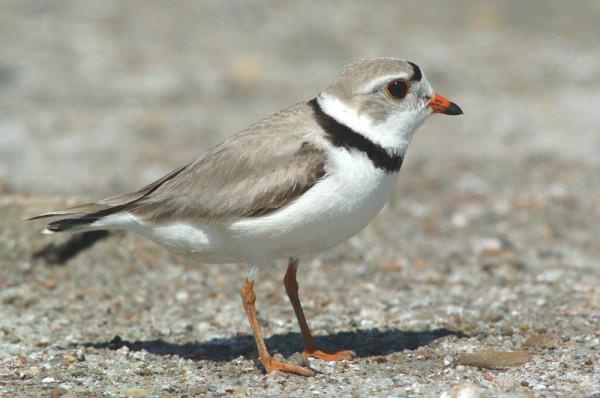
In Canada the prairie subspecies of the Piping Plover (
Charadrius melodus circumcinctus) breeds in central Alberta, southern Saskatchewan, southern Manitoba and the Lake of the Woods region of western Ontario, using
shorelines around saline/alkaline lakes, river islands and adjacent sand pits. The number of Piping Plovers has been decreasing everywhere.
This
guide determines local and landscape-scale habitat features that are optimal for Piping Plover at different life stages, as well as important non-habitat related beneficial management practices.
Piping Plover (
Charadrius melodus circumcinctus)
This guide was developed by Sue Michalsky and Heather Peat Hamm with technical and editorial input from Corie White, Julie Mackenzie, Ashley Vass and Ryan Dudragne and GIS support from Michelle Lanoie.
|
|
|
|
|
Upcoming Events!
Campout for Conservation at Old Man on His Back!
August 11, 2018, 10 am -11 am
Old Man on His Back (Swift Current/Eastend), Saskatchewan
August 12, 2108
St. Victor Petroglyphs Provincial Historic Park
August 15, 2018, 1 pm-7 pm
Val Marie, SK
August 28, 2018, 10 am-4pm
Moose Jaw, SK
|
|
Conservation Volunteer Opportunities!
The Saskatchewan Ministry of Environment is looking for volunteers to locate Ferruginous Hawks!
Read the details...
Parks Canada has many volunteer opportunities at the Grasslands National Park -
check them out!
|
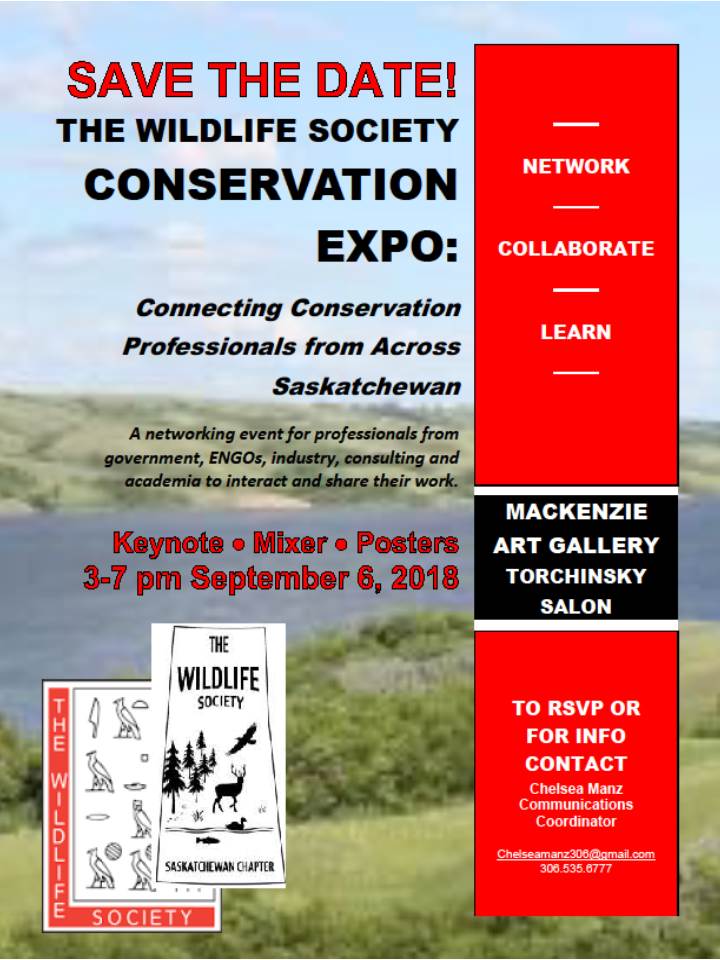
The Wildlife Society
Conservation Expo
6 September, 2018,
Regina, SK
|
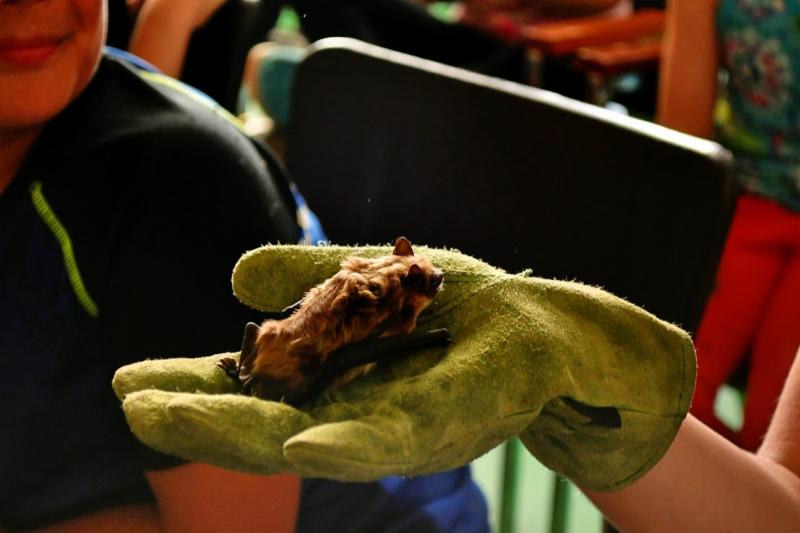
host successful "Bat Chat"
Over 40 people (including at least 25 youngsters) joined Melanie Elliott and her bat girls Batrick and Elizabat at the Research and education centre at Redberry Lake on last July 14th, 2018.
The Park at Redberry Lake in Saskatchewan is home to many "Big Brown Bats" (wingspan about 25 cm).
The event was organized by Sheri Hodgson and Michaela Baule, and co-sponsored by Saskatchewan Outdoors and Saskatchewan Lotteries.
|
|
Wildlife Volunteer Opportunity
Do you enjoy spending time on native prairie in the spring? Have you noticed any sharp-tailed grouse in your travels? The Saskatchewan Co-operative Wildlife Management Survey (CWMS) is a volunteer-based survey that asks participants to provide wildlife observations across Saskatchewan. Formerly the Co-operative Deer Management Survey, this survey has expanded beyond deer to include observations of moose, elk, sharp-tailed grouse and wild turkey. Observations can be collected throughout the year, but for sharp-tailed grouse, one of the key periods is in the spring, when active lek locations can be documented.
All observations can be recorded by downloading the SK CWMS mobile application to your Apple or Android Smartphone. Once you have downloaded the SK CWMS App, please call 1-800-567-4224 toll-free or email centre.inquiry@gov.sk.ca for your
participant number and activation code.
|
|
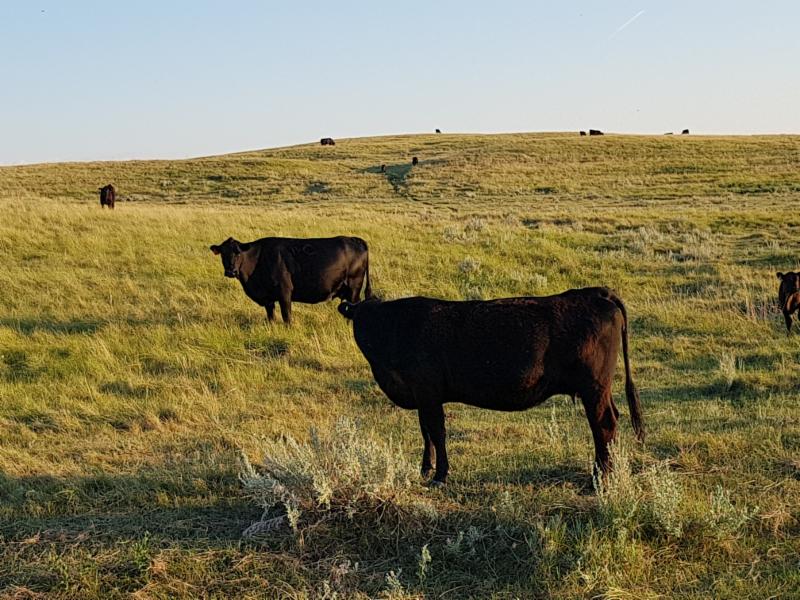
Saskatchewan Stock Growers Association (SSGA) and Parks Canada's Grasslands National Park (GNP) are teaming up to collaborate on a unique grass bank pilot project to conserve habitat for species at risk, particularly the Greater Sage-grouse, Sprague's Pipit, and Chestnut-collared Longspur.
The project area covers 40,000 acres of public and private land, much of which is considered critical habitat for Greater Sage-grouse, Sprague's Pipits, and Chestnut-collared Longspurs. Local ranchers will manage grazing on portions of the East Block of GNP and their adjacent private land with a goal of achieving habitat targets for the three species. Habitat targets are set and measured by the South of the Divide Conservation Action Program. Ranchers benefit from the program when they meet the habitat targets through a reduced grazing fee on GNP land, and through a financial incentive from SSGA through the Species at Risk Partnerships on Agriculture Land (SARPAL) program. The project is being undertaken with financial support of Environment and Climate Change Canada through the SARPAL fund.
More
information
on this project
here.
|
A new research led by Deepthy Kolady from South Dakota State University, indicates that cattlemen place a greater emphasis on conservation efforts than their farming counterparts. The
analysis from a farmer survey revealed that l
ivestock producers are adopting sustainable management practices with positive implications on environment, soil health, and economy.
|
|
Diego Steinaker, Editor, Saskatchewan Prairie Conservation Action Plan Newsletter
306-352-0472 |
|
|
SK PCAP gratefully acknowledges financial support in 2018-2019 from:
Ducks Unlimited Canada, Canada North Environmental Services, EcoFriendlySask.ca, Information Services Canada, Parks Canada - Grasslands National Park of Canada, Rancher's Stewardship Alliance Inc., Saskatchewan Cattlemen's Association,
Saskatchewan Ministry of Agriculture, Saskatchewan Ministry of Environment - Fish and Wildlife Development Fund,
SaskEnergy,
SaskPower, SaskTel, University of Saskatchewan - College of Agriculture and Bioresources, Water Security Agency.
SK PCAP gratefully acknowledges in-kind support for 2018-19 from:
Agriculture and Agri-Food Canada - Science and Technology Branch, Canadian Parks and Wilderness Association, Canadian Western Agribition, Environment Canada - Canadian Wildlife Service, Friends of Wascana Marsh, Meewasin Valley Authority, Native Plant Society of Saskatchewan, Nature Conservancy Canada, Nature Saskatchewan, Parks Canada - Grasslands National Park, Prairie Wind & Silver Sage, Ranchers Stewardship Alliance Inc., Redberry Lake Biosphere Reserve, Saskatchewan Association of Rural Municipalities, Saskatchewan Association of Watersheds, Saskatchewan Cattlemen's Association, Saskatchewan Environmental Society, Saskatchewan Forage Council, Saskatchewan Forage Industry Network, Saskatchewan Ministry of Agriculture, Saskatchewan Ministry of Environment, Saskatchewan Ministry of Economy, Saskatchewan Ministry of Education, Saskatchewan Ministry of Tourism, Parks, Culture and Sport - Royal Saskatchewan Museum and Friends of the Royal Saskatchewan Museum, Saskatchewan Research Council, Saskatchewan Stock Growers Association, Saskatchewan Wildlife Federation, Saskatoon Nature Society, SaskEnergy, SaskOutdoors, SaskPower, Society for Range Management - Prairie Parkland Chapter, South of the Divide Conservation Action Program Inc., University of Regina - Prairie Adaptation Research Collaborative, University of Saskatchewan - College of Agriculture and Bioresources, Wild About Saskatoon-Nature City Festival.
|
|
|
|