Two Clean Energy Action Alerts, Federal Weakening of Local Energy Legislation, What We Are Reading, and More! |
|
Action Alert:
Sign Letter asking Xcel to continue moving
away from coal toward clean energy
Please join us in signing onto this letter from 350 Colorado and Sierra Club urging Xcel to hasten its transition away from coal, focus on clean energy rather than natural gas, and make sure impacted communities are taken care of.
|
|
Action Alert:
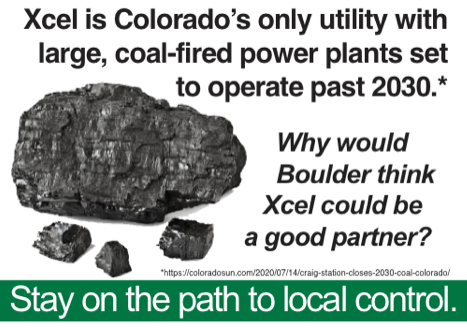
Ask Boulder City Council not to Rush into Franchise with Xcel, before the council meeting
Thursday, August 20, 6 pm
If you haven't already, and even if you have, please join us in asking Boulder City Council to defer consideration of a franchise with Xcel until next year, when the city will have a final price for local power. Thursday is the second reading of the franchise agreement and public comment.
Even with franchise discussions in work, the city is also still exploring local power. They recently issued a Request for Proposal to get actual bids from energy providers. Boulder deserves to know if local power is a viable solution and be able to weigh it side-by-side with a potential franchise agreement, as well as staying out of franchise. For more reading, this letter to City Council outlines the benefits of local power from the perspective of the Kansas Municipal Utilities organization.
|
|
FERC Weakens PURPA
On July 16, 2020, the Federal Energy Regulatory Commission (FERC) issued an order which fundamentally modifies small, distributed energy development. The Public Utility Regulatory Policies Act (PURPA) was passed in 1978 in reaction to the 1970s energy crisis as a way to provide pricing incentives and requirements for small energy facility development (<20 megawatts, called “qualifying facilities”; for example, small hydropower projects, community solar gardens, combined heat and power generators, etc.).
The July 2020 PURPA order removes many of the program requirements, allowing states to make their own decisions on how they will support Qualifying Facility development. The changes include lowering the required facility procurement size from 20 to 5 megawatts, which removes security for mid-size projects, removing the requirement for fixed financing options, which results in less price stability, as well as others.
FERC commissioner Richard Glick dissented from the order and stated that this decision “fundamentally overhaul[s]” and “administratively gut[s]” PURPA. Analysis of the order reveals that the impact may be less harmful to eastern states, which already have their own renewable energy requirements; Western states which have few renewable requirements will now have less federal requirements.
|
|
Ohio State Speaker of the House
Charged in Bribery Case Involving
$1 Billion Nuclear Plant Bailout
Ohio House Speaker Larry Householder and four alleged co-conspirators were charged with federal racketeering in an alleged money laundering scheme in the state of Ohio. The accusations revolve around how large amounts of money were funneled from "Company A" (widely believed to be Ohio utility FirstEnergy) through dark money groups, with the goal of electing Larry Householder as speaker of the Ohio House of Representatives, and securing a $1.3 billion Ohio tax payer funded bailout for two nuclear power plants owned by FirstEnergy. For a quick explanation of this complicated case, watch this video.
|
|
What We Are Reading
Making sure fossil fuel workers aren't left behind in the transition to clean energy
In the 2019 Colorado legislative session, in HB 19-1314 was passed. This bill is titled “Just Transition From Coal-based Electrical Energy Economy", and it focuses on how to transition workers and communities in Colorado who depend on the fossil fuel industry as we pivot to cleaner sources of energy. A state commission has issued a draft report on how this should be approached. Click HERE to read how this complicated task may unfold in the following years.
Making sure everyone has access to the clean energy boom
While the transition to clean energy has often strived to create a cleaner environment and help achieve equality in our country, that economic equality has been lacking in who is receiving new clean energy jobs and who is profiting in this moment. Click HERE to read about how the clean energy push is being reassessed in this national moment of racial and economic equality.
Making sure utilities prioritize social equity
Click HERE to read how multiple groups and companies are working to make sure that the transition to cleaner energy doesn't make the same mistakes that previous energy production has made, specifically in regards to harming marginalized groups. Ideas range from an electric truck pilot program aimed at reducing air pollution in low income neighborhoods, to transitioning Navajo coal plant workers to solar jobs.
|
|
Meet CEA Board Member
Josie Strutz
|
|
Josie Strutz moved to Colorado in the Summer of 2015, and since living in the Colorful State has fallen in love with everything "Colorado", from mountain biking to hiking, Josie is eager to spend as much time exploring as she does working to combat climate change through her career in the solar industry. Josie graduated from The George Washington University with a Bachelor of Science in Systems Engineering, and has worked in a variety of roles within the clean energy industry. Beginning her career with Solar Energy International, she has since explored working in solar panel manufacturing, residential solar, and is currently employed at Pivot Energy as a Project Engineer and Analyst. Josie's work is centered around production modeling and project pricing, and when she is not behind the computer she loves to spend time with friends and family, play outside, and listen to groovy tunes. |
|
Connect with CEA on social media |
|
|
|
|
|
|