|
|
Sylvia Woods Harp Center
August 2022 Newsletter
|
|
I wrote my Teach Yourself to Play the Folk Harp book in 1978. That year, while touring with Robin Williamson and His Merry Band in New York City, I had an appointment with an executive at Music Sales Corporation, one of the three major music publishing companies. I still remember exactly what he said when I showed him the draft of my book. "It looks like a great book, but nobody plays the harp. I doubt you'll sell 500 copies. So, we won't publish it, but we will distribute it for you."
Although I was initially disappointed, it turned out to be the best thing anyone ever did for me. Because of our conversation, I formed my own publishing company and have had complete control of my publications ever since.
I was recently asked how many copies of my Teach Yourself to Play the Folk Harp book I've sold since I first published it in 1978. Before you read the article below, I invite you to take a minute . . . and guess the number sold in the past 44 years. Write down your answer, and see how close you got!
-- Sylvia
|
|
On June 15, I was happy to be part of the Harp Column Academy's newest feature: " Ask Me Anything." This photo of me is from the Zoom event.
One of the questions submitted was how many people have learned to play using my Teach Yourself to Play the Folk Harp book. Of course, I have no idea how many people actually learned to play. But, before the event, I spent time figuring out how many copies have been sold since I first published it in 1978.
In the Zoom meeting, I asked the participants to guess this number. The guesses ranged from 1,450 to 10,000 copies. I then gave them this big hint: "In the past ten years, I have sold about 22,000 copies."
Their next guesses ranged from 40,000 to 200,000 copies! The correct answer was 98,000 copies!
This past month, I found a few more files with sales data from the early 1980s. So, the new total is about 100,000 copies! Wow!
As I said in the Ask Me Anything meeting, "I'm so happy, proud, and privileged to have been able to help so many people learn how to play the harp!"
Thank you all for your support of my books during the past 44 years . . . and, hopefully, for many more years in the future!
|
|
New Products at Harpcenter.com |
|
Here are some of the PDFs that I've added to harpcenter.com this past month.
Tango Strings - a fun, syncopated composition for lever or pedal harpists
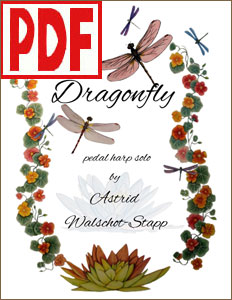
Dragonfly - a flowing original composition for advanced pedal harpists
|
|
In the previous two issues of this newsletter, I introduced Caroline Steinford's harp motif quilting patterns that we're now selling. Caroline's designs are inspired by the symmetrical traditional Hawaiian quilting patterns, using one color of fabric on a contrasting colored backing. My friend Tom Worthen wrote the following article about Hawaii's unique quilting tradition.
|
|
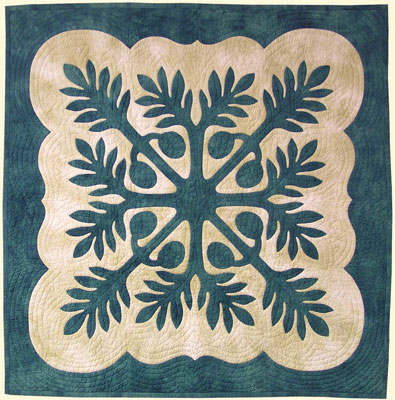
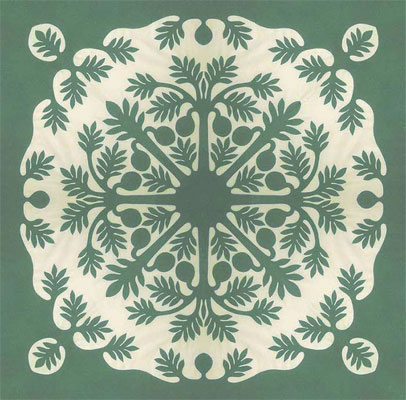
Certain aspects of Hawaiian culture are iconic. You see a dancer performing the hula or a surfer catching a wave, and you think of Hawaii. One often overlooked icon of Hawaiian culture is quilting. Showcasing a unique style and design, Hawaiian quilts reflect Hawaiian culture and are easily identified.
For centuries, Hawaiians pounded the bark of the mulberry tree to make cloth. The art of the Hawaiian quilt developed when western civilization introduced cotton in the early 1800s. Western missionaries brought patchwork quilt techniques with them to the islands. Observing the missionaries take a bolt of cloth and cut it into small squares just to sew it all back together didn’t make much sense to the Hawaiians. To Hawaiians, the art was in the stitching and the natural, symmetrical patterns. Like the cutting of paper to create a snowflake, a traditional Hawaiian quilt pattern is folded in half (½), and then half again (¼) and half again (⅛). From the symmetry of flowers and plants, Hawaiian quilters expressed the same beauty of nature found in hula and Hawaiian poetry and music.
|
|
Even though thinking about Hawaii will still create images of sandy beaches and coconuts found throughout the world, Hawaiian quilts reflect a culture grounded in nature and the art of fine stitches.
-- Tom Worthen
Editor's note: The quilt design photos shown in this article are copyrighted by the Pacific Rim Quilt Company. I want to thank Connie Sayler for her permission to use the images. Both patterns shown here feature breadfruit, or 'Ulu, a Hawaiian symbol of plenty and abundance. The breadfruit tree was a key source of food, wood, and medicine for the early Hawaiians and is an essential spiritual and cultural symbol. You can purchase Connie's Hawaiian Quilt patterns at www.pacificrimquilt.com.
|
|
In honor of my Teach Yourself book's milestone, my bestselling books and sheets from the last five years are on sale this month with the code word Teach.
To get the 15% discount, enter the code word Teach in the "Enter Promo Code" box on your shopping cart page and click "Enter Code" by August 31, 2022. See the "How to get the 15% discount" section at the bottom of this newsletter for more information.
|
|
by Sylvia Woods
Book, PDF, CD, mp3s, Video
15% off with Teach code
------------------------------
|
|
by Sylvia Woods
Book, PDF, CD, mp3s
15% off with Teach code
------------------------------
|
|
by Sylvia Woods
Book, PDF, CD, mp3s
15% off with Teach code
------------------------------
|
|
by Sylvia Woods
Book or PDF
15% off with Teach code
------------------------------
|
|
by Sylvia Woods
Book, PDF, CD, mp3s
15% off with Teach code
------------------------------
|
|
by Sylvia Woods
Book, PDF, CD, mp3s
15% off with Teach code
------------------------------
|
|
arranged by Sylvia Woods
Sheet or PDF
15% off with Teach code
------------------------------
|
|
arranged by Sylvia Woods
Sheet or PDF
15% off with Teach code
------------------------------
|
|
arranged by Sylvia Woods
Sheet or PDF
15% off with Teach code
------------------------------
|
|
arranged by Sylvia Woods
Sheet or PDF
15% off with Teach code
------------------------------
|
|
arranged by Sylvia Woods
Sheet or PDF
15% off with Teach code
------------------------------
|
|
arranged by Sylvia Woods
Sheet or PDF
15% off with Teach code
------------------------------
|
|
How to get the 15% discount
|
|
15% off select sale items when you use the code word Teach
Our newsletter promo codes are redeemable online and are only valid for the products listed above in the monthly sale section. They are not valid for phone or email orders. This month's code word is Teach.
#1. Put the items you want to purchase in your cart.
#2. On the page where you view the items in your cart, type this month's code word Teach in the "Enter Promo Code" box and click "Apply."
The actual price of the featured sale products on this page will then automatically change to reflect the discount. For example,
Unit Price: $9.95 (the original price)
Total Price: $8.46 (the discounted price)
You'll also see a note below the Promo Code box saying the name of the promo code you entered and the percentage amount of the discount.
REMEMBER: You must enter this month's code word Teach in the Promo Code box and click "Apply" on your shopping cart page by August 31, 2022, to get the discount!
This offer expires at the end of the day on 8/31/2022.
|
|
Sylvia Woods Harp Center
Lihue, Hawaii
|
|
|
|
|
|
|