A Visit to Qaumajuq, the Inuit Art Centre at the Winnipeg Art Gallery |
|
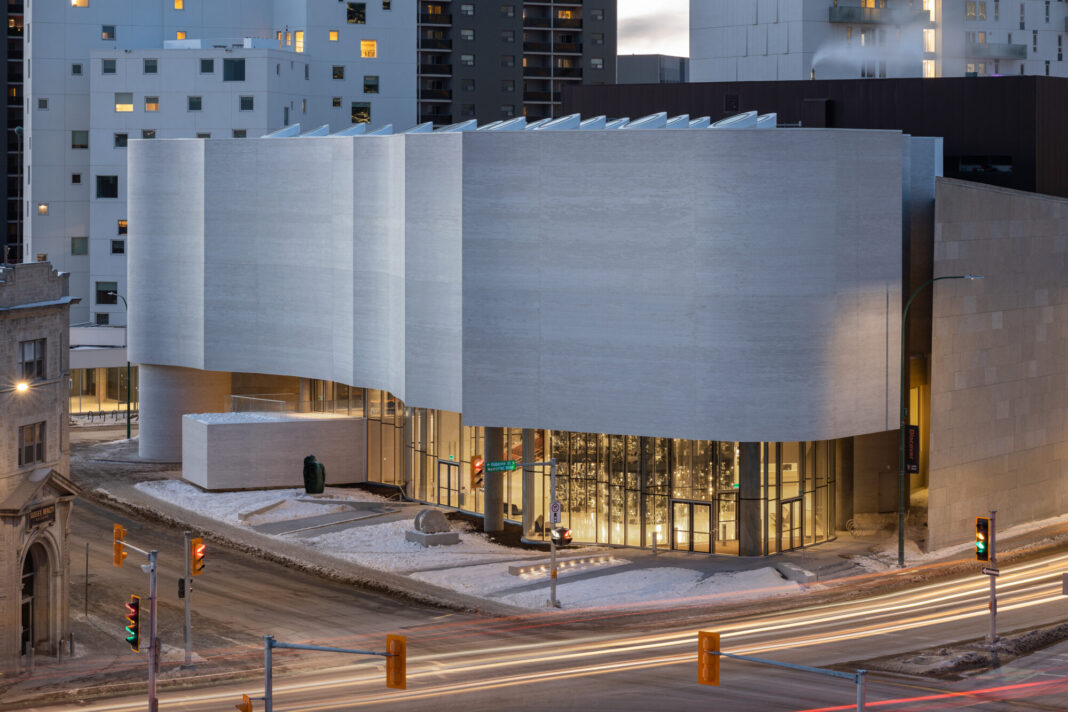
The Winnipeg Art Gallery opened Qaumajuq in March 2021. After years of planning, WAG has a new building devoted to its phenomenal collection of Inuit art. Qaumajuq means "it is bright, it is lit" in Inuktitut, and the name is perfect for this spacious, light-drenched building, which is connected to the original Winnipeg Art Gallery building on all levels.
|
|
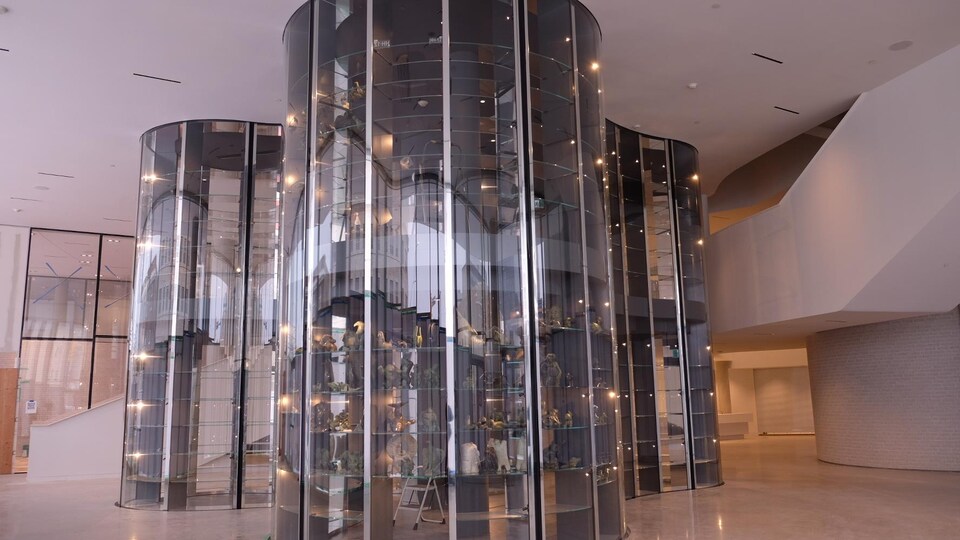
The pandemic and Canadian entry restrictions prevented me from visiting when Qaumajuq opened, but I made a two-day visit this month. This is a must-see for every serious collector of Inuit art. The centerpiece of Qaumajuq is a massive visible vault. WAG has the world's largest collection of contemporary Inuit art, and about 4500 pieces from its collection of stone sculpture are on view in the visible vault. This is a hollow column with a wavy perimeter, divided into about 40 columns, each with up to 25 glass shelves. The art is organized by community. That is, all of the pieces from Cape Dorset occupy adjoining columns, all of the pieces from Gjoa Haven occupy adjoining columns, and so forth. Within each community, pieces are frequently but not always organized by artist. There are interactive touch screens to allow you to identify individual works. |
|
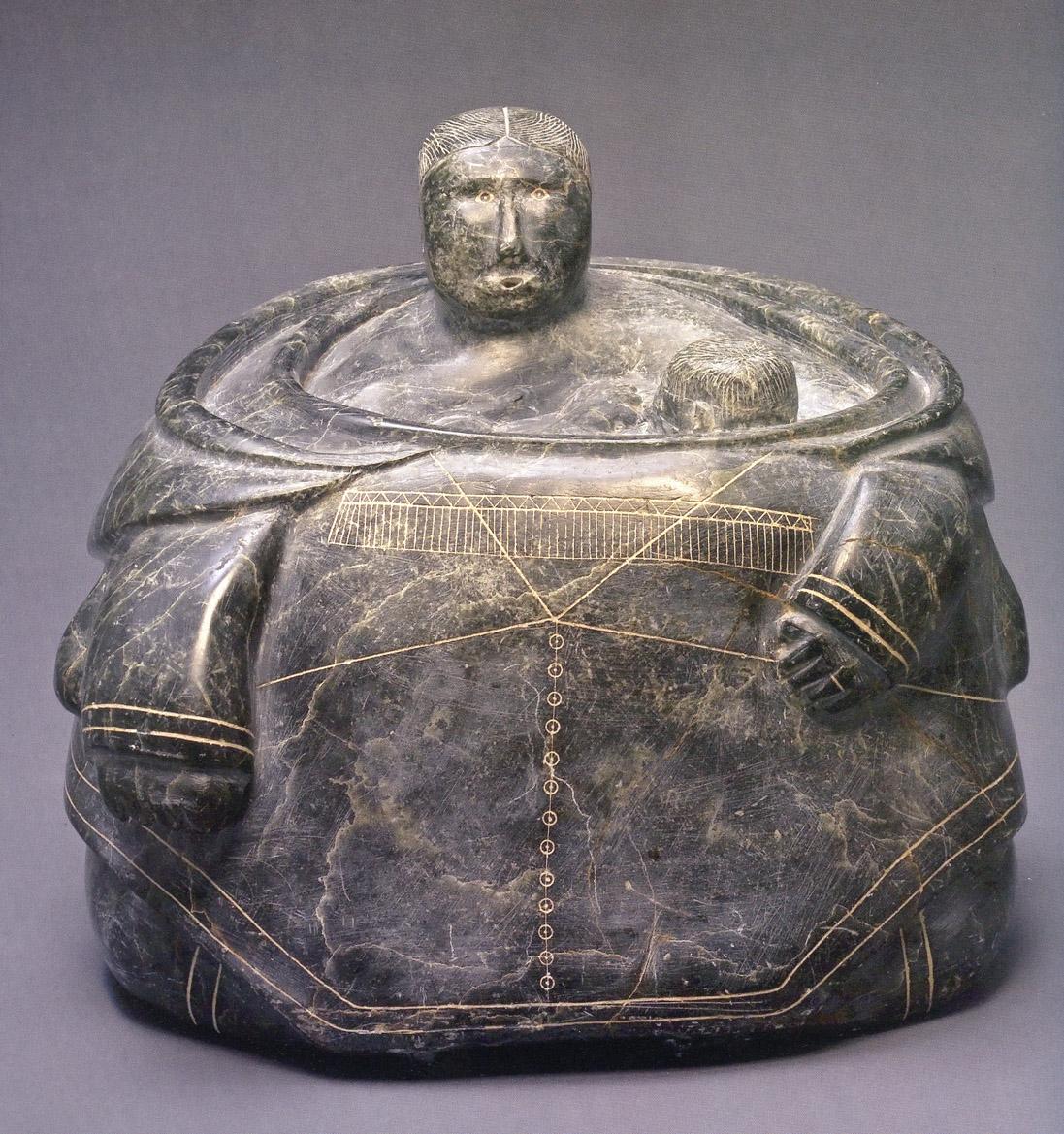
This was a kid-in-a-candy-store experience for me. You can see at close range a daunting number of masterworks, pieces that you had only seen in books or online. You can also discover many pieces that were previously unknown to you, and get a sense of context from browsing all the works from a community. For example, Akeeaktashuk's great 1953 Mother and Child (see below) sits next to Johnny Inukpuk's 1955 Mother and Child (see second picture bellow). |
|
These two mother-and-child sculptures share the same subject -- right down to the fact that the child in each case is nursing at the mother's breast -- and were executed within a few years of one another by artists from the same general area. (Although Akeeaktashuk and Inukpuk were in different camps, Inukpuk was aware of Akeeaktashuk as another skilled carver.) But everything else about them is different. Different stone, different style, different expression, different decoration on the mothers' amautis (parkas). Individually, each sculpture is a masterpiece which makes a deep impression on the viewer. Juxtaposed as they are, their impact is multiplied. This one shelf speaks volumes about the creativity in Inukjuak in the early 1950's, when the Inuit were just beginning to explore stone carving on a large scale. And it also is a testament to the great care and skill with which Darlene Wight, the Curator of Inuit Art at WAG, has selected and arranged works within the visible vault.
In addition to the visible vault, Qaumajuq has gallery space for conventional exhibitions. The main exhibition space has an inaugural exhibit, INUA, curated by four guest curators representing the four regions of Inuit Nunangat, the homeland of the Inuit in Canada. The exhibit features a number of contemporary pieces, including film and photography in addition to traditional media, and it also includes works from the 1950s, 1960s and 1970s. One section of the three-story-high wall is filled with a display of Baker Lake wallhangings. This display casually includes works by Marion Tu'uluq, Jessie Oonark, Irene Avaalaaqiaq and Victoria Mamnguqsualuq, the four premier textile artists from Baker Lake, along with examples by many lesser-known textile artists. In addition to the blockbuster inaugural exhibit, smaller exhibits feature discrete themes, including one charming exhibit focused on tattooing.
If you go, I recommend that you bring compact binoculars, since some portions of the visible vault can only be viewed at a distance. I also recommend that you do some homework in advance, such as reviewing Early Masters (WAG 2006), Darlene Wight's book on Inuit sculpture in the early 1950's. One cautionary note: at present, there is no permanent exhibit of works on paper or textiles, and most of the whalebone and ivory pieces in the collection cannot be included in the visible vault because of conservation concerns.
|
|
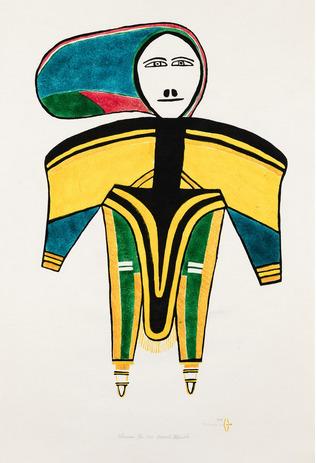
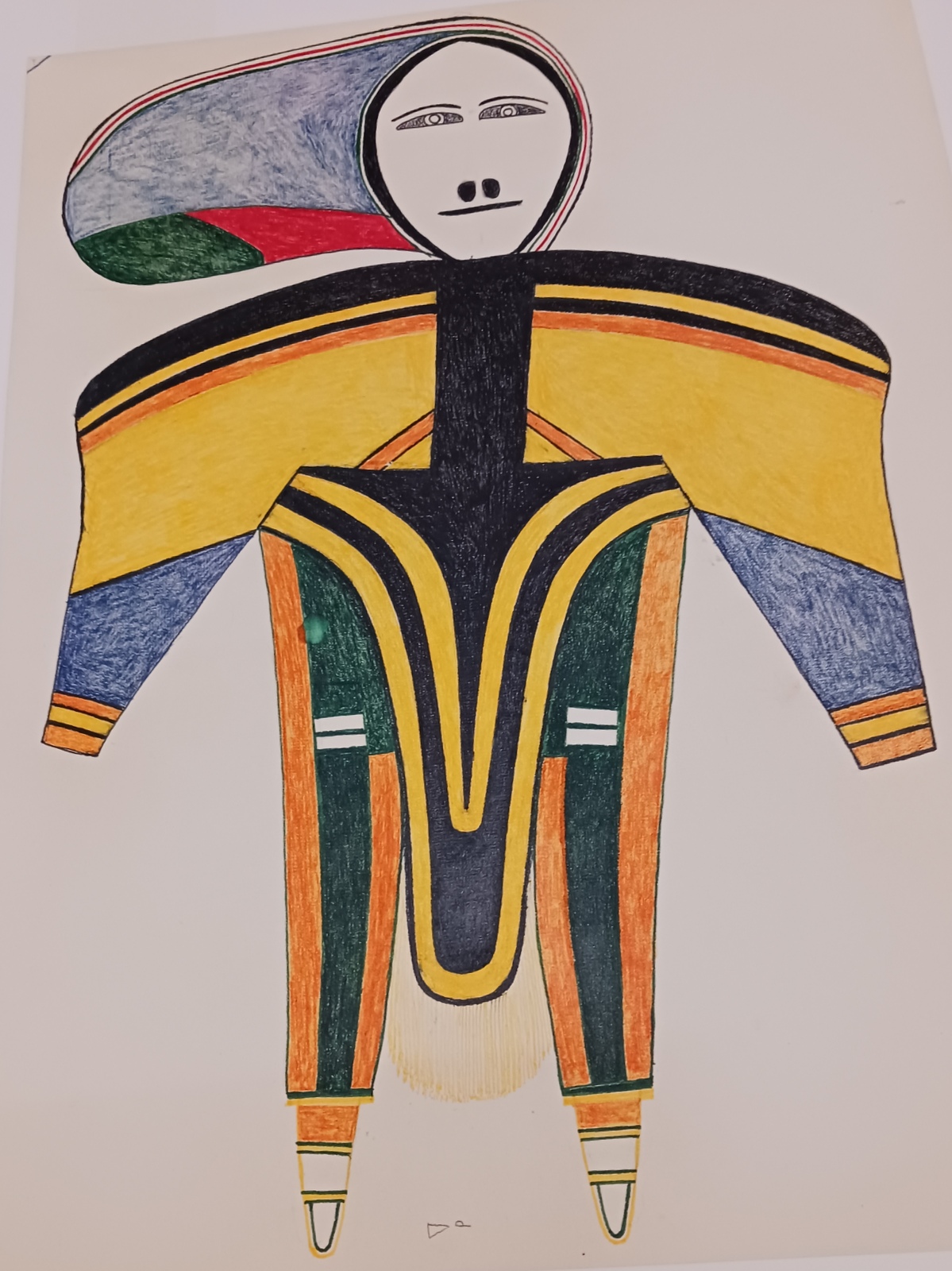
We are pleased to have Jessie Oonark's Woman in the gallery. This print appeared on the cover of the inaugural catalogue of the Baker Lake print collection (1970). It is a powerful image, speaking of the strength of Inuit women as well as demonstrating a sophisticated command of color. Oonark (1906-1985) was the premier graphic artist to emerge from Baker Lake, and her images are vivid, with strong geometric elements.
|
|
In Jessie Oonark, A Retrospective (WAG 1986), Jean Blodgett. writes: "Oonark's many depictions of elaborately styled and decorated garments demonstrate her keen interest in the visually stimulating. She delighted in seeing and creating innovative, colourful and decorative garments, and wearing them too. While the clothes she sewed might not be as elaborate as the garments in her drawings and wall hangings, Oonark did make and wear some striking garments herself."
|
|
Through the generosity of Darlene Wight, I was able to see Oonark's original drawing for Woman at WAG (above). The print was made, based on Oonark's drawing, by Thomas Mannik. Jean Blodgett quotes Sheila Butler's description of the process of translating a drawing to a print in Baker Lake at that time: "Right from the beginning, however, we did not present printing as an operation limited to an exact reproduction of a drawing. The printing was a creative process in its own right, and we worked together, making many proofs changing colours or strength of line, leaving out parts of drawings in some cases, adding spattered stencil effects, until the strongest image could be agreed upon. For this reason the final prints are signed by both artist and printer."
|
|
In keeping with our self-description as a virtual gallery run by collectors for collectors, we offer a limited number of pieces. Every piece is one that we would be happy to have in our personal collection, and the description of each piece explains why.
We are happy to assist you with inquiries, with searches for particular pieces or artists, with organizing your collections and with buying or selling at auction. Our Inuit artist search tool is available on our website, and we would be delighted to help you use it. If you prefer to puzzle things out for yourself, Deciphering Inuktitut Signatures will help you to identify artists.
We are always pleased to answer questions or just chat. You can contact us by email or by phone at (908) 487-5757.
Our very best wishes to you all.
Ann and Michael Lesk
|
|
Alaska on Madison | (908) 487-5757 | alaskaonmadison@gmail.com | www,alaskaonmadison.com |
|
|
|
|
|
|