I-site newsletter is a global educational newsletter FOR HEALTH CARE PROVIDERS launched in 2009, that monthly provides independent updates from the international literature on specialty rigid contact lenses such as corneal, orthokeratology and scleral lenses and related topics. View as Webpage
|
|
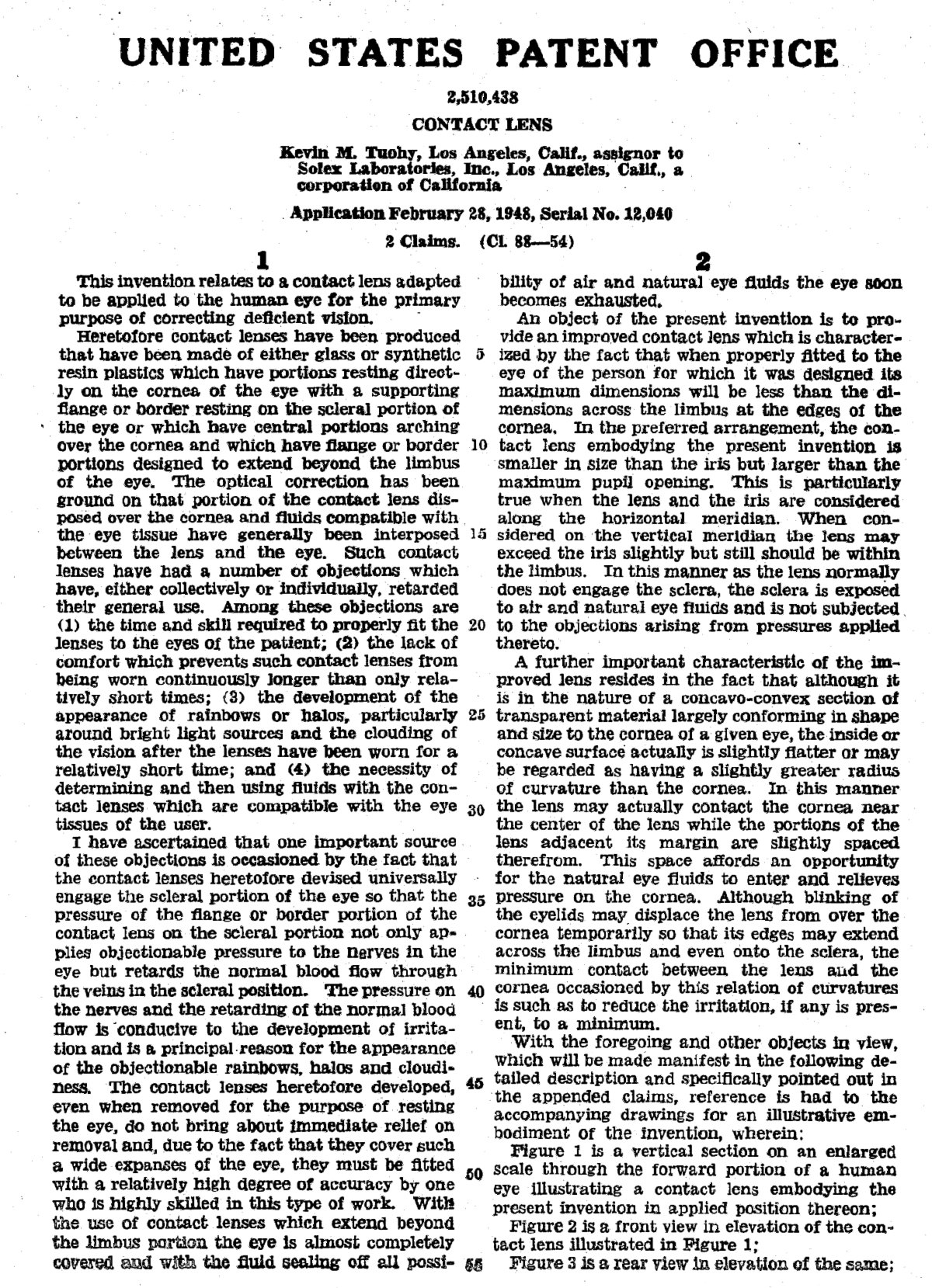
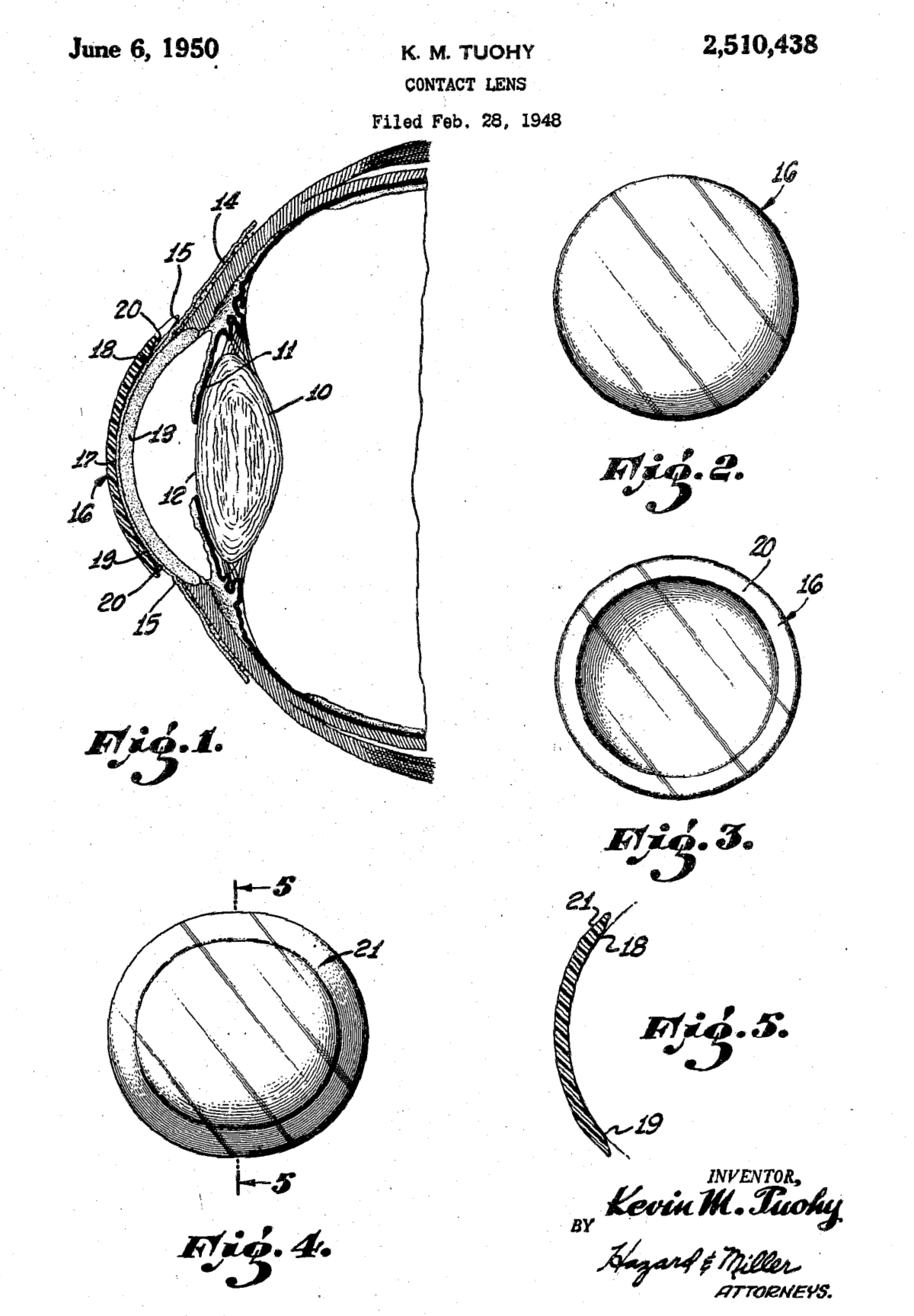
It depends a bit on how you count, but we are approaching the 75th anniversary of the rigid corneal lens! Kevin Tuohy is generally accepted as 'the inventor' of the rigid corneal lens; he applied for a patent (US 2,510,438) in 1947. The final patent was not awarded until 6 June 1950, which could be an alternative date to 'celebrate' the anniversary, as discussed with British contact lens historian Richards Pearson. Kevin Tuohy was born in New York in 1919 and started work in November 1939 with Theodore Obrig. Touhy trained as a technician before becoming a contact lens fitter and later joining Solex on La Cienega in Beverley Hills (US). While the actual truth cannot be determined, one story is that in 1947, the haptic portion of a lens broke off and Tuohy formed a better edge before trying the optic part on his eye. The base curve was about 3mm flatter than ‘K’ and the edges were very thick. Despite this, he tried the lens on several patients, and by 1948 the rigid corneal lens was launched. Tuohy lost a considerable amount of money defending the patent, including 10 years of litigation against other companies, according to the website of Andrew Gasson on the topic. That said, Tuohy and his promotion took the contact lens world by storm. He died in 1968 at only 49 years old. More information is available at the Contact Lens Museum (online and physical) at Pacific University (OR) in the US.
|
|
Contact Lens Update & Terminology |
|
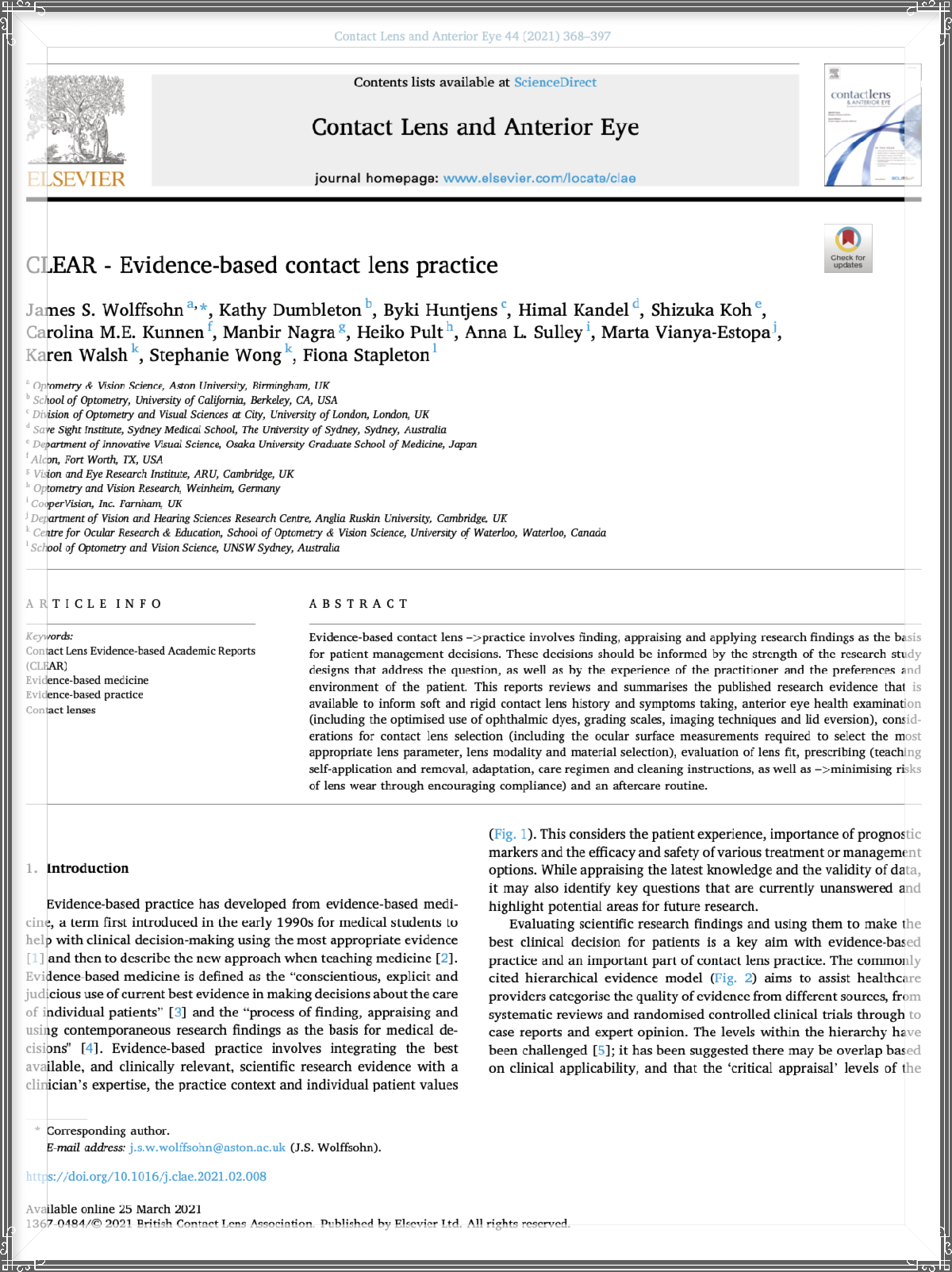
In observance of the unofficial rigid corneal lens anniversary, this edition of I-site newsletter is a 'special' on the modality. Whether a coincidence or not, the website and platform Contact Lens Update, an initiative of the Centre for Ocular Research & Education at the School of Optometry & Vision Science in Waterloo (CA), had a recent edition devoted to specialty rigid lenses, although it covers both scleral and corneal lenses. “Rigid corneal lens” is now the official terminology used for the modality internationally, as described in the Contact Lens Evidence-Based Academic Reports (CLEAR) paper. See link below (open access).
|
|
Prescribing Trends in the UK Hospital
Eye Service
|
|
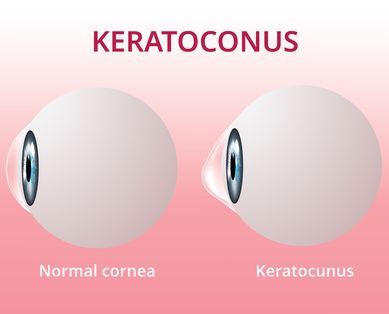
The aim of a study by Shehzad Naroo et al was to evaluate the types of contact lenses fitted by hospital optometrists within the Midlands region of the United Kingdom (UK). A questionnaire was sent to all lead optometrists in the region, and details from a total of 109 contact lens fits were collected. This included 45 females and 64 males, with a mean age of 39.4 ± 17.4 years. The mean wearing time was 6.3 ± 1.0 days per week and 10.7 ± 5.1 hours per day. Sixty-one percent of the contact lenses fitted were for patients with keratoconus, and more than half of all contact lenses fitted were rigid corneal lenses. The study highlighted that the main reason for fitting contact lenses in hospital contact lens practice is primary corneal ectasia, mainly keratoconus. While most patients with keratoconus were fitted with rigid corneal lenses, around 1 in 6 were fitted with soft contact lenses. This study addresses a gap in the literature about contact lenses fitted in UK hospitals and how they differ from community contact lens practice, the authors state.
Photo by Enric Moreu on Unsplash
|
|
Attitudes in Keratoconus Management in Latin America |
|
Answers to a questionnaire from 977 eye care practitioners with more than 10 years of experience (396 in Latin America and 581 in Europe) were evaluated. A total of 65.9% of Latin American responders prescribed rigid corneal lenses, but more than half of the respondents (54.0%) indicated they would fit more rigid lenses if they underwent further training for fitting. A majority of Latin American practitioners (74.0%) considered rigid corneal lens fitting more difficult in cases of keratoconus, requiring more diagnostic lenses (4.6 ± 2.7; median 4; range 1-10) than what are necessary for healthy eyes. Low availability of corneal topography was reported in Latin America (23%); practitioners with topographers are more likely to prescribe rigid corneal lenses (92.3%) and to detect more new patients with keratoconus per year (83.5%). A minority of respondents (25.8%) referred keratoconus patients to another optometrist, and 40.4% participated in co-management with ophthalmologists. In conclusion, the authors indicated that action needs to be taken to improve rigid lens training, facilitate eye care technology accessibility and encourage co-management between eye care practitioners to minimize disease progression and impact on patients' quality of life in Latin America. Photo Isabela Kronemberger on Unsplash
|
|
Correction of Ocular Aberrations in Keratoconic Eyes |
|
This paper by Jesus Carballo-Alvarez et al in Optometry & Vision Science evaluated the correction of ocular aberrations in keratoconic eyes and the impact on visual function using rigid corneal lenses with a base-down prism incorporated on the anterior surface. Two rigid corneal lens designs (standard and prismatic) were fitted to the same eye of each patient in a random order. The prismatic rigid corneal lens had a base-down prism of 1.6 prism diopters. Ocular aberrations were measured for a 3mm pupil diameter with and without both contact lenses, whereas high-contrast distance visual acuity, low-contrast distance visual acuity and contrast sensitivity were measured under photopic and mesopic conditions. The results showed that both lens designs improved oblique primary astigmatism, defocus, vertical coma, and coma-like and root-mean-square higher-order aberrations compared with the unaided eyes. Furthermore, the prismatic rigid lenses offered lower values of vertical coma and root-mean-square higher-order aberrations compared to the standard rigid lenses. Both designs (standard and prismatic) produced a positive vertical coma of lower magnitude than that of the negative vertical coma of the unaided eyes. In conclusion, the prismatic rigid corneal lenses corrected higher levels of higher-order aberrations compared with the standard lenses, but both contact lens designs with the same refractive power were equally effective at improving visual function. |
|
Changes in Lens Parameters after
Corneal Collagen Cross-linking
|
|
To evaluate changes in the parameters of rigid corneal lenses after corneal collagen cross-linking (CXL), 53 eyes of 41 keratoconus patients were evaluated in Qingdao Eye Hospital of Shandong First Medical University in China. The best-spectacle-corrected visual acuity, refractive power and the thinnest corneal thickness were not significantly changed over 6 weeks of follow-up after CXL, but the keratometry values in the flat and steep meridian and the maximum keratometry value (K-max) were all significantly increased in all patients. The rigid corneal lens base curve decreased by 0.07mm in the de-epithelial ('epithelium-off') group and by 0.13mm in the trans-epithelial group (two different techniques of CXL used in this study). The edge-lift design was used in 10 eyes postoperatively compared with 8 eyes preoperatively in the de-epithelial group, and it was used in 4 eyes postoperatively compared with 7 eyes preoperatively in the trans-epithelial group. The number of eyes using the toric peripheral design increased to 3 postoperatively compared with 2 preoperatively in the de-epithelial group and from 1 to 4, respectively, in the trans-epithelial group. The acceptance rate of rigid corneal lenses in both groups increased at 6 and 12 months after surgery compared to 6 weeks after surgery. Conclusions: the corneal curvature became slightly steep at 6 weeks after CXL and gradually recovered and flattened. The K-max in the trans-epithelial group decreased earlier and more than it did in the de-epithelial group. The base curve of the rigid lenses was slightly reduced after 6 weeks, and a toric peripheral design was increasingly needed. The authors concluded in the Chinese journal of ophthalmology that a good rigid lens fit can be achieved within 1 year after.
|
|
Initial Power of Rigid Corneal Lenses in Patients with Keratoconus |
|
To simplify the fitting process, this study from Iran was designed to predict the initial power of rigid corneal lenses using the regression model based on manual Javal keratometry data and refractive errors. In this retrospective study, 121 eyes of 69 patients with keratoconus were fitted with a specific trial set of rigid corneal lenses based on the standard criterion of "three-point touch" over a 7-year period. The results of multiple linear regression showed the following equation: power of contact lens = -14.368 (constant of the final multiple regression model) +0.475D (spherical refraction) +0.275D (flatter corneal power). In other words, this study indicates that lens power has a significant relationship with the power of the flat corneal meridian and with the spherical refractive error in keratoconus patients. The obtained regression model can be used to shorten patients' chair time and optometric examination time for predicting the contact lens power, according to the authors. Photo by Hush Naidoo Jade Photography on Unsplash
|
|
Global Specialty Lens Symposium 2023 |
|
Call for Free Paper & Posters |
|
The Education Committee of the Global Specialty Lens Symposium, to be held January 18-21, 2023 at the Horseshoe Las Vegas US (formerly Bally’s), invites the submission of abstracts for the presentation of Free Papers and Posters. The committee seeks topics including new and innovative concepts, clinical cases and research on all aspects of contact lenses (such as materials, designs, lens care, etc.) in addition to related topics such as corneal and ocular surface disease, diagnosis and treatment approaches, and practice management. The submission window deadline is October 3, 2022. |
|
Amsterdam, Netherlands
Copyright © 2022. All Rights Reserved
This newsletter is kindly supported by:
|
|
|
I-site is an educational newsletter that is distributed on a monthly basis and provides an update on rigid gas permeable-related topics (scientific research, case reports and other publications worldwide). I-site is objective and non-political. Disclosure: I-site's editor Eef van der Worp, optometrist PhD FAAO FBCLA FIACLE FSLS, receives educational grants from a number of industry partners but is not related to any specific company. |
|
|
|
|
|
|