Greetings from the Osher NRC.......................August 2023 | |
“Summertime, and the livin’ is easy,” might not resonate quite as much as it did in 1934 when George Gershwin wrote those famous lyrics. Nearly 90 years later, summer’s a bit harsher and busier. But we wish it to be easy and can usually sneak in at least a few days of true relaxation to enjoy it.
At OLLIs, summer is typically the time to explore a wider mix of courses and activities that don’t necessarily fit into the rest of the year’s terms. Reading catalog descriptions for summer session I get a kick out of how creative OLLIs are with courses like: Books for People too Busy to Read, The Golden Age of Mughals, Empowering through Cannabis, What’s it Like to Be a Bat, The History of Chess, Navigating Grief, and... Humans on Mars – the Dumbest Idea Ever (that’s the full title, not my opinion). We are clearly meeting our collective Osher Institute challenge to “Stay Curious” this summer.
This month our Network Newsletter has an appropriate summer assortment of contributions from OLLIs in North Carolina, Nebraska, Tennessee, and Virginia. We hope you get some ideas, tips, and inspiration from our features and our talented colleagues.
The Osher NRC team wishes you more days relaxing on chairs like the above,
| | |
|
OLLI AT VANDERBILT UNIVERSITY
OLLI Steel Band Travels to St. Lucia
| |
|
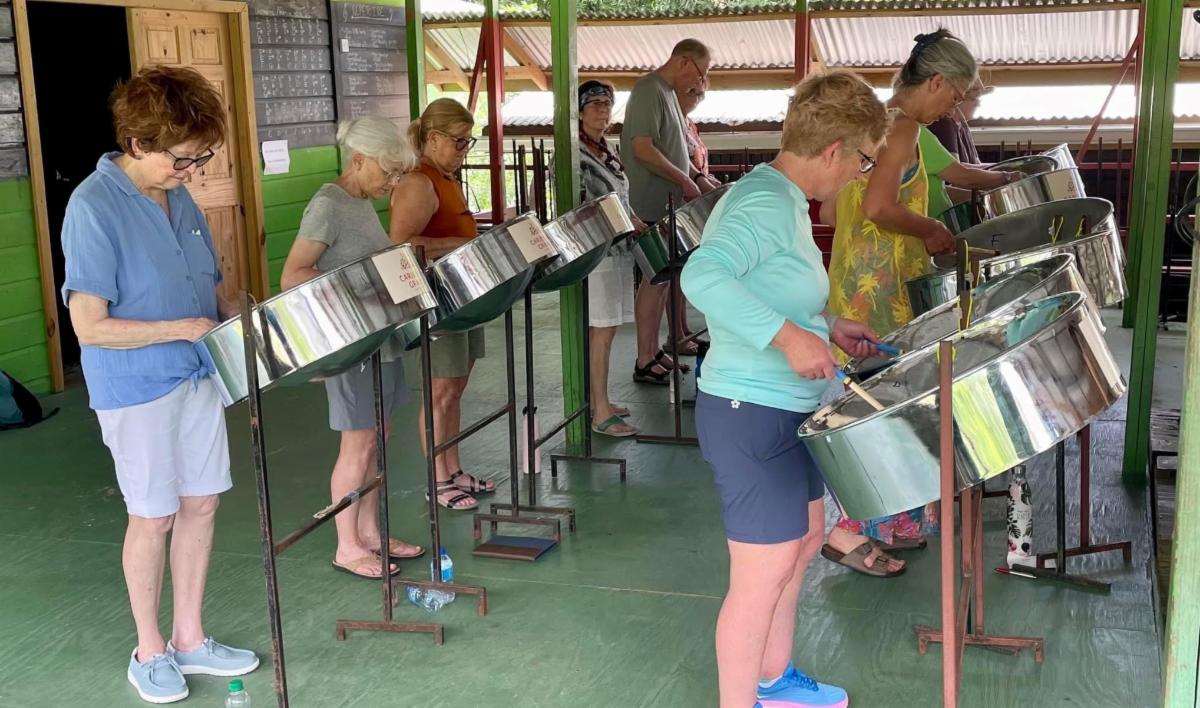
In May 2023, twelve members of the Vanderbilt University OLLI Steel Bands, and Mat Britain, founder and director of the OLLI Steel Band Program, traveled to Laborie, St Lucia, to attend a nine-day intensive steel band workshop. The workshop was hosted by the Laborie Pan Project in collaboration with the Laborie Development Foundation. Laborie is a small fishing village located on the southern tip of St Lucia, an island country in the West Indies. Mat taught alongside Andy Narell, a world renowned steel pan musician, arranger and composer.
Steel pans, the iconic island instruments, originated in the nearby dual-island Caribbean nation of Trinidad and Tobago. Developed in the early-to-mid 1900s, the steel pan has roots going back to the talking drums of West African cultures. The modern pans are chromatically pitched percussion instruments hand produced from 55-gallon industrial oil drums.
Playing in Laborie’s outdoor pan yard, the OLLI Steel Band learned three songs by rote, without using written music. Learning by rote, through repetition and memorizing the notes, is the traditional method used by steel pan musicians. Experiencing the island's heat and humidity, walking daily on challenging terrain, and working hard in intense rehearsals, the OLLI Band carried on learning three beautiful songs. The workshop culminated in a video shoot of the band playing the songs they learned, “Merci Mon Dieu” a Haitian Creole song made popular by Harry Belafonte, “People Make the World Go Round” originally recorded by the Stylistics in 1972 and later by a young Michael Jackson, and a song that was written by Mat Britain, “Sunday Soca.” Soca is calypso music with elements of soul originally from Trinidad.
The St Lucia adventure also offered picture postcard beaches, an historic sugar plantation tour, volcanic mountains, hiking, hot springs and a “healing” mud bath from a dormant volcano, group meals, and a boating and snorkeling excursion.
Mat Britain started the OLLI Steel Band Program at Vanderbilt in 2013 with twelve players. Today Mat directs the OLLI Steel Band Program teaching three OLLI steel bands, beginner, intermediate and advanced, with a total of forty-eight players. Steel pan is one of OLLI’s most popular offerings. As Mat has said “anyone can be in the beginner band, no musical experience is needed,” and for that reason there is always a waiting list to enroll in the beginner band. Being part of a band and playing music without the necessity of reading music is one of the joys of OLLI Steel Bands.
Submitted by: Norma Clippard, Director, OLLI at Vanderbilt University
| | |
|
OLLI AT UNIVERSITY OF NORTH CAROLINA ASHEVILLE
Men's Wisdom Works Groups
| |
|
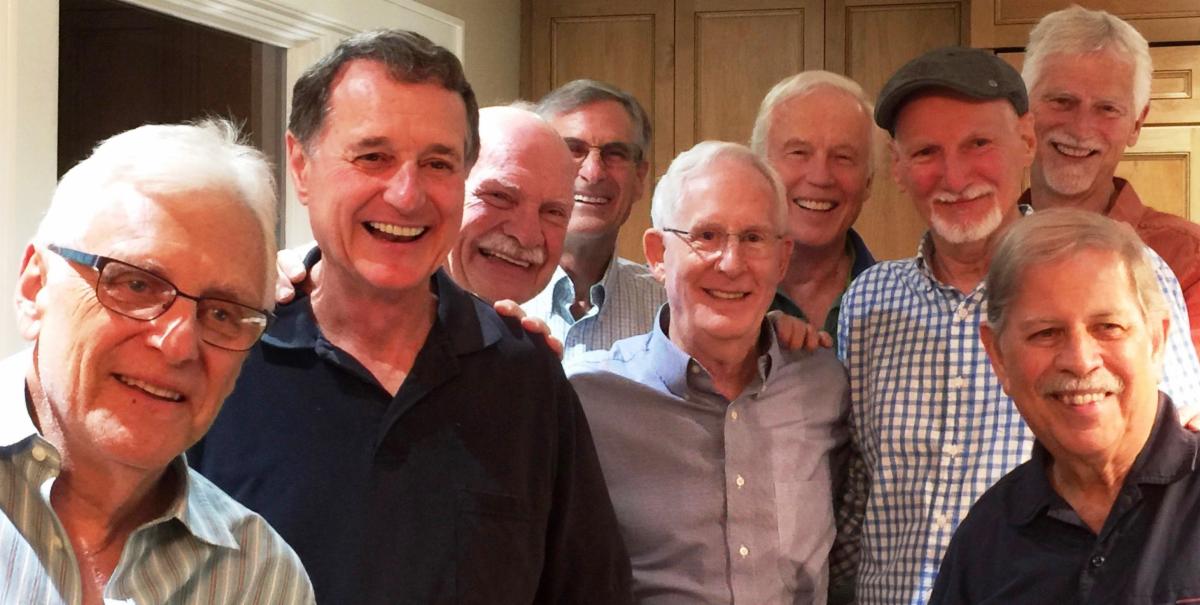
Nationally, about 35% of OLLI members are male. Some Institutes include gender in their goals toward diversifying membership. But attracting more men into membership isn’t always easy. Beyond developing courses that might appeal, building community with friendships and shared interest groups sometimes proves harder. Enter the well-established “Men’s Wisdom Works Groups,” formed in 2009 by male members themselves at the Osher Institute at University of North Carolina Asheville.
These groups of 10 to 12 members were designed to engage men in a supportive environment to explore issues facing them as they navigate life transitions and find purpose. They became popular, growing to about 20 small groups at their height, pre-pandemic. During social distancing times, many of the groups continued to meet in outdoor settings with appropriate social spacing. Post-pandemic, the groups are relaunching under the leadership of a central volunteer coordinator. Buck Bragg, the current central coordinator, helps keep group leaders organized and productive using an evolving structure of operating principles to guide them and ensure equity and solid connections. Small group leaders meet twice a year to compare notes. They seek a balance between avoiding small talk and recognizing when a member needs guidance beyond what the group can provide. The goal of the groups is to achieve deep, meaningful discussions and to establish connections that sustain men through times of change. The hundreds of men participating are at different ages and stages of retirement and have a range of life and relationship experiences. All these contrasts sustain rich conversations and build trusted friendships.
These groups prompted the development of women’s groups around 2012. The women’s groups have not had a strong central coordinator, but they too are designed to create meaningful discussion and connections.
Buck notes the secret of success for the Men’s Wisdom Works Groups lies in, “providing a non-judgmental environment, where men can meet and discuss matters with confidence and trust, listen to each other, and share their knowledge, experiences, and concerns. It’s at once a ‘safe space’ and a ‘brave place.’”
For more information, contact OLLI at UNC Asheville director, Catherine Frank.
| | |
|
INNOVATIVE COURSES AND CONTENT DELIVERY
Curriculum Corner
| |
|
Osher Institute at University of Nebraska-Lincoln
Discovering Titanic: Exploring the RMS Titanic Legend
Course Length: Three Sessions
Course Instructor: Sheryl Rinkol, Director of Titanic Education & Engagement
Course Delivery: In-person & Online
Engage with RMS Titanic’s legacy. In 1912, the Titanic was the largest ship in the world. Sinking on its maiden voyage, this technological wonder collided with an iceberg, resulting in the loss of 1,496 souls – the world’s largest sea disaster to that date. During the first session, we will focus on Titanic history, learning about The Ship’s innovative design, Edwardian life onboard, and last hours afloat. Switching to a hybrid mode, get an online glimpse of actual Titanic artifacts while hearing from a RMS Titanic, Inc. (RMST) expert and conservator about the recovery and conservation processes used. (RMST is granted salvor-in-possession rights to the wreck of Titanic and as such is the only company permitted by law to recover artifacts from the wreck site.) On the final third session, hear about the impact of Titanic leading to a 112-year international legacy. A special emphasis will be placed on TITANIC: The Artifact Exhibition (Las Vegas and Orlando), connecting artifact conservation to public display.
Of note: This class goes beyond learning the history of the Titanic and brings in a collection of artifacts from the ship. Though this course has been offered in the past, the new element for the fall term is a session offered via Zoom from the Titanic Artifact Conservation and Stewardship lab. This course utilizes both in-person teaching and virtual connection to allow students access to experience even more.
| | |
|
QUICK TIPS FOR HELPING OPERATE AN OSHER INSTITUTE
Quick Tip - Use QR Codes in Marketing Material
| | |
|
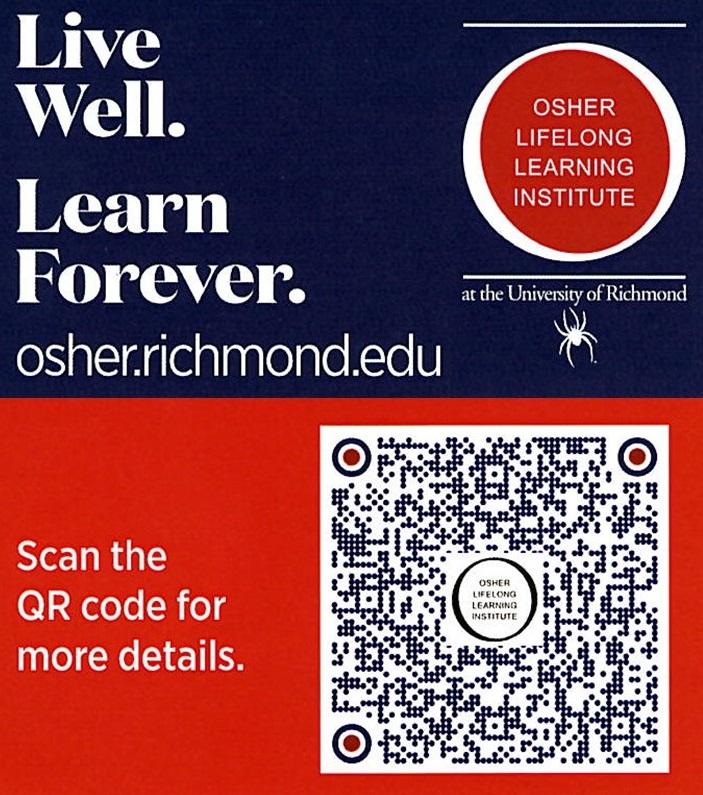
A QR (Quick Response) code is a square bar code like image that can be read by a smartphone’s camera and can direct the user to a website. QR codes work well on printed or physical marketing materials and they are free to use/generate (if you put “QR code generator” into Google you will find loads of results). Many OLLIs, including the Osher Institute at University of Richmond, have adopted this tool. To the left is an example of a business card with a QR code that can be handed out at recruitment events, farmers markets, by members to friends, etc. Other ideas could be a QR code on a postcard promoting a new term, with a link to your online catalogue, or a QR code on swag for a fundraising event, linking to a donations page. In other words, a QR code can be used in many ways as a quick and easy way to direct people to online materials or resources. | | |
|
CAREER OPENINGS IN THE OLLI NETWORK
Job Board
| |
|
National Resource Center for Osher Institutes, Northwestern University
Wieboldt Hall, Sixth Floor, 339 East Chicago Avenue, Chicago, IL 60611
| |
| | | |