|
The Corresponder
The Newsletter of the Committees of Correspondence for Democracy and Socialism
| | |
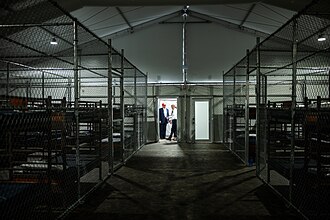
Been ICEd and sent to melt at ‘Alligator Alcatraz’:
A time for mourning
Reasons and ways to do something about the ‘Alligator Alcatraz’ detention center
August 25, 2025
8:00 – 9:30pm
Socialist Education Project
4th Monday Series
There are many reasons to want to close down detention centers since the inception of places formalized to hold and deport people. The reasons to mourn range from Native groups such as the Seminoles of eastern Florida loss of land and culture, and other peoples such as environmentalists concern about the degradation of the Earth, to plain old-fashioned understandings of human needs and rights.
| | |
The panel will be moderated by Meta Van Sickle, co-chair of CCDS, who currently lives in Florida. Her career spanned 42 years in public education from elementary through college level teaching. The emphasis of her work is caring with others, living and non-living things, and ideas.
Panelists:
Bill Gallegos is a longtime Chicano Liberation and Environmental Justice leader. He is a member of Liberation Road and is the author of “The Political and Historical Significance of the US Annexation of Mexico’s northern territories “.
Margaret Bogan, Ph.D. spent her career as an environmental educator in AL and FL. She is part of the northern FL Creek nation. Her emphasis is on native ways of interacting with our environment to protect and preserve Earth
| |
Meet the Native American tribe that beat the Trump administration in court -- for now
The Miccosukee Tribe is lauding a judge's ruling regarding "Alligator Alcatraz."
ByPeter Charalambous
August 9, 2025, 6:00 AM
ABC News Live--The temporary detention center dubbed “Alligator Alcatraz” was built on a rarely used airstrip in the Florida Everglades.
When the news broke in Florida Thursday that a federal judge had blocked further construction at the migrant detention facility known as "Alligator Alcatraz," more than a hundred members of the Miccosukee Tribe were entering the fifth hour of a contentious community meeting.
Curtis Esteban Osceola, a tribe member and attorney, interrupted the meeting to deliver the news of the unlikely victory.
"It was a roar of applause," Osceola recounted to ABC News. "Everyone was very, very pleased that the judge granted the temporary restraining order."
It's a temporary victory for an Indian tribe whose history has been partially shaped by broken promises from the United States. But temporary or not, Thursday's order put the Miccosukee -- a small tribe of less than a thousand members -- in the middle of the most high-profile use of an environmental law to challenge the Trump administration.
Less than two months ago, the Miccosukee first heard rumors that the largely abandoned airport on the outskirts of their reservation would soon be transformed into a detention complex to serve a central role in President Donald Trump's mass immigration plan. Some members at first dismissed the idea as a joke, according to Kendal Osceola, a 26-year-old tribe member -- but they quicky grew concerned as the normally quiet U.S. Route 41 was soon filled with government vehicles and construction trucks.
The video player is currently playing an ad. You can skip the ad in 5 sec with a mouse or keyboard
"When all this happened, you know, we felt alone. We felt isolated like our homelands were being trampled on," said Curtis Osceola, who serves as a senior executive policy adviser to the Miccosukee Tribe Chairman.
The temporary detention center more than doubled the residential density in the area, and the rapid expansion of the site sparked concerns that the tribe, whose members live a few miles upstream, would be harmed. The dozens of industrial light towers used at the site also contributed to light pollution, endangering the Miccosukee's ability to see the stars for their annual calendar, according to Osceola.
Curtis Esteban Osceola serves as a senior executive policy advisor to the chairman of the Miccosukee Tribe.
Peter Charalambous/ABC News
When the Miccosukee learned that a coalition of environmental groups had sued the state of Florida and the Trump administration for violating the National Environmental Policy Act, they quickly moved to join the case.
"We just want generally just to be left alone, and so when something like this gets dropped on our doorstep, it's something that we had to act on," said Curtis Osceola.
On Thursday, the environmental groups and tribe successfully convinced a federal judge in Miami to block any further construction at the site for two weeks while the case moves through the court.
U.S. District Judge Kathleen Mary Williams has divorced the case from any arguments about the allegedly inhumane conditions at the camp, focusing solely on the environmental impact of the site on the Everglades and the endangered animals that call it home. The Miccosukee's lawyers are set to present evidence this week in federal court about how they say the tribe would be harmed.
The plaintiffs are seeking more than a temporary halt of construction; they want a shutdown of the entire facility, and they hope to convince Judge Williams to issue a preliminary injunction. Florida Attorney General James Uthmeier has vowed to challenge the temporary restraining order while the complex continues "to send illegal aliens back to where they came from," Uthmeier says.
"We're cautiously optimistic," said Curtis Osceola following the issuance of the temporary restraining order. "We love the win, but we know that there is a process. We're pretty attuned to the legal process, and we know that this isn't the end."
Ten of the Miccosukee Tribe’s settlements are in the immediate vicinity of “Alligator Alcatraz.”
Peter Charalambous/ABC News
For Kendal Osceola, a Miccosukee Embassy Fellow who grew up on the reservation and hopes to raise her son there, Thursday's news was a step in the right direction.
"I want him to grow up experiencing almost the same thing as what I grew up with," she said of her son. "It's very much a step in the right direction. It's a small step, but that's usually how a lot of these big wins are made."
| | |
By Carl Davidson
Leftlinks Weekly, August 1, 2025
This past Wednesday, July 30, we decided to sit through and listen, attentively and sympathetically, to a 90-minute round of speeches by mainly young members of the Democratic Socialists of America. There were about 500 on the call overall, so it was mostly listening for those of us not on the panel, apart from whatever anyone posted in the chat.
It was titled "Fight Fascism, Build Socialism" and the speakers included Kareem Elify, Sheik Sadiq, Dan Denver, Olivia Catby, Megan Romer, Marilia Yishua, Brenna, Kate Royce, Katie Sims, Saya, Lira, Iman Abdulhadi, and Astra Taylor. They all highlighted DSA's successes in organizing against ICE, opposing genocide in Gaza, supporting trans rights, labor battles, and recent victories in a few electoral campaigns, including the wide-ranging impact of the Zoran Mamdown campaign in NYC.
The call emphasized the need to join DSA for collective action, strategic organizing, and building itself as a powerful socialist movement. The discussion emphasized the strategic nature of the right's policies, particularly the ongoing genocide in Gaza and the massive investment in Homeland Security and ICE, which includes offering student debt relief for recruiting ICE workers. Labor victories and battles were summarized along with Trans activism.
The speakers all highlighted interconnections of issues and advocated for a "solidarity statecraft’ fostering shared purpose and joining DSA. The conversation concluded with a call to action against fascism, urging collective involvement and solidarity among workers and activists.
As one among the veterans of much student organizing from our ‘Glory Days’ in the 1960s, I tried to transport ourselves from those years into theirs today. It was a good exercise. Time and again, we could hear the echoes of our voices back then. We could also hear new things that, for better or worse, were not our concerns in those days, like electing a mayor of New York City.
About an hour into the presentation, a long-held motto of mine popped into my mind. To do well in left and progressive politics, you need two things: 1. Clarity and determination on your most closely held values. 2. Knowing how to listen and how to count. Wednesday’s panel was very good at the first point, but not so good on the second.
For example, it’s fine to promote the work DSA has done in building this year’s waves of 50501 protest actions. But it's not fine to suggest that it’s nearly all DSA in the lead, nor is it the way to defeat fascism by primarily winning socialism. The mass insurgency against fascism in recent months, for example, has been initiated and led, in a considerable part, by Indivisible and the Working Families Party. Here in Beaver County, the ‘No Kings’ event was initiated directly by the local Democratic Party, which then sought and found wider allies.
But the speakers on this panel either ignored these organizations or disparaged them in various ways. In all of the presentations, it’s hard to find any reference to Democrats that doesn’t simply lump them all together with the party’s top leadership. Moreover, they are singled out as the cause and enablers of fascism. While there is some truth to this, it is largely false in fully explaining the overall rise of the ‘new right’ in the 1970s onward, then into the ’Tea Party’ and the rise of New Confederates in the Trump campaigns bloc, which was built around racist conspiracy theories about Obama and Hilary Clinton, then coupling these with demagogy about ‘invasions’ of immigrants.
Why does this matter? Because this more accurate assessment is needed to make a ‘better count’ of all the forces across the full terrain. On that terrain, you’ll find lots of Democrats from the local, statewide, and even national level. You’ll also find center force and anti-MGA right forces. One speaker did mention the ‘No Oligarchs’ mass rallies organized by Bernie and AOC, who heads up the unmentioned Justice Democrats, and both of them take part in the unmentioned Congressional Progressive Caucus, also a ‘No Kings’ ally.
Fascism in our country today is going to be defeated by a broad anti-fascist coalition with a variety of viewpoints and constituents. Some will aim to defend the Constitution and restore the status quo before Trump. Others will partially agree with them, but aim for something beyond the old status quo, for a new abolition democracy framed as a Third Reconstruction. And yes, another good number with be with DSAers aiming for an immediate transition to socialism as the way to defeat fascism and capitalism together at once. But if we count well, they will likely be a large and militant minority. That is what we mean by the importance of ‘knowing how to count.’
An antifascist coalition will include many non-socialists and even anti-socialists. They are still welcome to join and express their views. But they will be strongly opposed if they ever try to exclude socialists from the common front, an impossible task in any case.
Finally, we’ll note that there was no call for ‘left unity’ with other socialist organizations, in order to form something new and larger than the sum of all their parts. The panel’s plan for left unity was expressed in two words: Join DSA. While we do not quarrel with that as one piece of it, DSAers with that view need to do a better count of the socialist left. Those groups will vary; some can unite, others will not. And while it’s needed to approach many of them, it's not required to include all of them.
The DSA panel also expressed an inaccurate view on the opposition to Gaza and solidarity with Palestine, making the point that ‘Progressive on everything but Gaza’ was simply a term for reactionaries.
Those of us who have labored in the peace movement for many years know this is inaccurate. We know a good number of people who have worked for peace for decades, but still hold flawed views on Israel. We know Catholic Sisters who have been terrific partners with us on many campaigns, but are internally divided on Gaza. Many of the older sisters still incorrectly view Israel as a refuge from the aftermath of the WW2 Holocaust, while younger sisters are more in tune with Palestinian-American communities and have learned to view Israel and anti-Semitism in a new and more progressive way. And the same divisions that exist here among the Sisters still exist in the wider peace movement as well.
We also know of several Members of Congress who, in the past, could wear the label, ‘progressive on everything but Israel.’ We made it our business to constantly educate and pressure them. The ‘Squad’ has done this in the House, and Bernie has done so in the Senate. This week, we finally saw it erupt positively when half the Democrats in the Senate signed on to a Bernie-initiated letter calling for a ban on delivering certain weapons to Israel until there was a real ceasefire in Gaza, one that allowed food and other assistance to all Palestinians suffering under the current genocidal state of siege.
The wording and demands of this letter can be considered lame and too minimal by much of the Palestine solidarity movement. We could even agree, but this misses a key point. The Israeli Likud strongly opposes it, while other Israelis are glad to see it. It represents a breaking point, and it's likely to be followed by many more with stronger demands. Some battles are often not won all at once, but inch by inch.
We’ll conclude with a strong point about the panel. It was very clear on the need to focus not only on the genocide in Gaza, but also the rise of ICE as a paramilitary fascist force in the U.S. They did well in listing all all ways DSA has fought it, and even educated us on how the Depatment of Homeland Security was offered to dismiss student loans held by new young recruits needed as Trump’s new Gestapo.
We want DSA to succeed in its own terms. It has several major internal groupings, such as Groundworks and the Socialist Majority Caucus, that are doing good work in that direction. Others are pulling in mixed or opposing directions. That is natural for an organization as large as DSA. We are hopeful that its upcoming convention finds common ground that can help it succeed.
| |
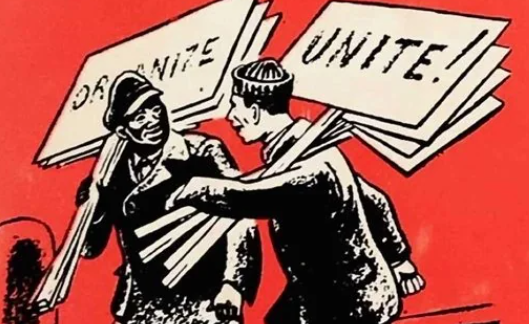
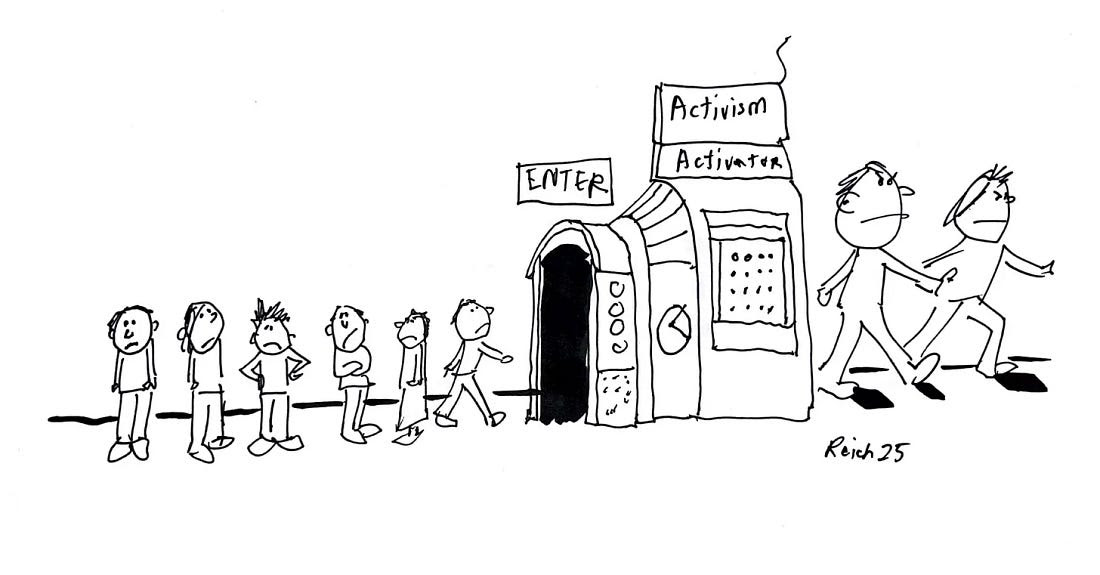
You can organize it.
Robert Reich
Aug 11
Friends,
Many of you responded to my “What You Can Do Now” post last Thursday with additional initiatives and ideas.
Here’s a particularly important one.
As you’re painfully aware, Trump’s ICE is rapidly morphing into a national police-state — targeting legal immigrants as well as the undocumented, some of them awaiting their asylum hearings, others working with approved green cards. Many have been hardworking members of their communities for decades.
Soon, 10,000 more ICE agents will join the ranks of this federal police force — covering their faces with masks, wearing no identification badges, and driving unmarked cars — taking people from their homes and jobs and sending them to crowded and unsanitary prison camps like Florida’s new “Alligator Alcatraz” or to prisons in other countries.
How can we fight this? The Trump regime is threatening sanctuary cities and towns with loss of federal revenue. Some states, such as New Hampshire, have passed laws making it illegal for cities and towns to provide sanctuary for immigrants and others.
But the Trump regime cannot prevent us from joining together with other citizens to become a Sanctuary Community — providing assistance to families whose lives and well-being are threatened by Trump’s federal police.
Sanctuary Communities — which are being organized around the country — simply announce themselves publicly and take steps such as:
- monitoring and documenting ICE raids,
- establishing an early-warning system to announce where ICE is making arrests,
- witnessing and videotaping arrests and disappearances,
- providing information to national and state media,
- meeting with state and town officials to oppose local law enforcement collusion with ICE,
- speaking with community groups, houses of worship, libraries, hospitals and clinics, veterans groups, schools, and colleges about ICE mistreatment of citizens and immigrants,
- raising funds for emergency assistance, and
- joining other Sanctuary Communities across the nation to stand against the proliferation of police-state tactics that do not represent our shared values as Americans.
Taking a stand against Trump’s emerging police state is not just about immigration and community. It’s a stand against fascism.
The courts alone cannot thwart fascist rule. The media alone cannot do it. But large numbers of American citizens rising up to oppose this police state can. Sanctuary Communities provide a means of protecting the rule of law and salvaging our democracy.
It’s not complicated to organize a Sanctuary Community. As I said, they’re being organized all over America. They don’t require national coordination or national leadership.
You can start one by reaching out to friends and neighbors. Together, you announce you have formed such a community and will take necessary steps to resist the demise of human rights and democratic principles.
Doing this is not without risk. The Trump regime has been willing to trample on civil rights and civil liberties in pursuit of its goals. Some Americans who have sought to protect vulnerable people have been arrested.
But if there was ever a time for citizen action, it is now.
(Connect through: We.Are.Sanctuary.Communities@gmail.com)
| | |
THE COMMITTEES OF CORRESPONDENCE FOR DEMOCRACY AND SOCIALISM (CCDS) Endorses the Hague Group Resolutions
The Hague Group, formed by nine nations in January 2025 to express concern about Israel’s genocidal policy in Gaza and the West Bank met in emergency session in July and adopted six resolutions listed below. Twelve countries adopted the resolutions and 30 countries (including the Republic of Ireland), primarily but not exclusively from the Global South attended and indicated they would bring the resolutions back to their countries. The resolutions in part declared the commitments of signatories to:
1. Prevent the provision or transfer of arms, munitions, military fuel, related military equipment, and dual-use items to Israel, as appropriate, to ensure that our industry does not contribute the tools to enable or facilitate genocide, war crimes, crimes against humanity, and other violations of international law.
2. Prevent the transit, docking, and servicing of vessels at any port, if applicable, within our territorial jurisdiction, while being fully compliant with applicable international law…
3. Prevent the carriage of arms, munitions, military fuel, related military equipment, and dual-use items to Israel on vessels bearing our flag, while being fully compliant with applicable international law….
4. Commence an urgent review of all public contracts, in order to prevent public institutions and public funds, where applicable, from supporting Israel’s illegal occupation of the Palestinian Territory which may entrench its unlawful presence in the territory, to ensure that our nationals, and companies and entities under our jurisdiction, as well as our authorities, do not act in any way that would entail recognition or provide aid or assistance in maintaining the situation created by Israel’s illegal presence in the Occupied Palestinian Territory.
5. Comply with our obligations to ensure accountability for the most serious crimes under international law through robust, impartial and independent investigations and prosecutions at national or international levels…
6. Support universal jurisdiction mandates, as and where applicable in our legal constitutional frameworks and judiciaries, to ensure justice for all victims and the prevention of future crimes in the Occupied Palestine Territory.
https://thehaguegroup.org/meetings-bogota-en/
| |
The Metro NYC CCDS has prepared a letter to Editors of local newspapers re the misuse of "antisemitism."
submitted by Georgia Wever
To The Editor:
Charges of antisemitism are easily tossed about recently. The practice needs close examination. I have seen that it isn’t always an effort to protect Jewish people. It has become a cover for a number of agendas that have nothing to do with the welfare of Jews
Trump's 2025 order escalates the meaning of antisemitism and directs federal agencies to prosecute and remove protesters. Shortly after the order was issued, Trump slashed $400 million in federal funding from Columbia University to force it to expel Muslim students. Many deportations have resulted - people who have written, taught, protested or spoken of the war on Gaza.
Some say protests against the Israeli bombing of Palestine are evidence of antisemitism because they criticize Israel or Zionists. Such charges of antisemitism can be a way to silence dissenting opinions. Some protesters are Jews, themselves, who reject being stamped as Zionist. Some Colleges have deported students by claiming they need "protection from harassment" by Jewish students. What is wrong with this picture?
We must seek ways to foster honest discussion of Israel's actions in Gaza. The new use of antisemitism changes the meaning of free speech in the USA. It is something to think about seriously.
| |
|
from Linda Sarsour:
"It’s hard for me these days to articulate my thoughts & take my friends and community through nuanced conversations. My mind in genocide doesn’t work the same.
"Just so I am clear: Apartheid Israel shouldn’t get ONE DIME from us. Ever. A state that maims, kills and steals doesn’t deserve our hard earned tax dollars. Ever.
"As for the conversation on the vote on the Marjorie Taylor Greene amendment to end aid for defense missile system for Israel requires more nuance not because of the substance but because of the process. There’s always more than just what we read on the internet. And to me, it was a set up by the GOP. All the Democrats including AOC, voted AGAINST the entire defense bill which is what we want. They voted NO on every single amendment. I also acknowledge and agree that Members of Congress have a responsibility to better communicate their decisions and sometimes their explanations might disappoint us, but it doesn’t always make it wrong.
"No one is immune to criticism. That’s our job as constituents to share our feedback. My point is not to throw the baby out with the bathwater. AOC, Andre Carson, Delia Ramirez, Ayana Pressley, Pramila Jayapal, Mark Pocan, Chuy Garcia, Lateefah Simon, Nydia Velasquez and others voted NO on the defense bill. They are ALSO co-sponsors of the Block the Bombs Act - an actual piece of legislation that BLOCKS offensive weapons/bombs to Israel that our movement has worked on. These are people who are not perfect (no politicians are) that have demonstrated solidarity with us at a time when so many in power have stood in our way.
"So these folks aren’t my enemies. They are the very few we have in Congress we can engage with and we sometimes won’t always agree and that is to be expected.
"But let me be crystal clear: a no vote on a symbolic amendment set to fail put forth by an anti-Black, anti-immigrant, anti-women white supremacist legislator from Georgia who still professes her support for Israel is not the end or the beginning for me. She’s not my champion even if a broken clock is right twice a day."
| |
The Genocide in Gaza is the Shame of Us All
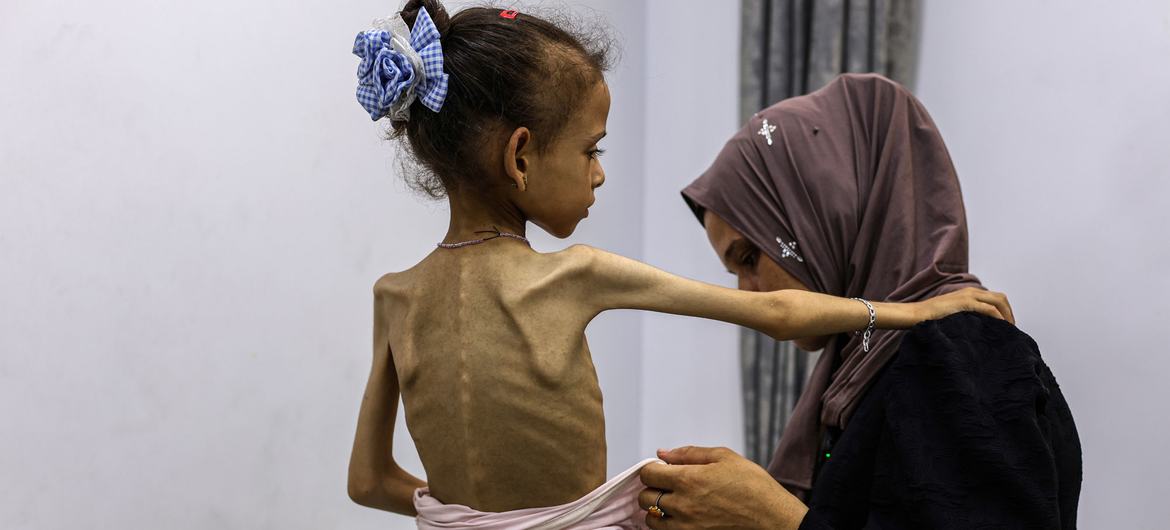
This is what it has come to: Israel is forcibly starving Palestinians. And when Palestinians go to the places Israel has designated as food distribution sites, they shoot them to death.
I will repeat that: Israel is forcibly starving Palestinians. And when Palestinians go to the places Israel has designated as food distribution sites, they shoot them to death.
Health authorities in Gaza said that 19 people died of starvation yesterday, including at least one infant.
Also yesterday, Israel killed 115 Palestinians – 92 of whom were shot while seeking food from the so-called “Gaza Humanitarian Aid Foundation” in Zikim, in Northern Gaza. Israeli troops opened fire and massacred at least 79 Palestinians as they gathered to wait for 25 aid trucks from the UN World Food Program.
One of those killed was Raed Sindy, who was killed while attempting to access aid for his family. His brother Ahmed said, “They go out just trying to stave off their hunger and the hunger of their children, but they come back wrapped in shrouds.”
And this was just Sunday. Identical massacres and reports of death by starvation have been occurring regularly for months. We know this.
We know this because it has been happening in plain view of the world. Although this news has been all but pushed aside in the mainstream media, it is readily available on Al-Jazeera and alternative news sites and through social media.
Most importantly, we know this because Palestinians themselves have been telling us: reporting on their own genocide every day, in real time. Every day, I scroll through my mobile device and see videos of decapitated babies, corpses pulled from the rubble of bombed houses, bodies burned beyond recognition.
We also know that Israel is building a concentration camp for Palestinians in Rafah, a major southern center which has been completely reduced to rubble. The Israeli Defense Minister is calling it a “humanitarian city,” which will accommodate an initial group of some 600,000 displaced Palestinians. It would then be expanded to accommodate Gaza’s pre-war population of some 2.2 million people. They would not be allowed to move to other areas in Gaza but would instead be encouraged to “voluntarily emigrate” to unspecified countries.
So many of us who have been protesting Israel’s genocide in Gaza for the past year and a half have warned that this what it would come to: the total ethnic cleansing of Gaza. Now it is happening in front of us, for all too see: by bombs, by bullets, by starvation and by forced emigration.
In the decades after the Holocaust, a number of books were written that took the American government and the Allies to task for its inaction during the genocide against European Jewry. But even in that case, it could be argued that while we knew much of what was going on, we didn’t know the full extent of the heinous reality that was the Final Solution. In this case, we have no such excuse. This plans of this genocide are being announced openly and without shame by its perpetrators.
They are doing so because they know they no one will stop them. Not the US government, which is funding and supporting this genocide, not the international community, which is either aiding and abetting or simply wringing its hands. Not the UN, nor the ICC nor the ICJ, which can make pronouncements but have no power of enforcement.
The destruction of the Palestinian people in Gaza is the moral outrage of our time. Shame on every government and institution that has the power to stop it and has refused. Shame on every individual who had the power to lift their voices against this outrage and has remained silent.
For shame. For shame on us all.
| | |
MAGA Can't Say It Wasn't Warned
Carl Davidson
Aug 10
LeftLinks Weekly for August 8, 2025
Of all President Donald Trump's crimes and corruptions appearing since his re-election, restoring a statue of a little-known Confederate military figure seems small in the scope of things, even for Trump.
His plate this week is rather full, with intrigues around the Jeffrey Epstein files, his pending face-to-face meeting in Alaska with Russia's Vladimir Putin over Ukraine, the genocidal disaster exposed daily in Gaza, and all the economic wreckage of his tariffs and firings of the bearers of bad news. All that should be make anyone's head spin.
But somehow the statue of Confederate General Albert Pike, stored in some obscure corner in D.C., was urgently to be returned to its stone base near Judiciary Square. It had been torn down by Black Lives Matter protestors a few summers ago. But park employees got new instructions from a March 27 Trump directive entitled, we kid you not: 'Making the District of Columbia Safe and Beautiful and Restoring Truth and Sanity to American History.' Other things in tune with this 'Beautification' measure were removing a picture of and quotes from Harriet Tubman from the National Park Service's webpage on the Underground Railroad. Similar stupidities were being enforced over at the Smithsonian Institution's Museum.
So who was Albert Pike anyway? According to Newsweek, 'Pike was a lawyer, poet and writer who played a major role in developing the judiciary in Arkansas before the Civil War. He was also a prominent Freemason. During the Civil War, he commanded the Confederacy's Indian Territory, raising troops there and exercising field command in one battle, according to the Encyclopedia of Arkansas.
Pike's career was a bit weird, to put it mildly. Commissioned as a brigadier general in the CSA, he lasted less than two years. The men under his command were accused of scalping Union troops. Forced to resign, he got a reprieve from President Andrew Johnson and moved to Washington, D.C., where he died in 1891. Some investigators also assert he was in the KKK, but a statue of him went up anyway to glorify the Confederacy in 1900.
The context here, unfortunately, has largely been forgotten by many Americans. After the final violent overthrow of Reconstruction in 1876, Rutherford Hayes became President in exchange for removing all federal troops from the South. The 'White Redeemers,' aka, Southern Bourbons and their KKK death squads, proceeded to erase anything having to do with Blacks in American politics. Part of this work extended beyond the South and into the new century, to include erecting statues of Confederate officers and leaders everywhere, including in 1900 in D.C., the nation's capital. 'Black Reconstruction,' on the other hand, was obliterated from history, saved for an inglorious account of the battles in D.W. Griffith's three-hour classic film, 'Birth of a Nation.' It was not until the Second Reconstruction of the 1960s that the true story of the Civil War and the revolutionary ten years that followed into the 1870s were resurrected in public memory.
The Second Reconstruction was overturned with the rise of the New Right in the 1970s, continuing to the rise of Trump and MAGA. With the massive protests following the murder of George Floyd and others, we can argue that a Third Reconstruction has begun, even down to a small band of activists toppling a racist statue in D.C. In the summer of 2020's tumult, voices roared and banners bloomed. Black Lives Matter demonstrators, protesting against injustices old and new, converged upon the monument. With impassioned hands and shouts that echoed down the Capitol’s marble corridors, they toppled the statue, sending both metal and memory to the ground.
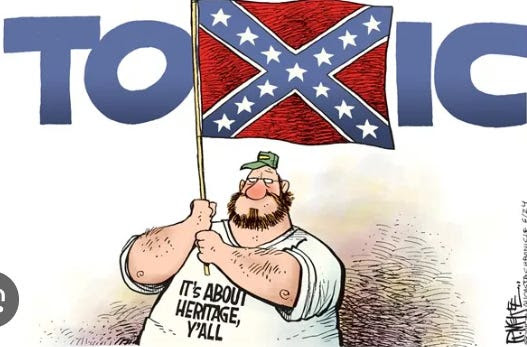
Today Trump would have us believe the statue was not merely a relic of the Confederacy but a piece of American heritage--an artifact of the nation's "imperfect, indomitable" past. Trump himself attended the unveiling, standing before a crowd as divided as the past it evoked. "We honor our history--not because it is perfect, but because it is ours," he declared.
So we are to 'honor' the Confederacy despite its instigation of a war that took over 500,000 lives, more than all the rest of 'our' wars combined.
But here's where it begins to make sense beyond mere memories of 'heritage.' The Civil War and its outcome left three lasting reminders: the 13th,14th, and 15th Amendments to our Constitution. Buried in the contending factions in the MAGA movement, we can find those aiming to cripple these Amendments today, if not get rid of them altogether.
The 14th is their foremost and most hated item. It clearly proclaims that 'all persons' in the U.S. have the same rights to 'due process' and 'equal protection' as any U.S. citizen. Many Americans today are nonplused when they read the actual text. They firmly believe, incorrectly, that non-citizens have no rights they are bound to respect. The 14th Amendment also states that anyone born here--save for children born of mothers residing in foreign embassies, which are not under U.S. jurisdiction-- is automatically a U.S. citizen, too. This drives both Trump and Stephen Miller, his immigration czar, into a tizzy, trying one flawed measure after another to get rid of it. Their minions are also nibbling at the 13th, trying to find ways to place seized immigrants into a state of involuntary servitude. And the 15th Amendment has been under a long attack to undermine the Voting Rights Acts of the 1960s.
All this adds up to why some of us insist on defining MAGA as neoconfederate, in addition to fascistic and theocratic. It's an essential item in shaping the MAGA inner core as 'fascism with American characteristics.' And the more we understand it, the better armed we are to defeat it. It is not simply an ugly and unwarranted statue. It represents the 'clear and present danger' demanding both a hard core and a wide front to defeat it now, in its earlier years, rather than later, when it will be even stronger.
| |
Wednesday, July 16, 2025
GROUNDING BRICS IN THE HISTORY AND THEORY OF THE NORTH/SOUTH STRUGGLE
(The shape of the international system is changing dramatically. The era of western colonial control of much of the world is being seriously challenged. And, more recently, the bipolar world established after World War 2-from the anti-communist military alliance system to the Bretton Woods system of financial control, to the ease of big power military interventions is weakening.
The latest iteration of these challenges, perhaps the post effective, is being waged by the BRICS organization described below. It may be the case that BRICS will constitute the most organized, powerful challenge to the old order. And this challenge offers the possibility for the establishment of an international system based on multilateral cooperation, reduced violence, and some more effective collaboration to challenge the global environmental crisis.
While nothing is guaranteed those supporting peace and justice should work in solidarity with sisters and brothers in the Global South.
https://peoplesworld.org/article/heir-to-the-non-aligned-movement-brics-presents-alternative-to-u-s-hegemony/ )
A repost from 2020
Harry Targ
Class Struggle is Global
Looking at the history of what is called international relations, the world has experienced various stages of development (or underdevelopment). First, in the era of primitive accumulation, as Marx described, rising military powers in Europe traversed the globe. They occupied land inhabited by various peoples and kidnapped laborers from one part of the world and transported them to another as forced laborers. They developed trade, invested in profitable overseas production, and expropriated vital natural resources to facilitate their own economic development. Killing the occupants of the land and kidnapping Africans to become slaves in the Western Hemisphere, Marx said, signaled the dawn of “civilization.”
Thus, we can speak of class struggle whether the topic for discussion is land grabbing, enslavement, extracting resources, or transforming local economies to fit the needs of the colonial powers. Andre Gunter Frank suggests that looking back at the birth of capitalism as a world system, we see the seeds planted for “the development of underdevelopment.” The economic circumstance of what would become the Global North is growing riches and for the Global South deepening poverty and immiseration.
Class Struggle and Resistance
But what dependency theorists, scholar/activists such as Walter Rodney and Frantz Fanon, and Marxists from Latin America add to the narrative is the fact that capitalist imperialism periodically generates resistance and rebellion, sometimes class struggle, on a global basis. Contemporary theorist, Vijay Prashad (The Darker Nations: A People’s History of the Third World, New Press, 2008) reminds us that the globalization of capitalism from the seventeenth to the twentieth centuries generated resistance, rebellion, and revolution. Haiti, for example, represented a paradigmatic revolution, overthrowing French colonial control in 1804.
And during the nineteenth century and the first half of the twentieth century anti-colonial campaigns spread throughout the world. In 1945 there were 51 nations in the new United Nations organization and by 1970 there were 170. People had liberated themselves from the formal bonds of colonialism. Along the way anti-colonial campaigns gained support and solidarity from people of color within colonial countries and national liberation movements across state boundaries in the struggle for independence. In addition, revolutionaries overthrew colonial and/or neo-colonial powers in Cuba, Vietnam, Angola, Mozambique, and Nicaragua.
Once independence was achieved, “new” nations began to collaborate around an anti-colonial, anti-neo-colonial agenda. Many met in Bandung, Indonesia in 1955 and formed a Non-Aligned movement in 1961, expanding its membership and loyalties to 120 countries today. Its motivation was to break the traditional bonds of colonial control, to reduce the continuing relationships between the former colonial powers and “their” colonies, and to rectify historic forms of exploitation and expropriation of value. This, dependency theorists suggest, included challenging indigenous ruling classes in poor countries who owed their allegiance to collaboration with the former colonial powers. The bottom line for newly independent countries was to rectify the grotesque economic inequalities that were the legacy of colonialism and to achieve national sovereignty.
Along with the creation of a non-aligned movement, leaders of the Third World in the 1960s and 1970s campaigned for global adoption of a New International Economic Order (NIEO). This program was introduced in the United Nations. It called for the creation of rules and regulations that would regulate global capitalism so that it was not so disadvantageous to countries of the Global South. Proposals involved facilitating technology transfer from the Global North to the Global South, reducing onerous rules about “intellectual property rights,” hiring corporate executives from the host country, and establishing requirements that minimal amounts of profits derived from foreign investments stay in the host countries where production occurred. These and other proposals were designed to “reform” global capitalism such that the growing economic inequalities between rich and poor would decline.
And to cap off the demands for global reform, spokespersons from the Global South introduced a plan for a New World Information Order (NWIO). This plan was designed to increase the amount of input citizens of the Global South could have in the production and dissemination of information about their own countries. This was needed because monopoly media organizations from the Global North controlled and framed most of the information about the world, including the Global South.
The response of western imperial powers to the NIEO and the NWIO was to inalterably oppose virtually every proposal made. They objected to any restraints on the complete autonomy of international corporate and financial capitalists operating in the Global South. In addition, they resisted the right of countries of the Global South to have any control over the production of narratives about their countries.
And in response to growing mobilizations of countries and peoples of the Global South, financier David Rockefeller from the then Chase Manhattan Bank, called together 200 bankers, corporate CEOs, a few trade union leaders and politicians from Europe and North America to establish The Trilateral Commission in 1973. The founding documents warned of the greater dangers to global capitalism from unrest in the Global South than from the Soviet Bloc. They hired Zbigniew Brzezinski to administer the new organization and they commissioned scholars such as distinguished US political scientist Samuel Huntington to draft position papers for the organization. In one paper Huntington warned of the “excess of democracy.” In other words, the increased activism within societies and between societies constituted a threat to stability and the global status quo.
By the 1980s, the Soviet Bloc weakened, collapsing in 1989. The countries of the Global South became entrapped in a debt system that required them to adopt new austerity policies that worsened the conditions of life of their citizens. The policies, known as “neoliberalism,” spread across the globe. Many leaders of formerly anti-colonial regimes, including some independence leaders, began to collaborate with the international overseers at the International Monetary Fund and the World Bank.
Economic inequality on the world stage grew. At various times 10-20 percent of the world’s population lived in abject poverty and another 20-30 percent at living standards below a livable income. As the living conditions for the world’s citizens worsened, the globalization of production increased and smaller numbers of huge banks began to control more and more of the world’s economic life.
Twenty-first Century Resistance to Neo-liberal Globalization Grows
An upsurge of resistance to the worsening plight of much of the Global South began to occur in the 1990s. The day the new North American Free Trade Agreement (NAFTA) went in effect in January, 1994, Sub-Commander Marcos of the Zapatista Movement (EZLN) in Mexico announced a new campaign against neoliberalism.
In addition, the formation of the World Trade Organization (WTO) in 1995 and the spread of neoliberal policies spurred growing resistance to globalization as citizens demanded their countries reject IMF imposed austerity programs. The anti-globalization campaign, based on grassroots movements from the North and South, gained worldwide attention during the founding meeting of the WTO in Seattle, Washington in December, 1999. The “Battle of Seattle,” signaled a global recognition that neoliberal globalization was bringing together activists from everywhere to challenge the globalization of capitalism. A World Social Forum assembled in Porte Allegre, Brazil, in 2001 with thousands of people from women’s, labor, indigenous peoples and other organizations. Their rallying cry was “Another World is Possible.”
In 2011, Arab Spring signaled another form of grassroots opposition to the further exacerbation of capitalism both within and between countries. Over the next several years, protests were initiated by various sectors of the working class, such as the precariat and “yellow vests,” indigenous peoples, women, people of color, gays and lesbians. These campaigns often generated expressions of international solidarity.
And it is in this emerging global class struggle that the Bolivarian Revolution emerged. Army officer Hugo Chavez was elected President of Venezuela in 1998. Subsequently he initiated changes and responded to demands for change from Venezuelan workers to build grassroots political institutions, form workers cooperatives, and to redistribute some of Venezuela’s oil wealth. Venezuelan policies significantly reduced the number of citizens living in poverty, increased access to health care and education, and encouraged the building of grassroots political organizations.
The Bolivarian Revolution, as it was called, borrowed from nineteenth century Latin American leader Simon Bolivar who struggled to achieve national sovereign control for the peoples of the region. The twenty-first century variant, led by Chavez, included initiating a regional Latin American bank, expanding trade agreements, and inspiring grassroots mobilizations in countries in Latin American and the Caribbean. Some variants of economic populism and grassroots political institution-building occurred in Bolivia, Ecuador, Nicaragua, Honduras, and El Salvador, Brazil, Argentina, Chile, Paraguay, and Uruguay. In addition, some Latin American countries began to collaborate worldwide to challenge the power and prerogatives of global capitalism.
The BRICS (Brazil, Russia, India, China, and South Africa), for a time, discussed ways to challenge the economic and political hegemony of the traditional great powers. Much of the Bolivarian Revolution was inspired by the Cuban revolutionary model of economic distribution, health care and education programs, and international solidarity. read more
| |
|
Remembering Hiroshima and Nagasaki
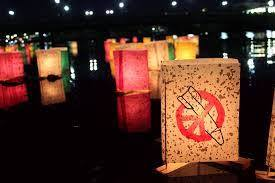
Lanterns for Peace
Peace Action Wisconsin
Saturday, August 9, 2025, 6-9 pm
Zao MKE Church, 2319 Kenwood Blvd. Milwaukee
Peace Action Wisconsin will hold a remembrance of the 80th anniversary of the atomic bombings of Hiroshima and Nagasaki and renew its commitment to a world free from nuclear weapons.*******************************************************************
REVISITING "AMERICAN EXCEPTIONALISM:" HIROSHIMA AND NAGASAKI (an August 5, 2017 repost)
Harry Targ
Continued study and research into the origins of the folk music of various peoples in many parts of the world revealed that there is a world body-a universal body-of folk music based upon a universal pentatonic (five tone) scale. Interested as I am in the universality of (hu)mankind-in the fundamental relationship of all peoples to one another-this idea of a universal body of music intrigued me, and I pursed it along many fascinating paths. Paul Robeson, Here I Stand, 1959.
America’s destiny required the U.S. “…to set the world its example of right and honor…We cannot retreat from any soil where providence has unfurled our banner. It is ours to save that soil, for liberty, and civilization….It is elemental...it is racial. God has not been preparing the English-speaking and teutonic peoples for a thousand years for nothing but vain and idle self-contemplation and self-admiration. No! He has made us the master organizers of the world to establish system where chaos reigns. He has given us the spirit of progress to overwhelm the forces of reaction throughout the earth.” Senator Albert Beveridge, Indiana, Congressional Record, 56 Congress, I Session, pp.704-712, 1898).
In these early August days we reflect on the decision to drop atomic bombs over Hiroshima and Nagasaki in the summer of 1945. The official explanation for the use of these horrific new weapons was that they were required to end the World War in Asia. But subsequent historical research has indicated that the United States chose to drop the bombs to threaten the former Soviet Union and as a result to facilitate the United States construction of a post-war world order that would maximize its economic and political vision.
United States foreign policy over the last 150 years has been a reflection of many forces including economics, politics, militarism and the desire to control territory. The most important idea used by each presidential administration to gain support from the citizenry for the pursuit of empire is the claim that America is “exceptional”.
Think about the view of “the city on the hill” articulated by Puritan ancestors who claimed that they were creating a social experiment that would inspire the world. Over three hundred years later President Reagan again spoke of “the city on the hill.” Or one can recall public addresses by turn of the twentieth century luminaries such as former President Theodore Roosevelt who claimed that the white race from Europe and North America was civilizing the peoples of what we would now call the Global South. Or Indiana Senator Beveridge’s clear statement: “It is elemental….It is racial.” From the proclamation of the new nation’s special purpose in Puritan America, to Ronald Reagan’s reiteration of the idea, to similar claims by virtually all politicians of all political affiliations, Americans hear over and over that we are different, special, and a shining example of public virtue that all other peoples should use as their guide for building a better society and polity.
However, the United States has been involved in wars for 201 years from 1776 to 2011. Ten million indigenous people had been exterminated as the “new” nation moved westward between the 17th and the 20th centuries and at least 10 million people were killed, mostly from developing countries, between 1945 and 2010 in wars in which the United States had some role. In addition, world affairs was transformed by the use of the two atomic bombs; one dropped on Hiroshima on August 6, 1945 instantly killing 80,000 people and the other on Nagasaki on August 9, 1945 killing another 70,000.
Comparing the image of exceptionalism with the domestic reality of American life suggests stark contrasts as well: continuous and growing gaps between rich and poor, inadequate nutrition and health care for significant portions of the population, massive domestic gun violence, and inadequate access to the best education that the society has the capacity to provide to all. Of course, the United States was a slave society for over 200 years formally racially segregated for another 100, and now incarcerates 15 percent of African American men in their twenties.
Although, the United States is not the only country that has a history of imperialism, exploitation, violence, and racism US citizens should understand that its foreign policy and economic and political system are not exceptional and must be changed.
Finally, a better future and the survival of humanity require a realization, as Paul Robeson suggested, that what is precious about all people is not their differences but their commonalities. Exceptionalist thinking separates people and facilitates decisions like the dropping of the bombs over Hiroshima and Nagasaki. Sharing what we have in common as human beings, both our troubles and our talents, is the only basis for creating a peaceful and just world.
| | "It's one thing for a fascist clique to take office in DC and begin to wreak havoc. But we're a big country of 50 states, hundreds of large cities and 3000 counties. They will have to go through all of them to consolidate their fascist hegemony, the long march through the civil society institutions 'in reverse,' so to speak. But we can fight them every step of the way, from our localities, then networking outward and upward. Win on our local ground first. We rarely win at the top what we haven't already secured at the base." Carl Davidson | | The grass is dry in Cleveland. Be sure to click the play button. | | | |  | |
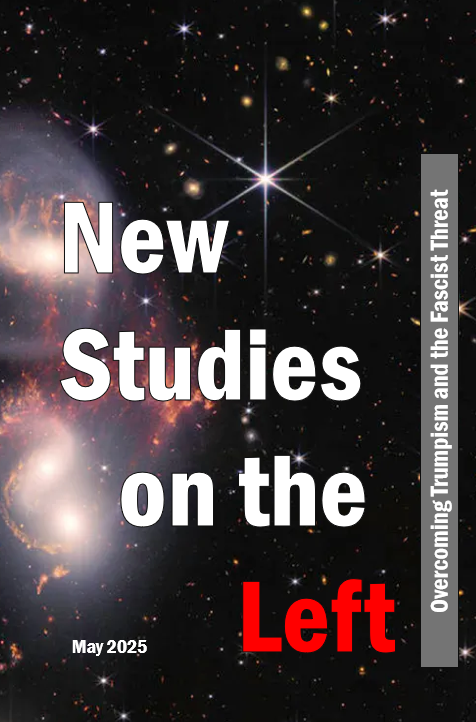
New Studies on the Left, May 2025
Paperback $14.95
...is a journal of socialist theory and practice. It is the successor to ‘Dialogue and Initiative, published as an annual journal of the Committees of Correspondence for Democracy and Socialism in book form from 2012 to 2022. It will continue the CCDS policy of left unity, including articles with a variety of left perspectives, including debates.
This issue contains a dozen articles grouped under the headings of Analysis and Global Reach, Electoral campaigns, and Book Reviews. Some are reprinted from other sources, but many appear here for the first time.
Among the authors are C.J. Atkins, Carl Davidson, Steve Early, Bill Fletcher, Jr., Suzanne Gordon, Jerry Harris, Jay Jurie, Paul Krehbiel, Matthew Scott, Rod Such, Harry Targ, and Janet Tucker and Steve Willett.
Table of Contents
Click HERE to purchase
| | | |
With the winning of the Trump/Vance ticket along with the far right in leadership of all 3 branches of government we need to bury our differences and build the left and the Progressive Majority, a majority that we know exists on most issues of public policy.
We need to build our organizations to defend democracy, in our communities and at the state and national levels including progressive gains won over several decades.
IN GENERAL WE NEED TO REBUILD OUR LEFT: PEACE ACTIVISTS, FEMINISTS, WORKERS, ENVIRONMENTALISTS, AND ALL HUMANISTS WHO UNDERSTAND THAT. (HOWEVER WEAK) US DEMOCRATIC INSTITUTIONS ARE UNDER ATTACK AND THE VERY PEACE AND ENVIRONMENTAL CONDITION OF THE WORLD ARE UNDER ATTACK
Harry Targ
| | "Organization is the central task; revolutionary education is the key link." Carl Davidson | | |
—–Neofascism, Imperialism, War, and Revolution in the Middle East, Gilbert Achcar interviewed by by Rodrigo Utrera | July 24, 2025 Now on our blog page
The Black Nation Thesis Archive, organized by Abdul Alkalimat, Now in our History Dept.
The Long American Counter-Revolution Historian Gerald Horne has developed a grand theory of U.S. history as a series of devastating backlashes to progress—right down to the present day. By David Waldstreicher in the Boston Review.
Marxism and the Black Experience. All references by Marx, Lenin and others on African Americans, compiled by Abdul Alkalimat. Now in our Archives section.
Bill Fletcher Collection. Some of his key works available online. In our Archives.
Richard Wolff, UMass Amherst In addition to the link above and button below, CLICK HERE for more classes by Wolff. For his new book on the three contending theories of Neoclassicalism, Keynesianism, and Marxism, go HERE. Otherwise Access Here For his lectures on Vol. 2 and Vol. 3 of Capital, go HERE.
New Video Course: "This is literally a reverse Robin Hood." U.S. Rep. Jasmine Crockett slams Trump's spending bill. HERE
New Text Course: Nicos Poulantzas: 'State, Power, Socialism' by Stuart Hall. HERE.
| | Organization is the central task; revolutionary education is the key link. | | |
Our Amazing Resource for Radical Education
CURRENT FEATURE: In the 'Study Guides' Section
A 4-PART STUDY OF THE SHAPING OF THE
RUST BELT WORKING CLASS.
From the settlers to the present, and how its consciousness is conflicted. Prepared by Carl Davidson and Rebecca Tarlau,
with some help from the DSA Rust Belt group.
There are hundreds of video courses here, along with study guides, downloadable books and links to hundreds of other resources for study groups or individuals.
Nearly 10,000 people have signed on to the OUL for daily updates, and more than 150,000 have visited us at least once.
Karl Marx's ideas are a common touchstone for many people working for change. His historical materialism, his many contributions to political economy and class analysis, all continue to serve his core values--the self-emancipation of the working class and a vision of a classless society. There are naturally many trends in Marxism that have developed over the years, and new ones are on the rise today. All of them and others who want to see this project succeed are welcome here.
NEW UPDATES...
On our Blog Page:
How to Create a Future of Cheap Energy for All
The WIRED & Octopus Energy Tech Summit in Berlin was bursting with innovative ideas for reaching net zero and on working together at an ever-greater scale.
How to Build an Underground Resistance Force in 16 Steps
Lessons from Blue Virginia, a community-based organization of women
Our Latino/a Studies Dept:
Forced Amnesia: The Hidden History Of America’s Far West
An emotional and historical journey through the American West on the tracks of the pre-1848 border, to meet families that lived there since long before the US takeover.
Our History Dept:
Marcus Rediker on the Quaker Abolitionist and Seaman Benjamin Lay – History from Below after the Transnational Turn.
This seminar subtitled “The Case of a Forgotten 18th-century Revolutionary,” was given by Marcus Rediker as part of the Development Studies Seminar Series on 24 October 2017 at SOAS University of London
To get regular updates, be sure to ‘Like’ us at http://facebook.com/ouleft.org Be sure to also, under ‘Like’, pick ‘Get Notifications.’ You can also ‘subscribe’ to our FB page and send in articles for our blog at the OUL main site, http://ouleft.org
Read more
http://ouleft.org
| | | | | |
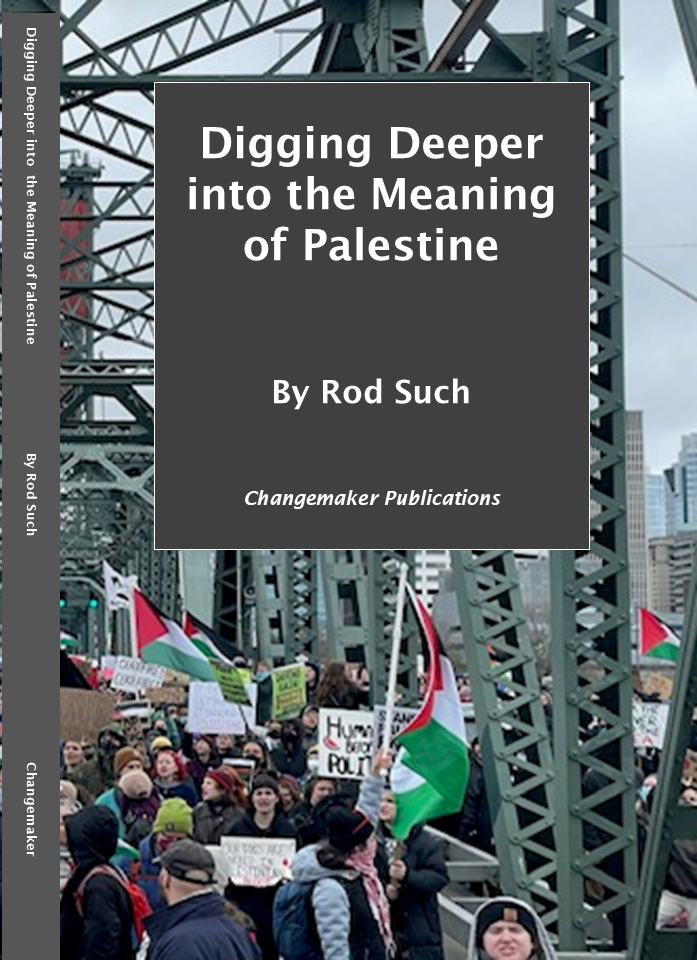
Digging Deeper into the Meaning
of Palestine
By Rod Such
Author's note: My initial decision to begin reviewing books on Palestine and the Palestinian liberation struggle was to write for political activists, rather than academics or the general public. This book, which collects dozens of reviews over a decade, might also be regarded then as a kind of wide-ranging primer or introduction to Palestine that will lead hopefully to an ongoing learning experience.
316 pages, $19.00 (discounts available for quantity), order at:
Changemaker Publications
https://www.lulu.com/spotlight/changemaker
| | | POWER TOOLS FOR UNION BUILDING | |
Timothy Sheard | 415 Argyle Rd. 6A | Brooklyn, NY 11218 US
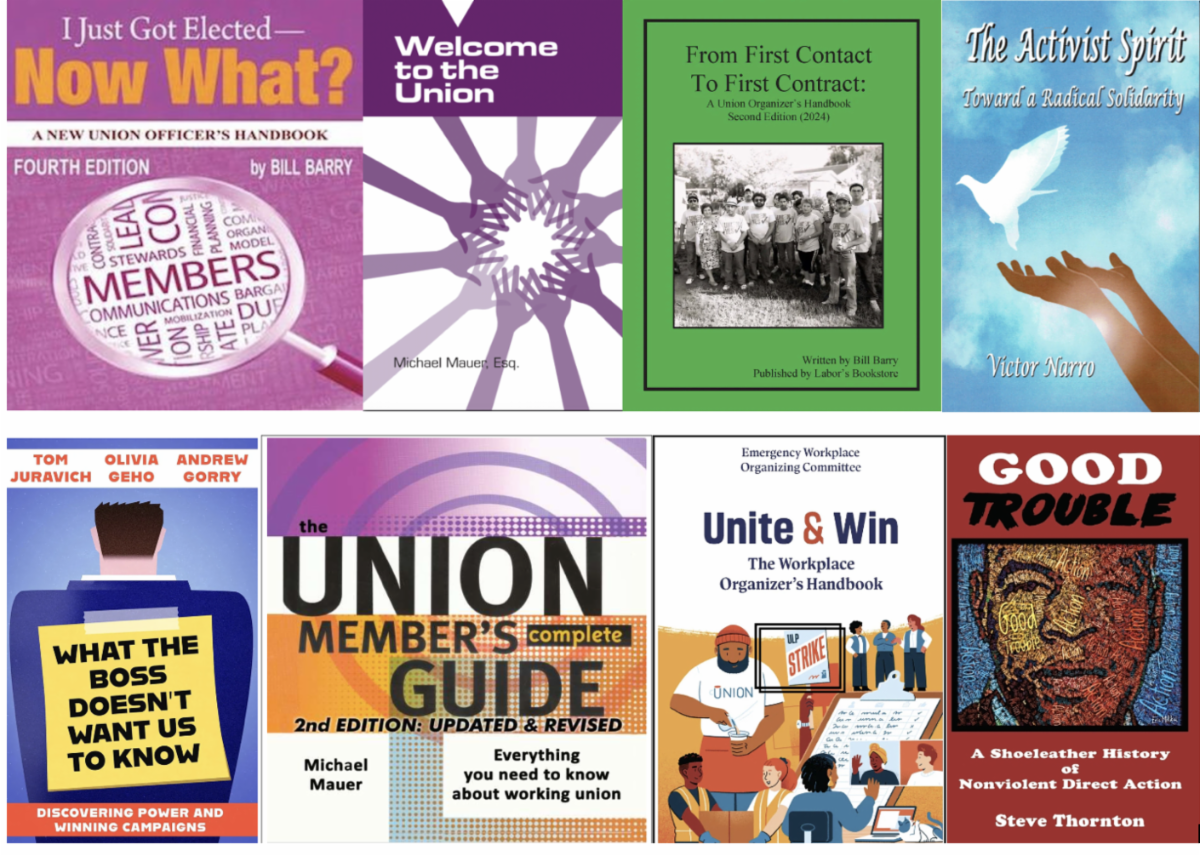
| | With grave new challenges from the current administration, Hard Ball Press is raising our game, with new books & new Staff. | | Click go to Hard Ball Press for fresh information about organizing the workplace and building union power. | | |
Hard Ball Press is thrilled to welcome Cynthia Selene Hernandez to our staff. Cynthia will take charge of new book development, design and marketing, beginning with a children's book about Women In Construction.
Cynthia began her organizing career during the Free Trade Area of the Americas protests in Miami in the early 2000s. As a student organizer in 2006, she took part in the Justice for Janitors campaign at Florida International University, which successfully advocated for improved wages and working conditions for janitorial staff.
With the support of a Pell Grant, Cynthia joined Florida International University's Labor Center (FIU), advancing from research intern to senior research associate and instructor. Her focus on wage theft led to the enactment of seven anti-wage theft county ordinances in Florida. After nearly a decade at FIU, she became the Executive Director of the South Florida AFL-CIO. She led labor and community coalitions to enhance wages and benefits for low-income families in Miami-Dade County.
In 2018, Cynthia joined Resilience Force as Florida Director, advocating for labor protections for resilience workers. As Hurricane Ian made landfall in Florida in 2022, she returned as Resilience Force National Training and Education Director.
| | | | Be sure to check out the latest organizing tools from Labor's Book Store and the latest labor news from Work-BItes. | |
CHANGEMAKER PUBLICATIONS: Recent works on new paths to socialism and the solidarity economy
Remember Us for Gift Giving and Study Groups
We are a small publisher of books with big ideas. We specialize in works that show us how a better world is possible and needed. Click Gramsci below for our list.
| |
522 Valencia St.
San Francisco, CA 94110
415 863-6637
| | | | | |