|
Dear Community:
Exactly 63 years ago today – August 28, 1963 – Dr. Martin Luther King, Jr. delivered his iconic "I Have a Dream" speech in Washington, D.C. His words resonate today as much as they ever have.
"I have a dream that one day this nation will rise up, live out the true meaning of its creed: 'We hold these truths to be self-evident, that all men are created equal.'"
The dream has not been fully realized, but the hard work continues. The hope continues. We Must Save Us. Blessings to all of you for a safe and healthy week ahead.
Renee Mahaffey Harris
President & CEO
| | |
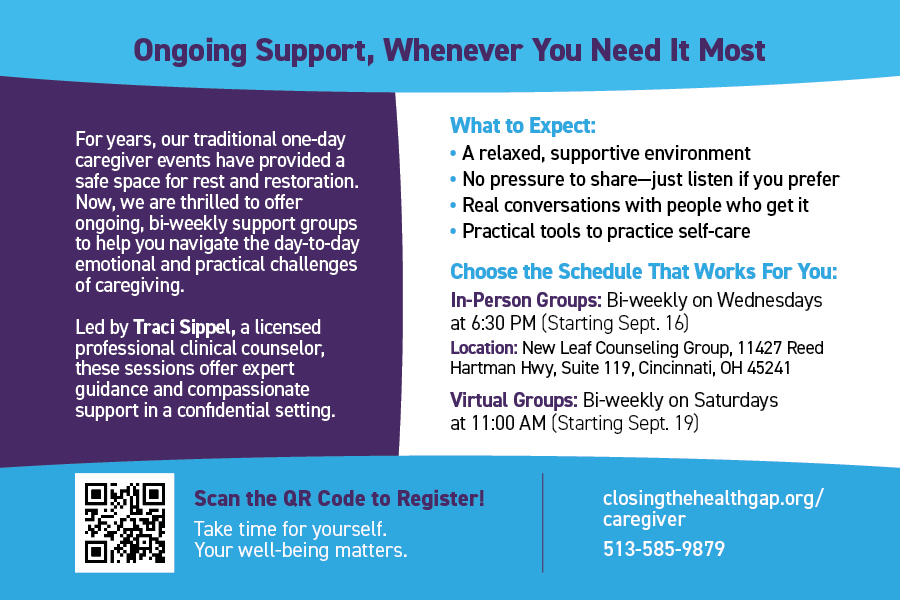
ATTENTION CAREGIVERS: Register for One-Day Sessions or Join Our New Bi-weekly Support Groups
For years, our one-day Caregiver Support Series events have helped attendees find restoration. Now, we are expanding our program to offer bi-weekly, ongoing support groups to help you navigate the daily challenges of caring for a loved one who is 60+.
Led by licensed professional clinical counselor Traci Sippel, these new in-person and virtual sessions give you a confidential space to talk openly, gain coping tools, and connect with people who actually get it. Find the group that fits your schedule:
- In-Person: Bi-weekly on Wednesdays at 6:30 PM starting Sept. 16 at New Leaf Counseling Group (11427 Reed Hartman Hwy, Suite 119)
- Virtual: Bi-weekly on Saturdays at 11:00 AM starting Sept. 19
CLICK HERE TO VIEW ALL HEALTH GAP EVENTS AND REGISTER!
| | |
Closing the Real-World Data Gap for Public Health
For nearly two decades, real-world data (RWD) have reshaped how the health care ecosystem understands patient care, treatment patterns, and outcomes. Providers, researchers, insurance companies, life sciences organizations, and health technology platforms now depend on access to data from medical claims, pharmacy records, lab results, and electronic health records, including social determinants of health data, to guide decision-making. The breadth of stakeholders and data sources highlights a critical reality: the same data that support individual patient care and business operations are increasingly essential for public health surveillance and science-informed public health interventions.
| |
Medicare Shared Savings Program and Disparities for Patients With Low Income
Value-based payment has been proposed as a mechanism to reduce persistent socioeconomic health care disparities in the United States, but some Medicare payment models have been associated with worsened disparities or a redistribution of resources away from patients with low income. The Centers for Medicare & Medicaid Services (CMS) introduced some reforms to Medicare to address these concerns, including programs intended to support the needs of low-income populations, but little is known about whether or how accountable care organizations (ACOs)—groups of clinicians and health care organizations that collaborate to assume responsibility for the quality and costs of their attributed patients—have affected socioeconomic disparities in care.
ACOs in the Medicare Shared Savings Program (MSSP)—one of the nation’s longest-running value-based payment efforts—are not explicitly measured on their ability to change health care disparities, but, because they are incentivized to manage the health and spending of beneficiaries, they may invest in programs, such as care coordination and chronic disease management, that disproportionately benefit patients with low income. Alternatively, ACOs may exacerbate disparities if these programs disproportionately benefit patients with higher income or if ACOs avoid patients with low income because they feel that they will be penalized for factors outside of their control.
|
How Do Poverty, Insurance, and Government Assistance Impact Diabetic Foot Ulcer Outcomes? A Scoping Review
The burden of diabetic foot ulcers, experienced by over 1.5 million people in the United States each year, is inequitable. Disparities exist along nearly every investigated social line. Patients identifying as a racial or ethnic minority, living in rural areas, or residing in disadvantaged neighborhoods consistently experience worse outcomes, including greater major amputation risks (i.e., above- or below-knee amputations). We have known this for decades. What we have yet to fully understand is how social drivers impact ulcer outcomes.
A clearer understanding of the causal pathway between social drivers of diabetic foot disease (SDDFD) and ulcer outcomes is likely to support better design and evaluation of interventions aimed at mitigating disparities. A conceptual model would help identify interactions between variables along the causal pathway, which would allow statistical models to account for mediators, moderators, and colliders. Those models would then more precisely estimate the effect of intervening at a variable in the pathway.
|
Large-scale proteomics to identify novel biomarkers linking social determinants of health to heart failure risk
Adverse social determinants of health (SDOH) associate with greater heart failure (HF) risk. Among 9879 community-based participants of the Atherosclerosis Risk in Communities (ARIC) cohort study, we assessed 4955 plasma proteins using an aptamer-based platform (SomaLogic). We derived an SDOH factor comprising income, education, and area deprivation index (ADI) in Black and white participants. Proteins associated with this factor at Bonferroni significance were tested for associations with incident HF using multivariable Cox proportional hazard models.
Among Black participants, 36 proteins were associated with both the SDOH factor and incident HF, 126 were among white participants, and 12 were shared between race strata. Eight of these demonstrated significant mediation effect in causal mediation models. Key results were replicated in 49,396 participants in UK Biobank. Mendelian randomization and colocalization suggested a potentially causal effect of C1q tumor necrosis factor–related protein 1 (C1QTNF1), an adiponectin paralog, on HF. We demonstrate protein biomarkers associated with SDOH burden and HF risk.
|
Successful systems won’t be ‘the ones with the best strategy’: 4 CEOs on closing the execution gap
Health systems face no shortage of strategy. What many are running low on is the capacity to execute it. That observation sits at the center of a conversation that Mandy Eaton, PhD, president and CEO of Springfield, Ill.-based Memorial Health, believes most health system leaders are not having openly enough.
“Most health system leaders understand the industry’s challenges,” Dr. Eaton said on the Becker’s Healthcare Podcast. “We understand reimbursement pressures, workforce shortages and rising costs, technology investments and constraints, and increasing consumer expectations. But what’s less discussed is that health systems are trying to solve all those challenges simultaneously, while continuing to care for patients every day.”
The systems that pull ahead over the next decade, she said, will not be defined by the strength of their plans alone.
“The organizations that succeed over the next decade won’t necessarily be the ones with the best strategy,” Dr. Eaton said. “They’ll be the ones that can consistently execute. They’ll know how to prioritize. They’ll know how to align resources. They’ll know how to manage change."
|
What Can You Say When You Can’t Say Everything?
Today’s decisions about what and how to communicate about population health occur amid very real fears and expectations of harsh reprisal that have had far-reaching impacts, both for people’s health and for the health professions. It is in this context that health researchers must share their findings with the public and policy makers, prevent confusion, and avoid harming groups already facing systemic barriers to health. In every communication context—from research papers to quotes on the nightly news—people must make thoughtful choices about what to say. Communication, therefore, is always an act of selection that requires both a clear purpose and a visible connection to the broader contexts for public health measures.
With planning, skill, resources, and adherence to best practices for health communication, even difficult or easily misinterpreted information can be communicated clearly and accessibly while also maintaining accuracy. To build trust and be understood by the public and policy makers, public health researchers and practitioners must clearly, directly, contextually, and descriptively speak to the challenges affecting population health.
| | |
More Articles of Interest
Nemours Kids Health, August 2026
Journal of Medical Internet Research, August 26, 2026
City of Atlanta, August 21, 2026
| | | | |