|
Welcome to the August Newsletter!
Thanks for opening! It's been a couple of months since our last edition, but we're back with a fascinating story and some outstanding auction pieces to share.
The highlights are first, August's No-Reserve Silent Auctions, featuring two beautiful works up for bid: Nina Volkova's quietly atmospheric "Ukrainian Marsh" and Mikhail Platunov's tender, mid-century portrait "Conversation."
Second, the Gallery spotlights some of our noted Ukrainian Artists, featuring some amazing landscapes and genre scenes from Igor Popov, Mikhail Akinshin, and Yuri Smirnov.
| | |
AUGUST'S NO RESERVE
SILENT AUCTIONS
| | |
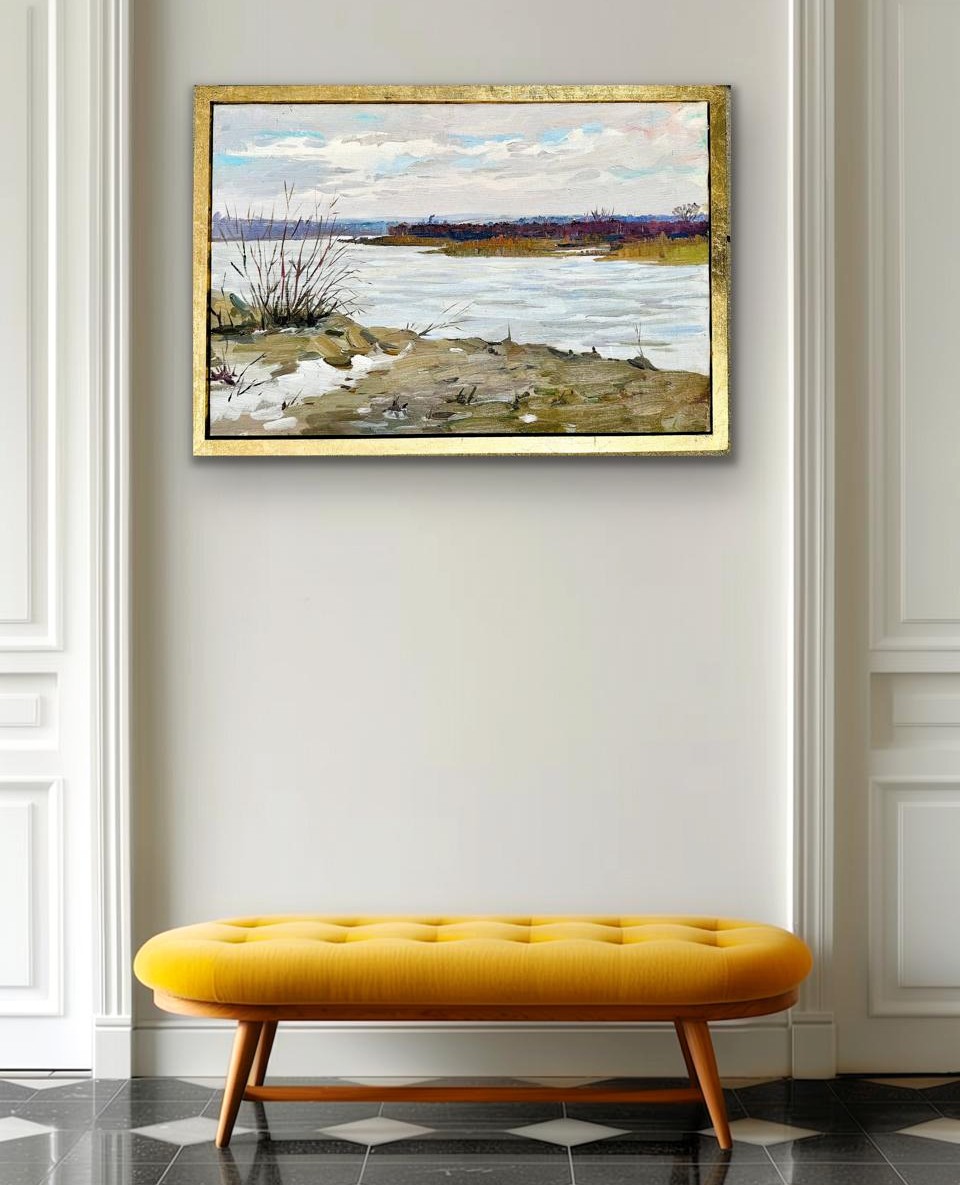
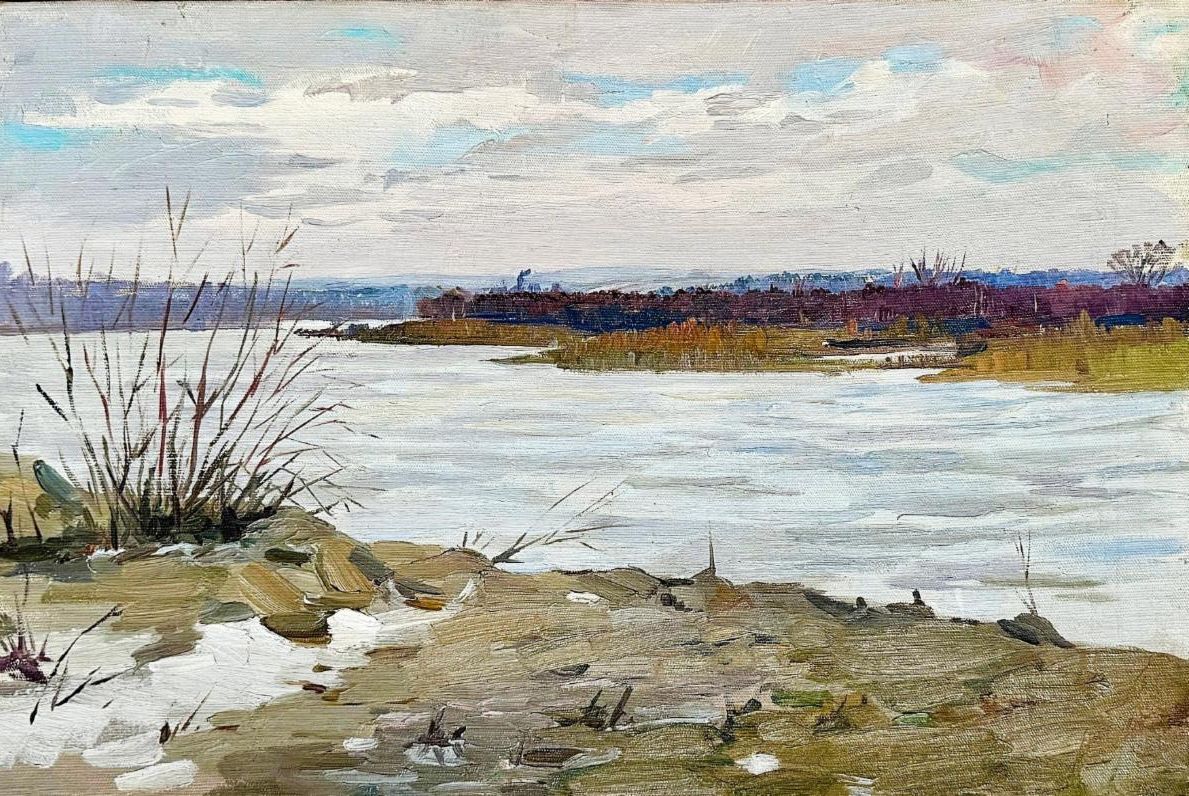
Volkova, Nina
"Ukrainian Marsh"
15¾'' x 23½'',
1961, Oil on Canvas, Framed
Estimated $2,000 to $3,000. Current Bid $1,250 by J. Clements, Next Bid is $1,500
-Read More Below
| | |
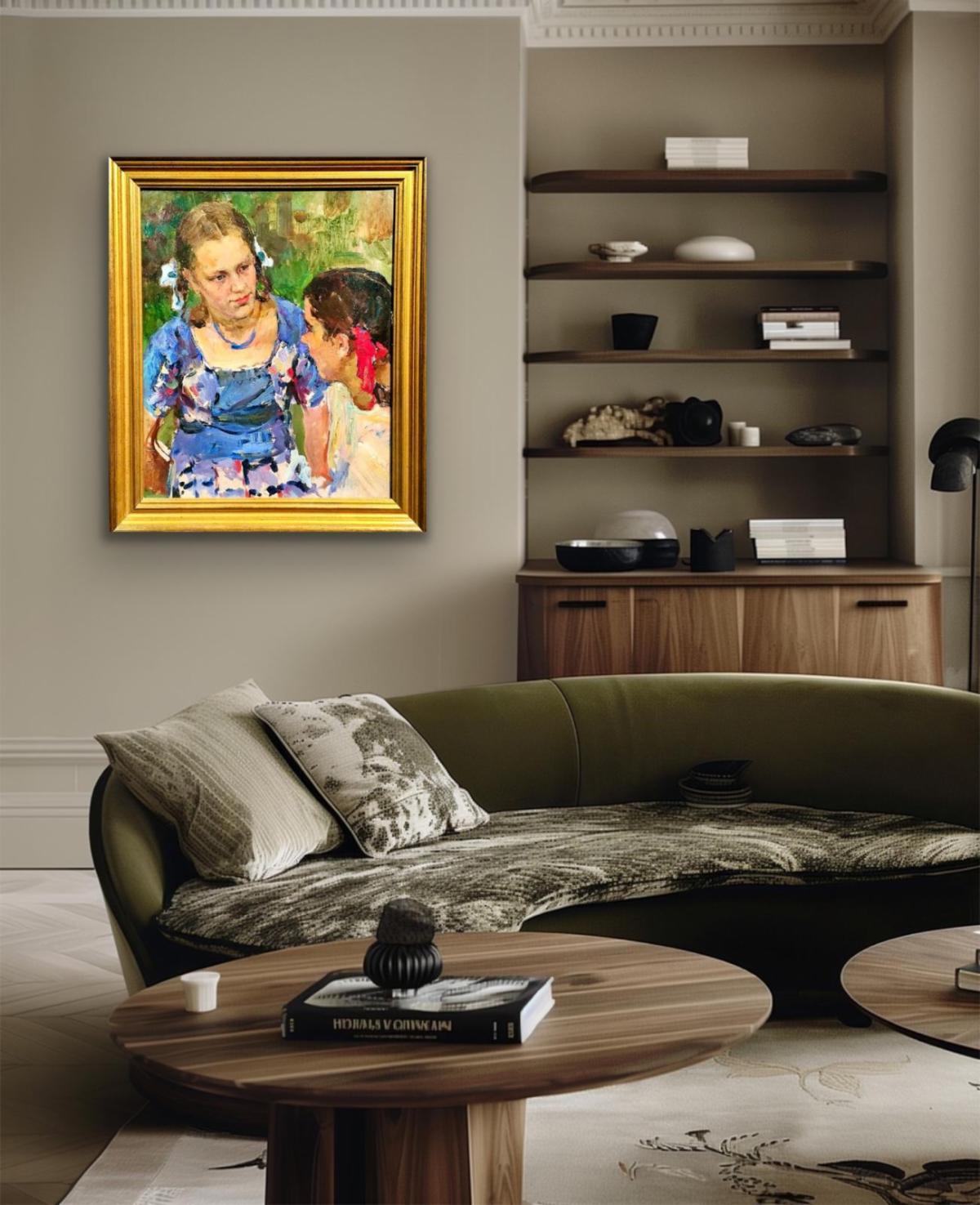
Platunov, Mikhail Georgievich
"Conversation"
19¾'' x 15¾'',
1952, Oil on Board Framed,
Estimated $2,000 to $2,500. Current Bid $1,000 by R. Dubberly, the Next Bid is $1,250
-Read More Below
| | |
First and foremost, we extend our congratulations to the winning bidders of the last Silent Auction!
For our August Silent Auctions, we proudly present a rare opportunity to add two beautiful works by highly acclaimed artists to your collection.
The first, a vibrant, confident, colorful work, by the noted artist Mikhail, G. The first, a vibrant, confident, colorful work, by the noted artist Mikhail, G. Platunov, "Conversation". The second a magical landscape, masterfully painted by the skilled Nina Volkova "Ukrainian Marsh."
We are thrilled to extend an invitation to you to place bids in August's exclusive auction. We deeply appreciate everyone who participated and placed bids in the last auction.
| | |
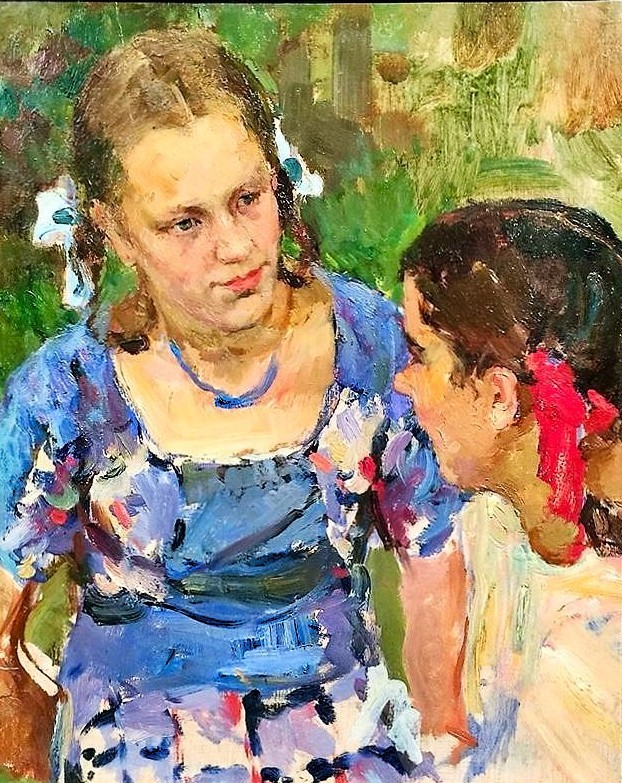
Platunov, Mikhail Georgievich
"Conversation"
19¾'' x 15¾'', (50 x 40 cm), 1952, Oil on Board Framed,
Estimated $2,000 to $2,500. Current Bid $1,000 by R. Dubberly, the Next Bid is $1,250
| | |
"Conversation" — has a nice, confident energy to it — very much that mid-century Soviet portrait style with an Impressionist loosening around the edges.
The subject, two young girls caught mid-secret. One's facing us head-on, the other's turned away — all we get of her is an ear, a red ribbon, and a tumble of dark hair. That's actually the smartest move in the painting: instead of two faces competing for attention, we get one girl's expression to read and ones is a total mystery. It makes you feel like you're eavesdropping, trying to guess what's being said just from that slightly wary, thoughtful look on the first girl's face.
The painting highlights several interesting contrasts. The dress and background are loose and splashy, confident strokes of blue, white, hits of pink and red thrown down fast. But the face slows way down: soft, careful blending in the skin, real volume in the cheeks and brow. That push-pull between a tightly rendered face and a loosely thrown-together dress is an old trick, but it works — your eye stays locked on her expression.
The painting portrays a real tenderness between two close friends. This is that Russian/Soviet genre tradition of catching kids in an actual unposed moment rather than posing them for a "cute kids" picture. She's not performing for the painter — she looks genuinely absorbed, a little guarded, listening. That's what gives it some real emotional honesty instead of feeling decorative.
"Conversation" is a warm, confidently painted piece — a good example of mid-century Soviet realist portraiture with an Impressionist touch that would make a great addition to any collection!
| | |
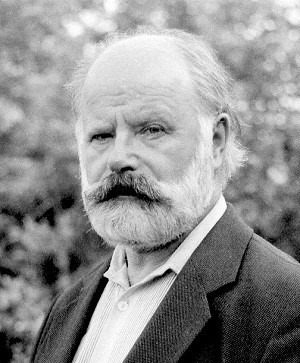
Anatoly Ivanovich Platunov (Platunov) 1930-2001
(Translated from the original Russian)
Anatoly Ivanovich Platonov (1930–2001)
Born October 18, 1930 in Kovrov, Vladimir Oblast, and died December 17, 2001 in Ufa. After the war his family moved to Vilnius, where he studied privately with painter Vytautas Varanka before enrolling in the painting faculty of the Lithuanian SSR State Art Institute, graduating in 1955. That year he settled in Ufa, drawn by a lifelong ambition: to paint the Ural Mountains — among the oldest on Earth — as a witness to the origins of human culture. Alongside his "Ancient Urals" cycle, he pursued an extensive study of the Bashkir people whose culture is bound to those mountains, producing numerous sketches of Bashkir women, whom he saw as the keepers of their people's traditions.
He worked for the Bashkir Artistic-Production Combine until 1984 and remained in Ufa for the rest of his life. He joined the Union of Artists of the USSR in 1966 and the Union of Artists of Bashkortostan in 1961, and was named Honored Artist of the Bashkir ASSR in 1990.
Platonov's realism is defined by a distinctive fusion: the colorful, painterly sensibility of the Lithuanian school combined with the rigorous draftsmanship of the Russian academic tradition. This is especially evident in his portraits, his most complex body of work. For Platonov, a sitter was never a generic type but a specific individual whose "topological" character — their inner life, expressed above all through the eyes — he sought to capture. His portrait subjects appear capable of dialogue, achieved through simple compositions paired with a complex, nuanced color palette, rendered in a classical style free of showy contrast or deformation.
His work is held in museum, gallery, and exhibition collections, and is recognized by admirers of classical Russian painting across Russia, Western and Central Europe, North America, Japan, Australia, and New Zealand. Artists like Platonov exemplify a broader pattern in Soviet art: painters trained in the Baltic republics who carried that region's chromatic sensibility into provincial Russian centers far from Moscow and Leningrad, giving cities like Ufa a richer, more independent artistic culture than they might otherwise have had.
| | |
Volkova, Nina
"Ukrainian Marsh"
15¾'' x 23½'', (40 x 60 cm)
1961, Oil on Canvas Framed
Estimated $2.000 to $3.000. Current Bid $1,250 by J. Clements, Next Bid is $1,500
"Ukrainian Marsh" belongs to the distinctive tradition of Russian and Ukrainian planar landscape painting — a school shaped by two centuries of academic training, yet insulated from the pressures of the commercial art world by both the Soviet system and the sheer scale of the region's untouched wilderness. That isolation, paired with the singular quality of light found in the forests and marshlands of the era, gave rise to a generation of landscape painters with a truly unique visual language.
"Ukrainian Marsh" captures this sensibility at its height. Rendered in a deep, muted palette, the painting conveys the starkness of the winter landscape, while a flowing river cutting through the scene hints at the coming thaw — a quiet suggestion of spring and renewal beneath the barren surface. The tension between stillness and movement, cold and coming warmth, gives the piece its emotional pull.
The palette is subdued and silvery — grey-lavender sky, pewter water, bleached winter grass — putting it somewhere in that raw in-between season of late autumn or early spring. That's not an accident: Russian and Ukrainian landscape painters, following the Itinerant tradition of Levitan and Savrasov, were drawn to exactly this kind of unglamorous, transitional light. It's melancholy rather than picturesque.
In the foreground, quick, calligraphic strokes of reeds and dry grass frame the scene and pull the eye back across the water toward a low, dark tree line — a classic Ukrainian river and composition. The loose, direct handling and close attention to the marshy ground itself — patches of old snow, waterlogged earth, scrubby growth, make "Ukrainian Marsh" a strong and representative example of mid-20th-century Ukrainian landscape painting, by one of the era's foremost artists.
| | |
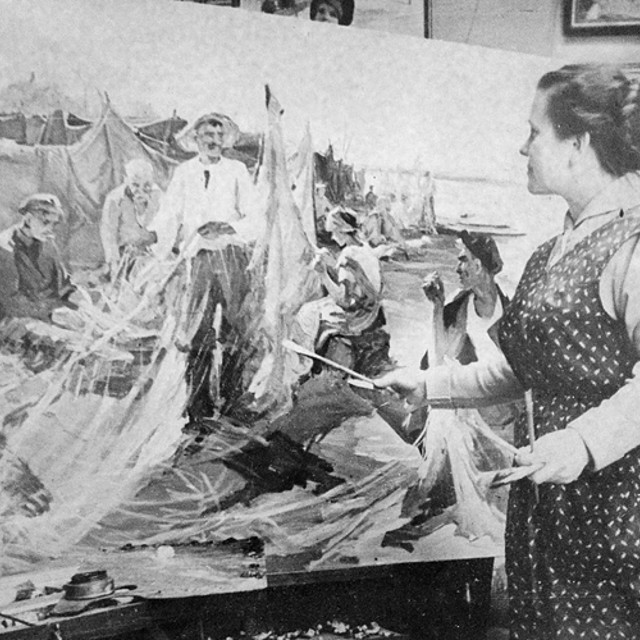
Volkova, Nina Pavlovna, 1917-1993
Volkova is a solid, representative figure of the mid-century Ukrainian Soviet school — not a radical innovator, but a technically accomplished, officially recognized painter whose landscapes capture the specific light and terrain of the Dnieper region where she spent most of her career. A work like "Ukrainian Marsh" is valued today less for grand historical significance than as an honest, well-crafted document of place and of a particular mid-century Soviet-Ukrainian painterly sensibility — the kind of picture that rewards close attention to paint handling more than it carries overt political or symbolic weight.
Born January 28, 1917 in the village of Uber, Kirov Region, Volkova graduated from the Dnipropetrovsk Art College in 1936, studying under M. Panin, and from the Kiev Art Institute in 1946, where her teachers were K. Eleev, K. Trochimenko, and M. Sharonov. She began exhibiting in Republican shows in 1947 and in All-Union and international exhibitions from 1948, and was a member of the Union of Artists of the USSR. Working primarily in easel painting, she was recognized as a master of genre painting, still life, and landscape, with a particular gift for achieving the intense open-air (plein air) impression central to landscape painting. She lived and worked in Kiev until her death in 1993.
Her best-known works — "In the Days of the German Occupation" (1946), "Girls of Krasnodon" (1947), "On the Day Off on the Dnieper" (1951), "Farmers' Collective Farm" (1960), and a portrait of General F. T. Umansky (1964–65) — trace the standard arc of a Soviet Socialist Realist painter of the war generation: wartime memory painting, Komsomol/heroic-youth subject matter (the Krasnodon girls were young Soviet partisans executed by the Nazis, a common postwar theme), collective-farm genre scenes, and official portraiture.
Her posthumous reach extended well beyond Ukraine, with exhibitions in England (1998), a solo show in Germany (1999), "From Russia to Russia" in Kaliningrad (2001), the International Art Salon (2007), Slovakia (2009), and Luxembourg (2011, at the RCSC Exhibition Hall). Her work is held in museum, gallery, and private collections in Ukraine and abroad, and she is listed in Matthew Bown's Dictionary of Twentieth Century Russian and Soviet Painters.
| |
|
We extend an invitation to place bids in August's exclusive auctions. We deeply appreciate everyone who participated and placed bids in the last auctions.
The current high bids for each painting are all just $1,000 $1,250! The next bids are followed by minimum bidding increments of $250. Remember, there is no reserve, at the end of the auctio6n the high bid wins! Bids will be taken via telephone, or e-mail until 7:00 pm MST, Friday, September 4th. Follow all the bidding updates on the Gallery's website and view the works in person by appointment!
Note that you may place a maximum bid and the Gallery will bid on your behalf up to your maximum. By placing a maximum bid, you will be assured you are not out bid at the last minute.
Please, e-mail bids only to info@McCartheyGallery.net and make sure your receive confirmation of your bid. Note that you may place a maximum bid and the Gallery will bid on your behalf up to your maximum. By placing a maximum bid you will be assured you are not out bid at the last minute.
Tel: 801-755-7072
email: info@McCartheyGallery.net
website: www.McCartheyGallery.net
We look forward to your participation and wish you the best of luck!
Warm regards,
Stephen Justesen
| | |
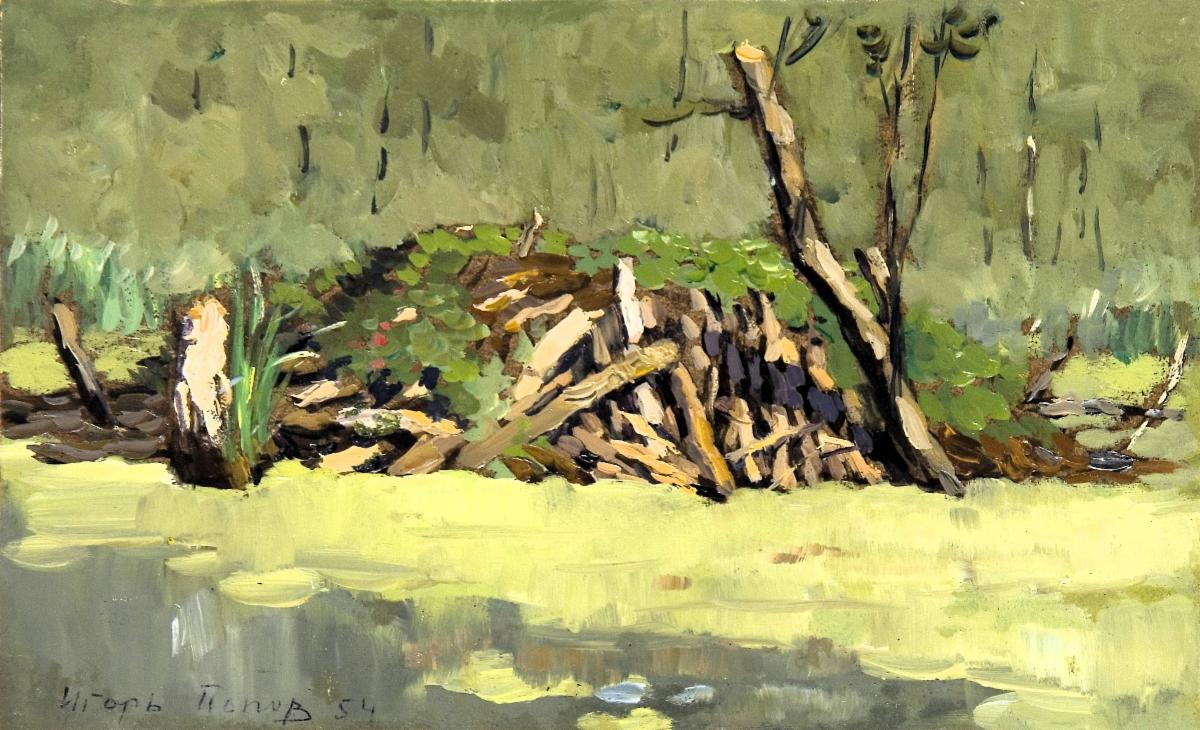
Popov, Igor Alexandrovich
"Beaver's Hut"
6¼'' x 9½'', (16 x 24 cm)
1954, Oil on Board
$2,000, Unframed
| |
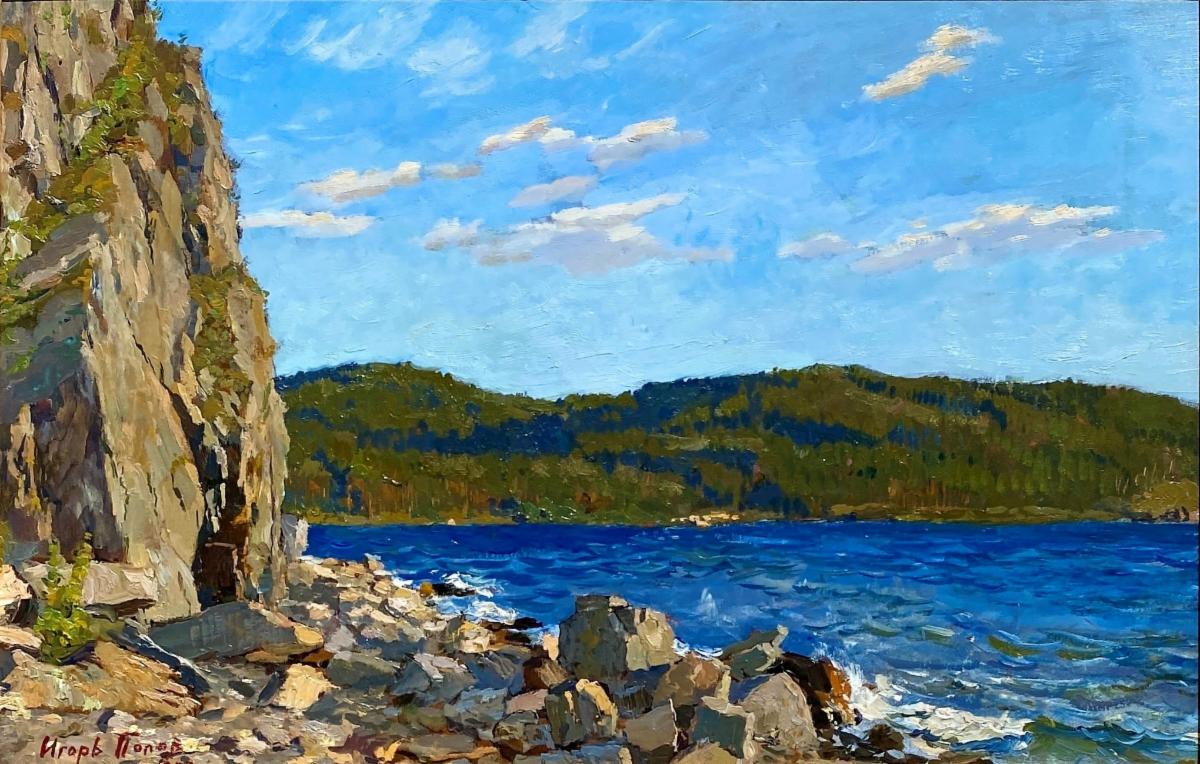
Popov, Igor Alexandrovich
"Windy Day on Lake Turgoyak"
15¼'' x 23¼'', (39 x 59 cm)
1953, Oil on Board
$9,500, Framed
| |
Igor Alexandrovich Popov (1927–1999)
Igor Popov was born in 1927 in Kharkov, Ukraine. He began his artistic education at the Moscow Intermediate Art School (1939–1945), then went on to study at the Surikov Moscow State Art Institute from 1945 to 1951, training under S. Gerasimov and V. Pochitalov. His cohort there was notably strong, including fellow students such as V. Popkov, V. Stozharov, V. Ivanov, I. Shevandronova, and N. Andronov, several of whom went on to become significant figures in Soviet art themselves.
Popov settled in Moscow, becoming active there from 1954, when he joined the Moscow branch of the Union of Artists of the USSR. He built his reputation primarily as a painter of cityscapes, becoming known as an outstanding master of the genre — his numerous depictions of Moscow were noted for their finesse and lyricism. Beyond cityscapes, he also worked in genre painting, portraiture, still lifes, and landscapes; a trip to Russia's North proved particularly inspiring, leading to a series of landscape works.
He was a regular participant in Moscow, republican, and All-Union exhibitions, including the major "Soviet Russia" exhibition in Moscow in 1960, and he also exhibited abroad alongside other Russian artists. In 1970, he received the Silver Medal from the USSR Academy of Arts for his portrait series "Fishermen of Galich." In the mid-1970s, he served as head of the Moscow Artists' Union, and in 1977 he was awarded the title of People's Artist of Russia. In 1985, he contributed to wall paintings for the Reception House.
Over his career, Popov held four solo exhibitions, including a notable one-man show in Moscow in 1989. His work is held in more than 20 museums across Russia, including the State Tretyakov Gallery and the State Russian Museum, as well as in the Kiev Museum of Russian Art and other major regional museums. His paintings are also present in private collections both in Russia and abroad, and have been regularly acquired by collectors in the USA, Great Britain, France, and Germany, among other countries.
Igor Popov died in Moscow in 1999.
| |
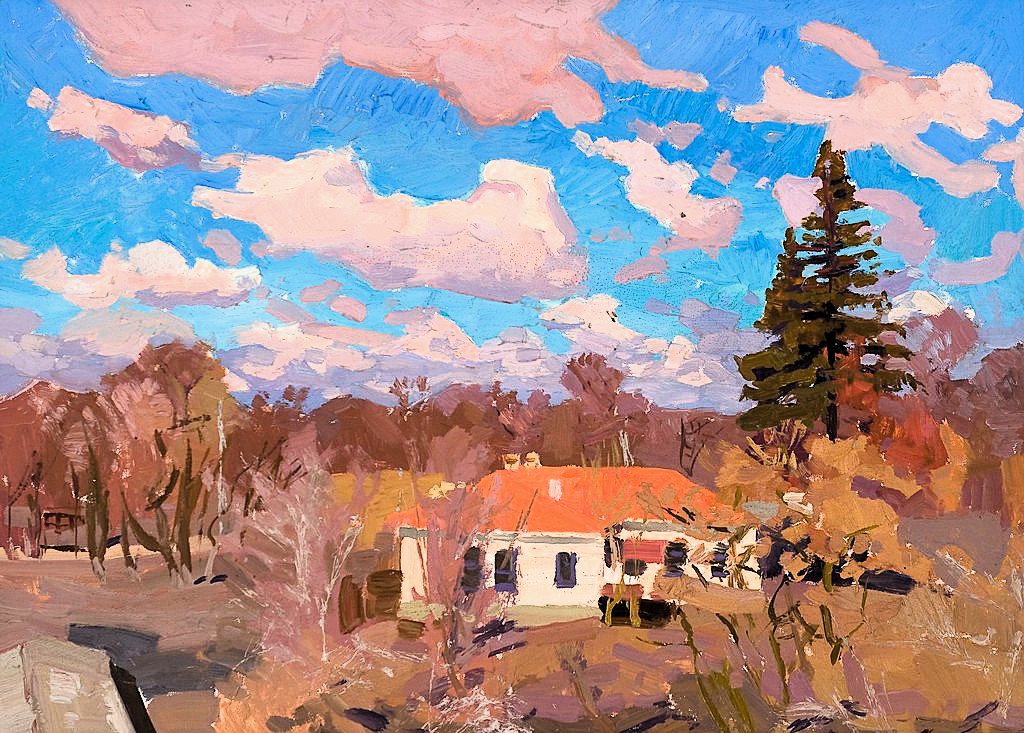
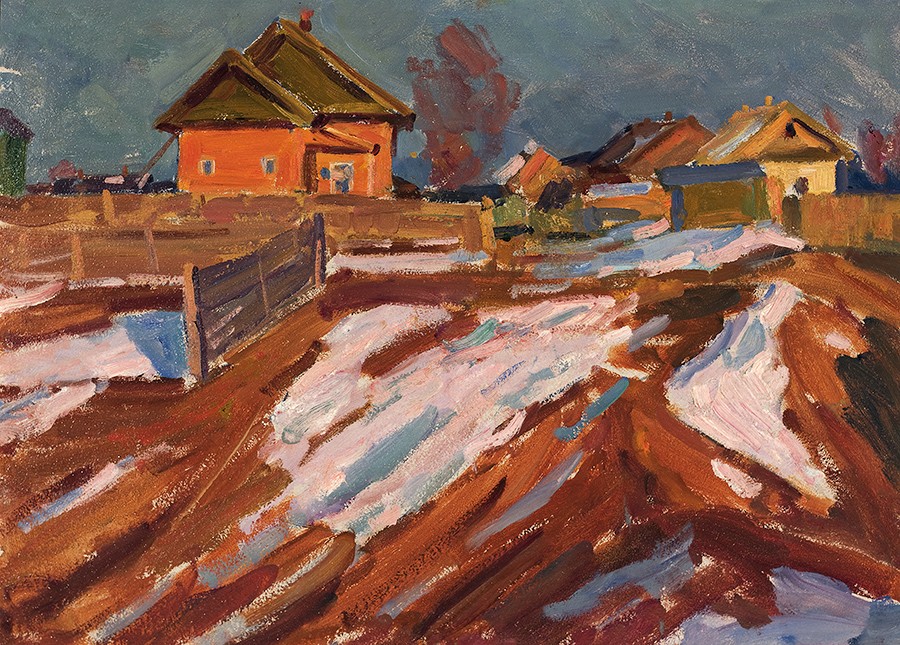
Akinshin, Mikhail Vasilievich
"House on the Prairie"
19¾'' x 27½'', (50 x 70 cm)
1963, Oil on Board, $1,250, Framed
| |
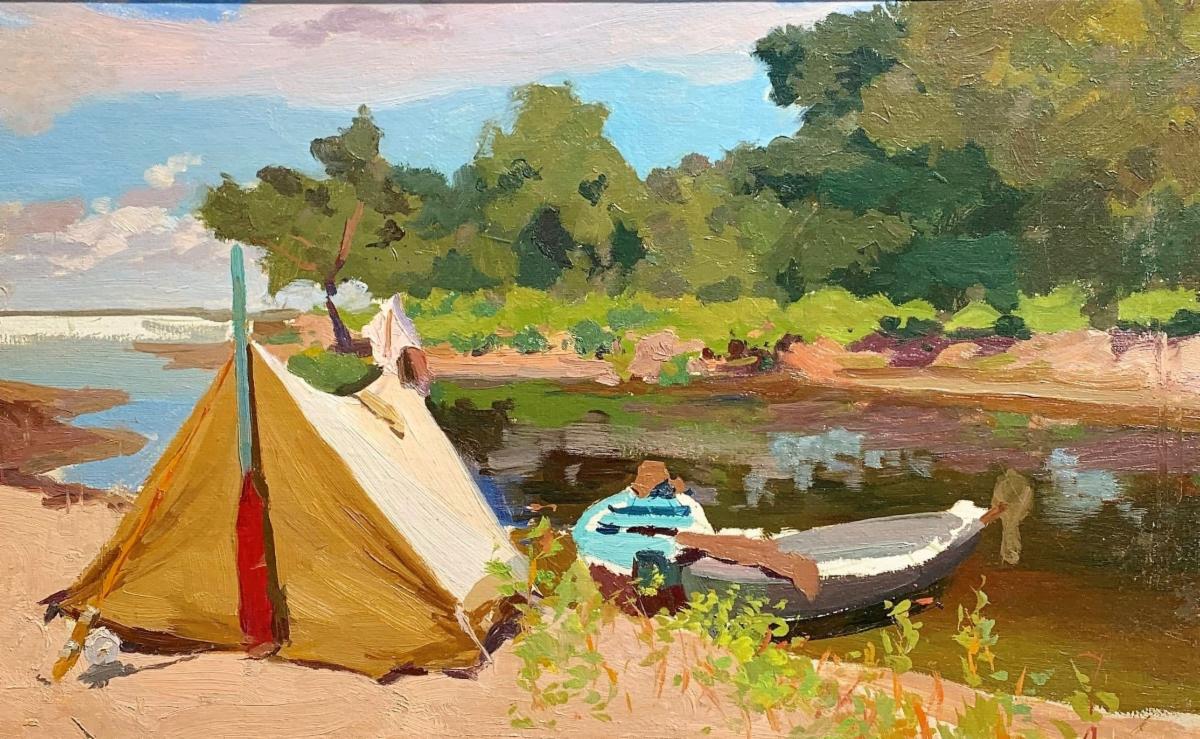
Akinshin, Mikhail Vasilievich
"On the Rest"
18¾'' x 29¼'', 1961, Oil on Board
$2,500, Framed
| |
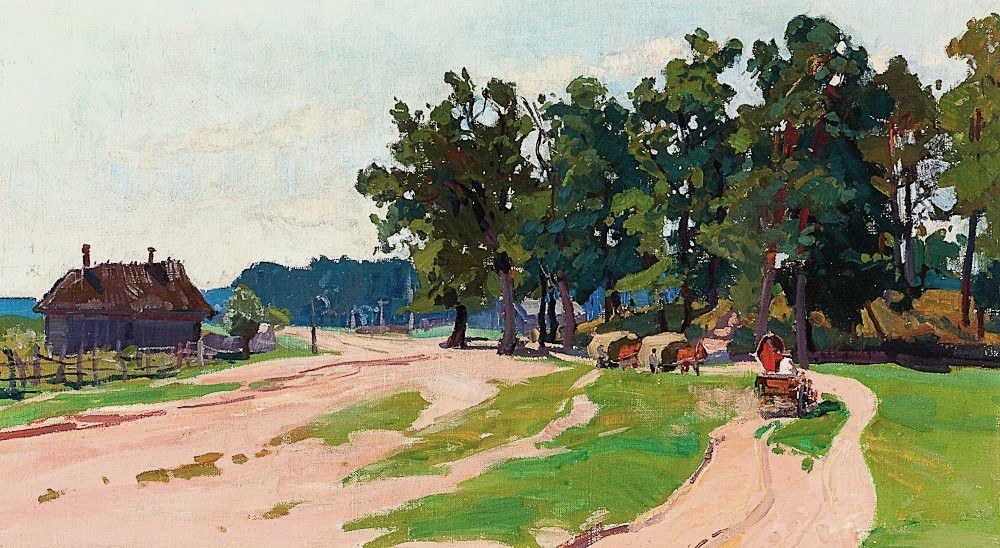
Akinshin, Mikhail Vasilievich
"Carts"
17¼'' x 31¼'', (44 x 79.50 cm)
1962, Oil on Board
$2,500, Framed
| |
Mikhail Vasilievich Akinshin, (1927–1982)
Mikhail Akinshin was born on February 18, 1927, in the village of Lomovo in Russia's Kursk region, to a peasant family. He trained at the Tashkent Art School, graduating in 1951, and briefly taught drawing before relocating to Zaporozhye, Ukraine, in 1953, where he began working as a professional artist. He later completed further training at the Kiev State Art Institute in 1962.
Akinshin built his career around landscape painting, drawing on extensive travels across the country to capture the distinct character, light, and detail of different regions — particularly the countryside of Ukraine and Uzbekistan, where he had studied. Rather than working from mechanical sketches, he treated his travel studies as the foundation for fully realized paintings shaped by personal feeling and reflection, giving his work a quality often described as philosophical and contemplative.
His style varied with subject: in one notable landscape of the northern town of Velikiy Ustyug (painted between 1968 and 1970), he used an elevated, bird's-eye perspective to highlight the town's historic character. In a companion piece, Evening, he instead worked from a low viewpoint, using bold contrasts of red, orange, and blue to emphasize the old Russian architecture up close.
Akinshin's career gained formal recognition starting in 1965, when he began exhibiting regularly at regional and national shows, and in 1968 he was admitted to the Union of Artists of the USSR. He died on July 22, 1982. A decade later, in 2012, the Zaporozhye Regional Art Museum marked the 85th anniversary of his birth with a retrospective exhibition titled From Voznesenka to Samarkand.
His work is included in reference texts such as A Dictionary of Twentieth Century Russian and Soviet Paintings, 1900–1980 by Matthew Cullerne Brown, and his paintings are held in museum and private collections across Ukraine, Russia, Uzbekistan, France, Switzerland, the UK, the US, and Canada.
| |
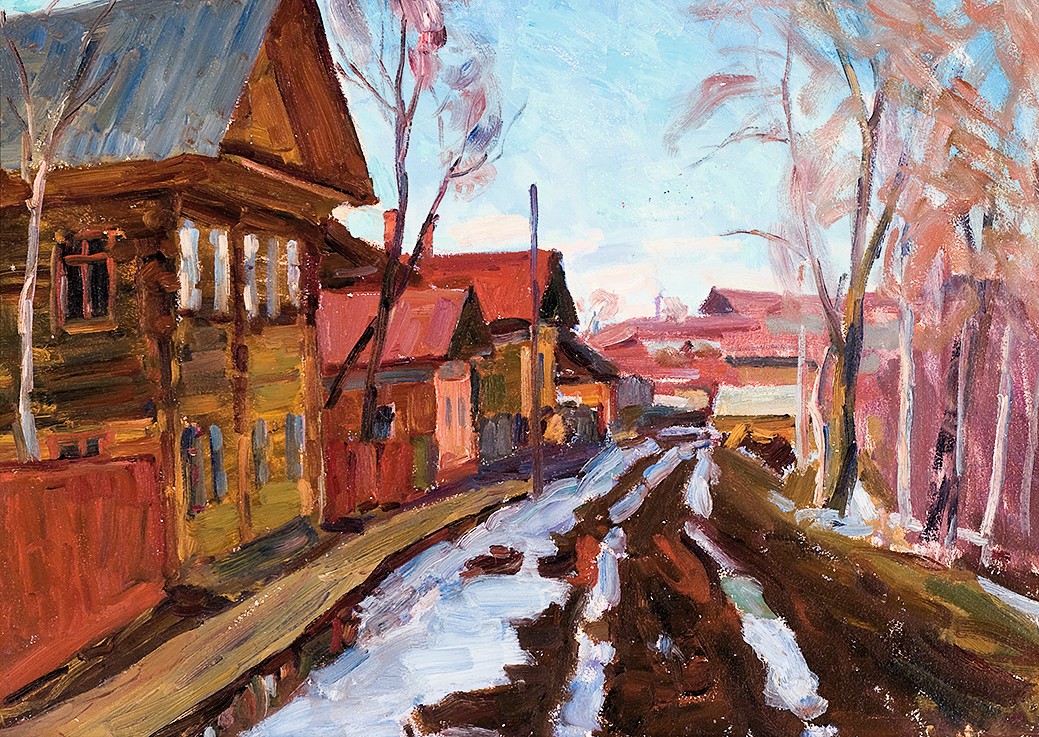
Smirnov, Yuri Alexandrovich
"Frosty Evening"
19¾'' x 27½'', (50 x 70 cm)
1968, Oil on Board
$2,500, Framed
| |
Smirnov, Yuri Alexandrovich
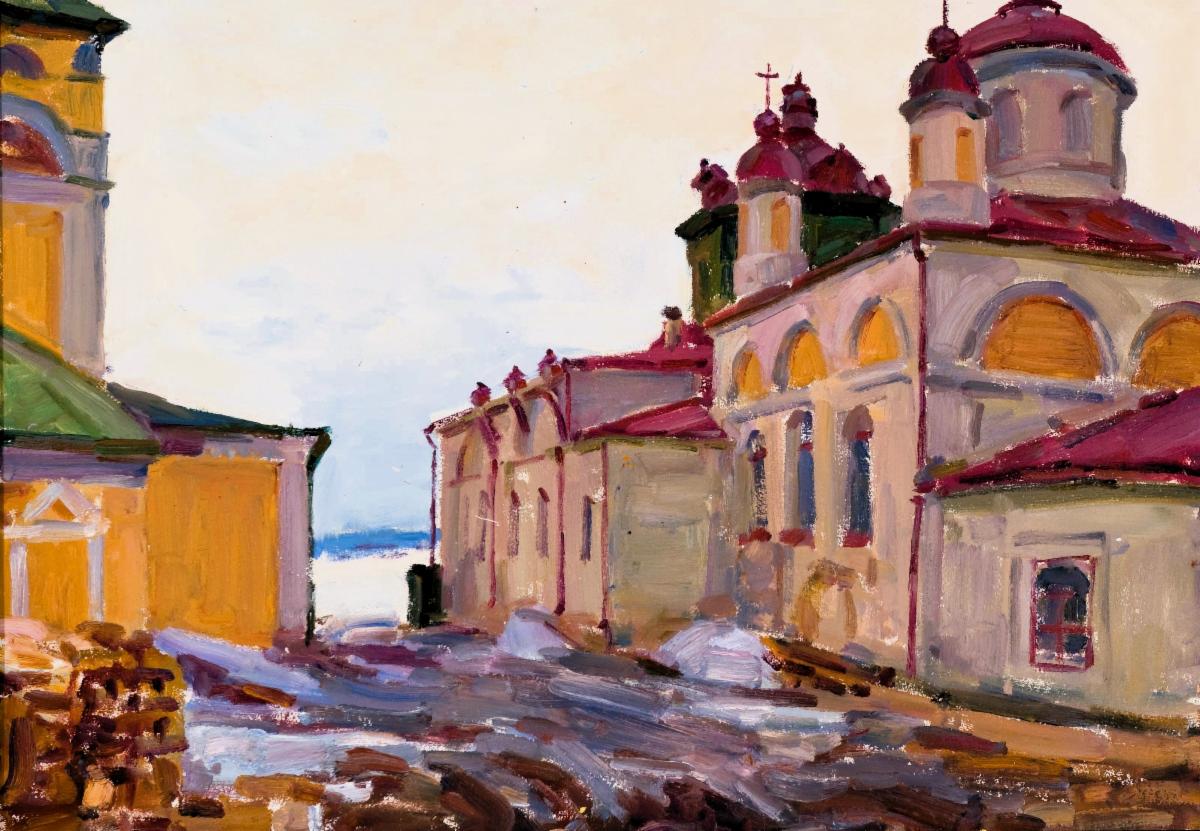
"Monastery of XVI Century"
19½'' x 27½'', (49.50 x 70 cm)
1968, Oil on Board
$2,000, Framed
| | |
Smirnov, Yuri Alexandrovich
"Frosty Evening"
19¾'' x 27½'', (50 x 70 cm)
1968, Oil on Board
$2,000, Framed
| | |
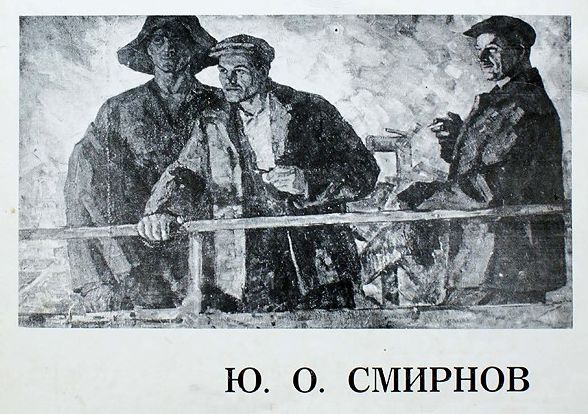
Yuri Aleksandrovich Smirnov (1925– )
Catalog from Smirnov's exhibition, Zaporizhzhya 1977
Yuri Aleksandrovich Smirnov was a Soviet Ukrainian painter and graphic artist, born on July 3, 1925, in Kharkov. He was Ukrainian by artistic tradition, working across both graphics and easel painting.
He began his formal art education at the Kharkov Art College. After the war, he continued his studies at the Kharkov Art Institute, where his teachers included M.G. Deregus and P.I. Kotov — both established figures in Ukrainian Soviet art. He completed his studies at the Kharkov Art Institute in 1951, going on to specialize in easel painting and graphic art.
Smirnov began exhibiting his work publicly in 1953, taking part in numerous regional and republican art shows over the following decade. In 1964, he was admitted to the USSR Union of Artists, formalizing his standing within the Soviet art establishment. Alongside his gallery and exhibition work, he contributed to diorama projects for the regional museums in Melitopol and Sumy — large-scale commemorative works that were a common commission for Soviet realist painters of his generation.
His subject matter reflected the concerns typical of Soviet Socialist Realism, blending portraiture, historical and political themes, and scenes of industrial labor. Known works from his output include a portrait of a Komsomol excavator operator; "Energetics" (1967); "Lenin and Children" (1973); "Shchors and Bozhenko" (1965), a historical subject centered on two Ukrainian Civil War commanders; and several paintings of steelworkers at their trade, along with quieter landscape studies such as "Sunny Day." This combination of ideological subject matter (revolutionary heroes, labor themes) with more personal, atmospheric landscape work was characteristic of many Soviet-era Ukrainian painters balancing official commissions with individual artistic interests.
In 1977, a personal exhibition of his work was held in one Zaporozhye. His paintings are held in museums, galleries, and private collections across Ukraine, Russia, and abroad, and his work continues to circulate in the art market for Soviet-era Ukrainian painting today.
| | | | |