August 2025

flipflop_glasses.jpg

Service

Are you interested in doing more service? The Connecticut OA Intergroup needs more people to step up! No amount of service is too big, or too small!

Tess T. Newsletter Editor, CT Intergroup

Step 8: Made a list of all persons we had harmed and became willing to make amends to them all

Tradition 8: Fellowship

  • Do we sometimes try to "fix" other people in OA meetings by giving them our "expert advice," or are we content to share our own experience, strength, and hope?
  • Do we make other people responsible for our abstinence or other aspects of our recovery?
  • Can we distinguish what therapists and workers in eating disorders treatment programs do from OA sharing?

Step 8 Principle: Self-Discipline

Now we apply the same Principles of self-discipline and love for others to all our actions. Self-discipline makes us less likely to hurt other people and quicker to make amends when we do.

Excerpts from "The Twelve Steps and Twelve Traditions of Overeaters Anonymous, 2nd edition, copyright Overeaters Anonymous, Inc. All rights reserved.”

Grateful to works Steps 1, 2, 3 Daily

One of my previous OA sponsors helped me hone in on which hat I wear and when. As a compulsive eater, who works professionally with other compulsive eaters, I often bring up how much our OA program of recovery has transformed my life. I am grateful for the promises coming true in my life as a result of working the steps. My relationship with myself and others transformed when I turned my will and my life over to my Higher Power. I work for my Higher Power, but I do not work for OA. I reach higher in my spiritual fitness not higher in my income when I spend time working my program. My job pays for my bills and the program pays for my sanity and food neutrality.

An Algorithm to Recovery

Many of us have a fascination with computers and programming. Part of it may be in the mystery behind the logical constructs that are used. People find it constraining, since one must think in a step-wise or systematic fashion to solve a problem. Creating such a step-wise set of instructions is called an algorithm. Conceptually, the twelve steps are an algorithm. We are provided with a step-wise set of instructions to solve a problem, namely, overeating. The domain of knowledge used to create the algorithm is spiritual since the weight of the world is taken off our shoulders and put in the hands of a Higher Power. Clearly, emotions aren’t as inert as an algorithm. To overcome the emotional baggage we carry, Step 8 addresses this beast so we can recover. Emotions are manifested in relationships; no individual is an island. We can tease out these entangled feelings that fuel our impulses and achieve freedom from food. So the takeaway is that the 12 Step algorithm provides us the vehicle by which we can detach ourselves from our emotions in order to take the edge off the overwhelming persistence of overeating.


-David, OA member


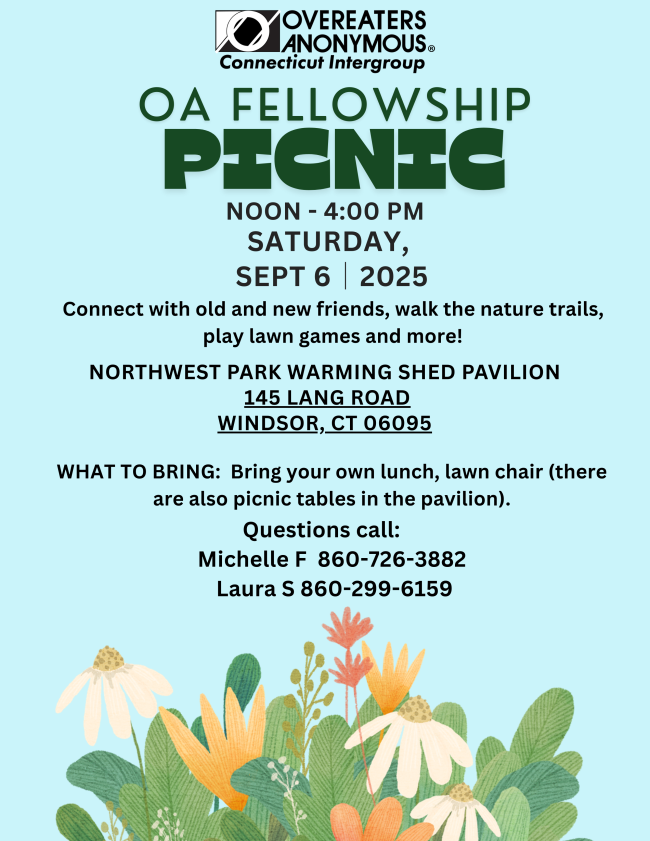
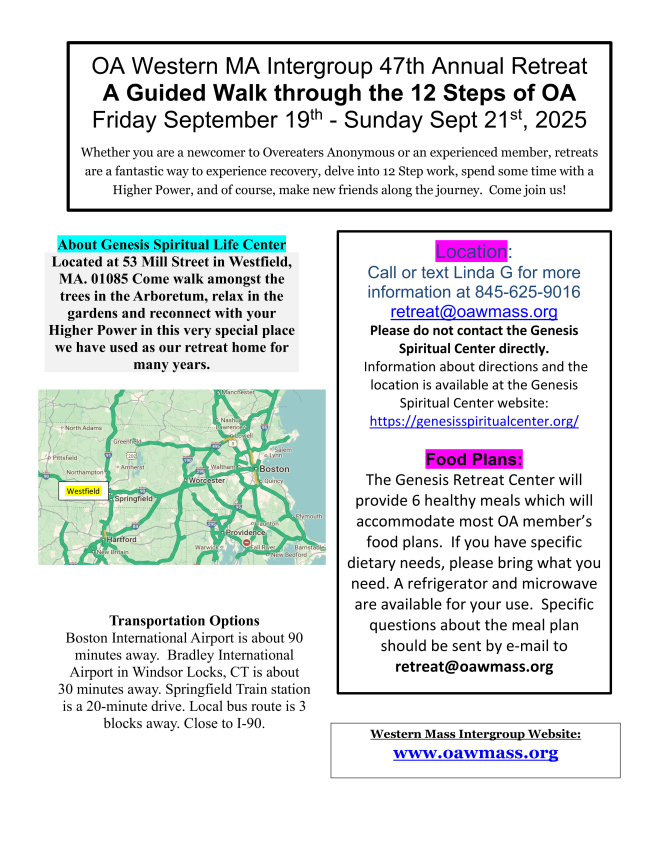
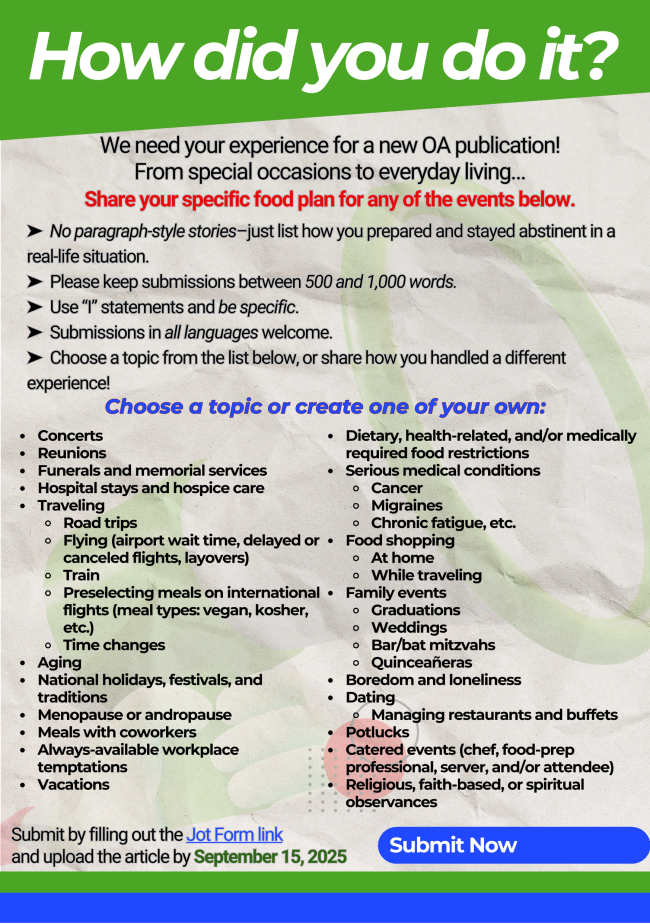
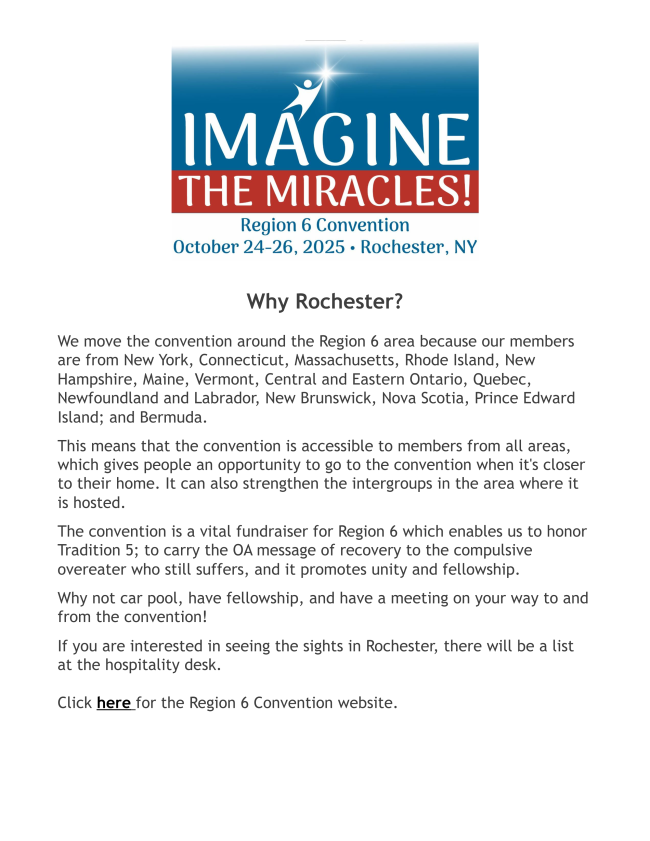
Connecticut OA Happenings - view all events here

Share your experience strength and hope as a sponsor, sign up at grateful4sponsorbank@gmail.com


Check CTIG Meeting List for changing zoom numbersconnecticutoa.org


Help Intergroup make plans for 2025 by taking the CTIG Member Survey here.

Disclaimer: personal stories and quotes throughout this newsletter express the experience, strength, and hope of the individual member and not of OA as a whole.


 Receiving this Newsletter from a friend? Click here to sign up to get your own copy every two months and also read some of our previous newsletters: Newsletter - CT Overeaters Anonymous (connecticutoa.org)
&
Checkout our Facebook page

HOW TO REACH US

We would LOVE to hear from YOU!

If you have a brief story to tell,

SUBMIT to:

secretaryctig@gmail.com

FOLLOW US
Facebook  Instagram