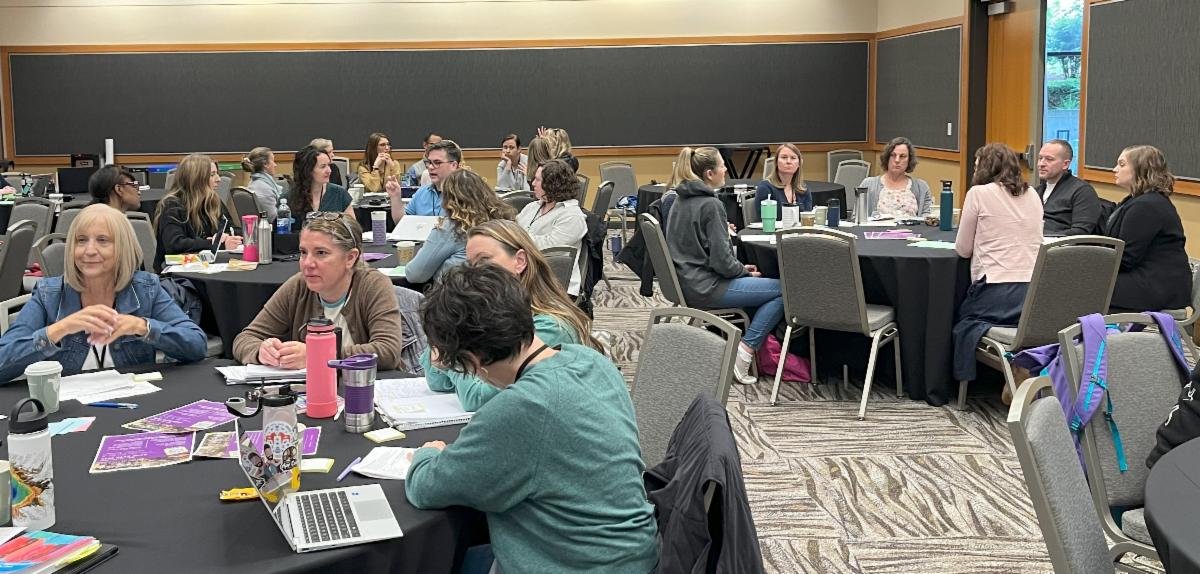
Educators from across the state gather in May to discuss their experiences in Dr. Stembridge's CRE residencies. Interested in bringing a CRE residency to your district? See below for application details! | |
CRE Residency Experiences - A Unique And Intensive Professional Development Experience: Applications OPEN! | |
|
Click here to apply to bring a CRE residency to your district.
Culturally Responsive Teacher Experiences (formerly known as CRE Teacher Residencies) are a unique and intensive professional development experience in which your team receives coaching, facilitation and technical assistance from Dr. Adeyemi Stembridge, author of “Culturally Responsive Education in the Classroom” and “Brilliant Teaching: Using Culture and Artful Thinking to Close Equity Gaps”.
Residencies are designed based on the needs of your educators and their students, and include 18 hours of in-person learning, coaching and technical assistance around the mental model that serves as the foundation for a culturally responsive classroom. The 18 hours are covered in three consecutive days using a sub release model. The dates and schedule will be mutually agreed upon once your team is selected and approved. We anticipate selecting up to 25 schools or districts for this one-of-a-kind professional development training.
District/School applicants must be able to agree to the following:
- Because the strategies and planning model of Culturally Responsive Education in the Classroom must be understood and supported by those in administrative and instructional leadership, all applications must have district and building-level administrative support for this opportunity. We encourage both district and building-level instructional leaders to commit to joining all sessions and residency opportunities.
- Applicants must commit to covering the cost of release time, substitute teachers, and/or stipends for team members as well as copies of “Culturally Responsive Education in the Classroom”. TPEP 664 professional learning funds and Title II Part A funds may be used to cover these expenses, however, applicants are responsible for applying for these funds directly with OSPI. CSTP will cover all expenses related to time and travel for Dr. Adeyemi Stembridge and provide lunch/snacks for participants.
- All participants must attend a follow-up meeting with CSTP approximately one month after your residency experience. This 90-minute meeting is to reflect on the CRE experience, discuss how CRE aligns with your district's instructional framework and how CSTP can support the continued implementation and momentum of the CRE work.
If you have any questions regarding this opportunity, please contact anzara@cstp-wa.org.
See our website for more information and FAQs.
| |
CSTP's National Board Component Support is Open for Registration | |
|
Registration is open for two CSTP-sponsored National Board Component Support cohorts, with potentially more on the way.
For the 2024-25 school year, we are partnering with the following facilitators:
-
Online cohort: Faciliated by Ranice Innocent. This will be Ranice's 6th year facilitating and supporting National Board Candidates/Cohorts. Foundations and all four components will be offered, with 12 clock hours available for each section. Read more and register here.
-
In-person cohort for music teachers: Stacy Brown will be hosting an in-person cohort for music teachers in the Olympia area. Components 2 and 3 will be offered in 24-25, with components 1 and 4 offered the year after, with 12 clock hours available for each section. Read more and register here.
| |
WERD Book Studies: Registration is Now Open! | |
|
We're excited for you to join us as Dr. Adeyemi Stembridge facilitates studies of his books Culturally Responsive Education in the Classroom and Brilliant Teaching.
We will be joined by the author at each weekly meeting, who will help facilitate learning and large-group discussions on this equity-based education book. In addition, participants will connect, discuss and reflect upon the book in small groups.These free book studies are open to all Washington paraeducators, teachers, principals, administrators, and ESAs. Registration is free, and each book study offers clock hours. See our website for more information.
Culturally Responsive Education in the Classroom
-October 1st: Preface, Chapter 1 and Chapter 2
-October 8th: Chapter 3
-October 15th: Chapter 4
-October 22nd: Chapter 5 and Chapter 6
-October 29th: Application & Implication
Register and learn more here.
Brilliant Teaching
-January 9th: Preface & Chapter 1
-January 16th: Chapter 2
-January 23rd: Chapter 3 & 4
-January 30th: Chapter 5, 6, 7 & 8
-February 6th: Chapter 9 & Afterword
Register and learn more here.
Plus: Facilitators Wanted
We are seeking Facililitators for our upcoming book studies. We have a few spots left and would love people interested in facilitating small group discussions and deepening their leadership skills and equity lens to consider joining our work with the WERD book studies with Dr. Stembridge!
Apply to be a WERD facilitator here.
| |
Partner with CSTP to Offer Clock Hours at Your Next Training | |
|
Are you running a course, professional development or book study and want to offer Washington State clock hours? CSTP is an approved Washington State clock hour provider and can approve your courses for clock hours. It is free for the instructor to apply for the course with participants paying a nominal fee.
Learn More and Apply for Clock Hours
| |
Career Connected Learning with CSTP | |
CCW is a statewide network of business, labor, education, and community leaders creating work-based and academic programs for young people in Washington to explore, prepare, and launch themselves into college and careers. CSTP is the designated Sector Lead for Education supporting this work at the state level. Here are our monthly updates.
Sector Strategy Updates
CSTP successfully updated our sector strategy that outlines our priorities in supporting workforce development and more diverse, equitable and accessible educator pathways. Take a peek on the CCW website.
PSESD 121
Puget Sound ESD 121 successfully won the most recent bid for Program Builder Funding and is currently in the process of building the Paraeducator to Credentialed Teacher Pathway. This is a huge endeavor to undertake and is a true manifestation of working collaboratively and to answer the question of "What does it mean to build, together?"
The pathway will be a partnership between Highline Community College and two districts: Auburn and Federal Way. This will be an innovative pathway to teacher certification that will be co-designed with paraeducators and educators of color in the Puget Sound region. Any paraeducator already employed, or willing to be hired by the Auburn or Federal Way School Districts would be eligible to meet with the program navigator of the program to help assess current transcripts, prior required learning assessments and create a path to degree and teacher certification completion and support applying for financial aid.
We are so excited to be partners in this work!
Regional Gatherings
CSTP as the Sector Lead will be co-facilitiating a series of Regional Gathering for Educator Pathways across the state starting in the Fall with an emphasis on Storytelling and Future Visioning and will center the driving question of “What does equitable and accessible pathways to becoming an educator in the region require of us?”
Part of these gatherings will also be an opportunity for cross-regional community learning with Puget Sound ESD Equity in Education Manager Darin Knapp joining to share about the work they are doing as an Education Program Builder. We look forward to sharing highlights from this series as the months continue!
| |
|
Are you interested in growing or expanding programming that supports pathways into the education workforce? Career Connect Washington is planning to open up their next round funding application window for Program Builders. A program builder can fall into 3 categories:
-
Career Explore programs provide early exposure to potential careers, helping students learn about different kinds of work and how their interests are connected to jobs in various fields through activities such as career fairs and worksite tours.
-
Career Preparation programs help students and young people identify personal interests and abilities through career-aligned classroom instruction. This includes Career and Technical Education (CTE) courses and hands-on experiences in internships and recognized pre-apprenticeship program
-
Career Launch combines paid worksite experience with classroom instruction and culminates in a valuable credential or progress toward a degree. By participating in Registered Apprenticeships and other Career Launch programs in K-12, CTC, and four-year college systems, students and young people can earn while they learn and become competitive job candidates.
If you have a program that you'd like to expand or build, consider checking out the Career Connected Washington website in the coming weeks for their open application announcement, and, reach out to Saara at saara@cstp-wa.org who supports our Education Sector Lead work with CCW.
| |
Latest Nakia Academy Applications Open Now | |
|
Applications are now being accepted for the 2024-25 statewide Nakia Academy virtual cohorts. This academy is for and by BIPOC educators to create a "safe space" for community building and professional learning. This is not a "program" but a community that is in continuous growth and support.
The deadline for applications is Sept. 3.
This is a continuation and expansion of the partnership between OSPI's BEST program, WEA and the addition of the WA State Counselors' Association (WSCA). Check out a video for a glimpse of what participants say about Nakia.
Apply here.
| |
WEA National Board Facilitator Training | |
|
To ensure consistency across the state, NBCTs are asked to participate in Facilitator Training prior to hosting a cohort group. Additionally, OSPI will only approve cohorts that are facilitated by trained facilitators. This training hones facilitation knowledge and skills, provides a deeper understanding of the revised National Board process, as well as develops skills in working with adult learners. Typically, OSPI co-locates Facilitator Training with WEA Jump Start sessions during the summer. Due to the ongoing pandemic and safety concerns, Facilitator Training will be hosted online this year.
OSPI's Regional Coordinators lead Facilitator Training.
Current Training Options:
Training is entirely online and free of charge.
Clock hours are free through OSPI. Facilitator Training will also include a virtual Pre-Training component that is required for all attending the in-person event. The purpose of the Pre-Training is to equip facilitators with a baseline of prior knowledge to avoid the sit-and-get structure and provide more time for discourse among participants during training.
Register for 2024 Facilitator Training
- August 5-7, 8:00 AM-12:30 PM (12 Clock Hours)
For any questions about Facilitator Training, please contact Steven Mueller.
| |
CDC Science Ambassador Regional Training: Seattle | |
|
The Centers for Disease Control and Prevention’s Science Ambassador program will be offering a 1.5 day regional training for middle- and high-school teachers and education leaders in Seattle, Washington at the University of Washington on Thursday, August 15, 2024 12:00 PM – 4:00 PM and Friday, August 16, 2024 from 8:00 AM – 4:00 PM local time.
Regional trainings are a professional development opportunity for participants to learn strategies to teach public health concepts and inspire interest in public heath careers in the classroom. This regional training will include interactive session on bringing public health topics—including applied epidemiology, infectious disease, population health, and public health careers—to the classroom. Participants will also have the opportunity to network with CDC staff, local public health professionals, and school of public health faculty and staff.
Participants must meet one of the below criteria:
- Currently teach middle school (grades 6-8) or high school (grades 9-12) OR
- Currently hold an education leadership position in a U.S. school, district, or state
Please REGISTER here.
| |
Local Success: School Ambassador Fellowship | |
|
Woodland Schools Educator Shari Conditt, NBCT, was recently accepted into the US Department of Education' School Ambassador Fellowship program after a two-year process. We love to see Washington state educators take their place on the national stage and put teacher leadership into action. Congratulations, Shari!
| |
Ready WA: A Day in the Life | |
|
Helin Taskesen, a 2023-2024 Ready WA Storyteller, gives us a front-row seat to a day in her life! From celebrating successes in the morning, to a stunning prom night in the evening, Helîn’s day was the perfect example of balancing school with opportunities. Here's to seizing opportunities and making them count! Go Helîn! Watch the story here.
| |
|
Join us for fun facts, obscure knowledge, and exploration of physics, genetics, etymology, art, and more!
| |
|
Electromagnetic radiation makes up a continuous spectrum of wavelengths and energies. We break this spectrum up into different classifications of waves depending on what we use the radiation for–and how dangerous it can be to us.
The shortest wavelengths and thus most energetic waves we call gamma radiation: powerful waves emitted from nuclear reactions that are best to be avoided altogether. Near the middle of the relevant spectrum we find ultraviolet light, which requires us to put on sunscreen, and visible light to which our bodies are particularly adapted.
On the other side of the spectrum we find radio waves. These long-wavelength waves are low energy and completely safe, which is why we can broadcast them through populated areas to listen to talk radio and music and not have to worry about health risks.
Individual waves have several defining characteristics. This includes the frequency (how “scrunchy” the wave maxima are) and amplitude (the “height” of the wave). Radio transmitters turn sound into certain frequencies and amplitudes of radio waves. When you turn a radio dial on a receiver, it resonates with those waves, reproducing the original sounds.
AM stands for amplitude modulation while FM stands for frequency modulation. AM radio is the simpler of the two, varying the height of the wave while remaining at a constant frequency. FM, in contrast, varies the frequency of the wave, meaning the receiver needs to interpret the deviations in frequency from the standard “carrier wave” and produce the resulting electrical signals.
AM radio can be broadcast on lower frequency bands. As these waves are less energetic, it has a much larger broadcast area. However, the fidelity is lower because the amplitude is more susceptible to interference, causing “noise” or static in the sound. FM has a smaller broadcast area but a much higher sound quality, making it better for music.
This explains why AM radio is used more for talk shows; static during someone’s political or sports opinion is a lot less disruptive than interference in the music of the 80s, 90s, and today.
In the end, AM and FM radio have persisted and coexisted for quite a long time. AM was developed in the 1800s, while FM was successfully developed in the 1930s. Since they can both be broadcast without interfering with the other, there was never a reason to remove AM from the air, leaving more options for your listening pleasure.
Let’s send out our congratulations to the radio–and thank all those radio waves for carrying information right through our neighborhoods and not harming a thing.
| |
Your gift ensures that CSTP continues to support student achievement through a focus on teaching excellence. With you as a partner in CSTP’s mission, you directly make a difference in the lives of youth across Washington State schools. Donations are tax deductible and essential as CSTP works to support educators navigate unique models of student engagement and teacher leadership. | |
Liking and sharing our posts on social media is another way you can support CSTP during these times. Thank you for sharing our message. | | | | |