Having trouble viewing this email? View as Webpage


Dear ,

I've been thinking a lot lately about listening. Specifically, about listening to ourselves.


So much of what we do as advocates centers on helping clients trust their own knowing. We sit with someone who says, "I know something isn't right, but my doctor says everything's fine." We listen, validate, and help them trust that whisper inside that says something needs attention. We help them advocate for themselves when their intuition is telling them to keep asking questions.


It's beautiful work. Essential work. But I wonder how often we extend that same grace to ourselves.


How many of us are walking around ignoring our own body's signals? Pushing through exhaustion because there's too much to do. Dismissing our own anxiety or persistent worry as just part of the job. Telling ourselves to toughen up while we're actually running on empty. We're so good at helping others trust themselves that we forget to trust ourselves.


Here's what I've been learning: there's a crucial difference between fear and intuition, and we need to learn to tell them apart.


Fear is loud. It screams. It catastrophizes. It creates elaborate stories about everything that could go wrong. It spirals and grows darker the more we feed it. Fear says, "You can't handle this" and "Something terrible is going to happen" and "Everyone will see you're not good enough." Fear demands our attention and often gets it, because it's so forceful, so insistent, so impossibly hard to ignore.


Intuition is quiet. It's a whisper. It's the calm knowing that something isn't right, even when you can't quite explain why. It's the gentle inner voice that says, "You need rest" or "This situation isn't safe" or "It's time to make a change." Intuition doesn't need to yell because it knows the truth. It speaks once and then waits for us to listen.


The problem is that intuition is easy to miss. In our busy lives, drowning in noise and responsibility, that quiet whisper gets drowned out by fear's relentless screaming. And the longer we feed the fear, the longer we listen to it, believe it, act on it, the longer and darker it becomes. It metastasizes. It colors everything. It convinces us that the loud voice is the true voice, the real voice, the only voice worth hearing.


But it's not.


So what does it mean to listen to ourselves?


It means paying attention to your body. That tightness in your chest- what's it telling you? That constant fatigue that doesn't go away with sleep- what do you need? That persistent worry that won't let go- is it fear spiraling, or is it intuition whispering something important?


It means creating enough quiet to actually hear ourselves. Not the noise of the day, not the demands of others, not the fear screaming in your head, but your own quiet knowing.


It means trusting that knowing even when it's inconvenient. Even when it means saying no. Even when it means asking for help. Even when it means changing course.


And it means recognizing that the advocates who best serve their clients are the ones who've learned to serve themselves first. Not selfishly, but with the same wisdom, compassion, and courage we offer to everyone else.


I want to invite you to try something this month:


When you feel that tight knot of anxiety or fear, pause. Notice it. And then ask yourself: Is this fear screaming, or is this intuition whispering?


If it's fear, what story is it telling you? Can you thank it for trying to protect you and then gently set it aside?


If it's intuition, what is it trying to tell you? What do you need to hear? What action might your quiet knowing be pointing toward? And then listen. Really listen. To yourself. To your body. To that whisper beneath all the noise.


Your clients need you healthy and whole. But more than that, you deserve to be healthy and whole, not just for what you can do for others, but simply because you matter.


Trust yourself. Listen to your body. Distinguish the whisper from the scream.


Join Us for This Important Conversation


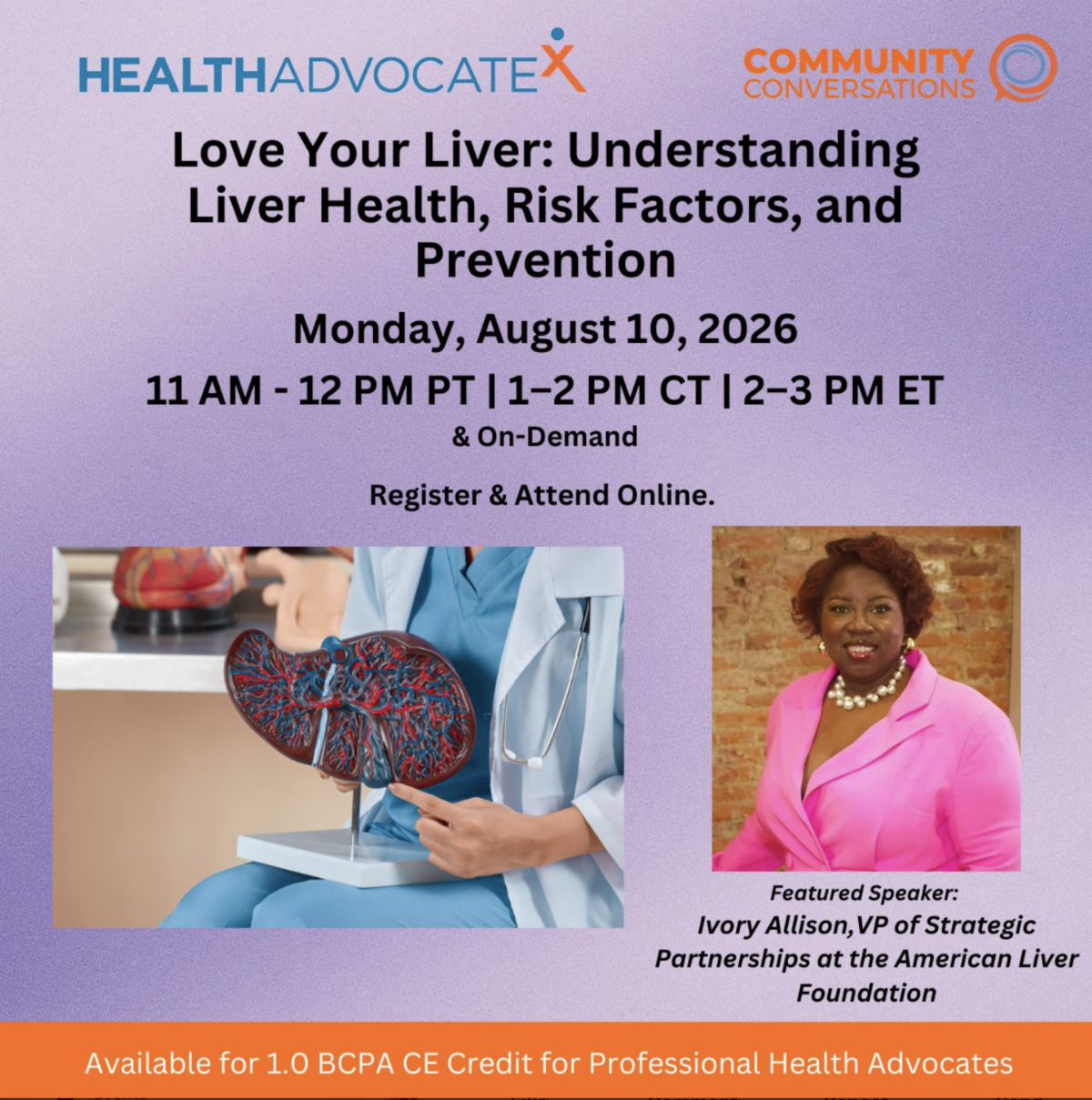
Speaking of listening to your body, I want to invite you to our upcoming community conversation: "Love Your Liver: Understanding Liver Health, Risk Factors, and Prevention."


The liver is often called "the silent organ." It performs hundreds of essential functions, yet liver disease frequently develops without obvious symptoms, meaning many people don't realize they're at risk until serious complications arise. This is the ultimate example of a whisper we need to listen to: our body's subtle signals.


Whether you're concerned about your own liver health, supporting clients navigating liver disease, or simply want to deepen your understanding of this vital organ, this conversation is for you.


Take Care,

Malynnda A. Stewart

Board Chair, HealthAdvocateX


FALL CONFERENCE Announcement


HealthAdvocateX will not have a presence at the Health Advocate Summit in Las Vegas this year, as there was no support for a professional advocacy track.


Instead, CHCAO's member organizations are hosting a Virtual Conference centered around the future of the profession of Patient and Health Care Advocacy. It will be a full-day virtual conference with opportunities for learning, sharing, and networking.


We hope you will join us as we partner with CHCAO to host a virtual conference for professional patient and health care advocates on Thursday, November 12th from 11am-5:00 pm EST. 


Stay Tuned and watch your email for more information from CHCAO member organizations.


Upcoming Events

August 10 Community Conversation - Love Your Liver: Understanding Liver Health, Risk Factors, and Prevention


REGISTER REGISTER HERE


When: Aug 10, 2026 | 11 AM–12 PM Pacific Time | 1–2 PM Central | 2–3 PM Eastern

Where: Online via Zoom

Cost: Free to the general public. Purchase 1.0 CE Credit for $10 for HealthAdvocateX Members; $30 for Non-Members.


The liver is one of the body's most vital organs, performing hundreds of essential functions that support overall health. Yet liver disease often develops silently, with many people unaware they are at risk until serious complications arise. Join Ivory Allison from the American Liver Foundation for an engaging community conversation exploring the importance of liver health, common risk factors for liver disease, prevention strategies, and steps individuals can take to protect their liver throughout their lifetime. 


Learning Objectives:

  1. Identify at least three systemic health conditions that may be affected by oral health status in older adults.
  2. Recognize common signs and symptoms of oral health problems that may warrant further evaluation or referral.
  3. Describe the advocate’s role in supporting communication, care coordination, and access to appropriate dental resources as part of whole person care.


About The Speaker –


Ivory Allison is a dual-sector executive with deep influence in the arts and health industries and partnership cultivation. For more than 20 years Ivory has had measurable impact nationally. She is currently the National Senior Director of Community Impact with American Liver Foundation (ALF) and before her appointment to the national team, Ivory created three national programs for the organization during her decade of service as the former Mid-Atlantic region’s Executive Director. In her current role, Ivory strategically builds coalitions, cultivates national partnerships, and curates programs aligned with the organization’s mission of being a national leader in liver health research and innovation, centered on equity. A dedicated and collaborative leader in the Philadelphia community, she is the President of the Philadanco! board of directors, a board member for West Catholic Preparatory High School and a member of the National Coalition of 100 Black Women Inc., Pennsylvania Chapter. Ivory earned her bachelor’s degree in Sociology from Saint Joseph’s University.

IN CASE YOU MISSED IT – FABULOUS CONTENT STILL AVAILABLE THROUGH OUR ON-DEMAND/ CLASSROOM 

The Missing Piece of Healthcare: Why Oral Health Matters


ACCESS HERE


Oral health is often treated separately from the rest of healthcare, despite its significant impact on overall health and quality of life. This presentation will explore the relationship between oral health and common medical conditions seen in older adults, including diabetes, cardiovascular disease, cognitive decline, aspiration pneumonia, malnutrition, and medication-related dry mouth. Participants will learn how to recognize potential oral health concerns, understand when dental issues may be contributing to broader health challenges, and identify opportunities for advocacy and appropriate referral.


Learning Objectives:

  • Identify at least three systemic health conditions that may be affected by oral health status in older adults.
  • Recognize common signs and symptoms of oral health problems that may warrant further evaluation or referral.
  • Describe the advocate’s role in supporting communication, care coordination, and access to appropriate dental resources as part of whole person care.


Explore Our Online Classroom


Did you miss one of our past events? Our online classroom is always open! Browse all courses available purchase with BCPA CE credit. 

Partner Highlight: Healthcare Advisor Nan

We’re proud to spotlight our newest partner member, HealthCare Advisor Nan, as a partner organization. Whether you’re managing a chronic illness, recovering from surgery, or caring for an aging loved one, we provide personalized assistance to make your healthcare journey easier and to help you make the right decisions. Learn more about their mission and resources at https://healthcareadvisornan.com/.


To learn more or to join us as a partner or organizational member, please visit: https://healthadvocatex.org/membership/

Inclusion, Diversity, Equity and Access (IDEA) Statement


OUR COMMITMENT

Approved by the Board September 21, 2022

Inclusion, Diversity, Equity and Access (IDEA) Statement


Our mission is to transform individuals into active participants in their care. We do this by educating, connecting, and empowering individuals, families, and professional advocates to include advocacy into all aspects of health and healthcare.


We recognize that:

  • Racism is a public health issue that impacts various intersections and communities differently.
  • Each person is unique and therefore experiences health care differently.
  • Every individual deserves health advocacy regardless of their race, ethnicity, language, nationality, gender, sexual orientation, gender identity and expression, spiritual practice, financial status, education, geography, disability, mental and physical status, age, weight, substance use disorder or other factors. 
  • Our organization is uniquely positioned to raise awareness on IDEA in health and health care.


We are committed to:

  • Raising awareness about the importance of IDEA in health and health advocacy in all aspects of care.
  • Expanding diverse representation within our organization, expert presenters, and educational offerings.
  • Intentionally messaging our values, sharing IDEA expectations for ourselves, affiliated advocates, and partnering groups.
  • Creating space for respectful dialogue about representation, equitable access, and inclusive practices in health care and health advocacy.
  • Educating our community and participating in opportunities about IDEA events and exercises to keep these issues in the forefront of our work.
  • Implementing systems to ensure IDEA is pervasive in our organization.


We will reflect on our accomplishments with humility and grace. We will recognize our limitations and remain open to what we may not see or realize so that we can improve and or repair any harm. 


Land Acknowledgement


HealthAdvocateX is headquartered in Seattle, Washington. We acknowledge that we are on the traditional land of the first people of Seattle, the Duwamish, Suquamish, Stillaguamish, and Muckleshoot People past and present, and honor with gratitude the land itself and each tribe. We invite you to join us in acknowledging and thanking indigenous people for their ongoing stewardship wherever you are located.


Do you have something you would like to share with the HealthAdvocateX community?

Please submit ideas to info@HealthAdvocateX.org
Email | Call Us: 206.377.3000 | Visit Our Website
STAY CONNECTED:
Facebook  Linkedin  Instagram  Youtube