|
Automobiles As Historical Artifacts
People's reasons for collecting are as diverse as the number of objects that are collected. You can collect things that are personally meaningful to you, objects of status or items that facilitate social connections. You can collect cars for the unique experiences they offer. For many collectors, learning is the motivating factor.
When you view classic automobiles as artifacts you are placing them in a historical context, and comparing and contrasting other similar objects with the socio-economic construct of the era.
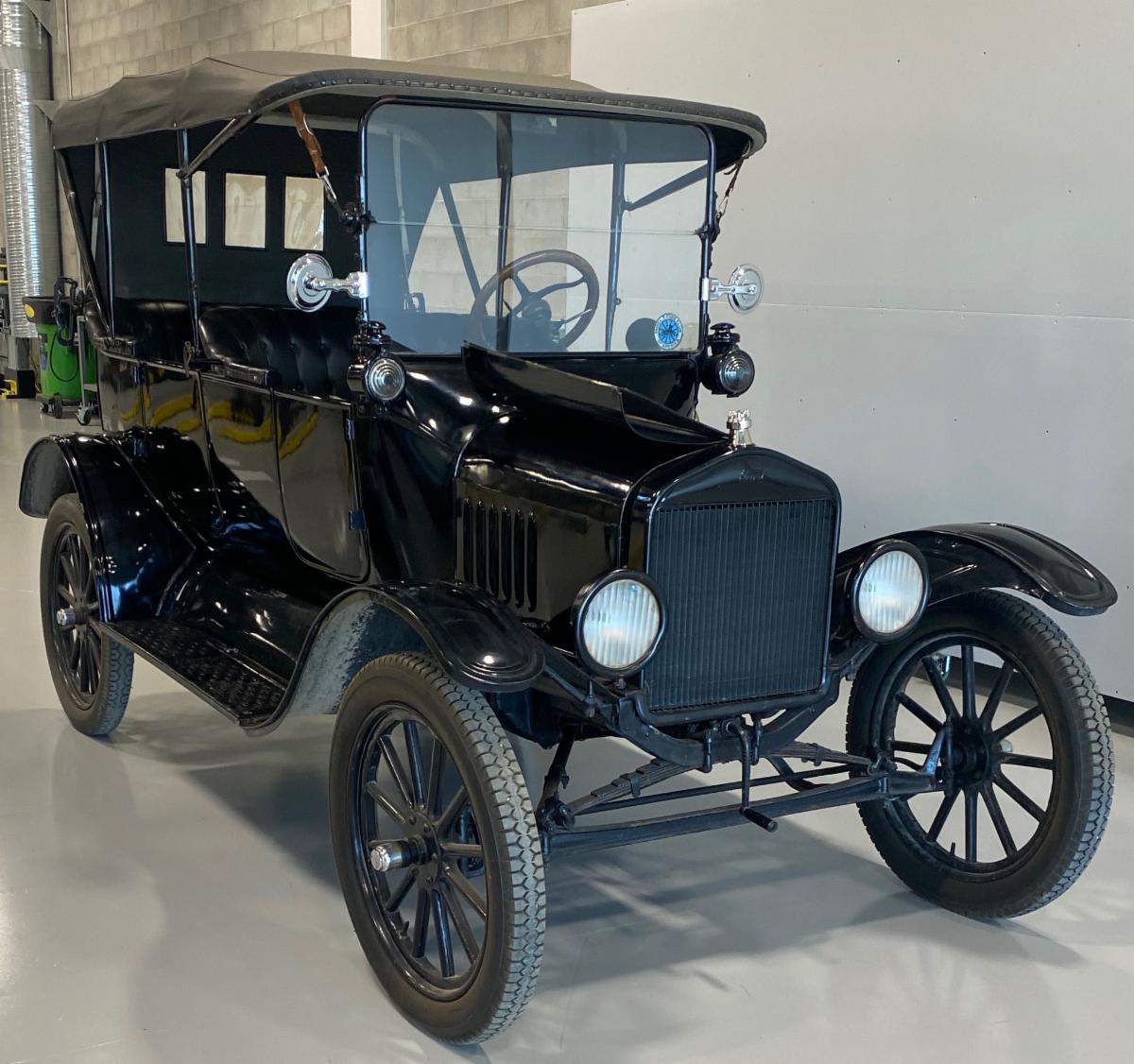
The 1917 Ford Model T pictured above arrived from a client who wants me to sell it for him. I feel strangely compelled to keep it. At first glance it looks like a spindly buggy, light years away from what we normally drive today. Look at it a little closer and you realize that it has all the parts in all the same places, working in the same way, as a modern ICE vehicle. If you take away the body and the wood-spoke wheels, the chassis and running gear don't look that much different than a car made 50 years later. The internals of the 3 litre, 4 cylinder engine operate in the same way as in today's combustion engines. Even the fuel economy isn't that different: A Model T will get about 20mpg which is better than a lot of new vehicles.
The Model T is probably the most important car in the history of the automobile. Before its introduction in 1909, 'motorcars' were only for the wealthy who had chauffeurs to start, drive and maintain them. By virtue of the first modern assembly line, the Model T could be made in great quantities at a price that the average family could afford. The list price of a Model T actually dropped from its initial price of $825 (about $USD 25,000 in today's money) to $260 in 1925. It would take most Ford assembly line workers 3-6 month's salary to afford one of the cars they were making - a ratio that is more or less the same today. Ford made 15M Model T vehicles from 1909 to 1926. By 1930, more than half of American families owned an automobile (from 2% in 1909), largely because of Henry Ford.
In 1917 most homes did not have electricity. It would take until 1925 for 50% of the homes in the US to have power. Early in his career, Henry Ford was employed by Thomas Edison and they would later become lifelong friends. Edison was keen motorist and even built his own electric car. Edison developed the magneto for the Model T which enabled it to operate without a battery. The cars were hand-cranked, up until the end of production when an electric starter was an option. Today, the name of the Ford/Lincoln EV development program is 'Team Edison'.
| 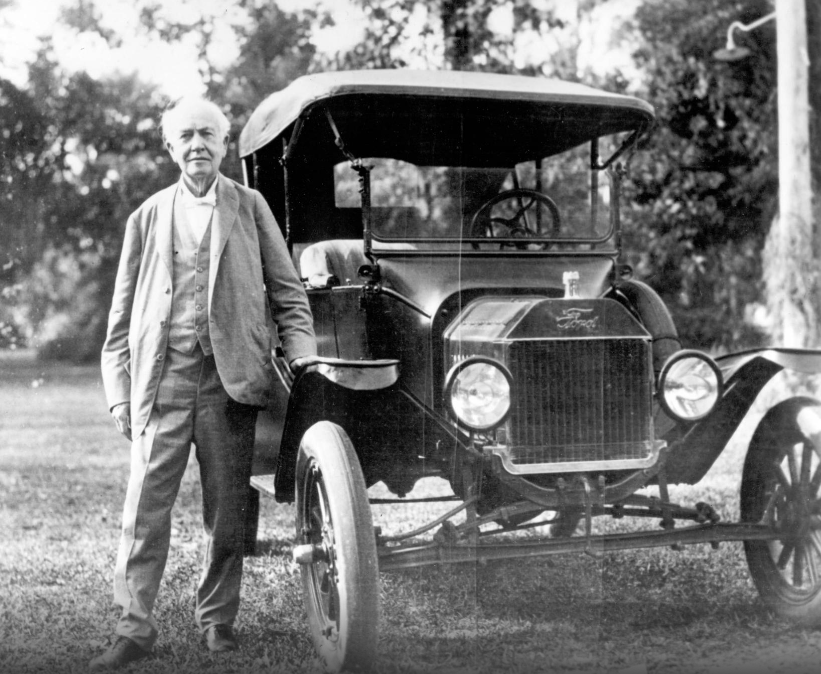 | Thomas Edison and the Ford Model T | |
The US entered WW1 in 1917, when Canadian forces were already fighting. In April of that year four Canadian divisions stormed Vimy Ridge in France and won one of the most important battles of WW1. The cost was tremendous: 3,598 Canadian soldiers were killed and another 7,000 were wounded in those few bloody days.
In 1916 Manitoba, Saskatchewan and Alberta women earned the right to vote, though there were race-based exclusions. The Federal Government offered suffrage to some women in 1917, and full suffrage in 1918 - though it wasn't totally inclusive until 1960.
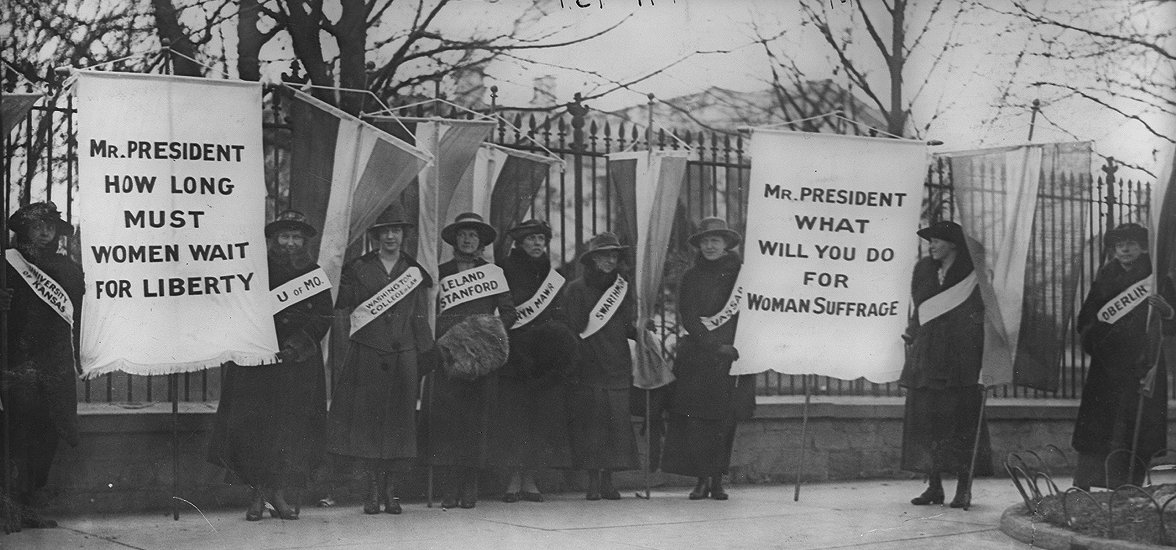
1917 was the year of the "Night of Terror" where 33 female suffragists in the US were arrested and brutally beaten after demonstrating in front of the White House. They displayed signs as 'offensive' as, "Mr. President, How Long Must Women Wait For Liberty?"
| Suffragists demonstrating outside the White House in 1917 | |
So, what can we make of our progress over the last 100 years? Cars, homes and life in general are safer and more comfortable - but not for everybody. A scan of the global news confirms that we are not as far ahead as we should be. Something like half the world's population still lives with anxiety over food, shelter or safety.
The power of an artifact like this 1917 Ford is that it opens paths of interest and discovery. I find the process of learning everything I can about a 'new' collector car to be the most satisfying aspect of the hobby.
|  | Ariya Update: I did try to order an Ariya and contacted 4 Nissan dealerships. Two said they weren't taking orders for the car. One said that they would get me one of the first cars, but after I asked for them to specify that they would sell it to me at MSRP they said all their cars were sold. The last dealer said they would take my deposit but wouldn't guarantee MSRP. Welcome to the new reality of trying to buy a car! I don't recall ever walking into a Nissan dealership, and this experience isn't likely to change anything.. | This Week on Bring A Trailer | 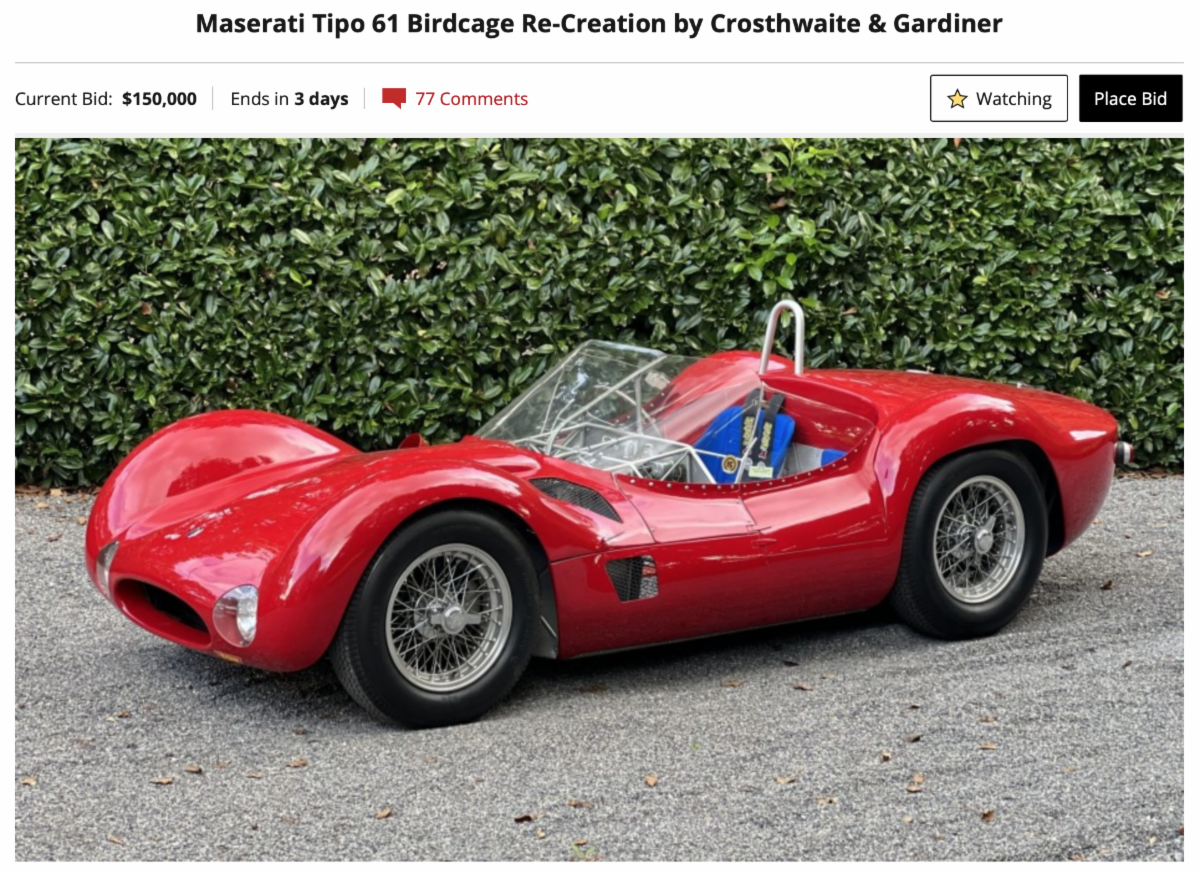 | |
Maserati Tipo Birdcage Re-Creation For Sale in Belgium
Auction Ending Tues, Oct 25th at 12:55pm
In the last decade or so we have seen factory built replicas of historically important vehicles. Jaguar Land Rover have 'remanufactured' a limited series of the Lightweight E Type, C Type, D Type and XKSS. Aston Martin re-created the James Bond DB5 and Bentley is re-creating the 30's Blower Bentley. These are all extremely accurate reproductions and extremely expensive with prices starting at well over $USD 1M.
Audi took a different approach and commissioned the British firm Crosthwaite & Gardiner to re-create the Auto Union C-Type V16 and D-Type V12 grand prix cars. Designed by Ferdinand Porsche just after he set up his own design consultancy in Stuttgart in the early 1930's, these 'Silver Arrows' were some of the most complicated (and fastest) racing cars ever created. Also, among the most difficult to reproduce.
Crosthwaite and Gardiner, who started out restoring and servicing vintage Bugattis, occupy the absolute top tier of historic racing restoration companies. This Birdcage was a commission to duplicate the customer's original car which was provided for reference.
An original Tipo 61 Birdcage might be $3M - $5M in todays Market. A faithful replica of a Maserati 450S just sold for $709k in St. Moritz. It might cost $1M to have C&G build you another replica, and that is if they are not booked up to infinity like most world-class restoration shops. Bidding is currently at $150k, but this is at least a $500k car.
| |
Recently Completed Auctions
on Bring A Trailer
| |
1957 Mercedes-Benz 300SC, for sale in OH
Reserve Not Met at $293,000
These cars just don't seem to have much of appreciative audience. It was bid to $401k in 2019, and only $293k this time, so RNM is not a surprise. 509 comments indicate lots of opinions, but few cheque writers.
"Consider this car a Mercedes 300sl Gullwing with a coupe body. It is one of only 98 built with the Injected version of the 3 Litre straight 6. The 1,400 Gullwings are iconic and nice examples are all over $1M. Despite their rarity and the fact that they cost more to restore than a Gullwing, the 300SC Coupes, Convertibles and Roadsters often sell for half of that. This example was bid to $401k in Feb 2019. I don't understand why these aren't $1M cars..."
| |
|
RESTORATION PROJECTS WANTED FOR WINTER 2022/2023
With our S3 E Type now complete and just the finishing touches left on our Series Land Rover, we are looking for 2 or 3 restoration projects to keep us busy over the winter. If you are thinking about undertaking a restoration, or buying a car to restore, let's talk!
| |
- On-Line Auction preparation and management
- Post-Sale logistics and sorting
- Restoration Project Management
- Dent Removal Wheel Repair Wraps and Tint Paint Touch Up Detail
Email Lawrence
Lromanosky@me.com
| Auctioned on Bring-A-Trailer: | |
1998 Hummer H1,
Dark Green on Tan Leather
Scheduled Oct, 2022
10,000 miles from new,
6.5 GM TurboDiesel, 4 speed auto, portal axles
Outfitted for fishing/camping with 5000w generator and inverter to run pull out kitchen in rear load area. Custom roof rack for fly fishing rods. VHS and CB Radio.
| |
1917 Ford Model T
Black! Retrofitted with an electric starter and electric lights. Older restoration holding up well. If you are looking for an 'analog' driving experience, this is it!
$INQUIRE
| |
1993 MERCEDES-BENZ E320 CABRIOLET
122,000km
Extremely well preserved Victoria car reconditioned to the highest standard by meticulous owner. Over 100 hours and $13,000 in parts (wholesale) was recently spent to replace all consumables. Looks like a new car.
The W124 and W126 and their variants were design masterpieces from Bruno Sacco that are not outsold by current Mercedes-Benz offerings. They only made about 35,000 E Class Cabriolets, with about 20,000 of them being fitted with 6 cylinder engines. That is about the same production number as a Porsche 996 Turbo or a Ferrari 360 Modena.
$40,000
| |