|
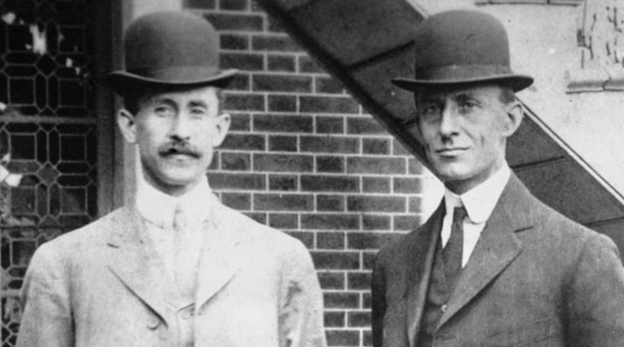
December 17, 1903. One vision, two brothers, four years of tireless labor— it all comes down to this one day. Skies are overcast on the beach with winds gusting to 27 miles per hour, a bit stronger than the brothers had hoped. Using a white sheet, they send a ready signal to the nearby lifesaving station on Kill Devil Hill. One brother climbs into position on his stomach amidst a maze of cables and levers to test the controls. At 10:35 a.m., he releases the restraining wire, launching their 40-foot, 605-pound creation into the air for a breathtaking 12 seconds before it lands in the sand 120 feet away. In those 12 seconds, Wilbur and Orville Wright changed the world forever.
Fast-forward nine years and Lawrence Sperry would once again revolutionize air travel with the introduction of his gyroscopic automatic pilot, or “George” as he nicknamed it. Sperry’s autopilot was a worldwide success, quickly becoming a standard feature in all types of aircraft. Over the years, autopilot has become infinitely more sophisticated, enabling the aviation process to become increasingly automated. These systems are designed to handle most aspects of routine flying, ensuring a smooth journey under normal conditions. However, when faced with unexpected turbulence or emergencies such as severe weather or mechanical failures, autopilot alone may not suffice. During these critical moments, the expertise of a skilled pilot becomes invaluable, ensuring that the aircraft be flown safely through out-of-the-ordinary challenges.
A notable example of this occurred in 2009 when Air France Flight 447 experienced a mechanical failure, causing autopilot to disconnect. The crew wasn’t properly equipped to handle the situation, and the plane experienced an aerodynamic stall from which they were unable to recover. The flight crashed into the Atlantic Ocean killing all 228 passengers and crew onboard. In the aftermath of the crash, journalist and former pilot William Langewiesch wrote, “Automation has made it more and more unlikely that ordinary airline pilots will ever have to face a raw crisis in flight, but also more and more unlikely that they will be able to cope with such a crisis if one arises.”
In many respects, this story is analogous to the investment landscape. Passive management strategies, akin to autopilot, can efficiently track market indexes during stable conditions, often at a lower cost to the investor. A set-it-and-forget-it approach is utilized, which can work well in a stable market. However, just as autopilot is limited in times of crisis, passive management can fall short in volatile markets or when specific or unique investment opportunities arise.
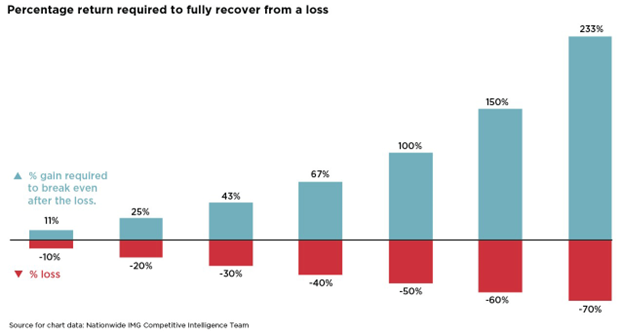
From October 9, 2007, to March 9 of 2009, the S&P 500 declined by approximately 50%. If an investor’s retirement savings had been passively invested in an index fund during this time, they would have seen the loss of half of their wealth over the course of just 17 months. What does it take to recover from a 50% decline? An investment return of 100% would be needed just to get back to the original value! With an average annualized market return of 10%, it would take more than 7 years just to get back to your starting point. This would be a devastating blow that, in some situations, might be insurmountable.
|