|
Welcome to the June BABN Policy and Trade Update.
May saw some important developments, specifically in UK politics, where the UK local elections highlighted an increasingly fragmented political environment and growing pressure on the Government, while the King’s Speech set out the legislative agenda for the year ahead, with implications for growth, regulation, and investment. Across the Atlantic, the SelectUSA Investment Summit once again brought together global investors and US stakeholders to drive inward investment, underscoring the continued strength of the transatlantic economic corridor.
On the trade side, new data from the Office for National Statistics (ONS) provides an early look at how UK-US trade patterns are adjusting in response to tariffs introduced in 2025, reinforcing the importance of stability and predictability for business.
BAB also published a one-year review of the Economic Prosperity Deal (EPD), assessing delivery to date and identifying the key areas where further implementation is needed - particularly on non-tariff barriers and regulatory cooperation. Our work also included a submission to the UK Government’s British Industrial Competitiveness Scheme (BICS) consultation, where we emphasised the importance of maintaining international alignment and avoiding new trade frictions for transatlantic businesses.
See below for a breakdown of policy and trade headlines and our published works.
Follow BAB on X and LinkedIn
| | |
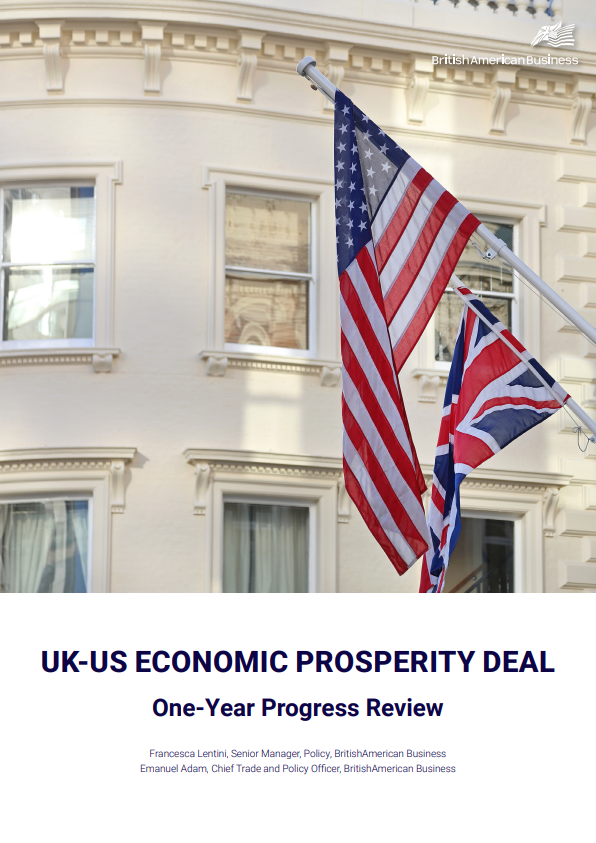
New BAB Publication: EPD One-Year Progress Review
May 2026
Overview: BAB published its one-year progress review of the UK-US Economic Prosperity Deal (EPD), assessing delivery to date and identifying remaining gaps. The review finds that while the EPD has delivered targeted tariff mitigation and incremental progress in sectors such as automotive, aerospace, and pharmaceuticals, it remains a framework rather than a fully implemented trade deal. Many of the most commercially significant elements, including non-tariff barriers, regulatory cooperation, and steel and aluminium arrangements, remain unresolved or only partially developed, with uneven delivery and limited clarity on timelines.
| | | |
Dive deeper: BAB’s analysis highlights that the EPD has secured important early wins, particularly in avoiding more punitive tariff outcomes. However, businesses continue to face higher costs and complexity, with the 10% baseline tariff still weighing on UK exporters. We emphasise that the next phase must focus on practical delivery, especially on regulatory issues, which remain the primary barrier to deeper transatlantic trade.
Looking ahead: The review calls for both governments to move from political commitments to implementation, prioritising commercially meaningful outcomes and maintaining momentum in the UK-US relationship.
Read more: You can read our full publication here and our press release here.
| | |
BAB responds to BICS Consultation
14 May 2026
What happened: BAB submitted a response to the UK Government’s British Industrial Competitiveness Scheme (BICS) consultation, which explored reforms to reduce regulatory burdens and improve the UK’s industrial competitiveness.
How BAB responded: Our submission emphasised the importance of ensuring that any regulatory changes enhance competitiveness without creating additional fragmentation, particularly for businesses operating across transatlantic markets. We highlighted the need for alignment with international standards, streamlined implementation, and close engagement with industry to avoid unintended barriers to trade and investment.
Read more: You can read our full submission here.
| | |
UK Local Elections: Fragmentation and Political Pressure
7 May 2026
What happened: The latest UK local election results point to an increasingly fragmented political landscape, with Reform UK emerging as one of the strongest performers across England and making notable gains in Scotland and Wales. Both Labour and the Conservatives experienced losses in key areas, underlining shifting voter sentiment and a more competitive electoral environment.
Why it matters: The scale of Labour’s losses has heightened pressure on Prime Minister Keir Starmer, with some comparisons already being drawn to past local election setbacks that weakened party leadership. The results have triggered renewed scrutiny of the government’s political position and its ability to maintain momentum ahead of the next general election.
Looking ahead: Senior figures within the Labour party have emphasised the need to listen and respond to voters, warning against internal divisions while acknowledging that the government must adjust course. The Prime Minister has already sought to reset the narrative, signalling a renewed focus on growth, defence, energy, and the UK’s international relationships as priorities moving forward. Meanwhile, a leadership challenge remains likely.
| | |
King’s Speech Sets Out Government Priorities
13 May 2026
What happened: On 13 May, the UK Government set out its legislative agenda in the King’s Speech, a formal annual address delivered by the monarch that outlines the government’s proposed laws and policy priorities for the year ahead. The speech follows the prorogation of Parliament and marks the start of a new parliamentary session.
This year’s programme signals a continued focus on economic growth, cost of living pressures, and elements of UK‑EU regulatory cooperation, alongside sector-specific measures in areas such as energy, financial services, and technology. In the lead-up to prorogation, the Government secured passage of several bills, in some cases accepting targeted concessions to ensure their approval.
Why it matters: The Government’s willingness to accept amendments to key legislation highlights the political constraints it faces, despite holding a parliamentary majority. This has implications for the pace and ambition of reform, particularly in areas where business is seeking clarity and consistency. Several proposed measures - notably in pensions, energy, and digital policy - carry potential implications for investment, infrastructure, and regulatory alignment, all of which are key issues for transatlantic business engagement.
Looking ahead: Attention now turns to the implementation of the legislative programme outlined in the King’s Speech. Further detail is expected as bills progress through Parliament, including on energy policy, financial services, and online safety, while additional proposals, particularly in the digital and technology space, may emerge later in the year.
| | |
SelectUSA Investment Summit
3-6 May 2026
Overview: The 2026 SelectUSA Investment Summit took place from 3-6 May in National Harbor, Maryland, bringing together thousands of investors, companies, and economic development organisations from across the United States and international markets. The summit once again served as a key platform for facilitating inbound investment into the US, with a strong focus on promoting state-level opportunities, strengthening international partnerships, and advancing sectoral collaboration across areas such as advanced manufacturing, energy, and technology. BAB joined a delegation of UK businesses and representatives from the US Embassy in London and the UK Government.
Read more: For information about the 2027 Summit, see here.
| | |
ONS Latest Data on Impact of US Tariffs
1 May 2026
Overview: New analysis from the UK’s Office for National Statistics (ONS) examines UK trade with the United States following the introduction of US tariffs in April 2025. The data shows that while overall trade flows have remained relatively resilient, there have been notable shifts in the composition of exports and imports, particularly in tariff-affected sectors.
Go deeper: The findings suggest that UK exports of goods most exposed to tariffs, such as automotive and metals, have faced pressure, while other sectors have partially offset these declines. More broadly, the data highlights how businesses have begun to adjust supply chains and trading patterns in response to the new tariff environment.
Looking ahead: The ONS notes that it is still early to assess the full impact of the tariffs, but the initial trends underscore the importance of reducing both tariff and non-tariff barriers to support stable and predictable transatlantic trade.
Read the full report here.
| | |
Thank you for reading this month's Policy and Trade Update. If you have any feedback or comments please contact us.
BAB participates in and offers policy and trade support to the BritishAmerican Business Network, a group of 18 independent trade organisations across North America and the U.K. If you would like to learn more about the network and its activities, please visit our website.
If you no longer wish to receive communications from BritishAmerican Business, please unsubscribe using the link below
| | | | |