Welcome to the October BABN Policy and Trade Update.


Prime Minister Andy Burnham met President Donald Trump on the margins of the UN General Assembly (UNGA) on 22 September, where they discussed the strength of the UK-US relationship and the importance of bilateral trade, with Burnham highlighting the benefits of existing trade agreements and his government’s focus on reindustrialization.


At UNGA, the Prime Minister also announced a new UK-US partnership on AI and autonomous technologies that will see the UK’s Defence Rapid AI Delivery Taskforce work with the US Department of War’s Chief Digital and Artificial Intelligence Office to accelerate the deployment of AI and autonomous systems, including to help protect critical infrastructure.


The Labour Party Conference took place in Liverpool from September 27–30. In his first conference speech as Prime Minister and Labour leader, Burnham called for a “new path” focused on reindustrialization, greater public control of essential services, and regional economic growth. He announced plans for a National Care Service, greater public control of water and housing, lower energy costs, changes to government procurement to support British businesses, and a closer relationship with Europe, while emphasizing fiscal discipline and cross-party cooperation. 


Follow BAB on X and LinkedIn

Headlines

UK-US Agreements on Fusion & AI


Overview: On 14 September, the UK and US announced new agreements on fusion energy and AI cooperation at the Global Fusion Policy Summit in London, including a supercomputing partnership between the UK Atomic Energy Authority and Princeton Plasma Physics Laboratory and a joint statement on cooperation over fusion regulation. The initiative builds on the wider UK-US nuclear relationship and is intended to accelerate commercial fusion development, combining AI, advanced computing and fusion expertise.


Read more: See information about the agreements here. 


Read more: See our statement on the agreements here.

BAB Joins 10th UK-US SME Dialogue


Overview: On 9 September in Cardiff, BAB participated in the 10th UK-US SME Dialogue, bringing together more than 80 SMEs and business organizations from both countries. Convened by the UK Department for Business, Innovation, Science and Trade (BIST), the Office of the United States Trade Representative (USTR), the US Department of Commerce and the US Small Business Administration, discussions focused on opportunities and obstacles for SME trade, the future of manufacturing, digital and AI innovation, and UK-US supply chains and investment.


Read more: See our statement on the dialogue here.

BAB Launches 2026 Transatlantic Confidence Index


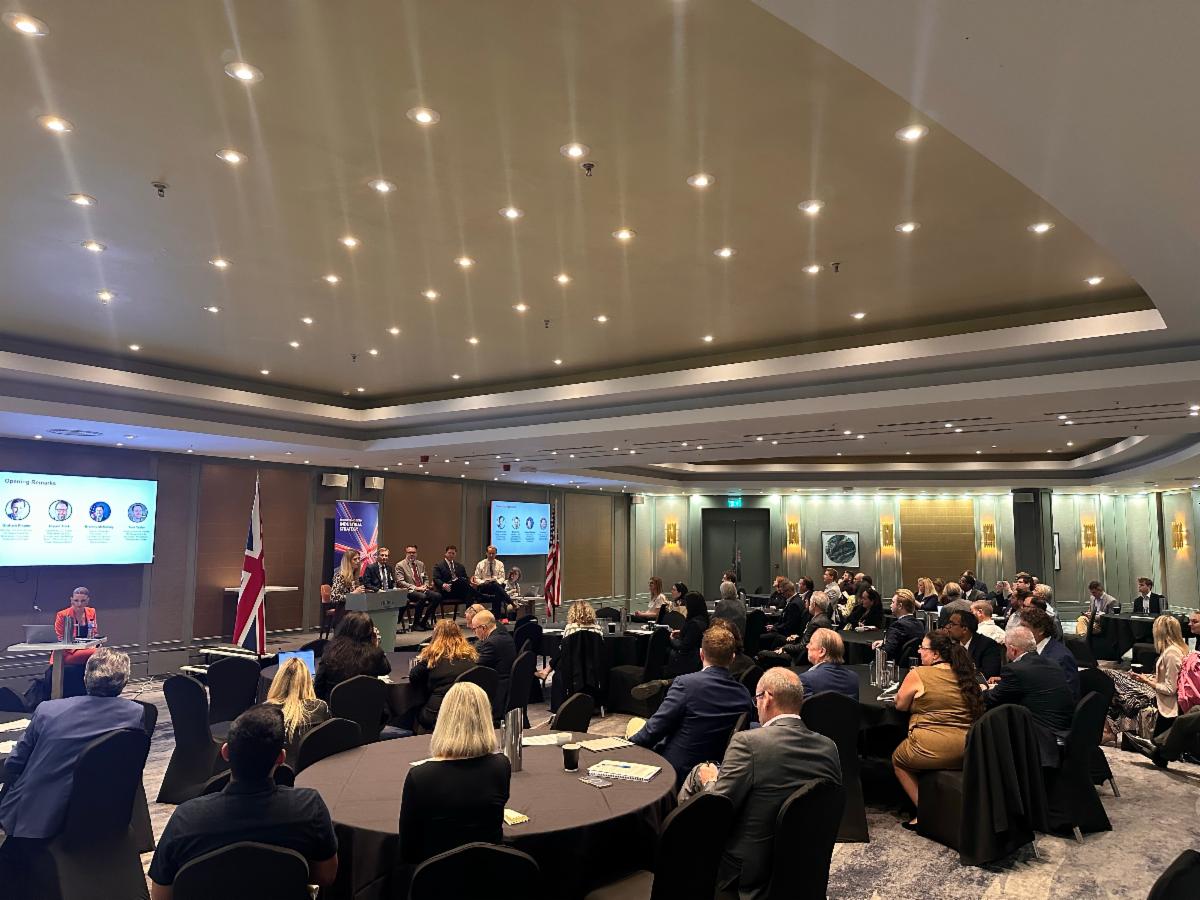
Overview: On 10 September in London at JP Morgan Headquarters, BAB and Bain & Company launched the 2026 Transatlantic Confidence Index, which surveyed 74 leading transatlantic companies and reveals a modest recovery in confidence in the transatlantic economy following last year’s sharp decline.


Key findings include:


  • Confidence in the US-UK business corridor has edged up to 6.7 out of 10, from a record low of 6.6 last year.
  • US companies’ confidence in the UK improves marginally, from 6.3 to 6.4, with investors continuing to raise concerns about tax, regulation and energy costs.
  • UK companies’ confidence in the US rebounds more strongly, from 7.5 to 8.1, with investment intentions remaining strong despite concerns around political stability, immigration and trade policy.


Read more: Read more about the index here.


Policy Work

BAB Report on UK Industrial Energy Costs


Overview: On 21 September, BAB released a new report calling for a national energy strategy in the UK to bring down industrial energy costs and strengthen the UK’s position as a destination for US investment.


Findings: The report finds that companies operating in the UK continue to face some of the highest industrial electricity prices in Europe, putting UK operations at a competitive disadvantage and increasingly influencing decisions about where companies invest. The report draws on government and industry data as well as a BAB survey, and interviews with companies from a cross range of sectors including manufacturing, technology, defence, life sciences, energy and food and drink. BAB’s survey found that 43 per cent of companies consider industrial energy prices a major barrier to investment in the UK. Businesses said the main effects were increased production costs and reduced, delayed or cancelled investment, with some also reporting lower output, profits and employment.


BAB's Recommendations: The report set outs 13 recommendations for a national energy strategy which includes measures to reduce costs in the near term alongside changes to improve the UK’s energy security and competitiveness over the longer term.


  • Reform the Marginal Pricing Model for Electricity
  • Remove Policy Costs on Electricity Bills
  • Scale the Electricity Grid
  • Strengthen Investment in Clean Energy
  • Increase Discounts for Network Charges
  • Leverage Oil and Gas in the North Sea
  • Invest in Fuel Refining
  • Recognize Biomethane in the UK Emissions Trading Scheme
  • Expand British Industrial Competitiveness Scheme (BICS) Eligibility
  • Expand Access to Carbon Capture, Utilization, and Storage (CCUS)
  • Facilitate Greater Use of Corporate Power Purchase Agreements
  • Enable Behind-the-Meter and Private Wire Solutions
  • Maximize Existing Dispatchable Biomass Generation


Read more: Read the full report here.

Thank you for reading this month's Policy and Trade Update. If you have any feedback or comments please contact us.


BAB participates in and offers policy and trade support to the BritishAmerican Business Network, a group of 18 independent trade organisations across North America and the U.K. If you would like to learn more about the network and its activities, please visit our website.


If you no longer wish to receive communications from BritishAmerican Business, please unsubscribe using the link below

Follow us online
LinkedIn  X  YouTube