|
Background
At its seventeenth meeting, the Conference of the Parties (COP17) passed Decision BC-17/12, providing for actions to follow up on the e-waste amendments to Annexes II, VIII, and IX, adopted at COP15 in 2022, and that entered into force on 1 January 2025.
In paragraphs 7-9 of that decision the Parties decided to develop a "guidance document on the identification of electrical and electronic waste under the new entries adopted by decision BC‑15/18, as well as on the distinction between waste that is to be classified as electrical and electronic waste (Y49 or A1181) and waste that is related to such electrical and electronic waste but can be classified under another entry in Annex II, VIII or IX." This new Guidance is now found in UNEP/CHW/OEWG.15/INF/20.
It is very important to note that the decision to provide new guidance would not have happened without the strong intervention of the European Union, as noted in paragraph 154 of the COP16 report:
154. "The representative of the European Union introduced a conference room paper submitted by the European Union and its member States. Noting that a number of questions on various aspects linked to the identification of waste covered by the new entries on e-waste had been raised in recent months, he suggested that it would be useful to enable Parties and observers to discuss such questions to facilitate a smooth implementation of the entries at the global level. His delegation therefore proposed the retention of the item on the e-waste amendments in the work programme of the Open‑ended Working Group and a focus on sharing best practices to ensure proper implementation. More specifically, the proposal was to launch work on developing guidance on the identification of e‑waste, especially the distinction between waste to be classified under one of the new e-waste entries and waste that was related to e-waste but could be classified under another entry in the Convention."
And so it was that the Guidance document was agreed to and, in fact, as noted by the Secretariat came "with generous financial support provided by the European Union." The Secretariat subsequently engaged a consultant, a former German delegate to numerous past Basel meetings named Joakim Wuttke, to develop a draft of the guidance document in consultation with the standing Expert Working Group (EWG) on the development of technical guidelines on e-waste. That draft had one reading by the EWG and some comments, including those of BAN, were received. In those comments, BAN delved into many problems we found in the draft, but the most important concern is the one we discuss today in this Delegate Alert.
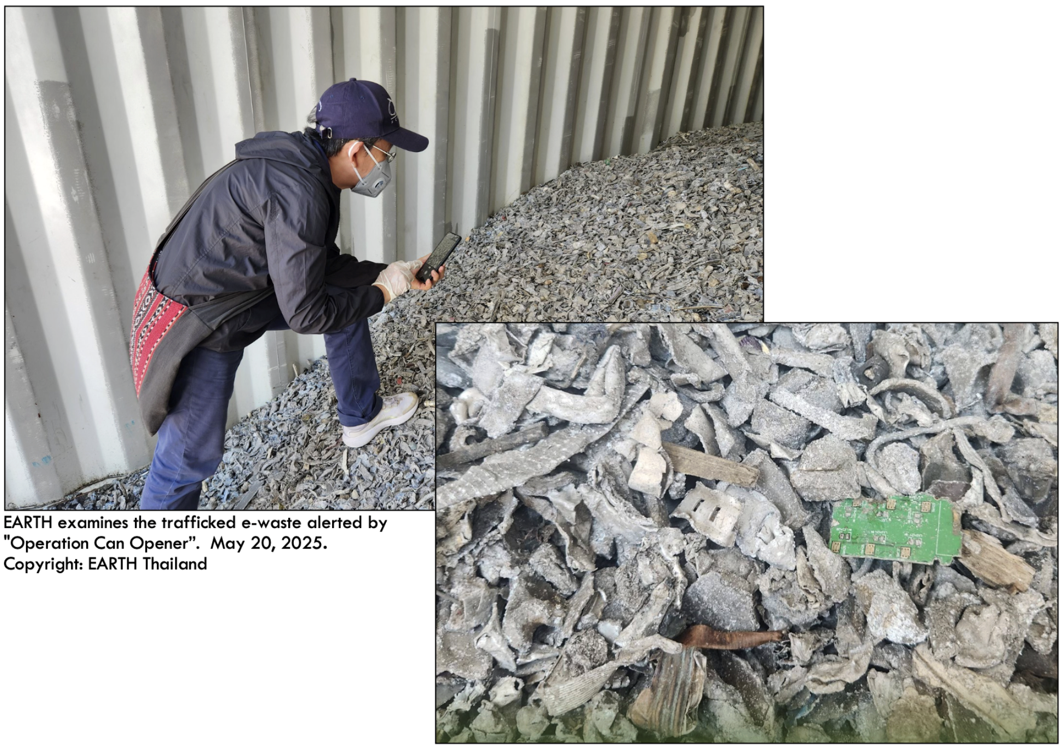
Importantly, the first and only real complaints or concerns heard publicly about the amendments at that time had come from the two major international scrap industry associations -- the Bureau of International Recycling (BIR) and ReMA, the US-based scrap trade association formerly known as ISRI. They were both unhappy that the trade conducted by their members of shredded metals, and in particular the non-ferrous fraction of shredded automobiles known as "zorba," was being halted by diligent enforcement officers in countries such as Thailand in Southeast Asia when they detected chopped circuit board waste mixed within the shipments. The ReMA and BIR key complaint was that such waste was never meant to be covered under the e-waste amendments. They also pointed to an Austrian government policy that as much as 10% of such e-waste being mixed into other metallic scrap would not fall under the scope of the new e-waste Amendments!
A careful reading of the draft Guidance UNEP/CHW/OEWG.15/INF/20 reveals much that is innocuous or inconsequential. However, buried within a table and a footnote, however, the consultant has delivered the industry-favoured Austrian interpretation — a new definition for B1010 (as applied to electric motors) and B1050 (as applied to non-ferrous "zorba-like" material) in which a 10% contamination allowance has been inserted instead of the original B1010 and B1050 listings which were clearly intended to be clean, commodity-like scrap metal streams without dispersible materials or contamination.
In retrospect, it would appear that this entire guidance exercise has been driven by a strong push — including direct financing — from the European Union, apparently on behalf of the car scrap industry. Most concerning is that it is being advanced with almost no debate as to whether granting one industrial sector a sweeping exemption from what the Parties originally agreed is at all appropriate.
The Need for Guidance is Clear -- The Need for Exemptions is Not
While BAN believes that there is indeed a strong rationale for guidance on the implementation of the e-waste amendments, BAN does not believe that there is any legitimacy to fundamentally altering the Amendments adopted by Parties and using of a guidance document for that purpose. Changes to amendments that will in effect alter the existing text of the Convention can only take place by virtue of new amendments.
There are indeed many "gray areas" worthy of exploring in a guidance of this kind and in accordance with its mandate, including how the amendments might impact the export of "zorba" and what steps industry might take to meet the new requirements legally. BAN had also hoped there would be a serious discussion with respect to electronic wastes that might be processed to the point where they can honestly be exempted under Annex IX listings. But perhaps most importantly, guidance is needed regarding how the Parties might classify lithium-ion batteries or their derivative materials such as black-mass. How should we classify solar panels, damaged or used, as well as partially spent batteries? Are these wastes? Are they e-wastes, and if so, Y49 or A1181? Unfortunately, the guidance process never first involved substantive discussions on what topics should be explored and therefore is absent these important discussions. Meanwhile, the Parties never carefully explored the topic of "zorba", but instead appear to simply wish to give way on this one issue for the benefit of one sector of the scrap industry. This is an altogether inappropriate course of action, resulting in a dramatic departure from what had been intended by the Amendments adopted by the Parties at COP15.
Beyond Process Issues: 10% Contamination Allowances Are Problematic
Most Parties and stakeholders would agree that carve-outs to the Basel Convention’s agreed text are inappropriate when introduced through a Guidance document. But even if the Basel text were formally amended to permit such an exemption, the substantive question remains: would it be sound policy?
First, such a limit-value exemption for circuit board or other electronic waste material is immediately not allowable in Annex IX due to the intent and purpose of the e-waste amendments to strictly control all e-waste. Further, on the basis of what we know about circuit boards and as is reflected in the Guidance Document on the Transboundary Movement of Electronic Waste, provisionally adopted by the Parties, most circuit boards are to be considered hazardous waste and the chapeaux above Annex IX states that one cannot have any hazardous materials as defined by the Convention's Annex I and III, in the Annex IX list. For the industry to counter this, it would have to prove that the circuit boards found chipped up in the car shredder waste were not hazardous — a near-impossible burden of proof. Where hazardous status cannot be confirmed, the material must be assumed to be hazardous and thus in violation of the Annex IX chapeau.
The Expert Working Group on the Revision of Annexes Rejected Limit Values
Further, it is very important to note that this is not the first time the approach of calling on the Convention to provide cut-off contamination concentration levels as part of its Annex definitions has been tried. For many months, the Expert Working Group (EWG) on the review of Annexes considered, for many sessions of their deliberations, the idea of placing numeric or concentration limits on Annex I and Annex III listings that ultimately would need to be replicated in Annexes VIII and IX. This approach was finally, after many months of debate, rejected, and the proposal was withdrawn with the agreement of all in the room. The reasons expressed by Parties and others for not using numeric limits were varied but persuasive. The reasons included the fact that such concentration limits:
-
Are not based on real science as waste streams, unlike manufactured chemical species, are different in makeup and synergistic effects with each shipment.
-
Are not scientifically sound because the safe levels of chemicals are in constant flux year by year and differ depending on the promptness of the updating in various jurisdictions.
- Are unfair to countries lacking the technical capacity and financial resources to ensure the stated values indicated by exporters were indeed accurate.
-
Are not precautionary nor do they honor the sovereign right of states to address a wider range of issues through the channel of a competent authority empowered to make a comprehensive organic contextual judgement on the overall soundness of a TBM proposal based on a variety of factors for each shipment.
- Incentivize dilution of purer waste streams by mixing in other material to be sent within a shipment just below the cut-off level. Pretending that dilution is a solution to pollution is unacceptable.
The Basel Convention does not rely on concentration limits for allowable contamination. Rather, it legislates and controls constituents found at levels and/or in circumstances that cause them to exhibit hazardous characteristics. These characteristics are not limited to intrinsic harm known to exist in the constituent prior to export, but may depend on individual circumstances — including the sensitivity of target populations, fragile ecosystems, synergistic effects, properties arising from climatic conditions, and types of processing or disposal. Each shipment is different, and each receiving facility and environment is different. There can be no "one-number-fits-all" scenario for determining hazardousness — which is precisely why human competent authorities, rather than numerical limit values, are indispensable.
Finally, one must be reminded that the Convention’s prime general obligation is to minimize the transboundary movement of wastes. That obligation is not contrary to the concept of a circular economy, despite recent claims to that argument. The circular economy was never meant to be built on waste trade -- the circularity was never meant to be a circle around the globe. It is clearly not meant to be built on externalizing negative costs to other nations. Where there is doubt about why a waste is being moved or whether an export may be exploitative, the precautionary approach is pivotal. When there is any doubt about causing harm in the recipient country, one must err on the side of not allowing the waste to be exported.
Where Did the Basis for Proposing the 10% Contamination Level Come From?
Even if one did not agree to the Basel approach to legislating hazard based on the situational context, and preferred a single cut-off level, one must ask first, did the complaining industry fully explore alternative ways of meeting the new law? Is it absolutely impossible to remove circuitry prior to shredding cars or is it just inconvenient or something that has not been done before? Why is it not possible to abide by PIC procedures or find other outlets besides export?
Next, we must ask, on what basis was this 90% figure derived? What was the science behind this percentage? Has a risk analysis been performed of worst-case scenarios within that 10%? How could one presuppose the hazardous make-up of e-waste when it is different every time, and secondly, how can one presuppose the sensitivity of the receiving country and facility? These are very fair questions to ask. Where did this figure come from? How do we know that the 10% might not contain a high concentration of brominated flame retardants, heavy metals, or PFAS? What if the 10% included that amount of PVC plastic, which, upon smelting recovery operations, was turned into high levels of dioxin in a smelter in a vulnerable community in Thailand or Vietnam?
On the question of concentration limits, the conclusion is clear: no single limit can be scientifically valid across all possible waste shipments. The Basel Convention has permitted one such limit, for PCBs at 50 ppm, but that was a narrow exception based on a single, well-defined chemical contaminant. Embedding allowable levels of contamination in a guidance document that contradicts the Convention’s own text is not acceptable. We must immediately remove from this Guidance any language that is fundamentally out of conformity with the legal text and obligations, the intent and purpose of the Basel Convention, including its annexes. That is not the purpose of guidance. Guidance can seek to use logic and precaution to outline a way forward when the Convention is so far silent on an issue, to explore issues needing legal and technical clarity, and propose approaches that do not undermine the Convention itself.
Conclusions
-
The current text found in the Guidance document draft that allows 10% of a load of waste to be contaminated with e-wastes is unacceptable from both a process and technical standpoint.
-
Guidance documents cannot be used to undermine or reverse agreed-upon text adopted by Parties. Rather, they should be used to assist Parties to better understand how the Convention's obligations and definitions might best apply to unclear matters or where the Convention is silent.
-
It can be expected that not all stakeholders will be happy with the result of new rules being adopted by a Convention. But the time to raise such issues was during the amendment negotiations and not afterwards.
-
Afterwards, complaints by certain stakeholders should be listened to and solutions debated, but those solutions cannot depart from the text of what has been agreed. Solutions of pre-cleaning, not exporting wastes, and using prior-informed consent can be proposed, as these are consistent with the agreed rules.
-
This current document is not acceptable in its present form for many reasons other than the ones highlighted in this alert. Despite the current shortcomings and inappropriate text, a Guidance on implementation of the amendments is necessary and warranted.
- We therefore should a) remove the inappropriate text, and renew the process by initiating a rigorous scoping exercise to identify the issues that genuinely require clarification, after which, the substantive research and drafting work can proceed. This should be grounded in the foundational purpose of any guidance document: to guide implementation, not to rewrite agreed text.
What delegates can do at OEWG-15
|