October 29, 2026


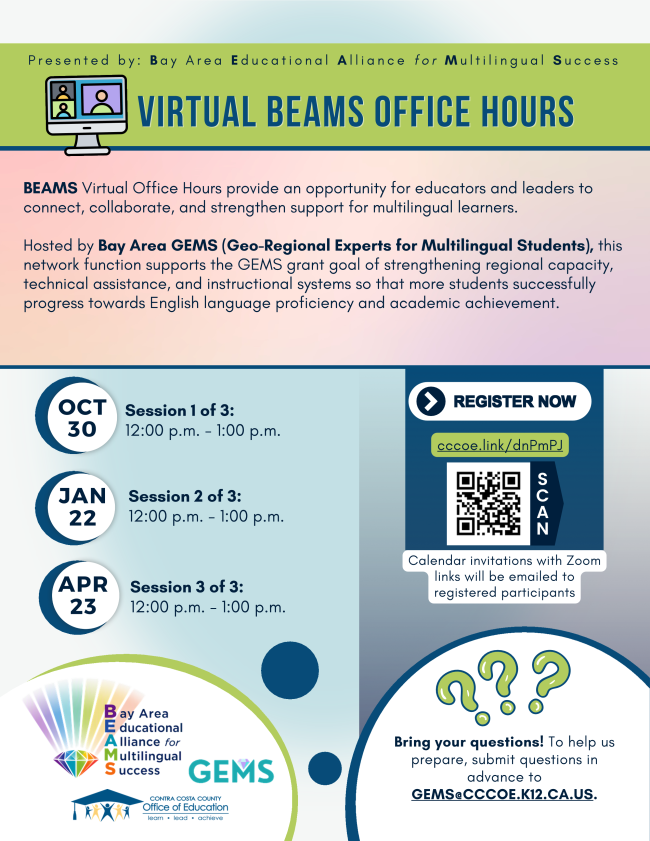
Bay Area Educational Alliance for

Multilingual Success (BEAMS)

Regional Network Newsletter


Important Updates


CDE Updates

AB 2555 Reclassification

A reminder that the resources CDE has shared in the Reclassification webinar BOX drive is downloadable through Oct. 30. Communication flyers for educators and families, a reource guide, webinar slides, and reclassification letter templates in English and 5 other languages have been added to support LEAs. The most updated guidance will be provided on CALPADS Flash #333 and the following CDE web pages: Reclassification webpage and the AB 2555 FAQs. A few FAQs are highlighted below, based on some recent local inquiries:

Q: What date should be used for reclassification?

A: For reclassification in the 2026–27 school year using 2025–26 Summative ELPAC or Summative Alternate ELPAC results, LEAs must reclassify eligible EL students on or before January 31, 2027, with a reclassification date between September 27, 2026, and January 31, 2027.


Q: Is a Reclassification form still needed to document reclassification of students based on their assessment score alone, pursuant to AB 2555?

A: To preserve the record of the reclassification, LEAs may continue to use their existing reclassification forms for the student's cumulative record. LEAs would only complete the Criterion 1 portion (English Language Proficiency), and disregard Criteria 2-4.


Q: If an LEA’s board policies and administrative regulations do not match the updated reclassification requirements, how long does the LEA have to change these policies?

A: It would be best practice for LEAs to update policies and regulations as soon as possible. Please note that students should still be reclassified according to the requirements in AB 2555 regardless of the status of the policies and regulations being updated.


Q: Can an LEA use local assessments to reclassify dually identified students prior to July 1, 2028?

A: No, an LEA may not use local assessments to reclassify a dually identified student. Prior to the alternate coursework, performance tasks, and rubrics being available, dually identified students must obtain an overall PL 4 on the Summative ELPAC or an overall PL 3 on the Summative Alternate ELPAC to be able to be reclassified.


CDE Survey: Guidance for Supporting Dually Identified Newcomer Students

Your experience can help shape CDE guidance for supporting dually identified newcomer students -- newcomer students and who are currently identified, have previously been identified, or may be identified as eligible for special education services. Please help complete the 8–10 minute survey: https://forms.gle/v4jDJJXVD3ynNgWx8, a joint effort of the CDE’s Multilingual Support Division and the Special Education Division. The survey closes Friday, October 30, and share it with colleagues and networks who support these students. If you have additional questions, please contact Geoffrey Munch, Education Programs Consultant, by email at Gmunch@cde.ca.gov.


LTEL Community of Practice Report

CDE announced the release of the Long-Term English Learner (LTEL) Community of Practice (CoP) Report, authored by Dr. Laurie Olsen, now available on the CDE LTEL CoP web page under the “Resources” tab and attached. This report highlights the work of LEA teams from across California that applied to be part of this CoP to improve outcomes for the LTEL students they serve. This report documents their process, successes, challenges, and next steps in their journey to use data and Design Thinking to improve the system to better serve students identified as LTELs. If you have questions about this report or the LTEL CoP, please email MSD@cde.ca.gov.


TK Multilingual Learner Screener

With AB 2467 (Chapter 608, Statutes of 2026) signed into law, the implementation timeline for the TK Multilingual Learner Screening Instruments has been updated as follows:

- Voluntary field test: 2027–28 school year

- Required statewide screening: beginning the 2028–29 school year

CDE will make the selected TK multilingual learner screening instruments and training available to LEAs at no cost. Frequently asked questions are now available on the TK Multilingual Learner Screening web page, and additional guidance and resources will be posted there as they become available. CDE is also recruiting large school districts (16–25 TK-serving sites) for the fall 2027 field test. Interested districts may complete the TK ML Screener Field Test Local Educational Agency Interest Form by November 30, 2026. Questions may be directed to TKMLScreener@cde.ca.gov.

ELPAC Updates

2026-27 ELPAC Pretest Training

Register for the 2026–27 ELPAC Pretest Virtual Training. This training will provide LEA ELPAC Coordinators with information about changes and updates to ELPAC testing for the 2026–27 test administration year. The webinar What’s New for ELPAC will be presented on Zoom on Wednesday, December 2, 2026 from 2–4 p.m.


2026–27 Summative Alternate ELPAC Administration and Scoring Training (AST)

ELPAC regulations require annual training for LEAs that have eligible students for the Summative Alternate ELPAC. Within two weeks of registering an eligible student, the LEA ELPAC coordinators or their designee must complete the online 2026–27 Summative Alternate ELPAC—LEA Certification course on the Moodle Training Site in order to continue administering the Initial Alternate ELPAC after November 2, 2026, or administer the Summative Alternate ELPAC to eligible students. The 2026–27 Summative Alternate ELPAC AST opens on Monday, November 2, 2026, in Moodle and the course takes approximately two and a half hours to complete. Alternative training option: An LEA with minimal eligible students may enter into a Memorandum of Understanding with a neighboring LEA. The Summative Alternate ELPAC testing window will run from February 1, 2027, through May 31, 2027. For more information, visit the Test Administration Trainings and Tutorials webpage.


The Results Are In—Now What?

The new module in the ELPAC: The Results Are In—Now What? series provides strategies on how to use data-informed action to improve instruction. This module is available on the Moodle Training Site. The newest module centers on the question: How can educators effectively implement instructional strategies identified through the professional learning community process to advance teaching and learning for EL students? Using collaborative inquiry and data-informed decision-making, educators will explore how meaningful instructional strategies can support student success. This professional learning series is designed for educators at every leve who share responsibility for the success of EL students. These interactive virtual modules provide independent educators or local teams with opportunities to learn, reflect, collaborate, and take action. Through authentic classroom video, real student work samples, and reflections from educators implementing these practices, viewers will gain practical insights into effective instruction for EL students. The module highlights how teams can move from analysis to action—using evidence from student learning to identify, implement, and refine instructional strategies that promote language development, academic achievement, and equitable outcomes for EL students.

DataQuest Resources

The 2025–26 Reclassified Fluent English Proficient (RFEP) Rate Data File, DataQuest Update Issue #30, and DataQuest Highlights have been released. The 2025–26 DataQuest End-of-Year (EOY) Flyer and the 2025–26 RFEP Rates Flyer provide high-level summaries of the data included in this release. If you have any questions, please see the Annual RFEP Rate webpage or send an email to dataquest@cde.ca.gov.


Professional Learning


Additional Professional Learning Opportunities


Preparing PK-3 Teachers for Multilingual Early Literacy Instruction

Oct 30

Spanish Language Arts SLA Quality: What Makes the Cut? (ELSF)

Nov 4

UC Berkeley CRLP: Language and Reading Assessment Practices Multilingual Learners from Spanish-Speaking Homes

Nov 5

Bringing ACTFL to the Bay - FLASCC Fall Conference

Nov 7

From Research to Action: Building a National Voice for MLs

Nov 10

Accessibility Supports for CAASPP, CAST & ELPAC

Dec 2

Evidence-Based Practices in Adolescent Literacy

Nov 16

Connecting California Virtual Conference

Nov 18

ERWC

Begins Jan 11

WestEd QTEL Institute

Jan 11-14

NCEL Summit

Jan 14

UCB California Reading & Literature Project Learning How English Works PD

Begins Jan 21

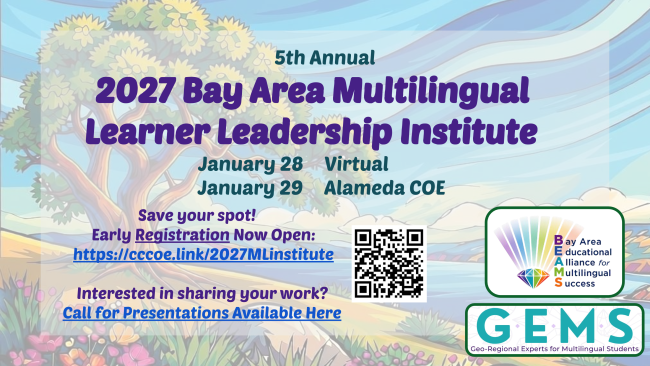
CABE 2027

Mar 10-13

All Titles Conference

Apr 13-15


Resources


Improving Instruction for MLs

  • Content-Based ELD Instruction Through Evidence-Based Practices Advancing Comprehensive ELD Implementation Brief Series #1 and #2

Dual Language Program Support


Contact Us


Bay Area Educational Alliance for Multilingual Success

BEAMS Network

Contra Costa County Office of Education

77 Santa Barbara Road

Pleasant Hill, California 94523

GEMS@cccoe.k12.ca.us