|
September 2026
From Engagement to Escalation: Understanding Shareholder Action
| | |
|
The recent dispute between ATG Capital Opportunities Fund LP and Empery Digital, Inc. offers a timely example of how advance-notice bylaws can become central to that process, and why both companies and shareholders need to understand the rules governing shareholder nominations.
At the heart of the case was a fundamental question: What information can a company require a shareholder to disclose when seeking to nominate directors, and what happens when the company's bylaws don't expressly require that information?
| | |
The dispute arose after ATG Capital Opportunities Fund submitted a notice to nominate a slate of director candidates for election to Empery Digital's board. Empery's Board rejected the nomination, arguing that ATG's notice failed to provide information required under the company's advance-notice bylaws.
One issue involved ATG's relationship with another Empery shareholder. Empery argued that the shareholders were coordinating and that their relationship constituted an "agreement, arrangement, or understanding," or AAU, that ATG was required to disclose. The Board also pointed to ATG's short position in Bitcoin exchange-traded funds as information it believed should have been disclosed.
The dispute ultimately went before the Delaware Court of Chancery. Empery relied in part on prior Delaware cases involving advance-notice provisions that expressly required disclosure of certain arrangements or relationships.
The distinction in this case was the language of Empery's own bylaws.
In its August 28 decision, the Court of Chancery held that ATG's nomination notice complied with Empery's advance-notice bylaws. The court concluded that the provisions relied upon by the Board did not require ATG to disclose the information the Board identified as missing. Because the Board lacked a contractual basis under the bylaws to reject the nomination, the court also held that the Board acted inequitably in doing so.
The case is continuing. On September 14, the Court of Chancery declined to certify an interlocutory appeal, concluding that its decision did not present a novel question of law.
What's Next?
The Delaware Supreme Court is scheduled to hear oral argument in Lane v. ATG Capital Opportunities Fund LP and Empery Digital, Inc. on October 7, 2026.
| | |
Advance-notice bylaws establish the procedural requirements shareholders must follow when nominating directors or bringing other business before a shareholder meeting. They give a company advance notice of a proposed nomination and provide time to evaluate the candidates and the information submitted before the meeting.
These provisions serve an important governance purpose. Without advance-notice requirements, companies could face nominations or shareholder proposals with limited time to review the matters being presented or provide other shareholders with relevant information.
But the Empery case highlights an equally important principle: the procedural framework works only to the extent that its requirements are actually established in the governing documents.
Advance-notice bylaws are designed to promote an orderly process for shareholder meetings and election contests. At the same time, the requirements they impose must be grounded in the language of the bylaws themselves. The Empery decision demonstrates how that distinction can become significant when a company challenges a shareholder nomination.
| | |
The Empery decision underscores the importance of clear and consistent advance-notice provisions.
For companies, the case illustrates why bylaws should clearly identify the information shareholders are required to provide when making a nomination. A company may have legitimate reasons for seeking information about a nominating shareholder, potential relationships with other shareholders, or other aspects of a proposed campaign. But the authority to require that information depends on the language of the applicable provisions.
The decision also demonstrates why precedent involving another company cannot necessarily be applied to a different set of bylaws. The requirements in one company's advance-notice provisions may differ materially from those in another company's bylaws.
For shareholders, the case highlights the importance of reviewing a company's specific advance-notice requirements well before making a nomination. Deadlines, disclosure requirements, definitions, and provisions concerning relationships with other shareholders or campaign participants can all affect the procedural path of a potential contest.
More broadly, the case demonstrates that the wording of an advance-notice provision can have significant consequences when a shareholder nomination is challenged. What may appear to be a straightforward procedural requirement can become a central issue in a contested election.
| | |
While the parties in a contested situation may have very different objectives, both sides have an interest in understanding the rules before a dispute reaches the ballot.
For Companies:
The case serves as a reminder to understand precisely what the company's bylaws require, and what they do not require, before relying on those provisions to challenge a shareholder nomination.
Companies may also want to periodically review their advance-notice provisions to determine whether they clearly address the information they expect shareholders to provide. Clear and consistent provisions can reduce uncertainty when those requirements are tested in a contested situation.
Just as importantly, companies should distinguish between information they believe would be useful to have and information the governing documents actually require a shareholder to provide.
For Shareholders and Activists:
Advance-notice requirements should be part of the planning process from the outset when considering a director nomination or potential proxy contest. Understanding the applicable deadlines, disclosure requirements, definitions, and provisions governing relationships with other shareholders or campaign participants can help shareholders assess the procedural requirements associated with a potential campaign.
For both sides, the broader lesson is that advance-notice bylaws establish more than a filing deadline. They form part of the procedural framework for shareholder action, and understanding that framework early can help reduce uncertainty when a contested situation develops.
The Empery case also demonstrates that the specific language of a company's bylaws matters. Requirements can vary from one company to another, and shareholders should not assume that a provision interpreted one way in a prior case will necessarily apply the same way elsewhere.
| | For additional market insights and shareholder engagement updates, visit Investor-Com.com | | |
The Empery dispute is one example of how shareholder action can develop into a formal solicitation or contested vote. The broader landscape is considerably more varied.
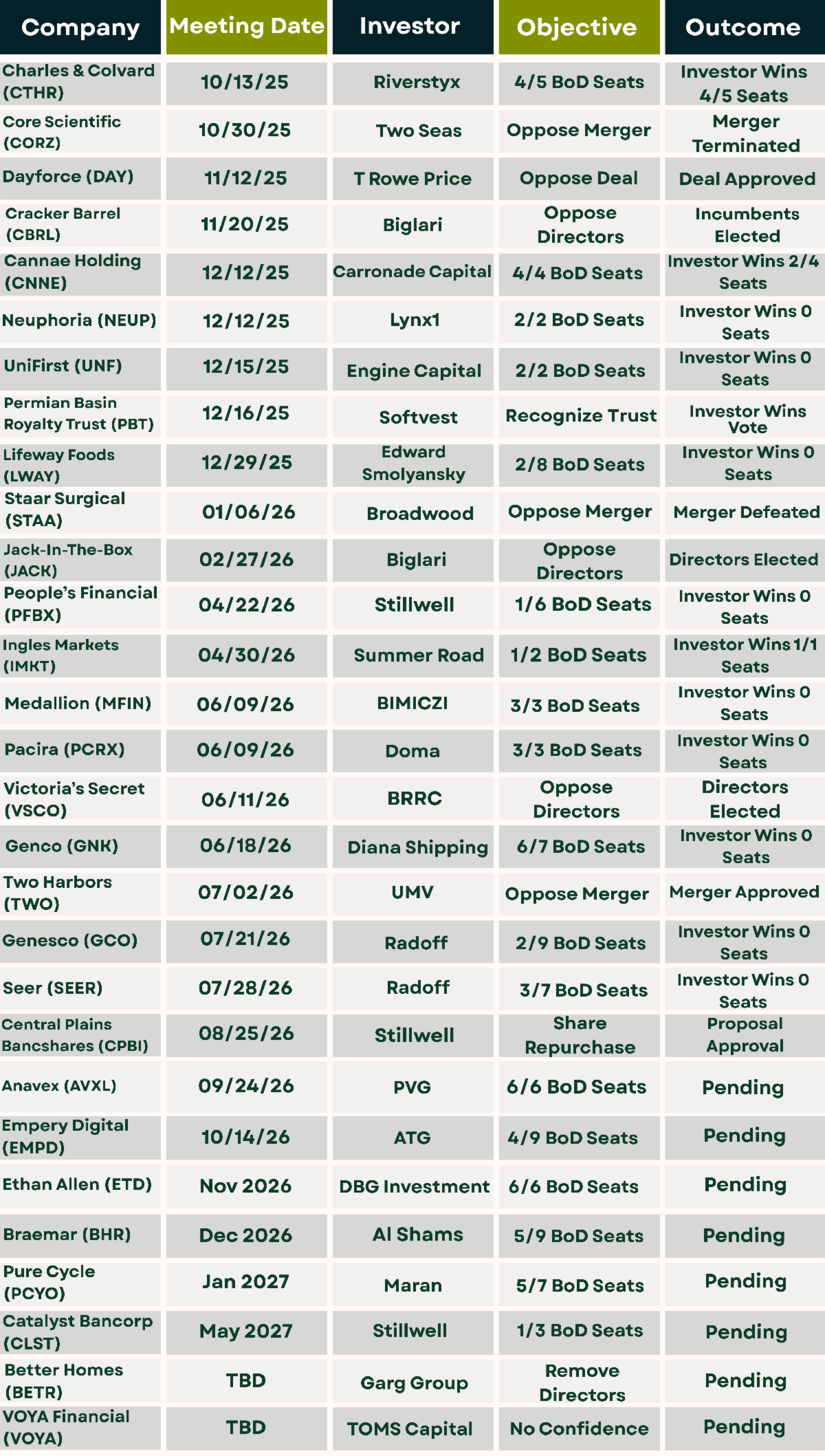
The current campaign activity tracked below includes more than 20 situations that proceeded all the way to a shareholder vote at an annual or special meeting, along with pending campaigns that have yet to reach a meeting. Not every shareholder engagement results in a vote: a significant number of potential campaigns are resolved through settlement, withdrawal, or other agreements before shareholders cast ballots.
Director elections represent a substantial portion of the activity shown, but they are not the only type of shareholder vote that can involve a solicitation campaign. Recent situations have also involved proposed mergers and other M&A transactions, "vote no" campaigns opposing incumbent directors without nominating an alternative slate, and a challenge involving a proposed share repurchase plan.
Among the pending situations, most involve director elections. Two illustrate the broader range of issues that can arise: a consent solicitation seeking to remove incumbent directors at Better Choice Company (BETR), and a "no confidence" vote at Voya Financial (VOYA).
| |
The variety of campaigns underscores that shareholder solicitations are not limited to traditional proxy contests. Depending on the circumstances, shareholders may seek to influence board composition, challenge a proposed transaction, oppose directors, or bring other matters before fellow shareholders.
For companies and shareholders alike, these situations can involve complex procedural and strategic considerations. Solicitation support can be particularly relevant when a campaign involves an unusual proposal, a contested M&A vote, or a "vote no" effort, where both strategic planning and knowledge of the solicitation process can play an important role.
|
| |
Beyond the Case: The Importance of Preparation
The broader lesson from Empery, and from the range of shareholder campaigns taking place across the market is that shareholder action is not governed solely by the arguments made by either side. The procedural framework surrounding a contested election can be equally consequential.
For companies, that means understanding the governance documents that will shape a potential contest before a dispute arises. For shareholders, it means understanding the rules that govern a nomination before deciding how to pursue one.
Advance-notice bylaws are designed to establish an orderly process for shareholder action. But as the Empery dispute demonstrates, the effectiveness of that process depends in part on how clearly those rules are written, and how closely the parties adhere to what the governing documents actually say.
As shareholder engagement continues to evolve, companies and investors alike benefit from approaching potential disputes with a clear understanding of their rights, responsibilities, and the procedural framework that governs them.
| | | Whether preparing for your next annual meeting or monitoring changes in your shareholder base, our team is ready to help you stay ahead of what's next. | | Thank you for reading and being part of our community. We appreciate your continued support. | | |
STAY AHEAD IN A CHANGING PROXY LANDSCAPE | As the proxy landscape grows more nuanced, issuers are encouraged to stay ahead of evolving trends in shareholder engagement. Investorcom provides tailored proxy solicitation, proactive stock surveillance, and strategic governance advisory services designed to keep you informed, engage effectively with shareholders, and anticipate key voting trends. We help clients navigate this changing proxy environment. Contact us to learn how we can support your next vote! | |
LET’S STAY CONNECTED!
Join the conversation and keep up with us on socials! Be the first to know about exclusive industry updates and insight, exciting announcements and company news you don’t want to miss. Why stop here? Follow us on social media and tag us, we’d love to connect. Engage with us today!
📲
SEE YOU ONLINE!
|
InvestorCom Recognized in Bloomberg | InvestorCom has once again been recognized in the latest Bloomberg Activism Scorecard for the first half of 2026. Ranked as the Top Advisor to Investment Funds in the sector rankings for H1 2026, and recognized among the top half of proxy advisors to activists in both the U.S. and global rankings. | | |
Star Equity Fund Nominates Rick Coleman For GEE Group Board | Another notable shareholder activism development emerged as Star Equity Fund has announced the nomination of Rick Coleman for election to the board of GEE Group, Inc. (NYSE American: JOB) ahead of the company's 2026 Annual Meeting. | | |
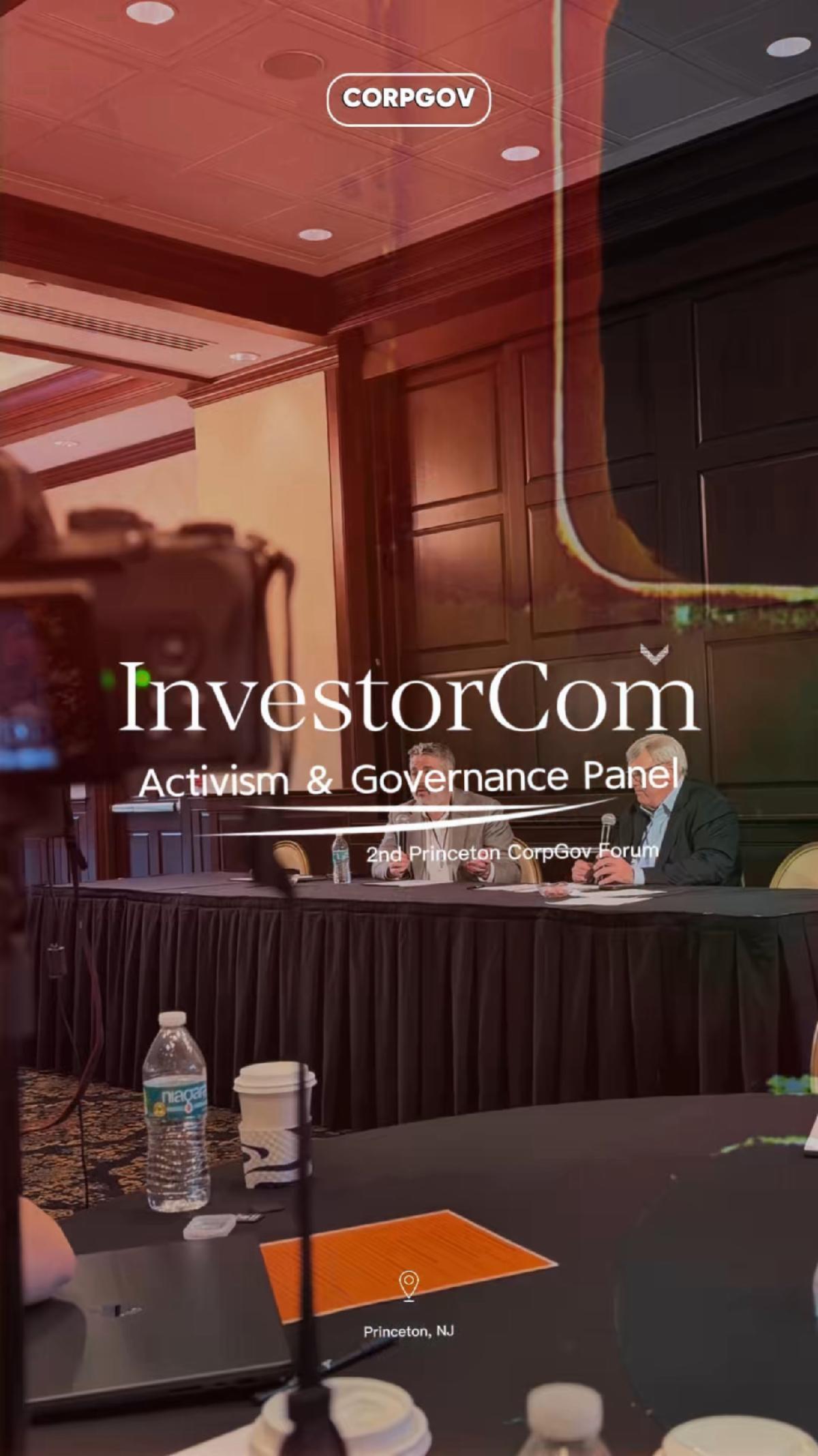
InvestorCom President and CEO John Glenn Grau had the opportunity to moderate an outstanding panel featuring Lawrence Elbaum | Thank you to everyone who joined us at the 2nd Princeton CorpGov Forum for an engaging discussion on shareholder activism, corporate governance, proxy advisory trends, institutional voting behavior, ESG, and the evolving role of boards and directors. | | |
|
Contact Us
203-972-9300
Info@Investor-Com.com
|
| We can't wait to serve you soon! | | InvestorCom | 1055 Washington Blvd Suite 520 | Stamford, CT 06901 US | | | | |