|
Phelan establishes new Naval Rapid Capabilities Office (Defense News 8/26)
“The civilian head of the U.S. Navy announced the service will consolidate several wings and create a new office focused on development and problem-solving. Navy Secretary John Phelan said the Navy established the Naval Rapid Capabilities Office, which will dismantle and absorb the Maritime Accelerated Response Capability Cell, Disruptive Capabilities Office, NavalX and the Navy’s execution of the Defense Department’s Replicator activities, according to an Aug. 19 memo obtained by Military Times. ‘The NRCO will serve as the single accountable organization spanning all naval warfare domains, responsible for the rapid assessment, execution, fielding and transition of urgent solutions within a three-year timeframe to ensure U.S. maritime supremacy,’ the memo said.”
Pentagon CTO to oversee Defense Innovation Unit following Beck’s exit (Defense News 8/26)
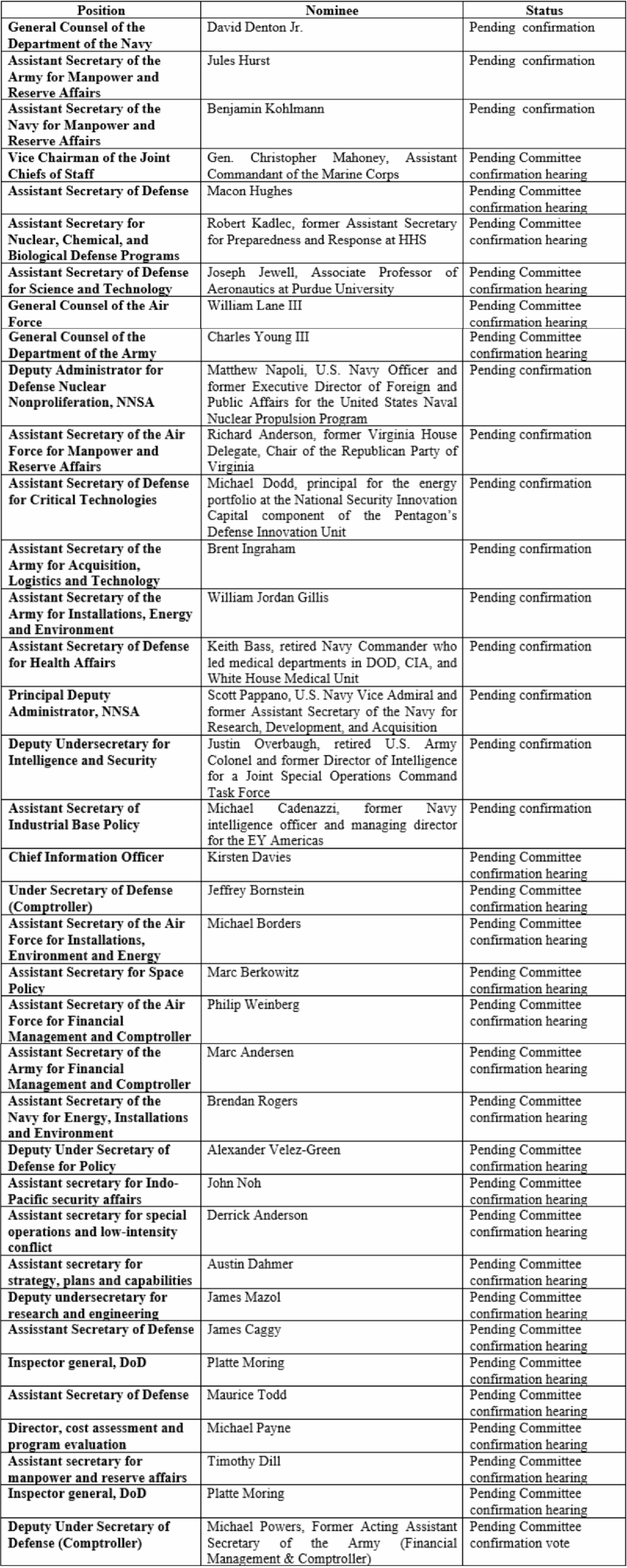
“Undersecretary of Defense for Research and Engineering Emil Michael will lead the Defense Innovation Unit in an acting capacity following former director Doug Beck’s resignation Monday. The Pentagon confirmed the personnel change in a statement to Defense News, adding that Michael Dodd, the incoming assistant secretary of defense for critical technologies, will be the acting deputy director of the commercial innovation hub. ‘Together, both are laser-focused on driving innovation and enhancing the department’s ability to deliver groundbreaking commercial technologies to empower the American warfighter,’ the spokesperson said.”
DoD R&E chief says Pentagon will trim ‘critical technology’ list (Breaking Defense 8/27)
“The Defense Department is planning to cut its number of ‘critical technology’ areas down from its current list of more than a dozen, Emil Michael, the Pentagon’s undersecretary for research and engineering, said today. ‘The critical technology areas that my component has published, historically, are statements to the world of what we think the most important things are. And so when you have a situation where everyone who comes to this job and just adds more, but they don’t take away, well, then the criticality gets diluted,’ Michael told reporters today at the NDIA Emerging Technologies Conference.”
Experts: Government stake in defense firms could harm industry (Defense News 8/28)
“Defense industry experts are warning that a potential government stake in major firms such as Lockheed Martin or Boeing could stifle innovation, create conflicts of interest, and lead to more contract award protests, following comments from a top administration official considering the move. Commerce Secretary Howard Lutnick on Tuesday sparked discussion of whether the Trump administration could broaden the government’s efforts to take slices of vital private firms into the defense world. Speaking with CNBC about the government’s recent acquisition of a stake in Intel, Lutnick indicated that Pentagon leaders could be looking at similar arrangements with other companies.”
Pentagon Cuts Set Back Critical AI Data Platform (Defense One 8/20)
“Personnel cuts are crippling progress on Advana, a Pentagon data platform that has been widely used in recent years to accelerate functions from logistics to finance to readiness—and which is key to the department’s AI plans, current and former defense and military officials say. ‘You tell this organization to do ‘A.’ Then you cut contracted staff by 80 percent and you have a turnover of close to what, 60 percent? Things are going to break. Things are going to get delayed. We’re in both places,’ said one defense official who asked for anonymity to speak freely.”
Allvin’s Surprise Exit Signals a Pivot for the Air Force, Not Hegseth Pressure (Defense One 8/21)
“Air Force Chief Gen. David Allvin’s abrupt retirement wasn’t driven by Defense Secretary Pete Hegseth, but by growing frustration with the service’s priorities, according to multiple people familiar with the decision. On Monday, Allvin announced his plans to retire after serving just two years as the service’s highest-ranking officer, typically a four-year job. No reason was given in the Air Force press release that contained his announcement. The first months of the second Trump administration have seen an unprecedented purge of senior military officers. In February, Hegseth fired the chairman of the Joint Chiefs of Staff; Allvin’s vice chief, Gen. James Slife; the chief of naval operations; and the judge advocates general of the Army, Navy, and Air Force. Others removed later include the commandant of the U.S. Coast Guard, the commander of NSA/U.S. Cyber Command, and the Pentagon’s representative to the NATO Military Committee.”
Hegseth Fires Defense Intelligence Agency Chief After Iran Report (Wall Street Journal 8/22)
“Defense Secretary Pete Hegseth fired the Defense Intelligence Agency director Friday, according to a senior defense official and another person familiar with the move, the latest in a slew of senior national-security officials dismissed by the Trump administration. Air Force Lt. Gen. Jeffrey A. Kruse was leading the Pentagon agency in June when it issued an evaluation of U.S. military strikes on Iranian nuclear facilities that concluded the attack had set back Tehran’s nuclear program only by a few months. The assessment contradicted President Trump’s assertion that the bombings had obliterated the Iranian sites.”
Trump Turns to Small Group of Advisers, Shrinks National Security Council (Wall Street Journal 8/30)
“When President Trump ordered airstrikes on Iran’s nuclear facilities in June, U.S. diplomats who would normally be told of the decision were left in the dark. After the attack, officials from Middle East countries pressed officials in Washington and at U.S. embassies in the region for information about whether the attack signaled Trump was launching a broader regime-change campaign, officials involved in those conversations said. Almost no one had an answer, other than to refer them to Trump’s public announcement of the bombings. They hadn’t received talking points on what to tell other governments.”
Pentagon moves AI office under R&D, raising fears it’s ‘demoting AI’ (Breaking Defense 8/18)
“Deputy Secretary of Defense Steve Feinberg has ordered a major overhaul of the military’s artificial intelligence efforts, including a reorganization that some former officials worry could be seen as a demotion for the Pentagon’s main AI office. Feinberg’s Aug. 14 memo launches three major reviews over the next 60 to 120 days and subordinates the Chief Digital & AI Office (CDAO) — which had reported directly to Feinberg — to the Pentagon’s new R&D chief, Emil Michael, ‘effective immediately.’ ‘This realignment will not create additional review layers or bureaucratic processes,’ a defense official told Breaking Defense after confirming the change. ‘CDAO will continue to execute all current statutory responsibilities without interruption during this transition.’”
Pentagon terminating JCIDS process as part of larger acquisition reform: Memo (Breaking Defense 8/22)
“As part of Pentagon leaders’ quest to rapidly field new weapons, they are revamping how requirements are validated and bidding adieu to the controversial Joint Capabilities Integration and Development System (JCIDS) process. In an Aug. 20 memo titled ‘Reforming the Joint Requirements Process to Accelerate Fielding of Warfighting Capabilities,’ Defense Secretary Pete Hegseth and his deputy, Steve Feinberg, lay out a roadmap aimed at fielding ‘new technology and capabilities faster.’ The objective, they note, is threefold: to streamline and accelerate the joint force needs, work with industry earlier in the process, and better integrate requirements determination and resource prioritization to make better budgeting decisions. While the memo lays out multiple changes, a key provision is the ‘disestablishment’ of JCIDS — a joint staff process for pinpointing gaps in military capabilities, and identifying and validating joint requirements. In turn, the Joint Requirements Oversight Council (JROC), which oversees that process, will stop validating component-level requirement documents. The JROC comprises the vice chiefs of each military service, and is chaired by the vice chair of the Joint Chiefs of Staff.”
Pentagon forms new task force to fast-track counter-drone capabilities (Defense News 8/28)
“The Pentagon is scrapping its old playbook for defending against small drones, moving beyond years of evaluations and studies toward a model that comes with new money and authority geared to field capability faster, according to a Thursday memo from the defense secretary. The directive from Defense Secretary Pete Hegseth announced the formation of the Joint Interagency Task Force 401 (JIATF 401) to ‘better align authorities and resources to rapidly deliver [joint counter-small unmanned aircraft system] capabilities to America’s warfighters, defeat adversary threats and promote sovereignty over national airspace,’ the memo states.”
NATO says all allies to meet 2% defense-spending target this year (Defense News 8/29)
“NATO said all alliance members will spend at least 2% of their GDP on defense this year, the first time for that to happen since the spending target was set more than a decade ago. Three countries – Poland, Lithuania and Latvia – are on track to meet a more ambitious target for 3.5% spending, set at a meeting just over two months ago, according to data on allied defense spending published by NATO on Thursday. European NATO countries have raised their defense budgets following Russia’s 2022 invasion of Ukraine, and also in response to criticism by U.S. President Donald Trump that allies weren’t spending enough. NATO members agreed at a June summit in the Netherlands to channel 5% of GDP into defense, including 3.5% on core defense.”
The Business of American Military Deterrence (Wall Street Journal 8/29)
“You’ve heard the problems. A $2 million interceptor to shoot down a $2,000 drone. Ukraine consuming more artillery shells in two months than the U.S. produces in a year. U.S. antiship missiles expected to run out on day eight of any war over Taiwan. A single Chinese shipyard churns out more tonnage in a year than the U.S. has since World War II. On the advice of Wall Street sharpie Bernard Baruch, who ran U.S. war production in 1917-18, President Franklin D. Roosevelt raided General Motors in late 1939 for its production genius. For nearly a year before Pearl Harbor, and before Germany’s subsequent declaration of war against the U.S., William Knudsen was already on the job, organizing U.S. defense production.”
|