WEEKLY UPDATE

February 2, 2026

Listen To The Update

If you would like to listen to the Defense and Critical Technologies Weekly Update, click here!


The Week Ahead

On Saturday, January 31, the federal government entered a partial shutdown following the expiration of the Fiscal Year 2026 continuing resolution. Agencies facing a lapse include the Department of Defense, Department of State, Department of Homeland Security, Treasury, and major domestic programs related to transportation, housing, labor, education, and health. However, the shutdown is expected to be brief. After a week of negotiations between Republicans and Democrats over DHS policy guardrails, the Senate passed a revised funding package by a 71–29 vote. The measure provides full-year FY26 funding through September 30 for five appropriations bills, including Defense, and extends a two-week continuing resolution for DHS through February 13 to allow more time for negotiations over immigration enforcement policy. Because the House has not yet acted, a partial shutdown is expected to continue at least through Tuesday.


The House Rules Committee is meeting this afternoon to prepare the funding package for floor debate. Speaker Mike Johnson (R–LA) is hoping to hold a final vote on the bill Tuesday. If and when the Rules Committee advances the bill, it would take a simple majority (218 votes) to pass the legislation. However, some Republicans, including the House Freedom Caucus, have already stated their opposition to the package which does not include full year appropriations for DHS, meaning Johnson would need bipartisan support to pass the legislation. A spokesperson for House Minority Leader Hakeem Jeffries (D-NY) indicated there is not yet an agreement in place between Democratic and Republican leaders on Democratic votes. While House Democrats remain divided, several Democrats voiced their support for the legislation on a Sunday evening caucus call, suggesting there could be enough votes to quickly pass the bill, once advanced by the Rules Committee. Once passed, attention will then shift quickly to the more contentious negotiations over full-year DHS funding and immigration enforcement policy ahead of the February deadline.

At the Department of War, the shutdown is causing civilian furloughs and work without pay for active-duty military personnel. While non-essential activities will cease, the Department could still issue task orders under existing contracts to support activities deemed necessary for safety, property protection, or national security. If the shutdown resolves quickly, impacts are expected to be minimal


The FY26 Defense Appropriations bill provides $838.7 billion in base discretionary funding, $8.4 billion over the President’s requested budget. The bill includes significant funding to increase munitions production capacity and procurement, support Golden Dome development, and address workforce shortfalls. Appropriators increased funding for Navy, Defense-Wide, and Army accounts, while the Space Force, Marines, and the Air Force budgets stayed near the requested level. (More on this below).


As Iran continues its violent crackdown on domestic protests, President Trump has ordered a massive naval force, including the USS Abraham Lincoln Carrier Strike Group to waters near Iran. He described this fleet as a “massive armada.” The President said Iran is ‘seriously talking’ with the US and in hopes of avoiding military escalation with the United States. The President said he hopes the talks will lead to a new deal to restrict the Iranian nuclear program. Amid the threat of U.S. military involvement, Sen. Tim Kaine (D-VA) and Sen. Rand Paul (R-KY) filed legislation on Thursday that would restrict military action against Iran. Senators could force a vote on the war powers resolution in the coming weeks. 

Upcoming Hearings of Note

Senate Armed Services Committee

Senate Foreign Relations Committee

  • 02/03/2026 – Subcommittee on Near East, South Asia, Central Asia & Counterterrorism: Countering Terrorism in North Africa: Opportunities and Challenges.
  • 02/04/2026 – Subcommittee on Europe and Regional Security Cooperation: A Pathway to European Energy Security

House Foreign Affairs Committee

  • 02/03/2026 – Subcommittee on Middle East & North Africa: U.S. Policy Toward Lebanon: Obstacles to Dismantling Hezbollah’s Grip on Power.
  • 02/04/2026 – Africa Subcommittee: Defending Religious Freedom Around the World.

House Committee on Homeland Security

  • 02/03/2026 – Subcommittee on Transportation & Maritime Security: Frontline Defenders: How the Coast Guard’s Deployable Specialized Forces Combat Narcoterrorists and other Maritime Threats on the High Seas.

Senate Committee on Veterans’ Affairs

  • 02/04/2026 – Full Committee: Independent Spirits: Veteran Health & Healing through Adaptive Sports.

House Committee on Veterans’ Affairs

  • 02/03/2026 – Subcommittee on Disability Assistance & Memorial Affairs: Legislative Hearing:
  • H.R. 1004 – Love Lives On Act of 2025
  • H.R. 1685 – Justice for ALS Veterans Act of 2025
  • H.R. 2164 – Dayton National Cemetery Expansion Act
  • H.R. 7260 National Cemetery Administration Annual Report Act of 2025
  • H.R. 4469 – PRESUME Act
  • H.R. 5339 – Susan E. Lukas 9/11 Servicemember Fairness Act
  • H.R. 6698 – Board of Veterans Appeals Annual Report Transparency Act of 2025
  • H.R. 5723 – Fraud Reduction and Uncovering Deception (FRAUD) in VA Disability Exams Act
  • H.R. 6943 – Veterans Burial Allowance and Reimbursement Act of 2025
  • 02/04/2026 – Joint Subcommittee on Technology Modernization and Subcommittee on Economic Opportunity Oversight Hearing: Digital G.I. Bill Undelivered: Contracting Challenges and the Need for Acquisition Reform.

Senate Commerce, Science, & Transportation Committee

  • 02/03/2026 – Full Committee: Nominations & Legislation:
  • Nominations:
  • John DeLeeuw to be a Member of the National Transportation Safety Board.
  • Daniel Edwards to be an Assistant Secretary of Transportation.
  • Steven Haines to be an Assistant Secretary of Commerce for Industry and Analysis.
  • Robert Harvey to be a Federal Maritime Commissioner.
  • Ryan McCormack to be Under Secretary of Transportation for Policy.
  • Legislation:
  • S. 71 – Baby Changing on Board Act (Welch).
  • S. 1898 – ORBITS Act (Hickenlooper).
  • S. 2585 – MAP for Broadband Funding Act (Fischer).
  • S. 3199 – 988 Lifeline Location Improvement Act of 2025 (Barrasso).
  • S. 3266 – USMMA Athletics Act of 2025 (Wicker).
  • S. 3468 – National Programmable Cloud Laboratories Network Act (Fetterman).
  • S. 3639 – SAT Streamlining Act (Cruz).
  • S. 3700 – FAA SMS Compliance Review Act of 2026 (Cantwell).

House Committee on Science, Space, and Technology

  • 02/04/2026 – Full Committee: Markup of the NASA Reauthorization Act of 2026


Please let us know if you would like to receive a summary of these hearings.

The Senate Tees Up Defense Funding

On Friday, the Senate passed a conferenced version of the Fiscal Year 2026 Defense Appropriations Act, with a 71-29 vote. The bill approves $838.7 billion in base discretionary funding, an $8.4 billion increase above the President’s original budget request and prioritizes munitions replenishment, naval expansion, defense industrial base resilience, and servicemember compensation.


A central feature of the bill is a $3 billion increase for munitions production and research and development programs. $2.1 billion of the funds are aimed at investments in PATRIOT PAC-3, THAAD, and Standard Missile-3 IB interceptors; these capabilities are directly tied to Golden Dome program requirements. The legislation also provides $650 million to expand solid rocket motor production capacity and authorizes multi-year procurement authority for eight critical munitions programs to accelerate production and increase capacity across the supply chain.


The bill also addresses urgent maritime needs, including $1.9 billion for ship operations, $1.9 billion for the Virginia-class submarine program, $800 million for Medium Landing Ships, and $242 million for long-lead materials for the FF(X)-Frigate. Further funding is directed toward shipyard workforce wage increases and completion of prior-year shipbuilding programs.


The bill also provides $9.4 billion to address unfunded requirements identified by the services and combatant commands. Among the notable increases are $897 million for the Navy’s F/A-XX sixth-generation fighter, $500 million for additional KC-130J aircraft, $313 million for CH-53K helicopters, and funding for amphibious and maritime support platforms.


Capacity-building efforts among partners are reinforced by an allocated $3.7 billion for security cooperation funding across Europe, the Middle East, and the Indo-Pacific. This includes full support for the $1 billion Taiwan Security Cooperation Initiative and increased funding for the Baltic Security Initiative. Additional assistance is directed toward partners such as the Philippines, Jordan, Bahrain, and Lebanon. 


While many requested budgets were met or surpassed, the bill rejects the Army’s agile funding proposal and adds approximately $300 million to the Joint Light Tactical Vehicle program, despite the service’s call to end the program. $5.7 billion in unobligated funds was rescinded from underperforming or cancelled programs. It also provides $6 billion in Department transfer authority and $1.5 billion for the Intelligence Community to address unforeseen contingencies.


The conferenced FY2026 Defense Appropriations Bill reflects increased Congressional focus on diminished stockpiles, support for the Trump Administration’s Golden Dome effort, and an increased concern over the status of American shipbuilding and Naval capacity. While not fully funding all Department-identified shortfalls, the Senate’s final agreement underscores bipartisan recognition that replenishment, production scalability, and readiness restoration are prerequisites for maintaining U.S. military superiority in an increasingly competitive strategic environment.


The text of the funding package, including the FY26 Defense Appropriations Bill, can be viewed HERE.

The FY26 Defense Appropriations Bill report can be viewed HERE.

A summary of the FY26 Defense Appropriations Bill can be viewed HERE.


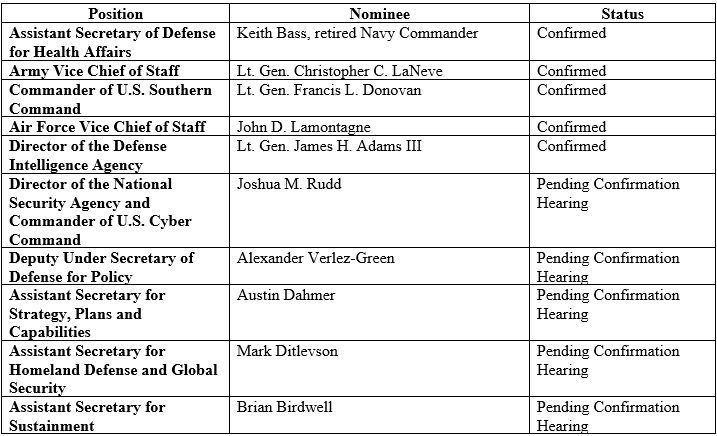
Department of War Nomination Tracker

Recommended Defense Articles

Pentagon CTO picks six defense tech vets to lead Critical Technology Areas (Breaking Defense 1/30)

“Two months after pruning the Pentagon’s list of 14 ‘Critical Technology Areas’ down to just six top priorities, Defense Department CTO Emil Michael has announced the six officials who will lead research into those CTAs. The six men all have prior experience in the DoD’s extensive technology apparatus. Four served at some point in the Air Force, historically the most technologically minded branch. Three of them were already the ‘principal directors’ overseeing one of the old 14 CTAs, while the others were chosen from across the Department.”


Navy shipbuilding stands to get $27 billion in funding in 2026 (Defense One 1/26)

“House and Senate appropriators backed the White House’s shipbuilding goals with an additional $6.5 billion in funding for fiscal year 2026—including adjustments to fix accounting errors resulting from last year's budget reconciliation. The compromise bill, released last week, allots a total $27.2 billion for shipbuilding, with increases across several efforts. That $27.2 billion topline covers 17 ships, including ‘one Columbia-class ballistic missile submarine, two Virginia-class fast attack submarines, three Medium Landing Ships, and one T-AGOS [Surveillance Towed-Array Sensor System] ship for anti-submarine warfare,’ House appropriators wrote in their bill summary.”


Op-Ed: “Golden Dome’s cyber protection must be a design choice, not an afterthought” By Jack Wilmer and Lt. Gen. Charlie Moore (DefenseScoop 1/28)

“Public discussion of Golden Dome has so far focused on hypersonic weapons, drones, cruise missiles, maneuvering reentry vehicles, and space-based sensors. But the threat of cyber operations targeting the space and ground systems has remained mostly unexamined, which could imperil one of the most consequential national defense projects in decades. A missile-defense architecture can perform flawlessly in testing and still fail in conflict if its infrastructure can be manipulated, degraded, or denied. Golden Dome risks becoming a system that works beautifully in theory but collapses when America needs it most. As such, policymakers and the Golden Dome Program Office must address a fundamental question: What is the best path forward to protect the defensive shield from cyber vulnerabilities?”


New U.S. defense strategy ‘barely mentions technology’ (DefenseScoop 1/26)

“The new National Defense Strategy broadly prioritizes the Trump administration’s plans for protecting U.S. territories and assets and juicing the military’s industrial base, but contains few references to specific technologies of interest. As it pivots the primary focus of America’s military more inward around the Western Hemisphere and urges allies to take on more burden-sharing against severe global challenges in other regions, the 2026 NDS includes noticeably less technology callouts than its recent predecessors.”


Key Gulf Allies Say They Won’t Aid U.S. in an Iran Strike, Limiting Trump’s Options (The Wall Street Journal 1/28)

“Saudi Arabia on Tuesday ruled out the use of its airspace and territory for a potential U.S. attack on Iran, complicating the Trump administration’s options in response to Tehran’s violent crackdown against Iranian protesters. The Saudi move follows a similar statement Monday by the United Arab Emirates’ foreign ministry. The declarations from the two Gulf states represent a foreign policy setback for the Trump administration as it seeks to ratchet up pressure on Tehran, which has defied Washington’s demand that it halt uranium enrichment and end the suppression of protesters.”


US Air Force eyes improved comms with bombers after Midnight Hammer (DefenseNews 1/30)

“To ensure future missions such as last summer’s strikes on Iranian nuclear facilities can succeed, the U.S. Air Force must improve the way it securely transmits critical information with bombers and other aircraft securely transmit critical information, a top general said Thursday.”


Op-Ed: “A Serious Defense Budget, at Last” By The WSJ Editorial Board (The Wall Street Journal 1/23)

“President Trump likes to take credit for persuading NATO to spend 5% of GDP on defense, but in 2025 he didn’t ask Congress to meet that target. That changed this month as he said he’ll propose a military budget of $1.5 trillion. It’s the right decision for a world of proliferating threats. For ‘the Good of our Country, especially in these very troubled and dangerous times,’ he wrote on Truth Social, ‘our Military Budget for the year 2027 should not be $1 Trillion Dollars, but rather $1.5 Trillion Dollars.’”


Critics see ‘chilling effect’ of DOD crackdown on 8(a) small-biz deals (DefenseNews 1/26)

“Defense Secretary Pete Hegseth on Jan. 16 lambasted a decades-old contracting program that provides business opportunities for small and disadvantaged businesses, calling it a breeding ground for fraud and disparaging it as a ‘DEI’ effort. But experts and an executive from a firm that uses such contracts say the level of fraud critics like Hegseth alleged has been greatly exaggerated. Some fear the harsh rhetoric around the program signals a desire to eliminate it, which they say would hurt small businesses and the Pentagon’s ability to quickly respond to unfolding emergencies.”


Trump’s threats to Canadian jets raise questions about a key customer: The Pentagon (Breaking Defense 1/30)

“President Donald Trump’s recent threat to decertify and impose steep levies Canadian-made commercial jets is designed to pressure Ottawa, but it’s unclear if the fallout could also extend to planes used by the US military. ‘Based on the fact that Canada has wrongfully, illegally, and steadfastly refused to certify the Gulfstream 500, 600, 700, and 800 Jets, one of the greatest, most technologically advanced airplanes ever made, we are hereby decertifying their Bombardier Global Expresses, and all Aircraft made in Canada, until such time as Gulfstream, a Great American Company, is fully certified, as it should have been many years ago,’ Trump said in a post on his social media platform Truth Social late Thursday.”


Senior DOD officials back Cybercom 2.0, as Cyber Force debate continues to churn (DefenseScoop 1/30)

“Advocates of creating an independent U.S. military service focused on cyber argue that the Pentagon’s new force generation model isn’t a sufficient solution for fixing the department’s problems. During a congressional hearing this week, senior officials said their revised model is still needed regardless of whether a decision is ultimately made to create a Cyber Force. The new model, rolled out in November under the ‘Cybercom 2.0’ initiative, aims to modernize the way the Defense Department builds and develops digital forces and talent, including by more closely linking U.S. Cyber Command with the military departments to recruit, assess, select, train and retain the nation’s digital warriors.”


Pentagon wants ‘low-collateral’ drone interceptors at all U.S. military installations, task force director says (DefenseScoop 1/28)

“The Pentagon is looking to put ‘low-collateral’ kinetic drone interceptors at every U.S. installation as part of its attempt to bolster security around stateside military bases against unmanned aerial system threats, according to the director of the department’s counter-UAS task force. Brig. Gen. Matt Ross, director of Joint Inter-Agency Task Force-401, told reporters Tuesday that net launchers and ‘kinetic energy’ systems were necessary to protect homeland facilities, in part because they allow the military and law enforcement to better assess where the UAS came from and what it was doing after it gets brought down.”


SPACECOM chief cites Army, Marines as models for expanding on-orbit warfighting exercises (Breaking Defense 1/28)

“Gen. Stephen Whiting, commander of US Space Command (SPACECOM), today called for a foundational pivot to maneuver-based space operations to echo how the rest of the Joint Force fights — including increased investment in enabling technologies such as refueling, repair and on-orbit logistics, as well as new scaled-up exercises. In a speech at the annual Space Mobility Conference in Orlando, Fla., he cited the core Marine Corps doctrine (MCDP 1) of ‘shattering enemy cohesion through rapid, focused, and unexpected actions’ as a model for where space warfighting needs to go. He added that because size of SPACECOM’s area of operations is huge, making a maneuver warfare a reality requires ‘sustained’ logistics based on-orbit.”


Pentagon’s new ‘non-kinetic effects cell’ bolsters Gen. Caine’s goal to better integrate cyber into U.S. military operations (DefenseScoop 1/29)

“Better weaving cyber capabilities into American military operations has been a priority for Chairman of the Joint Chiefs of Staff Gen. Dan ‘Razin’ Caine. A new team has been set up at the Pentagon to do just that. Caine, the U.S. military’s top officer who was picked for the job by President Donald Trump, has highlighted the important role that digital tools played recently in major operations, like Operation Absolute Resolve and last year’s Operation Midnight Hammer in Venezuela and Iran, respectively.”