|
If you would like to listen to the Defense and Critical Technologies Weekly Update, click here!
| | |
This week, lawmakers are closely tracking the continued war in Iran, particularly around the Strait of Hormuz, where threats to maritime traffic, including harassment of commercial vessels, increased Iranian drone activity, and continued risk to global energy flows are ongoing. The situation has prompted additional U.S. naval presence and force protection measures, with Pentagon officials emphasizing freedom of navigation and deterrence. U.S. efforts to rally allied support for securing the Strait of Hormuz have largely faltered, with several key NATO and Indo-Pacific partners declining to participate or commit forces, leaving Washington increasingly isolated in managing the crisis. The sustained risk to a critical chokepoint is expected to remain a central focus for both the Department of War and Congress in the coming week, particularly as lawmakers assess escalation risks and potential impacts on global energy markets. Congress is also anticipating an emergency supplemental funding request of approximately $200 billion from the administration to support operations in Iran. However, several Democratic senators have already expressed skepticism about such a request, leaving its prospects for passage uncertain.
Additionally, the U.S. Navy unveiled five additional Program Acquisition Executives (PAEs), part of a major acquisition reform initiative centered on restructuring Program Executive Offices (PEOs) into empowered PAEs to accelerate capability delivery and improve accountability across key mission areas. The reform effort reflects broader Pentagon priorities to streamline acquisition, reduce bureaucratic friction, and better align program management with operational needs, particularly in areas such as shipbuilding, unmanned systems, and digital capabilities. Defense officials have framed the move as part of a longer-term shift toward more agile and decentralized acquisition structures. Congressional committees will continue to assess implementation, resourcing, and performance of these PAEs and may refine authorities, as needed, in the upcoming FY27 NDAA.
On March 20, the White House released a National Policy Framework for Artificial Intelligence, marking a significant step toward a unified federal approach to AI governance. The framework centers on priorities including child safety, innovation, intellectual property protections, and maintaining U.S. leadership in global AI competition, while advancing a “one rulebook” standard to reduce regulatory fragmentation and expand workforce development and risk assessment capacity. Congressional Republicans and administration officials have largely endorsed the framework as a pro-innovation blueprint, while Democratic lawmakers have criticized it as lacking sufficient consumer protections and limiting state authority. (More on this below).
| |
Upcoming Hearings of Note
House Armed Services Committee
- 03/25/2026 – Strategic Forces Subcommittee: "National Security Space Programs and Activities"
- 03/25/2026 – Military Personnel Subcommittee: "Changes at Military Treatment Facilities and the Effects on Military Readiness and Beneficiary Access"
- 03/26/2026 – Cyber, Information Technologies, & Innovation: Information Technology Posture of the Department of Defense
Senate Armed Services Committee
- 03/24/2026 – Full Committee: To receive testimony on Low-Cost Munitions
- 03/24/2026 – Cybersecurity Subcommittee: To examine enterprise security and information technology operations of Department of Defense networks and systems; to be immediately followed by a closed session at 3:45 p.m., in SVC-217.
- 03/25/2026 – Full Committee: To receive a closed briefing on Operation Epic Fury.
- 03/26/2026 – Full Committee: Open/Closed: To receive testimony on the posture of United States Space Command and United States Strategic Command in review of the Defense Authorization Request for Fiscal Year 2027 and the Future Years Defense Program
House Foreign Affairs Committee
- 03/25/2026 – Full Committee: Securing the Future: Arms Control and International Security for the Modern Age
- 03/26/2026 – Full Committee: Markup
- H.R. 7654, To authorize the consolidation of reports required to be submitted by the Bureau of Global Health Security and Diplomacy of the Department of State, and for other purposes;
- H.R. 7642, To authorize the recruitment and retention of specialized disaster assistance professionals by the Department of State;
- H.R. 7641, To provide for a pilot program to require congressional notification of additional information for certain foreign assistance programs;
- H.R. 7633, To require the United States flag to be displayed on United States foreign assistance;
- H.Res. 971, Condemning the coercive actions of the People’s Republic of China against Japan in response to statements regarding Taiwan and reaffirming the United States commitment to its allies in the Indo-Pacific region;
- H.R. 1744, To extend and authorize annual appropriations for the United States Commission on International Religious Freedom through fiscal year 2028;
- H.R. 3447, To require the Secretary of Commerce to issue standards with respect to chip security mechanisms for integrated circuit products, and for other purposes;
- H.R. 7669, To require a report that describes the current restrictions imposed by the Taliban on women and girls in Afghanistan since August 2021;
- H.R. 7616, To require the Secretary of State to develop a strategy to identify and mitigate relationships that pose a risk to United States foreign policy interests between certain European institutions and certain covered entities of concern, and for other purposes;
- H.R. 6428, To require the Secretary of State to submit a report on participation in educational and cultural exchange programs;
- H.R. 7058, To require the Secretary of State to conduct assessments of the risks posed to the United States by foreign adversaries who utilize generative artificial intelligence for malicious activities, and for other purposes;
- H.R. 7653, To enhance diplomatic engagement on international biotechnology and biosecurity matters;
- H.R. 6196, To authorize and encourage the United States to pursue a model of locally led development and humanitarian response and expand engagement with local actors and increase its local partner base;
- H.R. 7632, To designate a Coordinator for hybrid warfare accountability, require the Secretary of State to submit a report identifying Chinese entities materially supporting Russia's defense industrial base and recommending appropriate sanctions, and for other purposes;
- H.R. 2504, To require the Secretary of State to develop a strategy to strengthen United States-European nuclear energy cooperation and combat Russian malign influence in the nuclear energy sector in Europe;
- H.R. 7649, To ensure that persons found responsible for the unauthorized diversion or destruction of United States humanitarian assistance are liable to the United States, and for other purposes;
- H.R. 7605, To abolish the United States African Development Foundation;
- H.R. 7630, To prohibit United States recognition of the claims of sovereignty of South Ossetia or Abkhazia within the Republic of Georgia;
- H.R. 7675, To require the Secretary of State to establish the Initiative on Foreign Investment Screening, and for other purposes; and
- H.R. 7674, To require the Secretary of State to submit to Congress a strategy to support a democratic transition in Venezuela, and for other purposes.
Senate Foreign Relations Committee
- 03/24/2026 – Full Committee: To examine arms control and transforming international security functions at the State Department.
- 03/25/3036 – Full Committee: To receive a closed briefing update on the Russia-Ukraine war.
House Committee on Homeland Security
- 03/25/2026 – Full Committee: Funding Lapse and Security Gaps: Assessing the Harmful Impacts of the DHS Shutdown on Americans
- 03/26/2026 – Transportation and Maritime Security Subcommittee: “Arctic Security in an Era of Global Competition: Safeguarding U.S. Interests in Frigid Waters.”
House Committee on Veterans’ Affairs
- 03/25/2026 – Subcommittee on Oversight and Investigations: Legislative Hearing
- H.R. 6654, the “Veterans Affairs Management and Oversight of Software Assets Act”;
- H.R. 7280, the “Veteran DATA Act”;
- H.R. 7319, the “VA Bonus and Relocation Recovery Act”;
- H.R. 7683, the “VA Fiscal Management Modernization Act”;
- Discussion Draft, the “Vets CLEAR Act”;
- Discussion Draft, the “Veterans Affairs Subcontractor Competition and Opportunity Network Act”;
- Discussion Draft, “to amend title 38, United States Code, to require that certain sterile processing technicians of the Veterans Health Administration hold appropriate professional certifications, and for other purposes”;
- Discussion Draft, “to amend title 38, United States Code, to modify the rate of pay for care or services provided under the Community Care Program of the Department of Veterans Affairs based on the location at which such care or services were provided, and for other purposes”;
- Discussion Draft, “to establish an entitlement to a supplemental period of unpaid parental leave for employees of the Department of Veterans Affairs”;
- Discussion Draft, “to deem certain individuals as parents of Department of Veterans Affairs employees for purposes of determining entitlement to certain family and medical leave for such employees”;
- Discussion Draft, “to prohibit the downgrading of law enforcement positions in the Department of Veterans Affairs, and for other purposes”;
- Discussion Draft, “to amend title 38, United States Code, to establish the Office of Congressional and Legislative Affairs in the Department of Veterans Affairs, and for other purposes.”
- 03/26/2026 – Subcommittee on Economic Opportunity Oversight: "Kitchen Table Issues: Lowering Costs for Veteran Families Through the VA Home Loan Program.”
-
03/26/2025 – Subcommittee on Disability Assistance and Memorial Affairs: Markup
- H.R. 1004, the “Love Lives on Act of 2025”;
- H.R. 2164, the “Dayton National Cemetery Expansion Act of 2025”;
- H.R. 5339, the “Susan E. Lukas 9/11 Servicemember Fairness Act”;
- H.R. 5723, the “FRAUD in VA Disability Exam Act”;
- H.R. 6698, the “Board of Veterans Appeals Annual Report Transparency Act of 2025”;
- H.R. 6943, the “Veterans Burial Allowance and Reimbursement Act of 2026”.
House Committee on Energy and Commerce
-
03/26/2026 – Health Subcommittee: Policies to Protect Our Communities from Illicit Drug Threats
- 03/26/2026 – Communications & Technology Subcommittee: The Telecommunications Act of 1996: 30 Years Later
House Committee on Science, Space, and Technology
- 03/25/2026 – Space and Aeronautics Subcommittee: The Future of Low Earth Orbit: From the ISS to Commercial Platforms
- 03/26/2026 – Environment Subcommittee: Beneath the Waves: The Science and Technology of Deep-Sea Mining
Senate Commerce, Science, & Transportation Committee
- 03/25/2026 – Full Committee: Markup
- S.1682, Alex Gate Safety Act of 2025;
- S.1885, Stop the Scroll Act;
- S.1962, Secure Space Act of 2025;
- S.2378, SAFEGUARDS Act of 2025;
- S.3257, Mental Health in Aviation Act of 2025;
- S.3404, Satellite Cybersecurity Act of 2025;
- S.3597, National Quantum Initiative Reauthorization Act of 2026;
- S.3618, No Fentanyl on Social Media Act;
- S.3791, Regional Ocean Partnerships Reauthorization Act of 2026.
House Permanent Select Committee on Intelligence
- 03/24/2026 – Full Committee: Committee Business to Consider: 1) Amendment to Committee Rules; 2) Release of Committee Transcripts.
Senate Select Committee on Intelligence
- 03/24/2026 – Full Committee: To receive a closed briefing on certain intelligence matters.
- 03/25/2026 – Full Committee: To receive a closed briefing on certain intelligence matters.
Please let us know if you would like to receive a summary of these hearings.
| | | The National Policy Framework for AI | | |
Last week, the White House released a National Policy Framework for Artificial Intelligence, outlining a legislative roadmap intended to guide Congress toward establishing a unified federal standard for AI governance. Administration officials emphasized that the framework is designed to balance innovation with safeguards, focusing on areas such as child protection, intellectual property rights, free speech, and workforce development, while also reinforcing U.S. leadership in global AI competition. The framework calls for measures including stronger protections for minors online, expanded support for AI infrastructure and small business adoption, and enhanced national security capacity to assess risks associated with advanced AI systems.
The proposal also places significant emphasis on enabling continued AI innovation by reducing regulatory barriers, expanding access to testing environments, and increasing the availability of federal data for research and development. At the same time, it defers key legal questions, particularly around copyright and fair use, to the courts, while suggesting optional licensing frameworks and potential future protections for creators. Officials have framed this approach as a way to avoid overregulation while maintaining flexibility as technology evolves.
A central component of the framework is the push to establish a single federal policy that would preempt certain state-level AI laws in order to prevent a fragmented regulatory landscape. While the proposal preserves state authority over generally applicable areas such as fraud, child protection, and zoning, it argues that AI development itself should be governed at the federal level due to its interstate and national security implications. This effort builds on prior executive actions aimed at minimizing state-level constraints on AI and advancing a “one rulebook” approach to its regulation.
Early reactions have underscored divisions over the framework’s approach, particularly regarding federal preemption and the scope of regulatory safeguards. While some lawmakers have signaled openness to advancing elements of the proposal, especially around child safety and workforce development, others have raised concerns about the lack of enforceable protections and the potential erosion of state authority. As a result, the framework may serve as a starting point for negotiations rather than a standalone legislative vehicle as Congress continues to debate the broader structure of national AI policy.
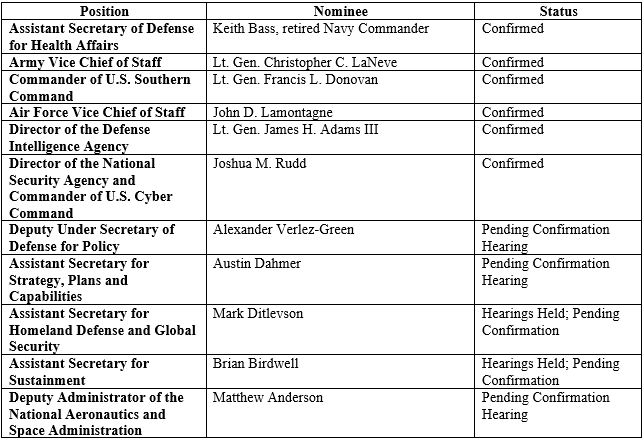
| | Department of War Nomination Tracker | |
Recommended Defense Articles
| | |
U.S. War Planes and Helicopters Kick Off Battle to Reopen Hormuz (The Wall Street Journal 3/19)
“The U.S. and its allies have intensified the battle to reopen the Strait of Hormuz, sending low-flying attack jets over the sea lanes to blast Iranian naval vessels and Apache helicopters to shoot down Iran’s deadly drones, American military officials said. The stepped-up operation is part of a multistage Pentagon plan to reduce the danger from Iranian armed boats, mines and cruise missiles, which have halted ship traffic through the waterway since early March. If the danger can be reduced, the U.S. could send U.S. warships through the strait and eventually escort vessels in and out of the Persian Gulf.”
Record-smashing $1.5-trillion spending proposal will fund only the ‘most essential things’: comptroller (Defense One 3/17)
“Virtually all of the giant reconciliation fund has been doled out, the Pentagon’s acting chief financial officer said Tuesday. ‘Everything except for $1.3 billion in the $153 billion that's been given to the Department of Defense by the One Big, Beautiful Bill Act has been apportioned and [has] been released to the services and program managers. And so that money is all starting to flow,’ Jules Hurst, who is performing the duties of Pentagon comptroller and chief financial officer, said at the McAleese annual defense programs conference in Arlington, Va.”
Pentagon says lethal boat strikes are ‘just the beginning’ in South, Central America (Politico 3/17)
“A top Pentagon official told lawmakers Tuesday that existing military operations targeting Latin American drug cartels are ‘just the beginning’ — and left open the possibility of deploying ground forces even as lethal boat strikes against alleged smugglers continue indefinitely.”
Navy unveils acquisition reform, establishes five more PAE organizations (Breaking Defense 3/16)
“The Navy announced today that it is establishing five new portfolio acquisition executives, known as PAEs, as part of a wider acquisition reform initiative across the services. ”
Army to ‘ramp up all munitions across the board,’ general says, including specialized missiles (DefenseScoop 3/18)
“The Army’s top general in charge of munitions said Tuesday the service was looking to boost armament stocks ‘across the board,’ but singled out some specialized missile systems, one of which has struggled in development, that he expects to make production gains soon.”
US intelligence elevates AI as a top global threat in new report (Defense One 3/19)
“Artificial intelligence is a major subtheme of the U.S. intelligence community’s annual report on threats—one increasingly described in strategic, not just technical, terms. In its 2026 Worldwide Threat Assessment, released on Wednesday, the Office of the Director of National Intelligence calls AI a ‘defining technology for the 21st century,’ notes that it is being used in combat, and identifies China as ‘the most capable competitor’ to the United States. The assessment, released on Wednesday as intelligence leaders testified to lawmakers, offers a rare window into how they interpret the global threat landscape.”
Army is not satisfied with readiness rates, says service’s undersecretary (Breaking Defense 3/17)
“The Army is not at a satisfactory readiness rate, according to one service official, and will have to further rely on industry to fill its capability gaps. ‘To say we’re satisfied with our readiness rates, I think would be disingenuous. We have real problems with our major weapons systems, both aircraft and ground, and we have to address those things, and we’re doing so through a number of different ways,’ Army Undersecretary Michael Obadal said today during the annual McAleese Defense Programs Conference. ‘Public-private partnerships in an organic industrial base (OIB) is one of the most fundamentally different approaches that we can take.’”
In new timeline, Army set to take full control of THAAD missile program by 2027 (Breaking Defense 3/18)
“The Army will soon officially assume control of the Terminal High Altitude Area Defense (THAAD) missile system, a program the Missile Defense Agency has long managed, according to a new timeline disclosed by a service official. Lt. Gen. Frank Lozano, the Army’s Program Acquisition Executive of Fires, told an audience at the annual McAleese Defense Programs Conference Tuesday the current THAAD office ‘will be transferring over to me from MDA in [fiscal year] ’27.’”
US poised to accept new F-35s without radars, sources say (Breaking Defense 3/19)
“Starting this fall, all new F-35 Joint Strike Fighters delivered to the American military will come without radars, an issue that could stretch into the future and restrict the jets from participating in combat operations, Breaking Defense has learned. In the best case, a new, redesigned radar could be ready as soon as next year, meaning only a handful of jets may be impacted. But if delays for the sensor stretch on, over a hundred jets may be delivered with a ballast where the new radar is supposed to be.”
Army receives first optionally-piloted Black Hawk helicopter (DefenseScoop 3/20)
“The Army has taken delivery of a UH-60M Black Hawk that has been upgraded with autonomous flight capabilities, the service announced Friday. The optionally-piloted helicopter — which has been designated UH-60Mx — will move into a ‘rigorous testing phase’ over the coming months, according to an Army news release. Upcoming tests are designed to validate the Black Hawk’s ability to be controlled by troops on the ground and perform in complex, real-world missions without a pilot in the cockpit.”
US Air Force special operations seeks kamikaze drones (DefenseNews 3/18)
“The U.S. Air Force wants small one-way attack drones for its special operations forces, according to an Air Force Request for Information. ‘Air Force Special Operations Command (AFSOC) and Special Tactics (ST) units currently lack a purpose-built First-Person View (FPV) unmanned capability,’ warned the RFI, which is due April 17. ‘This deficit restricts the force’s ability to employ FPV systems in specialized mission sets and limits the development of standardized Tactics, Techniques, and Procedures (TTPs) essential for modern, high-intensity conflict.’”
| | | | |