|
If you would like to listen to the Defense and Critical Technologies Weekly Update, click here!
| | |
Last week, the conflict with Iran entered a critical phase as the administration approached the 60-day threshold under the War Powers Resolution, raising pressure on both the White House and Congress to define a path forward. April 29 will mark two months since the start of U.S. military strikes, triggering statutory requirements to either withdraw forces or seek congressional authorization, with a limited extension available on national security grounds. Republican lawmakers, including Thom Tillis and John Thune, indicated they will be looking for clear signs of progress or a defined end state, while others such as Jerry Moran have called for an end to offensive operations and a return of U.S. forces. The administration has already reset multiple timelines for concluding the conflict, and the two-week ceasefire announced earlier this month is set to expire in the coming days, with Pentagon officials signaling forces remain prepared to resume strikes if necessary. At the same time, Democrats are expected to bring forward additional war powers resolutions this week, potentially forcing a vote on congressional authorization and setting up a broader debate over the scope and duration of U.S. involvement.
Separately, the administration’s FY27 budget request continues to face scrutiny on Capitol Hill following White House budget director Russell Vought’s defense of the proposal before the House Budget Committee. Anchored by a $1.5 trillion defense topline, the request frames the increase as a “paradigm shifting” investment, emphasizing the need for multiyear procurement agreements to enable the defense industrial base to expand capacity and scale production. A central feature of the proposal is the push to move roughly $350 billion through reconciliation, allowing the administration to advance key priorities without bipartisan support, a strategy that is likely to draw significant Democratic opposition. At the same time, broader debates over defense spending are intersecting with ongoing disputes over U.S. security assistance, as Bernie Sanders plans to force votes on resolutions to block select arms sales to Israel, testing the level of congressional resistance amid the ongoing Iran conflict.
Last week, the annual Space Symposium in Colorado underscored a growing Pentagon-wide effort to overhaul acquisition processes and accelerate the delivery of critical capabilities, particularly within the United States Space Force. Much of the discussion centered on structural reforms aimed at reducing bureaucratic friction, including the creation of new acquisition portfolios designed to streamline decision-making and limit the number of approvals required before funds can be executed, alongside a broader push from Defense Secretary Pete Hegseth to move faster on procurement. Air Force Secretary Troy Meink framed the effort as a “once in a generation opportunity” to modernize the acquisition enterprise, while officials also highlighted expanded use of multiyear procurement contracts and new satellite buying approaches to provide industry with greater predictability and enable upfront investment. In parallel, senior leaders pointed to a shift in operational thinking toward orbital maneuver warfare, with Chief of Space Operations Chance Saltzman emphasizing closer alignment with United States Space Command on developing maneuverable, refuelable satellite architectures as part of a phased plan through 2040, reinforcing maneuverability as a central pillar of future space operations. (More on this below).
| |
Upcoming Hearings of Note
House Armed Services Committee
- 04/21/2026 – Subcommittee on Cyber, Information Technologies, and Innovation: Cyber Posture of the Department of Defense
- 04/22/2026 – Full Committee: U.S. Military Posture and National Security Challenges in the Indo-Pacific Region
- 04/22/2026 – Subcommittee on Strategic Forces: FY27 Budget Request for Nuclear Forces and Atomic Energy Defense Activities
- 04/22/2026 – Subcommittee on Seapower and Projection Forces: Revitalizing Shipbuilding and the Maritime Industrial Base
Senate Armed Services Committee
- 04/20/2026 – Subcommittee on Strategic Forces: To examine the Department of Energy's atomic energy defense activities and Department of Defense nuclear weapons programs in review of the Defense Authorization Request for Fiscal Year 2027 and the Future Years Defense Program
- 04/21/2026 – Full Committee: Closed hearings to examine the posture of United States Indo-Pacific Command and United States Forces Korea in review of the Defense Authorization Request for Fiscal Year 2027 and the Future Years Defense Program
- 04/21/2026 – Subcommittee on Seapower: To examine maritime unmanned surface vessels
House Foreign Affairs Committee
- 04/22/2026: Full Committee: Markup:
- Baird Amendment in the Nature of a Substitute to H.R. 8036
- Baumgartner Amendment in the Nature of a Substitute to H.R. 8170
- Davidson Amendment in the Nature of a Substitute #124 to H.R. 6624
- Fine Amendment in the Nature of a Substitute #111 to H.R. 6996
- H.R. 4505, To strengthen enforcement of United States export controls by increasing the number of export control officers of the Bureau of Industry and Security of the Department of Commerce who are stationed in foreign regions
- H.R. 4920, To require modernization of information technology systems and applications of the Bureau of Industry and Security of the Department of Commerce
- H.R. 5543, To require the Secretary of State, in coordination with the Secretary of Defense, to submit a report on emerging threats posed to the Republics of Estonia, Latvia, and Lithuania, and for other purposes
- H.R. 5853, To amend the Export Control Reform Act of 2018 to increase the civil penalties that may be imposed under such Act
- H.R. 6058, To provide for multilateral semiconductor technology supply chain coordination, and for other purposes
- H.R. 6322, To amend the Export Control Reform Act of 2018 to establish a whistleblower incentive program and provide protections to whistleblowers
- H.R. 6331, To modify certain definitions under the Export Control Reform Act of 2018
- H.R. 6624, To restrict the export to foreign entities of concern of United States intellectual property and sensitive information related to synthetic biology, and for other purposes
- H.R. 6996, To facilitate the export of United States artificial intelligence systems, computing hardware, and standards globally
- H.R. 7003, To authorize the Under Secretary of Commerce for Industry and Security to appoint certain personnel in order to attract highly qualified experts, and for other purposes
- H.R. 7962, To amend the Export Control Reform Act of 2018 relating to the review of the interagency dispute resolution process
- H.R. 8036, To amend the Export Control Reform Act of 2018 to permit the Secretary of State, Defense, or Energy to submit proposed rules to the Export Administration Review Board, to require the Secretary of State to evaluate the military civil fusion strategy of the People’s Republic of China, and for other purposes
- H.R. 8170, To provide for export restrictions on certain semiconductor manufacturing equipment and components therefor, and for other purposes
- H.R. 8202, To amend the Export Control Reform Act of 2018 to provide for a ten-year statute of limitations for export control violations
- H.R. 8283, To prevent foreign adversaries from threatening the national security of the United States by extracting key technical features of closed-source, American-owned artificial intelligence models, and for other purposes
- H.R. 8284, To enhance the administration of export control licenses under the Export Control Reform Act of 2018, and other purposes
- H.R. 8285, To amend the Export Control Reform Act of 2018 to require a competitive market review of applications for a license to export, reexport, or transfer in-country certain technology, and for other purposes
- H.R. 8287, To require the Assistant Secretary of State for Intelligence and Research to submit a comprehensive report on the impact and effectiveness of United States semiconductor export controls on the People’s Republic of China, and for other purposes
- H.R. 8288, To amend the Export Control Reform Act of 2018 to provide assistance for compliance with that Act
- H.R. 8289, To amend the Export Control Reform Act of 2018 to ensure expeditious processing of license applications, and for other purposes
- Huizenga Amendment in the Nature of a Substitute #68 to H.R. 6058
- Kamlager-Dove Amendment in the Nature of a Substitute to H.R. 4505
- Mast Amendment in the Nature of a Substitute to H.R. 8169
- Meeks Amendment in the Nature of a Substitute #123 to H.R. 4920
- Miller Amendment in the Nature of a Substitute #73 to H.R. 6331
- H.R. 8169, To amend the Export Control Reform Act of 2018 to provide for expedited consideration of proposals for additions to, removals from, or other modifications with respect to entities on the Entity List, and for other purposes
- H.R. 8320, To require additional duties of the Ambassador at Large for Cyberspace and Digital Policy with respect to United States diplomatic efforts ahead of certain international conferences, and for other purposes
- H.R. 8321, To promote peaceful space exploration, expand participation in the Artemis Accords, establish norms for safe and sustainable space activities, and advance national security and economic competitiveness through leadership in space
House Committee on Veterans’ Affairs
- 04/21/2026 – Subcommittee on Disability Assistance and Memorial Affairs: Examining VA Benefits: Pension and Fiduciary, and VA Life Insurance Options
House Appropriations Committee
- 04/21/2026 – Full Committee: Markup: Fiscal Year 2027 Military Construction, Veterans Affairs, and Related Agencies Bill, Fiscal Year 2027 Financial Services and General Government Bill, and Interim Subcommittee Allocations
Senate Appropriations Committee
- 04/21/2026 – Subcommittee on Department of Defense: To examine proposed budget estimates and justification for fiscal year 2027 for the National Guard and Reserves Forces
House Committee on Energy and Commerce
- 04/21/2026 – Subcommittee on Communications and Technology: SAT Streamlining Act: Modernizing Satellite Licensing for the Final Frontier
- 04/22/2026 – Subcommittee on Environment: Help or Hindrance? The impact of U.S. Environmental Laws on Critical Material Supply Chains, National Security, and Economic Growth
House Committee on Science, Space, and Technology
- 04/21/2026 – Subcommittee on Research and Technology: Robots Made in America: Advancing U.S. Leadership in Manufacturing and Automation
House Permanent Select Committee on Intelligence
- 04/20/2026 – Full Committee: Fiscal Year 2027 Budget Request for Compartmented Programs (CLOSED)
- 04/21/2026 – Subcommittee on the National Intelligence Enterprise: Fiscal Year 2027 Budget Hearing for the Department of Energy (CLOSED)
- 04/21/2026 – Subcommittee on Central Intelligence Agency: Fiscal Year 2027 Budget Request for the Central Intelligence Agency (CLOSED)
- 04/22/2026 – Subcommittee on Defense Intelligence and Overhead Architecture: Fiscal Year 2027 Budget Request for the Military Services (CLOSED)
- 04/22/2026 – Subcommittee on Defense Intelligence and Overhead Architecture: Fiscal Year 2027 Budget Request for the Defense Intelligence Agency, United States Cyber Command, and United States Special Operations Command (CLOSED)
- 04/22/2026 – Subcommittee on National Security Agency and Cyber: Fiscal Year 2027 Budget Request for the National Security Agency (CLOSED)
Senate Select Committee on Intelligence
- 04/21/2026 – Full Committee: Closed hearings to examine certain intelligence matters
- 04/22/2026 – Full Committee: Closed hearings to examine certain intelligence matters
Senate Energy and Natural Resources Committee
- 04/21/2026 – Full Committee: Hearings to examine the President's proposed budget request for the fiscal year 2027 for the Department of Energy
Senate Judiciary Committee
- 04/22/2026 – Full Committee: Hearings to examine China's ongoing theft of U.S. innovation
Please let us know if you would like to receive a summary of these hearings.
| | | Space Acquisition Developments | | |
Last week, the annual Space Symposium in Colorado underscored a growing Pentagon-wide effort to overhaul acquisition processes and accelerate the delivery of critical capabilities, particularly within the United States Space Force. Much of the discussion centered on structural reforms aimed at reducing bureaucratic friction, including the creation of new acquisition portfolios designed to streamline decision-making and limit the number of approvals required before funds can be executed. The initiative aligns with a broader push from Defense Secretary Pete Hegseth to move faster on procurement, as the department prepares for a potential influx of resources. Air Force Secretary Troy Meink framed the effort as a “once in a generation opportunity” to modernize the acquisition enterprise and ensure the department maintains its operational advantage, while emphasizing that success will depend on both internal execution and external support.
In parallel with these structural reforms, the Space Force is pursuing new acquisition strategies to support long-term capability development, including expanded use of multiyear procurement contracts. Officials emphasized that such authorities are critical to enabling contractors to make upfront investments in infrastructure and production capacity, particularly as the department demands faster timelines and greater output. The service is also exploring alternative purchasing approaches for satellites, seeking to provide industry with greater predictability while reducing overall costs. These efforts reflect a broader shift toward aligning acquisition mechanisms with emerging operational requirements, particularly as space systems become more central to joint force operations.
Senior leaders also highlighted a significant evolution in the Space Force’s operational concept, particularly in the area of orbital maneuver warfare. Chief of Space Operations Chance Saltzman indicated that the service is increasingly aligned with United States Space Command on the need to develop maneuverable, refuelable satellite architectures capable of sustaining operations over extended periods. This marks a notable shift from earlier skepticism regarding the near-term utility of such capabilities. The service’s long-term planning framework outlines a phased approach through 2040, including demonstrations of on-orbit refueling and “space tug” systems between 2025 and 2030, operationalization of refueling and high-thrust transfer vehicles in the early 2030s, and eventual fielding of a comprehensive on-orbit logistics architecture. Senior officials, including Space Command head Stephen Whiting, emphasized that maneuverability will be central to maintaining U.S. advantage in a contested space domain, reinforcing its role as a core pillar of future space warfighting capability.
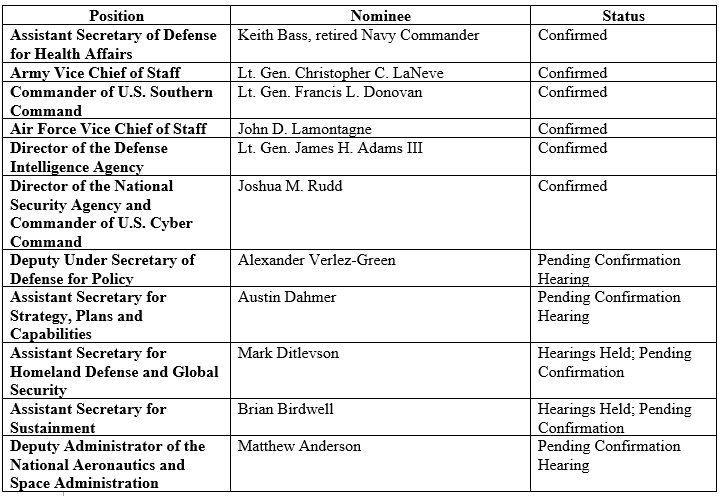
| | Department of War Nomination Tracker | |
Recommended Defense Articles
| | |
Republicans reject Iran limits as war powers milestone nears (Politico 4/15)
“Senate Republicans rejected a fresh attempt to halt the U.S. military campaign against Iran on Wednesday, again backing up President Donald Trump as he projects optimism that the conflict could soon be over despite uncertain peace negotiations and a U.S. Navy blockade of Iranian ports. It’s the fourth time war powers legislation has failed since hostilities began.”
How the U.S. Navy Is Blockading the Strait of Hormuz to Choke Off Iran’s Ports (The Wall Street Journal 4/14)
“American military forces began blockading all traffic attempting to enter and leave Iranian ports on Monday, setting up a potential game of cat and mouse with shadow-fleet tankers that ship sanctioned Iranian oil from the Islamic Republic’s terminals. With enough warships, a blockade could intimidate many tankers attempting to move oil to and from Iran. But U.S. forces would also need to be ready to board and seize hostile ships that try to break the blockade.”
Space-based missile defense may cost too much for Golden Dome’s 12-figure spending plan (Defense One 4/16)
“Space-based interceptors may be too costly even for the massively budgeted Golden Dome missile defense system, the program’s leader said Wednesday. Acknowledging what many analysts have said ever since President Trump ordered up orbiting interceptors in one of the first executive orders of his second term, Space Force Gen. Michael Guetlein told the House Armed Services Strategic Forces subcommittee on Wednesday that building and deploying satellites armed to down enemy missiles early in flight may never be affordable.”
The Pentagon wants a 188 percent bump for missile procurement. Can industry deliver? (Breaking Defense 4/13)
“The Pentagon’s budget request for fiscal 2027 increases funding for missile procurement by 188 percent — a shocking spike in demand that experts agree completely outstrips the defense industry’s production capacity. As a result, the experts say, the Pentagon and Congress are likely to provide the ability to spend this year’s funding over multiple years, while sending a signal to industry that munitions are a long-term priority amid global uncertainty.”
Trump nominates Niemi as Air Force’s inaugural chief modernization officer (DefenseScoop 4/17)
“Maj. Gen. Christopher Niemi has been nominated to serve as the Air Force’s first-ever chief modernization officer as part of a reorganization of the service’s Air Force Futures. The Trump administration announced Niemi’s nomination for promotion to three-star general on Wednesday. If confirmed by lawmakers, he would serve in a dual-hatted position as both the Air Force’s deputy chief of staff for strategy, design and requirements and the service’s official chief modernization officer, according to an Air Force spokesperson.”
Pentagon, FAA sign safety agreement over counter-drone laser (DefenseScoop 4/13)
“The Pentagon and Federal Aviation Administration inked an agreement over the use of domestic counter-drone technology, the agencies said in a joint statement Friday, following back-to-back airspace incidents earlier this year and recent laser safety testing.”
Army pushes industry to share costs as GE seeks more funding for ITEP testing (Breaking Defense 4/17)
“The Army wants companies to ‘burden share’ costs when it comes to testing and development of programs, a senior aviation leader said. The comments come days after General Electric Aerospace’s statement that the company would need more money to wrap up qualification testing for the Improved Turbine Engine Program (ITEP) in the next 12-18 months.”
Air Force secretary eyes multi-year deals for satellites, aircraft (Breaking Defense 4/17)
“The Department of the Air Force is seeking lawmakers’ blessing to award multi-year deals for aircraft and satellites, according to Secretary Troy Meink, expanding the Pentagon’s push to ramp up production for key weapons systems. Speaking Wednesday during a briefing with reporters at the Space Symposium conference here, Meink said Pentagon officials are ‘working with the Hill to help get that authority [for multi-year procurement] across the board, not only with munitions, but actually with the production of aircraft, with the production of spacecraft. And I think we’ve gotten really good support from the Hill on this.’”
Marine Corps’ inaugural agentic and genAI workshop spotlighted need for training, more trust (DefenseScoop 4/14)
“Senior military officials are reviewing all the insights and input gained from the Marine Corps’ first Generative and Agentic AI Workshop that was held in Quantico last month, according to Maj. Christopher Clark, who said the service aims to use those findings to inform integration plans and reliable tech deployments.”
Army asks lawmakers to back production halt to Paladin line (Breaking Defense 4/16)
“If the US Army gets its way, it will not be buying additional M109A7 Paladin Integrated Management (PIM) howitzers next year as it looks at alternative options to fill the gap, service Secretary Dan Driscoll told lawmakers today. ‘We are looking at a mobile tactical cannon, which can in place … [in] 40 seconds versus 15 minutes [with the PIM] which matters a lot with the drone threat,’ Driscoll told members of a House Appropriations subcommittee today.”
| | | | |