|
If you would like to listen to the Defense and Critical Technologies Weekly Update, click here!
| | |
On April 3, the Trump administration released its Fiscal Year 2027 budget request, anchored by a $2.2 trillion topline and an unprecedented $1.5 trillion for defense, including roughly $1.15 trillion in discretionary spending and $350 billion in mandatory funding that the White House says would need to move through reconciliation. The request highlighted the administration’s priorities, including munitions production, defense-industrial expansion, and next-generation capabilities. White House fact sheets highlighted 5 to 7 percent troop pay raises, rapid procurement of 12 critical munitions, major support for Golden Dome, expanded investment in critical minerals and the National Defense Stockpile, $65.8 billion for shipbuilding across 18 battle force and 16 non-battle force ships, increased support for the nuclear enterprise, unmanned and counter-unmanned systems, and “historic” AI investment including continued backing for GenAI.mil. Pentagon rollout materials with more detailed programmatic justification are expected later this month, and Hill scrutiny is likely to focus heavily on shipbuilding, munitions capacity, homeland missile defense, and emerging technology. (More on this below).
Separately, Congress returns this week with the long-running DHS funding fight still unresolved, though there has been some movement toward a two-track solution. The Senate has passed a bill to fund most of DHS operations, including agencies such as FEMA, but excluded large parts of ICE and CBP, with Republican leaders now eyeing a separate reconciliation package to address those immigration-related accounts on a party-line basis. Lawmakers in the House may take up the Senate-passed bill to provide fresh funding to the rest of DHS after nearly two months of strain, but some Republican members want assurances first that ICE and CBP-related funding will be addressed through reconciliation, potentially by June 1. In the meantime, the administration has recalled furloughed DHS employees and moved to restore compensation administratively, underscoring the political urgency around finally resolving the standoff.
Also, after a two-week ceasefire was announced last week, U.S. and Iranian delegations met in Islamabad for 21 hours of direct talks but failed to reach agreement, leaving the ceasefire’s future uncertain. The obstacles reportedly included Iran’s nuclear program, access through the Strait of Hormuz, and Tehran’s broader regional demands, while violence involving Iran’s regional partners has continued to strain the truce. Following the collapse of talks, the U.S. announced that it would begin a maritime blockade of Iranian ports and coastal areas, while also moving to destroy mines in the Strait of Hormuz; Iran’s Revolutionary Guards responded by warning that approaching military vessels would be treated as ceasefire violations. Taken together, those developments suggest that while diplomacy has not fully collapsed, the current ceasefire framework remains unstable. Both House Minority Leader Hakeem Jeffries (D-NY) and Senate Minority Leader Chuck Schumer (D-NY) have indicated they plan to bring forward new war powers resolutions on Iran in the coming days.
| |
Upcoming Hearings of Note
House Committee on Armed Services
- 04/15/2026 – Full Committee: Member Day
- Rep. Julie Johnson (D-TX)
- Rep. Marcy Kaptur (D-OH)
- Rep. August Pfluger (R-TX)
- Rep. Dina Titus (D-NV)
- Rep. Emily Randall (D-WA)
- Rep. Sylvia Garcia (D-TX)
- Rep. Pablo Hernández Rivera (D-PR)
- Rep. Timothy Kennedy (D-NY)
- Rep. Nikki Budzinski (D-IL)
- Rep. Vicente Gonzalez (D-TX)
- Rep. Kathy Castor (D-FL)
- Rep. Tom Barrett (R-MI)
- Rep. Hillary Scholten (D-MI)
- Rep. Veronica Escobar (D-TX)
- Rep. James Baird (R-IN)
-
04/15/2026 – Readiness Subcommittee: Military Readiness for Fiscal Year 2027
- 04/15/2026 – Strategic Forces Subcommittee: FY27 Missile Defense & Missile Defeat Programs and Activities.
- 04/16/2026 – Intelligence and Special Operations Subcommittee: Defense Intelligence Enterprise – Challenges, Priorities, and Resourcing for Fiscal Year 2027.
- 04/16/2026 – Military Personnel Subcommittee: Military Department Personnel Chiefs: Personnel Posture.
- 04/17/2026 – Cyber, Information Technologies, and Innovation Subcommittee: Science, Technology, and Innovation Posture of the Department of Defense.
Senate Committee on Homeland Security & Governmental Affairs
- 04/15/2026 – Full Committee: The Second Amendment
Senate Committee on Veteran Affairs
- 04/15/2026 – Full Committee: To examine programs for justice-involved veterans.
House Committee on Veteran Affairs
- 04/15/2026 – Full Committee: Faster Decisions, Stronger Outcomes: VA’s Work to Streamline the Disability Claims Backlog.
- 04/16/2026 – Economic Opportunity Subcommittee: Bounce Houses, Drones, and Massage Chairs: A Review of VA’s Purchase History in the Veteran Readiness and Employment Program
Senate Committee on Foreign Relations
- 04/15/2026 – Full Committee: Reforming the UN: Assessing U.S. Efforts and Priorities.
- 04/15/2026 – Full Committee: Nominations
- Ademola Adewale-Sadik to be United States Director of the African Development Bank for a term of five years
- Yeouk Kim to be Representative to the Association of Southeast Asian Nations
- 04/16/2026 – Full Committee: Nominations
- John Breslow to be Ambassador to the Republic of Cyprus
- Fleet White to be an Assistant Secretary of State (Political-Military Affairs)
- Todd Steggerda to be Representative to the Office of the United Nations and Other International Organizations in Geneva
- Preston Wells Griffith III to be Representative to the Vienna Office of the United Nations and to be Representative to the International Atomic Energy Agency
House Committee on Foreign Affairs
- 04/15/2026 – East Asia and Pacific Subcommittee: Helping American Businesses Win Abroad: Strengthening U.S. Commercial Diplomacy
- 04/16/2026 – Western Hemisphere Subcommittee: Latin America After the Fall of Maduro.
Senate Commerce, Science, and Transportation Committee
- 04/14/2026 – Full Committee: Legislative Hearing
- S.1682, to direct the Consumer Product Safety Commission to promulgate a consumer product safety standard for certain gates;
- S.1885, to require the Federal Trade Commission, with the concurrence of the Secretary of Health and Human Services acting through the Surgeon General, to implement a mental health warning label on covered platforms;
- S.1962, to amend the Secure and Trusted Communications Networks Act of 2019 to prohibit the Federal Communications Commission from granting a license or United States market access for a geostationary orbit satellite system or a nongeostationary orbit satellite system, or an authorization to use an individually licensed earth station or a blanket-licensed earth station, if the license, grant of market access, or authorization would be held or controlled by an entity that produces or provides any covered communications equipment or service or an affiliate of such an entity;
- S.2378, to amend title 49, United States Code, to establish funds for investments in aviation security checkpoint technology;
- S.3257, to require the Administrator of the Federal Aviation Administration to revise regulations for certain individuals carrying out aviation activities who disclose a mental health diagnosis or condition;
- S.3404, to require a report on Federal support to the cybersecurity of commercial satellite systems;
- S.3597, to reauthorize the National Quantum Initiative Act;
- S.3618, to require the Federal Trade Commission to submit to Congress a report on the ability of minors to access fentanyl through social media platforms;
- S.3791, to reauthorize Regional Ocean Partnerships.
- 04/15/2026 – Full Committee: To examine the Federal Trade Commission
House Committee on Science, Space, and Technology
- 04/15/2026 – Investigations and Oversight Subcommittee: The State of Scientific Publishing: Assessing Trends, Emerging Issues, and Policy Considerations
Senate Committee on Energy and Natural Resources
- 04/15/2026 – Energy Subcommittee: Legislative Hearing
- S.465 – To require the Federal Energy Regulatory Commission to reform the interconnection queue process for the prioritization and approval of certain projects;
- S.1327 – To require the Federal Energy Regulatory Commission to establish a shared savings incentive to return a portion of the savings attributable to an investment in grid-enhancing technology to the developer of that grid-enhancing technology;
- S.3034 – To amend the Federal Power Act to require the Federal Energy Regulatory Commission to review regulations that may affect the reliable operation of the bulk-power system;
- S.3192 – To require Transmission Organizations to allow aggregators of retail customers to submit to organized wholesale electric markets bids that aggregate demand flexibility of customers of certain utilities;
- S.3269 – To direct the Comptroller General of the United States to conduct a technology assessment focused on liquid cooling systems for artificial intelligence compute clusters and high-performance computing facilities;
- S.3947 – To amend the Federal Power Act to establish a categorical exclusion for reconductoring within existing rights-of-way.
House Committee on Energy and Commerce
- 04/15/2026 – Health Subcommittee: Healthier America: Legislative Proposals to Improve Public Health.
- 04/15/2026 – Commerce, Manufacturing, and Trade Subcommittee: Computing Power and Competition: Examining the Semiconductor Ecosystem.
- 04/16/2026 – Energy Subcommittee: The Fiscal Year 2027 Department of Energy Budget.
House Select Committee on the CCP
- 04/16/2026 – Full Committee: China’s Campaign to Steal America’s AI Edge.
House Committee on Oversight and Government Reform
- 04/15/2026 – Government Operations Subcommittee: “Fraud Prevention: Understanding Fraud in Federally Funded Programs Run by the States"
Please let us know if you would like to receive a summary of these hearings.
| | | The Presidential Budget Release | | |
Last week, the White House released its Fiscal Year 2027 budget request, outlining a sweeping defense posture anchored by a $2.2 trillion topline and an unprecedented $1.5 trillion in defense spending—a 44 percent increase from FY26. The proposal includes approximately $1.15 trillion in discretionary funding and $350 billion in mandatory spending, the latter of which the administration intends to pursue through reconciliation to support critical munitions production and expansion of the defense industrial base. While the long-rumored $200 billion Iran-related supplemental request was not included, officials framed the submission as a strategic blueprint focused on restoring military readiness, accelerating modernization, and reinforcing deterrence across multiple domains. Additional details are expected later this month with the release of the Pentagon’s Justification Books and Unfunded Priorities Lists, which will provide program-level specificity and highlight service-level requirements not captured in the initial request.
The request places significant emphasis on rebuilding core warfighting capacity, particularly through investments in munitions, shipbuilding, and nuclear modernization. The administration highlighted plans to rapidly procure 12 critical munitions and expand industrial base capacity, alongside $65.8 billion for shipbuilding, including support for 18 battle force and 16 non-battle force ships, as well as continued procurement of Columbia-class and Virginia-class submarines and amphibious platforms. The proposal also reinforces the nuclear enterprise, prioritizing modernization, diversification of delivery systems, and recapitalization of nuclear command, control, and communications. In parallel, the budget advances a layered homeland missile defense vision through Golden Dome, supporting development of space-based sensors, interceptors, and both kinetic and non-kinetic capabilities, alongside broader investments in space launch infrastructure and classified programs.
In addition to traditional platforms, the budget underscores a strong push toward next-generation technologies and operational concepts. The administration highlighted “historic” investments in artificial intelligence, including scaling its AI ecosystem, expanding infrastructure, and supporting continued development of the GenAI.mil platform, as well as prioritizing the rapid development of the F-47 sixth-generation fighter. Significant resources are also directed toward unmanned and counter-unmanned systems, with an emphasis on equipping combat units with drones while defending against increasingly proliferated low-cost threats. The proposal further expands investments in critical minerals and domestic supply chains, including reforms to the National Defense Stockpile and growth of the Industrial Base Analysis and Sustainment program, while also incorporating funding for border-related defense support activities, including ISR, transportation, and deterrence operations along the southern border.
The request also includes targeted investments in personnel and institutional reform, including troop pay raises ranging from 5 to 7 percent and increased funding for the Military Health System to restore focus on combat medical readiness. At the same time, the administration emphasized efforts to reduce bureaucratic inefficiencies and reallocate resources toward higher-priority capabilities, framing the proposal as part of a broader effort to “revive the warrior ethos” and accelerate capability delivery. As in prior years, the president’s budget is unlikely to be enacted in its current form but serves as a key starting point for congressional negotiations. Lawmakers are expected to begin hearings and detailed reviews in the coming weeks, with particular focus on shipbuilding, munitions production, and emerging technologies, ahead of markups later this spring. Senior defense officials, including Secretary of War Pete Hegseth and Joint Chiefs Chair Gen. Dan Caine, are scheduled to testify before the House Armed Services Committee on April 29, with additional appearances before the Senate expected to follow as the FY27 NDAA and appropriations processes move forward.
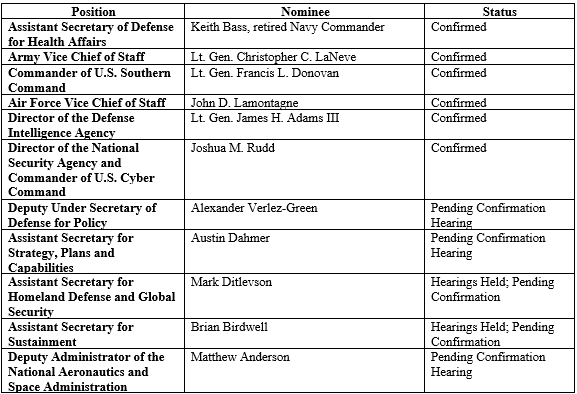
| | Department of War Nomination Tracker | |
Recommended Defense Articles
| | |
Trump's $18B Golden Dome request bets almost entirely on reconciliation (Defense One 4/3)
“Almost none of the $17.5 billion the White House is seeking in fiscal 2027 for the Golden Dome missile-defense project would come from the Defense Department budget, an Office of Management and Budget spokesperson confirmed to Defense One. Less than $400 million would come from DOD's budget, with the rest from a proposed reconciliation bill, the second in as many years. Congress uses reconciliation, a special budgetary process that requires a simple majority to pass, to quickly enact mandatory spending legislation.”
U.S. Strikes More Than 50 Military Targets on Kharg Island (The Wall Street Journal 4/7)
“The U.S. conducted strikes on military targets on Kharg Island early Tuesday, according to two U.S. officials, ahead of President Trump’s deadline for Iran to reopen the Strait of Hormuz. The U.S. struck more than 50 targets on the island, which sits off Iran’s southern coast and is the country’s main oil export hub, according to one of the officials. The strikes took place early Tuesday morning east coast time, the officials said, and did not include oil infrastructure. Trump has set a Tuesday evening deadline for Iran to reopen the strait or face devastating attacks on its energy infrastructure.”
DOD officially launches new Economic Defense Unit to mesh military aims with global financial sway (DefenseScoop 4/10)
“Deputy Defense Secretary Steve Feinberg set up a new unit to lead all the Pentagon’s work that involves fusing economic leverage and requirements into joint U.S. military planning and operations, according to a memorandum obtained by DefenseScoop. The two-page memo formally establishes the Economic Defense Unit and the position of EDU director, who will oversee the new hub and report to Feinberg as the deputy secretary’s principal advisor for economic competition across the Defense Department.”
Army looks to quadruple procurement for Precision Strike Missile in 2027 (DefenseScoop 4/7)
“The Trump administration’s budget request for fiscal 2027 calls for significant funds to increase stockpiles of a long-range Army missile that’s been used during the United States’ ongoing war with Iran. Recently released budget documents show that the Army is asking for nearly $2 billion to purchase more Precision Strike Missiles (PrSM) in FY27 — nearly four-times the amount that Congress allocated in fiscal 2026, which was $546 million.”
Navy to use underwater drones to help clear Iranian mines from Strait of Hormuz (DefenseScoop 4/11)
“The Navy plans to use underwater drones in the coming days as part of its new effort to clear Iranian mines from the Strait of Hormuz, U.S. Central Command announced Saturday. The strait is a critical maritime chokepoint for oil exported from the Middle East, and reopening it to more shipping traffic has been a top objective of President Donald Trump amid the shaky ceasefire between the United States and Iran that began a few days ago and paused Operation Epic Fury, the military name for the American war effort against Tehran that kicked off Feb. 28.”
Space Force slates $1.8B for commercial sats to replace GSSAP neighborhood watch birds (Breaking Defense 4/9)
“The Space Force has set up a pool of 14 vendors to compete for $1.84 billion over the next decade to provide future space monitoring satellites and/or services, the service announced Wednesday. The first task order under the new indefinite delivery/indefinite quantity (ID/IQ) contract vehicle for the newly dubbed Andromeda program (formerly known as RG-XX), will buy commercial birds to replace the service’s venerable Geosynchronous Space Situational Awareness Program (GSSAP) constellation of neighborhood watch satellites that can snuggle up close to and inspect adversary spacecraft.”
Inside the Race to Protect Submarine Cables From Sabotage (The Wall Street Journal 4/9)
“From the Baltic Sea to the Pacific Ocean, a global scramble is under way to protect submarine cables vulnerable to potential sabotage. Governments, militaries, cable owners and tech startups are taking action to bolster the defenses of the world’s underwater cable network, through which most international data traffic travels.”
Spy agencies eye new Anthropic AI model that spots cyber flaws (Defense One 4/8)
“Anthropic’s decision to keep close hold on a powerful frontier AI model, paired with a new initiative to study its effects on global networks, is prompting intelligence-community discussions about the ways such tools might help friendly and adversary forces alike. On Tuesday, Anthropic unveiled Project Glasswing, a bid to raise AI-powered defenses before AI-enabled attackers can overwhelm critical software.”
DIA centralizes AI efforts with Digital Modernization Accelerator (Breaking Defense 4/10)
“After a year-long push to rationalize its previously uncoordinated AI efforts, the Defense Intelligence Agency is institutionalizing its new, more centralized and more efficient approach, the DIA’s chief AI officer said Thursday. ‘One of the things that we were serious about was getting out capabilities quickly,’ said Maj. Gen. Robert Kinney at SCSP’s ai+intelligence conference here. ‘[When] I talk to the team … I reinforce this frequently: I want you to move like somebody’s on your heels, and they’re about ready to eat you.’”
‘Hybrid constellations’ are making it hard for militaries to hide (Defense One 4/9)
“A planned satellite constellation will be able to image any location on Earth every 15 minutes and take more detailed images, a novel capability that could reveal even the nimblest and stealthiest military maneuvers, its developer says. On Thursday, Vantor announced plans to enlarge its current fleet of 10 satellites ‘five-fold’ with spacecraft that will produce images with 20cm resolution—better than its current 30- and 40cm imagery. The company also plans to add two dozen high-revisit/lower-res satellites. When the constellation is complete some time after 2029, Vantor officials said it will vault the company to the forefront of the space-imagery industry.”
After clashes with Hegseth, Army secretary says he isn’t going anywhere (The Washington Post 4/7)
“Army Secretary Dan Driscoll has no plans to resign or otherwise leave his role at the Pentagon, he said in a statement to The Washington Post on Tuesday, after a series of internal clashes with Defense Secretary Pete Hegseth that have caused other U.S. officials to question how long they can coexist. Driscoll’s statement follows last week’s abrupt ouster of the Army’s top officer, Gen. Randy George, and two other senior military leaders — and as Hegseth’s top spokesman, Sean Parnell, has privately told colleagues that he is interested in Driscoll’s job should it become open, according to officials familiar with the matter.”
| | | | |