|
If you would like to listen to the Defense and Critical Technologies Weekly Update, click here!
| | |
Last week, President Trump traveled to Beijing to meet with President Xi Jinping for high-level talks on U.S.-China relations, with Taiwan emerging as the central defense issue. According to public reporting, Trump said he discussed U.S. arms sales to Taiwan with Xi and indicated that a decision would be made soon, while also stating that he made no commitments to Beijing. Xi reportedly raised the question of whether the United States would defend Taiwan in the event of a Chinese attack, but Trump declined to provide a direct answer, maintaining the ambiguity that has long shaped U.S. policy. The exchange underscored Taiwan’s continued centrality as the most immediate military flashpoint in U.S.-China relations. While the broader summit also included discussions on Iran, trade, technology, and economic competition, the Taiwan discussion is likely to draw the greatest attention from defense committees as Congress considers arms sales, Indo-Pacific posture, munitions capacity, export controls, and related NDAA provisions. (More on this below).
Last week, Defense Secretary Pete Hegseth and Joint Chiefs Chair Gen. Dan Caine appeared before both the House and Senate Defense Appropriations Subcommittees to defend the administration’s FY27 defense request and address congressional concerns regarding ongoing operations in Iran. The hearings focused heavily on the cost of the Iran conflict, with Pentagon officials stating that the war has cost roughly $29 billion to date, an increase from the previous estimate of approximately $25 billion in late April. Members questioned the administration’s end-state planning, the legal and strategic basis for continued operations, the effect of sustained combat on U.S. munitions inventories, and the degree to which future war costs are reflected in the FY27 request. Hegseth emphasized that U.S. stockpiles remain sufficient and that the Department is working to expand production capacity, while Caine addressed broader readiness concerns, including the strain of balancing Middle East operations with European posture requirements and long-term Indo-Pacific deterrence.
A reported drone strike on Sunday targeted the United Arab Emirates’ Barakah nuclear power plant. Although the incident reportedly caused no injuries or radiological release, it raised renewed concerns about the vulnerability of critical infrastructure in the Gulf and the potential for the conflict to expand beyond direct U.S.-Iran engagements. President Trump warned Iran after speaking with Israeli Prime Minister Benjamin Netanyahu to move quickly in diplomacy or face renewed/destructive military consequences. Iranian officials signaled that their armed forces remained prepared if diplomacy failed. The event adds pressure on U.S. and partner air defenses, which have already been strained by repeated missile and drone threats across the Gulf, Red Sea, and broader Middle East.
The Golden Dome missile defense proposal also emerged as a major budget issue after the Congressional Budget Office estimated that the system could cost approximately $1.2 trillion over 20 years, far exceeding the Pentagon’s previous estimate of roughly $185 billion. CBO officials cautioned that their estimate is based on the capabilities described in President Trump’s January 2025 executive order rather than the Pentagon’s still-developing architecture, making the final cost highly uncertain. Much of that uncertainty centers on space-based interceptors, which account for a large share of the estimate but may not be included if they prove too expensive or technically impractical. The funding strategy has also drawn scrutiny, as early Golden Dome funding has relied heavily on reconciliation rather than the regular defense authorization and appropriations process. Lawmakers raised concerns that this approach may not provide the sustained funding required for a program of this scale, particularly as Congress debates whether the broader $1.5 trillion FY27 defense plan is fiscally and politically achievable.
| |
Upcoming Hearings of Note
House Appropriations Committee:
- 05/18/2026 – Homeland Security Subcommittee: Oversight Hearing on the Department of Homeland Security
House Armed Services Committee:
- 05/19/2026 – Full Committee: U.S. Military Posture and National Security Challenges in the Greater Middle East and Africa
- 05/20/2026 – Full Committee: Department of the Air Force Fiscal Year 2027 Budget Request
- 05/20/2026 – Seapower & Projection Forces Subcommittee: Navy FY27 Budget Request for Seapower and Projection Forces
Senate Armed Services Committee:
- 05/19/2026 – Full Committee: To examine the posture of the Department of the Navy in review of the Defense Authorization Request for Fiscal Year 2027 and the Future Years Defense Program
- 05/20/2026 – Personnel Subcommittee: To examine the Department of Defense personnel policies and programs in review of the Defense Authorization Request for Fiscal Year 2027 and the Future Years Defense Program
Senate Appropriations Committee:
- 05/19/2026 – Defense Subcommittee: To examine proposed budget estimates and justification for fiscal year 2027 for the Army
- 05/20/2026 – Energy and Water Development Subcommittee: To examine proposed budget estimates and justification for fiscal year 2027 for the U.S. Army Corps of Engineers and the Bureau of Reclamation
- 05/21/2026 – Defense Subcommittee: To examine proposed budget estimates and justification for fiscal year 2027 for the Navy
House Foreign Affairs Committee:
- 05/19/2026 – Oversight and Intelligence Subcommittee: 25 Years After September 11 – Lessons Learned from the Special Inspector General for Afghanistan Reconstruction
- 05/19/2026 – South and Central Asia; East Asia and Pacific Subcommittee: More Bang for the Buck: Aligning Commercial Diplomacy Between State and Commerce
- 05/20/2026 – Western Hemisphere Subcommittee: Confronting the Totalitarian Ortega-Murillo Regime
Senate Commerce, Science, and Transportation Committee:
- 05/19/2026 – Aviation, Space, and Innovation Subcommittee: To examine the evaluation of FAA safety measures from the DCA crash
House Science, Space, and Technology Committee:
- 05/21/2026 – Environment Subcommittee: Research-Driven Resilience: Applying Science to Secure U.S. Water Systems from Cyber Threats
Senate Environment and Public Works:
- 05/20/2026 – Clean Air, Climate, and Nuclear Innovation and Safety Subcommittee: To examine proposed legislation entitled, "Build Nuclear with Local Materials Act", "RECHARGE Act", and "Enrichment Licensing Modernization Act"
House Veterans’ Affairs Committee:
- 05/18/2026 – Technology Modernization Committee: “PACT Act Implementation: Modernizing VA Disability Claims Through Effective Technology”
- 05/20/2026 – Full Committee: Legislative Hearing
- H.R. 6733, the “VISN Reform Act of 2025”
- H.R. 6580, the “VA National Formulary Act of 2025”
- H.R. 6755, the “Accountable Leadership for Veterans Act of 2025”
- H.R. 6599, the “Leasing and Infrastructure Act of 2025”
- H.R. 6583, the “Research Reform Act of 2025”
- H.R. 6549, the “VA Contracting and Procurement Act”
- H.R. 6740, the “VA TRUST Act”
- H.R. 6764, the “Veterans Affairs Advisory Committee Oversight Act of 2025”
- H.R. 6904, the “Veterans Readiness and Employment Improvement and Accountability Act of 2025”
- H.R. 6843, the “Establishing the Veterans Economic Opportunity and Transition Administration Act of 2025”
- H.R. 6861, the “Consolidating Veteran Employment Services for Improved Performance Act”
- H.R. 6833, the “Acquisition Reform and Cost Assessment Act of 2025”
- H.R. 2303, the “Board of Veterans’ Appeals Attorney Retention and Backlog Reduction Act”
- H.R. 210, the “Dental Care for Veterans Act”
- H.R. 3183, the “SAFE STEPS for Veterans Act of 2025”
- H.R. 5203, “To direct the Secretary of Veterans Affairs to update directives of the Department of Veterans Affairs regarding the management of acute sexual assault, and for other purposes”
- H.R. 4114, the “EVEST Act”
- H.R. 3869, the “Every Veteran Housed Act”
- H.R. 1732, the “GUARD VA Benefits Act”
- H.R. 2722, the “VA Funding and Workforce Protection Act”
- H.R. 1391, the “Student Veteran Benefit Restoration Act of 2025”
- H.R. 4876, the “Reproductive Freedom for Veterans Act”
- Discussion Draft, the “Get Justice-Involved Veterans BACK HOME Act”
- Discussion Draft, the “Toxic Exposure Advisory Committee Establishment Act”
- Discussion Draft, “To amend title 38, United States Code, to establish the Advisory Committee on Toxic Exposure of the Department of Veterans Affairs”
- Discussion Draft, the “Honor Vets Act”
- Discussion Draft, “To provide for the modernization of the electronic health record system and other health information technology activities and systems of the Department of Veterans Affairs, and for other purposes”
Senate Veterans’ Affairs Committee:
- 05/20/2026 – Full Committee: To examine the President's proposed budget request for fiscal year 2027 and 2028 advance appropriations requests for the Department of Veterans Affairs
House Permanent Select Committee on Intelligence:
- 05/19/2026 – Full Committee: 2026 Worldwide Threats Hearing (OPEN)
House Homeland Security Committee:
- 05/20/2026 – Full Committee: “TSA Modernization: Industry Perspectives on Key Security and Travel Reforms 25 Years After 9/11”
Please let us know if you would like to receive a summary of these hearings.
| | | |
The meetings in Beijing last week put Taiwan at the center of Trump’s first major in-person engagement with Xi since returning to office. Public reporting suggests the discussion touched directly on pending U.S. arms sales to Taiwan, with Trump later saying that he had not given Beijing any assurances and would decide soon whether to proceed. Xi also pressed on the larger question behind the arms-sales debate: whether Washington would intervene militarily if China moved against Taiwan. Trump did not answer directly, preserving U.S. strategic ambiguity and leaving the most consequential security issue in the Taiwan Strait unresolved.
The summit also showed the tension between Trump’s effort to stabilize relations with Beijing and the defense community’s focus on maintaining credible deterrence in the Indo-Pacific. Xi reportedly warned that if Taiwan is handled well, U.S.-China relations could remain stable, making clear that Beijing views Taiwan as the central condition for broader cooperation. Trump, meanwhile, described his meeting with Xi in positive terms, but the substance of the Taiwan discussion is likely to draw scrutiny from lawmakers already focused on China, Taiwan arms sales, munitions production, export controls, and Indo-Pacific posture. The pending Taiwan arms package and Trump’s stated willingness to decide soon could become particularly relevant as Congress moves toward defense markups, especially if members view any delay or modification as weakening deterrence.
In talks about Iran, Trump said Xi expressed interest in helping negotiate an end to the Iran war and reopening the Strait of Hormuz and the White House said both sides agreed that the strait must remain open. U.S. officials appear to be looking for ways to pressure Beijing to use its economic leverage with Tehran as a large purchaser of Iranian oil. At the same time, the summit did not appear to produce a meaningful shift in China’s position, leaving the administration to maintain deterrence in the Indo-Pacific while also looking to Beijing for help managing Iran, Gulf stability, and the flow of energy through the Strait of Hormuz.
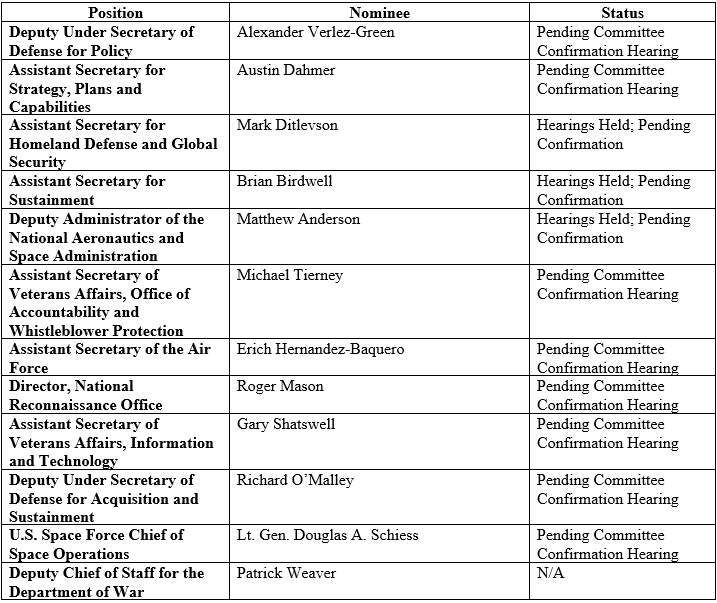
| | Department of War Nomination Tracker | |
Recommended Defense Articles
| | |
Gen. Caine’s Silence on Iran War Leaves Questions About Military Strategy (The New York Times 5/13)
“In nearly 14 hours of congressional testimony in recent weeks, Gen. Dan Caine was repeatedly asked versions of the same two questions: How had the world’s most powerful military allowed the Iranians to cut off the flow of oil through the Strait of Hormuz, and what could it do to get ships moving again? The answers General Caine delivered highlighted the tightrope he walks. As the chairman of the Joint Chiefs of Staff, he is obliged to stay out of the political fray inflamed by the war in Iran. But he works for a president who demands absolute loyalty.”
Xi’s Taiwan Warning to Trump Highlights Tensions in Beijing Summit (The Wall Street Journal 5/14)
“Chinese leader Xi Jinping warned President Trump that any mishandling of Taiwan could lead to ‘an extremely dangerous situation,’ directly raising a point of tension that has loomed over what the U.S. president said at the start could be ‘the best summit ever.’ Xi’s remarks, while in line with China’s longstanding position, threatened to dim the mood of a visit both countries hoped would stabilize ties.”
U.S. Intelligence Shows Iran Retains Substantial Missile Capabilities (The New York Times 5/12)
“The Trump administration’s public portrayal of a shattered Iranian military is sharply at odds with what U.S. intelligence agencies are telling policymakers behind closed doors, according to classified assessments from early this month that show Iran has regained access to most of its missile sites, launchers and underground facilities.”
House Foreign Affairs Committee considers proposals to speed up U.S. weapons exports (DefenseScoop 5/12)
“Allies’ ability to buy American-made military equipment and related assets have historically faced challenges associated with lagging administrative processes and bureaucracy. The second Trump administration aims to change that, along with lawmakers on Capitol Hill. This new legislative package was crafted to ‘meet the needs of the changing landscape,’ a senior official with HFAC’s Republican majority told DefenseScoop.”
US Army abruptly cancels deployment of 4,000 soldiers to Poland (DefenseNews 5/13)
“The U.S. Army has canceled the deployment of the 2nd Armored Brigade Combat Team, 1st Cavalry Division — more than 4,000 soldiers and associated equipment — to Poland.”
Pentagon signs deals with industry to rapidly field 10,000 low-cost missiles (DefenseScoop 5/15)
“The Defense Department announced a batch of agreements with companies Wednesday that aim for the procurement of at least 10,000 inexpensive cruise missiles within three years. Under the new Low-Cost Containerized Missiles (LCCM) program, Anduril, CoAspire, Leidos and Zone 5 Technologies will provide test missiles to the Pentagon to begin an experimentation and assessment campaign this June, according to a DOD news release.”
Here’s how the Army plans to spend nearly $1 billion in procuring small counter drone tech (Breaking Defense 5/15)
“Under the Defense Department’s nearly $1.5 trillion fiscal 2027 budget request, the Army would have almost $1 billion in procurement funding to spend on small counter unmanned aerial system technology (cUAS) capabilities — nearly double the amount the service was granted in its enacted budget for FY26. Should Congress approve it, the FY27 budget would set aside $994 million in total for small cUAS, with all of that sum coming from discretionary funding. The FY26 enacted budget included $596 million for the same line item with $336 deriving from discretionary spending and $260 coming from mandatory, or reconciliation, funding.”
Navy unveils three new PAEs for aviation, mission systems, munitions (Breaking Defense 5/11)
“The Navy today revealed the latest three portfolio acquisition executives, known as PAEs, in lockstep with broader acquisition reforms across the Pentagon. The Navy has tapped the following individuals to serve as interim PAEs for their respective organizations: PAE Aviation, led by Vice Adm. John Dougherty; PAE Mission Systems, led by Jim Day; and PAE Munitions, led by Paul Mann.”
| | | | |