WEEKLY UPDATE

February 23, 2026

Listen To The Update

If you would like to listen to the Defense and Critical Technologies Weekly Update, click here!


The Week Ahead

Both the House and Senate return from recess this week. President Donald Trump will give his first official State of the Union address to a joint session of Congress on Tuesday. His address comes in the wake of the Supreme Court’s ruling that the administration's use of International Emergency Economic Powers Act (IEEPA) tariffs exceeds the powers given to the president by Congress under the law. The decision could have major impacts on defense contractors and the Department of War. (More on this below).


The Department of Homeland Security (DHS) remains in a partial shutdown after Congress failed to pass full-year appropriations or a continuing resolution before the most recent deadline, leaving several components operating under contingency plans. Personnel across DHS, including the Coast Guard, are continuing operations without pay, and service leaders have warned that prolonged funding uncertainty could disrupt maintenance, procurement, and readiness. Lawmakers from both parties have emphasized the Coast Guard’s critical role in maritime security, counterdrug operations, and Indo-Pacific presence, though disagreements over immigration policy and broader DHS priorities have so far prevented passage of a final funding measure. As lawmakers return to Washington this week, negotiations are expected to continue to resolve disagreements surrounding funding for ICE and other border control programs.


On February 19, the White House released its long-anticipated National Maritime Strategy, outlining a government-wide plan to expand U.S. shipbuilding capacity, strengthen the maritime industrial base, and counter China’s growing naval and commercial shipping influence. The strategy directs the Department of War and the Department of Transportation to accelerate procurement of sealift vessels, expand public and private shipyard capacity, and improve workforce development pipelines to address long-standing production shortfalls. Lawmakers from both parties have welcomed the strategy’s focus on industrial base expansion, though some have raised questions about funding and execution. Supporters argue the plan represents a necessary step to restore U.S. maritime competitiveness, while critics have emphasized that sustained congressional appropriations will be required to achieve its objectives. In addition to implementation within the executive branch, the administration is also expected to seek legislative changes to support the strategy in the coming weeks and months.


House lawmakers will force a vote this week to prevent the Trump administration from taking military action against Iran without congressional consultation. Rep. Thomas Massie (R-KY) and Rep. Ro Khanna (D-CA) plan to file a motion to discharge on the measure prepared months ago, triggering a vote on the chamber floor. While past similar efforts have been unsuccessful, several prominent Democrats, including Sen. Tim Kaine (D-VA), have said in recent weeks that they hope a military build-up in the Middle East will persuade some GOP officials to re-establish Congress’s role in military action against foreign adversaries.

Upcoming Hearings of Note

House Armed Services Committee

  • 02/24/2026 – Subcommittee on Tactical Air and Land Forces: Modernization of the Organic Industrial Base

Senate Armed Services Committee

  • 02/24/2026 – Full Committee: To examine rebuilding American critical minerals supply chains.
  • 02/26/2026 – Full Committee: Nominations
  • Mark Ditlevson to be Assistant Secretary of Defense for Homeland Defense and Americas Security Affairs
  • Brian Birdwell to be Assistant Secretary of Defense for Sustainment

House Foreign Affairs Committee

  • 02/24/2026 – Full Committee: Advancing National Security through Commercial Diplomacy
  • 02/24/2026 – South and Central Asia Subcommittee: Strengthening Export Control Enforcement

House Committee on Homeland Security

  • 02/24/2026 – Full Committee: Before the Whistle: Assessing Information Sharing and Security Collaboration Ahead of Major Events

House Committee on Veterans’ Affairs

  • 02/24/2026 – Full Committee: Joint House and Senate Legislative Presentation of Disabled American Veterans & Multi VSOs
  • 02/24/2026 – Subcommittee on Economic Opportunity: Markup
  • H.R. 982, Warriors to Workforce Act;
  • H.R. 5634, Veterans Flight Training Responsibility Act of 2025;
  • H.R.7049, Improving Mental Health Care and Coordination for Homeless Veterans Act;
  • H.R. 7083, CRUISE Act;
  • H.R. 7103, Improving Emerging Tech Opportunities for Veterans Act;
  • H.R. 7141, Affordable Housing Guarantee Act; H.R. 1803, Fair Access to Co-ops for Veterans Act of 2025;
  • H.R. 1957, End Veteran Homelessness Act of 2025;
  • H.R. 1965, Veteran Education Assistance Adjustment Act;
  • H.R. 3159, Improving SCRA Benefit Utilization Act;
  • H.R. 5436, To amend title 38, United States Code, to prohibit an educational institution from withholding a transcript from an individual who pursued a course or program of education at such institution using Post-9/11 educational assistance;
  • H.R. 7150, To amend title 38, United States Code, to require the Secretary of Veterans Affairs to submit to Congress a quarterly report on housing loans insured, guaranteed, or under laws administered by the Secretary, and for other purposes.

Senate Committee on Veterans’ Affairs

  • 02/24/2026 – Full Committee: Joint House and Senate Legislative Presentation of Disabled American Veterans & Multi VSOs

House Appropriations Committee

  • 02/24/2026 – Subcommittee on National Security, Department of State, and Related Programs: Oversight Hearing – National Endowment for Democracy

House Committee on Oversight and Government Reform

  • 02/24/2026 – Subcommittee on Government Operations: An Update on DoD’s Struggling Background Check System


Please let us know if you would like to receive a summary of these hearings.

SCOTUS Overturns Trump Tariff Authorities

On Friday, the Supreme Court of the United States (SCOTUS) overturned key legal authorities underpinning certain tariff measures implemented during the Trump administration, ruling that the executive branch exceeded its statutory authority under the International Emergency Economic Powers Act (IEEPA). The decision could significantly alter the trade environment that has shaped defense supply chains under the Trump administration.


Tariffs on steel, aluminum, and other strategic materials were originally justified in part on national security grounds to incentivize domestic sourcing and reshoring of key components used in military platforms, munitions, and shipbuilding. Their removal may lower input costs for some defense contractors but could also increase reliance on foreign suppliers, particularly in sectors where domestic production remains limited.


Some policymakers have expressed concern that the ruling could complicate ongoing efforts to strengthen the defense industrial base. Lawmakers on the House and Senate Armed Services Committees have emphasized the importance of maintaining secure and reliable access to strategic materials, particularly amid rising competition with China. Others argue that removing tariffs could reduce procurement costs and improve efficiency in major acquisition programs. Congress may now consider legislative options to clarify tariff authorities tied to national security or expand alternative tools such as Defense Production Act investments.


While the full impact will depend on implementation and potential legislative responses, the ruling introduces new uncertainty into the regulatory framework governing defense supply chains. Following the decision, President Trump announced new global tariffs of 15 percent under Section 122 of the Trade Act of 1974, though that authority expires after 150 days, introducing additional uncertainty. Defense firms, particularly those involved in shipbuilding, aerospace, and munitions production, are expected to reassess sourcing strategies and cost projections as the legal and policy landscape evolves.


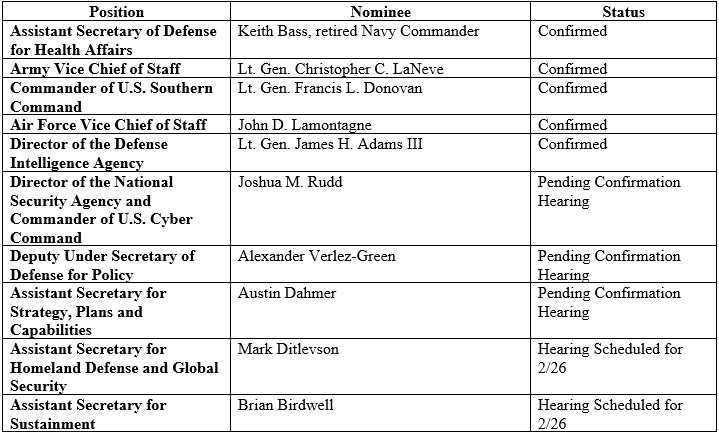
Department of War Nomination Tracker

Recommended Defense Articles

U.S. Military Moves Into Place for Possible Strikes in Iran (The New York Times 2/18)

“The rapid buildup of U.S. forces in the Middle East has progressed to the point that President Trump has the option to take military action against Iran as soon as this weekend, administration and Pentagon officials said, leaving the White House with high-stakes choices about pursuing diplomacy or war.”


SpaceX and Blue Origin abruptly shift priorities amid US Golden Dome push (DefenseNews 2/19)

“Within weeks of each other, the two largest U.S. commercial space companies abruptly shifted their priorities toward lunar development. The moves came as the Department of Defense accelerates plans for a next-generation missile shield known as the Golden Dome, raising questions about whether America’s return to the moon is as much about defense as it is exploration.”


U.S. Plans to Deploy More Missile Systems in the Philippines, Challenging China (The Wall Street Journal 2/17)

“The U.S. plans to deploy more advanced missile systems and other weapons in the Philippines to deter Chinese aggression in the South China Sea, the State Department said Tuesday, affirming a policy that has angered Beijing. Senior officials from the U.S. and the Philippines met in Manila this week for annual talks on their alliance, which rests on a mutual-defense treaty signed in 1951. Their strongly worded statement—which condemned what it said were Beijing’s illegal and deceptive activities in the South China Sea—comes when the Trump administration has increased pressure on, and at times openly questioned, other longstanding defense alliances, especially in Europe.”


The U.S. Military Hardware Pouring Into the Middle East (The Wall Street Journal 2/19)

“The U.S. military has deployed scores of combat aircraft across the Middle East and will soon have a second aircraft carrier within range of Iran if President Trump gives the order to strike. Over the past month, dozens of jet fighters and support aircraft have flown from the U.S. and Europe to bases in Jordan and Saudi Arabia, according to flight-tracking data.”


Forthcoming US arm sales changes leave unanswered questions (Breaking Defense 2/20)

“When US President Donald Trump issued a new executive order on foreign arms sales two weeks ago, he ordered the Defense, State and Commerce Departments to conduct a series of reviews, with the goal of a large-scale restructuring of how America sells weapons abroad. But it also left industry and analysts with a myriad of questions about the long-term ramifications on international sales.”


US is withdrawing all 1,000 troops from Syria: WSJ report (Al Jazeera 2/18)

“The United States is preparing to pull back the nearly 1,000 troops from its military that remain in Syria, the Wall Street Journal reported, citing three US officials. Last week, the US military confirmed it was withdrawing from the al-Tanf base, located in southern Syria near borders with Iraq and Jordan. The base served as a ‌key hub for operations for the global coalition against ISIL (ISIS), which at the time controlled large areas of Syria and Iraq until sustaining critical losses in 2017. US Central Command (CENTCOM) said last week’s ‘orderly departure’ was ‘part of a deliberate and conditions-based transition’. The Wall Street Journal, meanwhile, indicated that the broader withdrawal of US troops in Syria would unfold over the next two months. The administration of President Donald Trump has been weighing a full withdrawal since at least January.”


Canada Gives U.S. Arms Makers the Cold Shoulder on Military Spending (The New York Times 2/15)

“The Canadian government, faced with increasing hostility from the Trump administration, plans to divert billions of dollars in military spending it long gave to U.S. defense companies and direct it instead to domestic manufacturers. Prime Minister Mark Carney’s wholesale expansion of Canadian military spending was prompted by pressure from President Trump, but with relations between the longstanding allies deteriorating, American companies will no longer reap the benefit.”


Pentagon CTO urges Anthropic to ‘cross the Rubicon’ on military AI use cases amid ethics dispute (DefenseScoop 2/19)

“The Pentagon will adhere to existing laws and regulations associated with surveillance, security and democratic processes as it fast-tracks the military’s frontier AI adoption, but it won’t permit companies supplying the technology to determine its rules for operation, Undersecretary of Defense for Research and Engineering Emil Michael told DefenseScoop. His comments come as the Defense Department is locked in a high-stakes dispute with Anthropic about the U.S. military’s use of the startup’s Claude AI model in real-world operations.”


Air Force launches program to modernize Air Operations Centers (DefenseScoop 2/19)

“The Air Force has initiated a new effort to upgrade its central command-and-control systems with new capabilities, including artificial intelligence and enhanced data fusion. The service’s software factory, known as Kessel Run, will soon kick off the Next-Generation Air Operations Center (AOC) Weapon System program to modernize command centers. According to an announcement posted Wednesday, Kessel Run expects to release the first request for information before the end of February and wants to award a contract by June 2027.”


Navy weighs creating robotic autonomous systems commander amid unmanned push (Breaking Defense 2/18)

“The Navy is considering establishing a robotic autonomous systems (RAS) commander to oversee unmanned capabilities amid a larger push to integrate unmanned vessels into the rest of the fleet, Chief of Naval Operations Adm. Daryl Caudle said. Caudle unveiled plans to employ a hedge force strategy that seeks to capitalize on unmanned systems and create a range of tailored options combining various systems in his new ‘Fighting Instructions’ framework. Included in these plans are directions for the Navy to figure out how to fully embrace RAS in its command structure.”


DIU wants commercially developed imagery satellites for on-orbit spying (Breaking Defense 2/18)

“The Defense Innovation Unit (DIU) wants to buy commercially produced satellites to take close-ups of other spacecraft in geosynchronous Earth orbit (GEO), according to a new solicitation. The goal of the new Geosynchronous High-Resolution Optical Space-Based Tactical Reconnaissance (GHOST-R) program is to rapidly put on orbit the capability keep near real-time tabs on the whereabouts of both ‘adversary and friendly’ satellites, as well as take good enough pictures to be able to discern their purposes, explains the call for industry proposals published on Monday by the Pentagon’s in-house accelerator.”