|
BHIPP Bulletin
Volume 12, Issue 1
July 2026
| | Cognitive-Behavioral Therapy (CBT) in Pediatric Primary Care | | |
This month's BHIPP Bulletin is a contribution from
Erika Chiappini, PhD, Assistant Professor in the Department of Psychiatry and Behavioral Sciences at Johns Hopkins University School of Medicine and BHIPP Consultant.
| | |
Cognitive-behavioral therapy (CBT) is an evidence-based therapy that emphasizes the relationship between thoughts, feelings, and behaviors. It has been identified as a first line behavioral intervention for a variety of pediatric disorders, including anxiety, depression, OCD, PTSD, disruptive behaviors, chronic pain, and insomnia. CBT is a structured, time-limited intervention with a focus on developing skills to manage unhelpful emotions and reactions. What distinguishes CBT from “talk-therapy” is the identification of treatment goals and skill development over the course of treatment. Further, a hallmark of CBT is the emphasis on “homework,” or practicing skills learned in the session at home and in the community to support generalization of skills across settings.
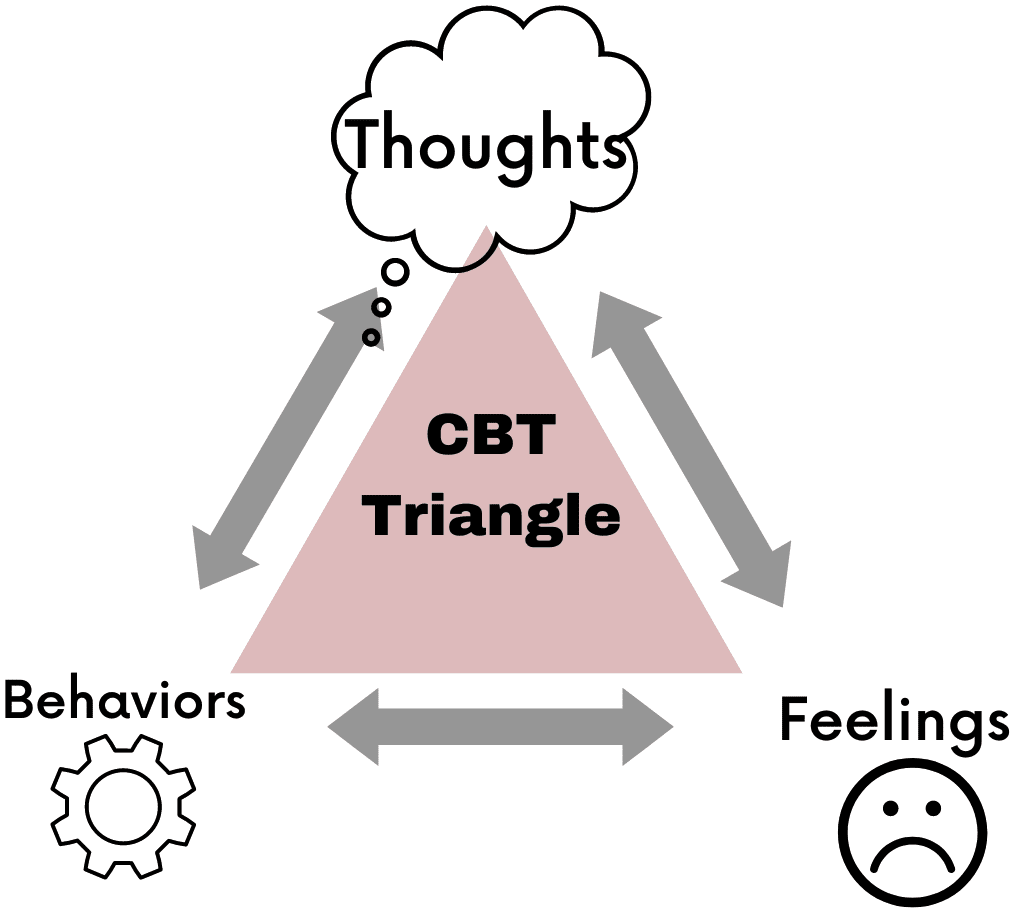
CBT works by addressing each of the three “points” of the CBT triangle – thoughts, feelings, and behaviors.
| | |
CBT often has a progression of skills development. Most CBT protocols first focus on identifying feelings and understanding the purpose of emotions. This may include work to identify the somatic symptoms of an emotion (e.g., heart racing in anxiety), to support kids and teens in early recognition of their emotions. After emotion identification, youth are often taught relaxation skills, such as deep breathing, mindfulness, or progressive muscle relaxation, to help engage their parasympathetic nervous system to reduce their flight-or-flight response before using a different skill if needed, such as addressing unhelpful thinking patterns or taking a specific action.
CBT protocols then typically work to help youth identify unhelpful or maladaptive thinking patterns called cognitive distortions or "thinking trap," when negative thoughts or self-talk get "stuck." CBT provides guidance on cognitive restructuring to change these thoughts to be more realistic, helpful, and/or kind. This include "checking the facts" of the unhelpful thought, "talking back to it," and learning to separate the self from the thought. The overarching goal of cognitive restructuring is to teach that thoughts are not true "just because I thought it" or because it was associated with a strong feeling. Educating youth to examine their thoughts can help them engage in different behaviors in the future.
This brings us to the last area of focus in CBT -- behavior change. In most CBT programs, this is where the biggest reductions in anxiety, mood, and other behavioral symptoms occur. Emotions are typically associated with certain kinds of behaviors. For example, fear and worry are associated with escape and avoidance of activities, low mood and depression lead to withdrawal and avoidance, and anger can be associated with more threatening behaviors (like aggression). By engaging in different behaviors when we have certain feelings, we can activate a different emotion or start to experience the emotion in more helpful ways. In anxiety, exposures are the process of gradually confronting feared stimuli, leading to greater confidence in managing anxiety in the moment. In depression, the main component of treatment is behavioral activation, or the practice of engaging with daily and social activities. The thought behind these principles is that if we can act in a way that is consistent with what we would like to be doing (or inconsistent with the feeling we are experiencing), we are teaching and leading ourselves to have different emotions. If we wait to “feel better” to change our behavior, we may find ourselves stuck in a negative feedback loop that actually leads to greater feelings of anxiety, depression, and other problematic emotions, behaviors, and thought patterns. Behavioral tasks can be particularly powerful when combined with cognitive restructuring as youth can compare their thoughts prior to the activity (i.e., what did they expect) to what actually happened, which may disprove their thought or teach them they can tolerate it anyway.
| | |
The evidence base for CBT is robust with studies supporting CBT as a first-line treatment for mild-moderate cases of anxiety and depression and is recommended before or alongside medication options. It is most effective for children 7 and older, when children’s cognitive development allows for greater insight into their own thoughts and actions. Prior to 7 years, caregiver-based behavioral interventions show greater efficacy. CBT is typically 8-16 sessions with homework between sessions and can be offered in a variety of settings (individually, groups, and over telehealth) depending on a child’s needs. Since kids and teens typically live at home, effective CBT interventions should also include caregivers in treatment regardless of the age of child, but certainly more involvement with younger children.
Across studies and disorders, CBT has been shown to be effective for about 60% of youth (range of 50-77% depending on study) with significant improvements in symptoms and daily functioning. What about the other 40%? There are several reasons that CBT may not be as successful in some youth. First, CBT requires active engagement in treatment, including completing the out-of-session practices and involvement from parents in learning skills themselves and supporting their children with completing practices at home. Second, there can be significant variability among clinicians who say they are doing CBT and the skills they are utilizing and teaching. Many may be appropriately focusing on feeling identification, relaxation, and cognitive restructuring; however, studies have found that fewer clinicians are consistently incorporating behavioral tasks in their treatments. For example, few clinicians use exposure in their treatment of anxiety due to lack of training about their use, misplaced fear that exposure may rupture rapport with patients (studies actually show the opposite), or system-level limitations (e.g., time, liability concerns). An additional barrier is the shortage of trained CBT providers in many areas.
| | |
Pediatric primary care providers (PCPs) can support the patients and families they serve who are in engaging with CBT by:
-
Screening for early identification of children who may benefit from CBT. There are many validated and brief screeners, such as the SCARED and GAD-7 for anxiety, PHQ-9 and CES-D for depression, and the Pediatric Symptom Checklist (PSC) for general behavior screening.
- Setting expectations for CBT before the referral, including letting families know about skills they may learn, the course of treatment (time-limited, skills based), and active participation requirements (e.g., completing tasks outside of visits, parent involvement).
- Identifying appropriate referrals to licensed therapists trained in CBT (BHIPP referral request can help!). For families already engaged in therapy, you can ask about what they are learning in therapy to ensure they are learning skills and provide education as needed.
- Supporting the addition of medication when needed, such as for moderate to severe symptoms, or partial response to CBT after a few weeks (again, BHIPP consultation can help here!).
| | |
As always, if you have questions about the behavioral health needs of your patients, we encourage you to call the BHIPP consultation line at
855-MD-BHIPP (632-4477), open 9am-5pm Monday-Friday, for resource/referral networking or consultation support.
We will keep you informed about all our services and training events through our website (www.mdbhipp.org) and monthly e-newsletters. Additionally, BHIPP is on LinkedIn, Facebook, and Instagram. We invite you to follow us there to stay up-to-date on upcoming training events, pediatric mental health research, and resources for providers, families and children.
| | Attend a Rural Health Regional Meeting! | | |
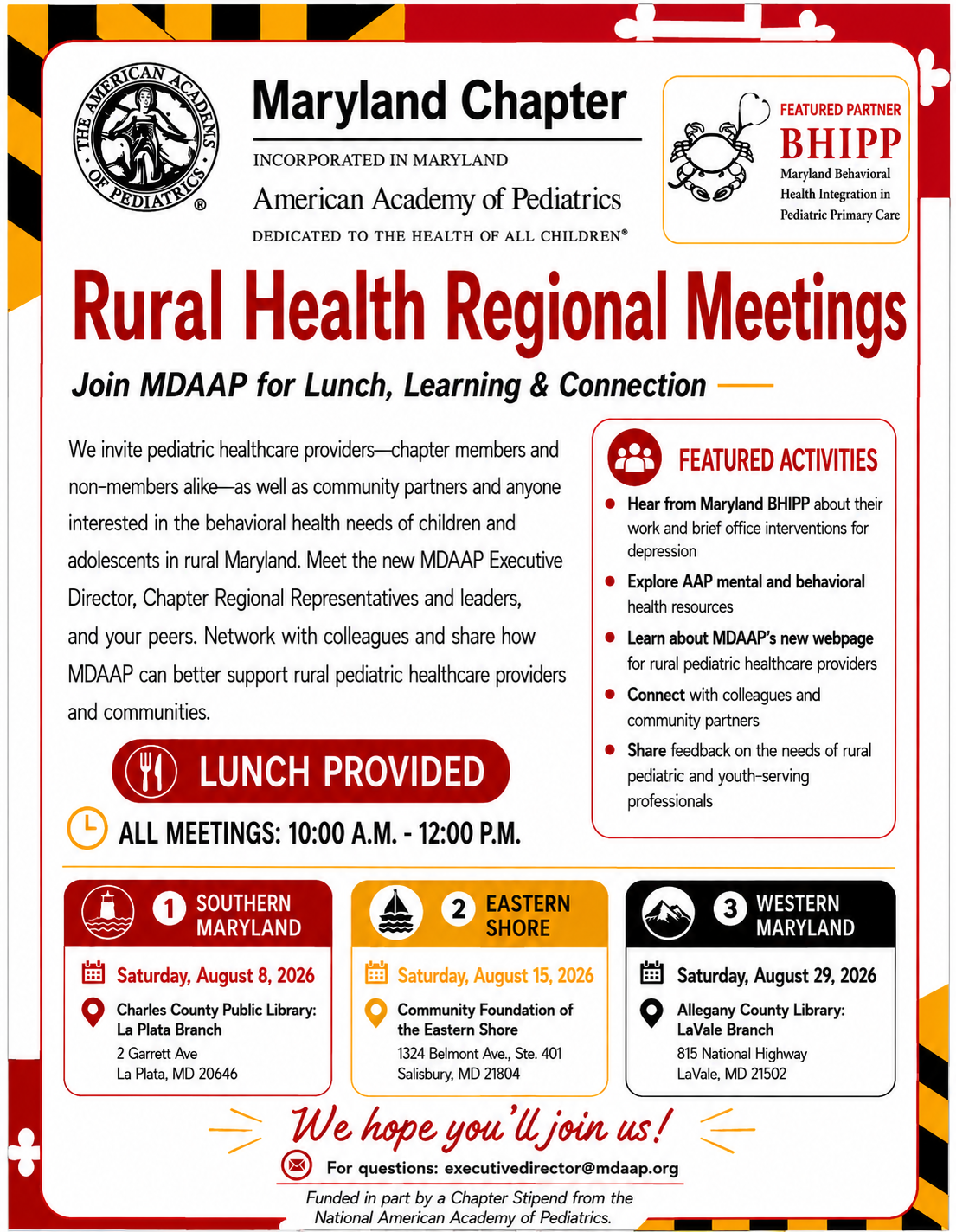
Pediatric healthcare providers, join the Maryland Chapter, American Academy of Pediatrics for one of three Rural Health Regional Meetings this August! Hear from BHIPP about our services and on brief office interventions for depression, connect with colleagues and community partners, explore AAP behavioral health resources, and share feedback on the needs of rural pediatric providers.
The meetings will be held from 10:00am to 12:00pm on August 8th in Southern Maryland, August 15th on the Eastern Shore, and August 29th in Western Maryland. To learn more and register, click the buttons below.
| | Follow BHIPP on Instagram! | | Follow BHIPP on Instagram @marylandbhipp for behavioral health resources, continuing education and training opportunities, clinical tools, and updates to support pediatric primary care, emergency medicine, and mental health providers across Maryland in managing their patients' mental health concerns. | | |
High Five for Prenatal to Five is hiring a
Behavioral Health Specialist!
| | The High Five for Prenatal to Five collaborative early learning project is hiring a Early Childhood Behavioral Health Specialist (BHS)! The BHS will work as an early childhood development expert within the pediatric primary care team at Dundalk Pediatric Associates in Dundalk, MD to provide screening, assessment, brief interventions, consultative services, education, referral linkages, advocacy, and follow-up for families with children ages 0-5. | | |
BHIPP is supported by funding from the Maryland Department of Health, Behavioral Health Administration and operates as a collaboration between the University of Maryland School of Medicine, the Johns Hopkins University School of Medicine, and Salisbury University.
BHIPP and this newsletter are also supported by the Health Resources and Services Administration (HRSA) of the U.S. Department of Health and Human Services (HHS) as part of an award totaling $1,379,327 with approximately 20% financed by non-governmental sources. The contents of this newsletter are those of the author(s) and do not necessarily represent the official views of, nor an endorsement, by HRSA, HHS or the U.S. Government. For more information, visit www.hrsa.gov.
Copyright © 2021 Maryland Behavioral Health Integration in Pediatric Primary Care (BHIPP), All rights reserved.
| | | | |