|
BHIPP Bulletin
Volume 11, Issue 5
November 2025
| | |
Caregiver Well-Being
A Newsletter in Recognition of
National Family Caregiver Month
| | |
This month's BHIPP Bulletin is a contribution from
Rheanna Platt, MD, Associate Professor in the Department of Psychiatry and Behavioral Sciences at Johns Hopkins University School of Medicine and BHIPP Consultant.
| | In 2024, the US Surgeon General released an Advisory (reserved for what are deemed ‘significant public health issues’) on the mental health and well-being of parents entitled "Parents Under Pressure”. In this newsletter, we will summarize the report’s findings and recommendations with a focus on recommendations for health care providers. | | |
Part of the rationale for the 2024 report included describing the rapidly changing demands/stresses of parenthood; The report underscored that in addition to more “traditional” parenting challenges (e.g., ensuring children’s safety, promoting their development), modern parenthood also includes new stressors including managing screen time and social media and it’s impacts, as well as potentially related societal trends such as increased loneliness, rising rates of firearm-related injuries, and increased number of hours working which lead to increased challenges balancing work and home responsibilities (Office of the Surgeon General (OSG), 2024).
The report highlighted several recent concerning trends, noting that in a 2023 survey, relative to other adults, parents were more likely to report high levels of stress overall (33% vs 20%), to report feeling so stressed that they were unable to function (41% vs 20%), and to report financial stressors (66% vs 39%), including rising costs of child care (OSG, 2024). Several parenting-related stressors were highlighted, including household food insecurity (associated with parental depression and anxiety), poverty, military deployment, experiences of racism, caring for aging parents in addition to children, and caring for youth with intellectual or developmental disabilities or other social health care needs. The accumulation of these stressors, in addition to other risk factors, may lead to mental health conditions among parents (with estimates that about ¼ of parents have a mental health condition). While highlighting potential effects of parent mental health conditions on parenting/caregiving, the report also emphasized that “an adult’s mental health challenges may not have a negative impact on a child if they do not disrupt the child’s sense of safety, stability, support, and bonding with parents or caregivers” (OSG, 2024).
| | |
In addition to summarizing some of the challenges facing parents today, the advisory included numerous recommendations at multiple levels (e.g., policy, community/society, health care).
Specific recommendations for health care providers included:
-
Prioritizing prevention and screening: In addition to screening for caregiver mental health concerns at particular time points (e.g., postpartum depression screening), parent mental health screening could be considered at regular annual visits, particularly amidst those with risk factors for mental health conditions (e.g., parents of children with special health care needs). Additional recommendations included use of visits to discuss/normalize stresses of parenting, offer resources related to stress management and/or support, and encourage parents to bolster their own social support systems/combat loneliness.
-
Along with screening, the report emphasized the importance of fostering connection with resources (e.g., mental health and other support resources for parents), both within the clinic (e.g., through integrated behavioral health programming) and with external resources (e.g., community mental health resources).
In addition to recommendations for health care and social service providers, other recommendations included:
-
Policy recommendations: Expanded programs for supporting families (e.g., Head Start, home visiting, paid family leave), addressing social and economic factors (e.g., poverty) contributing to parental stress, and ensuring access to mental health care for parents.
-
General societal recommendations: Promoting a culture that values caregiving, encourages connection amongst parents, and fosters open dialogue about the challenges of parenting
-
Community recommendations: Investment in ‘social infrastructure at the local level’ (e.g., community parks, green spaces, community programs) to facilitate connections between parents, fostering open dialogue about parental stress and parent mental health, involvement of parents in shaping community programming, and integrating parenting support into education programs (e.g., early childhood education, school programming), equipping parents with conversation starters to use with health care professionals.
-
Employer recommendations: Expansion of policies and programs that support parents in the workplace (e.g., access to mental health care, policies encouraging work-life harmony)
-
Recommendations for families, friends, and parents: Offering assistance to other parents, recognizing that parenthood is experienced differently by everyone, prioritizing self-care, recognizing signs of mental health conditions among parents, making plans to regularly connect with other parents, and developing an understanding of informal and formal resources.
| |
Resources for Families
-
National resources to be aware of that are focused on perinatal mental health include:
- Maternal Mental Health Hotline at 1-833-TLC-MAMA (852-6262) (available in English and Spanish, 24 hours per day/7 days per week)
-
Postpartum Support International has information about a postpartum helpline as well as support groups and mental health resources
-
Local resources for parents of children with special health care needs (including mental health conditions) include:
-
Maryland Coalition of Families: Offers family peer support for families with mental health and/or substance use challenges
-
Parents Place of Maryland: Provides resources, support, and information to parents of children with disabilities and special health care needs
| | |
As always, if you have questions about the behavioral health needs of your patients, we encourage you to call the BHIPP consultation line at
855-MD-BHIPP (632-4477), open 9am-5pm Monday-Friday, for resource/referral networking or consultation support.
We will keep you informed about all our services and training events through our website (www.mdbhipp.org) and monthly e-newsletters. Additionally, BHIPP is on LinkedIn and Facebook. We invite you to follow us there to stay up-to-date on upcoming training events, pediatric mental health research, and resources for providers, families and children.
Reference
Office of the Surgeon General. (2024). Parents Under Pressure: The U.S. Surgeon General’s Advisory on the Mental Health & Well-Being of Parents. U.S. Department of Health and Human Services, National Institutes of Health. https://www.hhs.gov/sites/default/files/parents-under-pressure.pdf
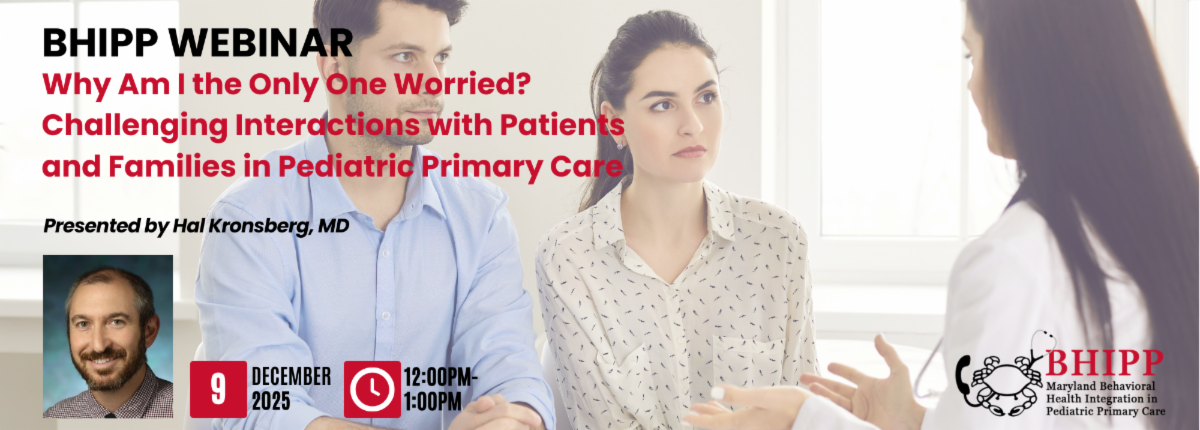
| | Sign up for the BHIPP ECHO PMHNP Series! | | Register for the new BHIPP PMHNP ECHO series! The first session will be held on October 7th from 11:00am-12:00pm. Join our multidisciplinary team of child behavioral health experts every month between October 2025 and May 2026 for virtual case-based learning and didactic presentations. This series is designed for Maryland Psychiatric-Mental Health Nurse Practitioners (PMHNPs) who want to deepen their knowledge of child and adolescent mental health. | | Register for the upcoming BHIPP Webinar! | | Register for an upcoming BHIPP Webinar on December 9th at 12:00pm! BHIPP Webinars are a series of interactive, web-based learning sessions that are a virtual space for pediatric primary care, emergency medicine, and behavioral health providers to connect, learn and share about strategies, practices and resources to promote mental health and resilience among children and families as well as providers. Free CME and CEU credit is available for participation! | | Join the BHIPP ECHO Series for Pediatric Primary Care Providers! | | Register for the BHIPP ECHO Series for Pediatric Primary Care Providers! The first session will be held on December 11th from 12:00-1:00pm. Join our multidisciplinary team of child behavioral health experts bimonthly from October 2025 and May 2026 for virtual case-based learning and didactic presentations. Free CEU, CME, and ABP MOC Part 2 credits are available for participation. | | How has BHIPP helped you provide behavioral health care to your pediatric patients? | | |
Thank you for your participation in BHIPP. We want to hear from you! Tell us about your experiences and how BHIPP has helped improve your practice in the Health Professional Impact Survey. Help programs like ours continue to serve health professionals like you in the future by sharing your feedback!
Haven’t connected with us yet? Please reach out for support and resources to help you address your pediatric patients’ behavioral health concerns: 855-MD-BHIPP (632-4477)
| | |
BHIPP is supported by funding from the Maryland Department of Health, Behavioral Health Administration and operates as a collaboration between the University of Maryland School of Medicine, the Johns Hopkins University School of Medicine, and Salisbury University.
BHIPP and this newsletter are also supported by the Health Resources and Services Administration (HRSA) of the U.S. Department of Health and Human Services (HHS) as part of an award totaling $1,379,327 with approximately 20% financed by non-governmental sources. The contents of this newsletter are those of the author(s) and do not necessarily represent the official views of, nor an endorsement, by HRSA, HHS or the U.S. Government. For more information, visit www.hrsa.gov.
Copyright © 2021 Maryland Behavioral Health Integration in Pediatric Primary Care (BHIPP), All rights reserved.
| | | | |